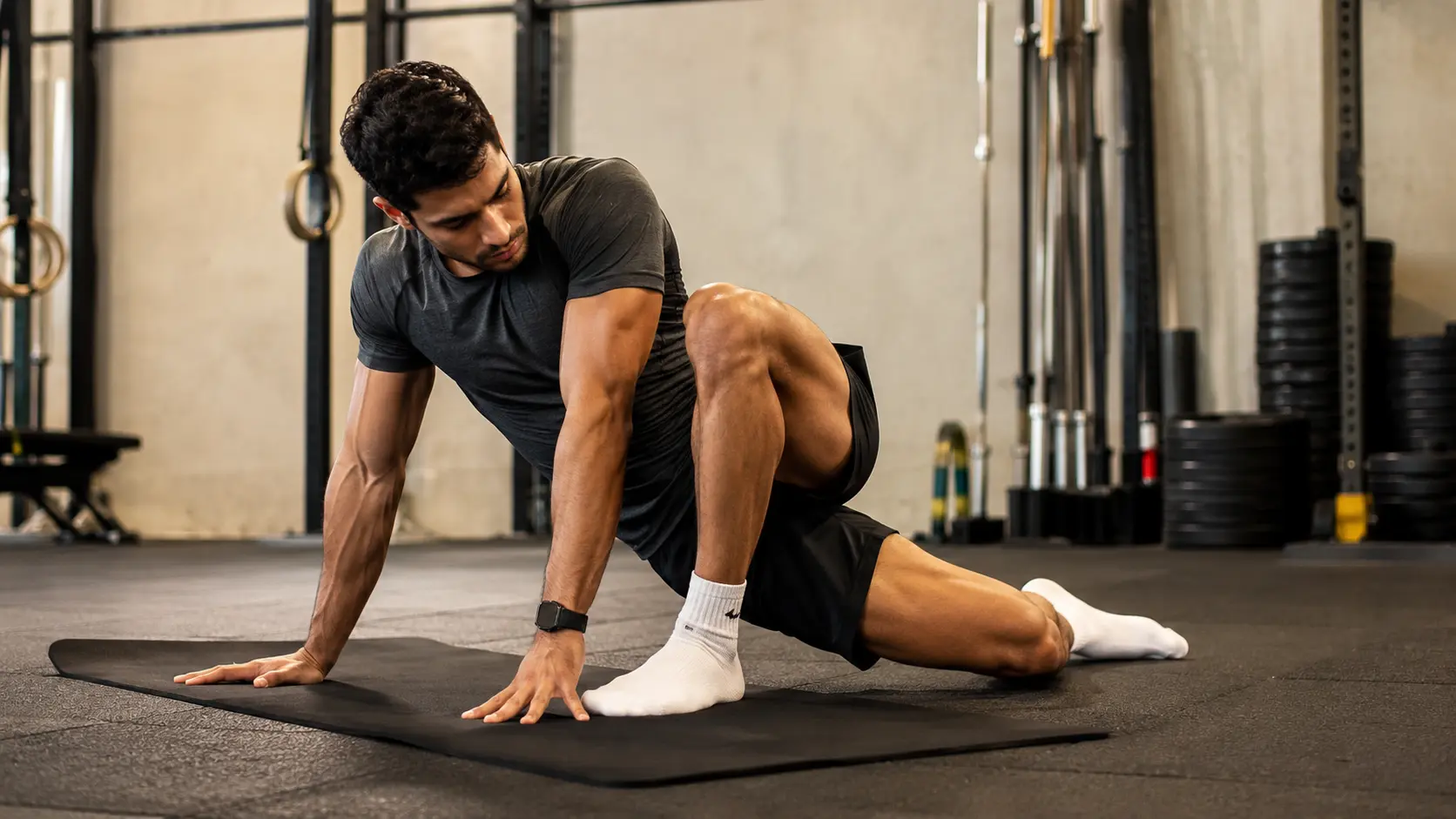
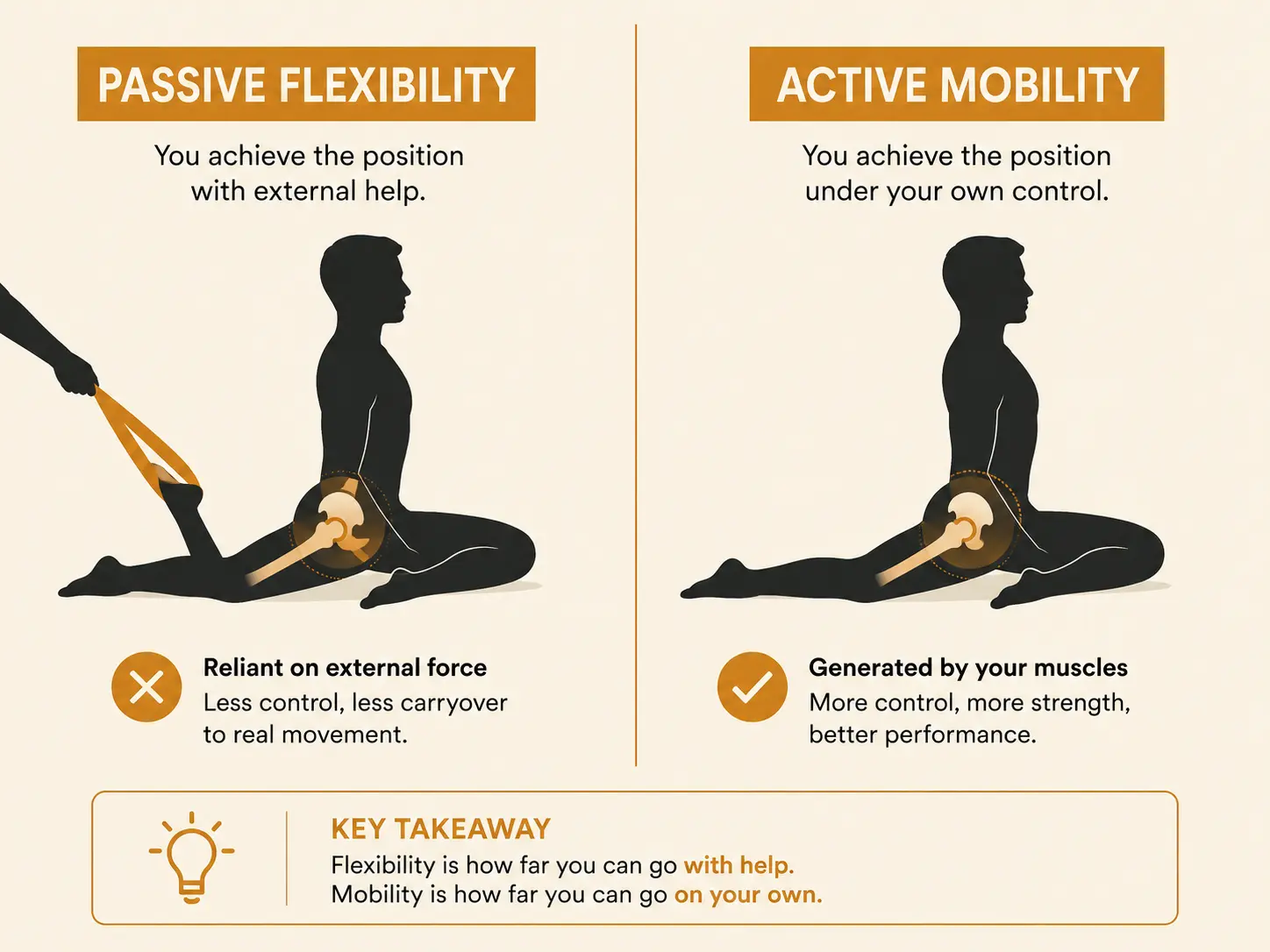
- Flexibility is passive range of motion — how far a muscle stretches with outside help. Mobility is active control — how far you can move a joint under your own strength.
- You can be flexible without being mobile: passing a passive hip stretch doesn't guarantee control of that same range in a squat.
- Static stretches under 60 seconds per muscle trivially affect strength (1-2%); holds over 60 seconds can reduce strength and power by 4-7.5%.
- Eccentric strength training increased flexibility roughly twice as much as static stretching alone in one study on young athletes.
- Static and PNF stretching produce better long-term range-of-motion gains than dynamic stretching; dynamic stretching offers better short-term, pre-activity benefits.
Mobility and flexibility are not the same thing, and the difference matters practically: flexibility is how far a muscle can passively stretch, while mobility is how well you can actively control a joint through that same range using your own strength. Most people confuse them because both show up as "range of motion" on the surface — but a person can pass every passive flexibility test and still fall apart the moment that same range needs to hold weight or control.
This piece breaks down the actual mechanical difference, what the research says about training each one, and — since almost no one has unlimited time for a stretching routine — which one is actually worth prioritizing for most goals.
The Actual Difference, In Plain Terms
Flexibility is a property of a muscle: how far it can lengthen when something else — gravity, a partner, your own hands — moves the joint through its range. Mobility is a property of a joint plus the nervous system: how far you can move that joint yourself, under control, using your own muscles. Flexibility involves only the muscle's elasticity. Mobility involves the muscle, the joint capsule, the connective tissue, and the strength and motor control needed to actively use that range.[1]
| Flexibility | Mobility | |
|---|---|---|
| What it measures | Passive muscle length | Active joint control |
| How it's tested | Someone else moves the limb, or gravity does | You move the joint yourself, unassisted |
| What limits it | Muscle and connective tissue length | Strength, motor control, joint structure, and flexibility combined |
| Classic training tool | Static stretching, PNF holds | Controlled articular rotations, loaded stretching, eccentric training |
Why This Gets Confused: The Flexible-But-Immobile Trap
The clearest illustration of the difference is someone who can pass a passive flexibility test with ease and still move poorly under real conditions. A person lying on a table might have a hip flexed comfortably to their chest with a partner's help — genuinely good passive flexibility — yet the same person's hip can visibly cave inward or their knee can collapse the moment they try to control that same range while squatting under their own bodyweight, let alone a loaded bar.[2]
What the Research Says About Training Each One
Static and PNF (proprioceptive neuromuscular facilitation) stretching produce the largest long-term gains in passive range of motion, while dynamic stretching and active mobility work produce better short-term, activity-ready results — the two approaches aren't competing, they're suited to different timeframes and goals.[3]
One especially useful finding: eccentric strength training — the slow, controlled lengthening phase of a lift, like the lowering portion of a hamstring curl — increased flexibility roughly twice as much as static stretching alone in a study on young athletes.[4] This matters because it means well-structured progressive overload training can build flexibility as a side effect, not just strength.
The Timing That Actually Matters: Stretching Before vs. After Training
Static stretching held for more than 60 seconds per muscle group, done immediately before strength or power work, produces a measurable, meaningful decline in performance — research puts the drop at roughly 4-7.5% in strength and power output. Shorter holds of 60 seconds or less, especially inside a full warm-up that also includes dynamic movement, only trivially affect performance (around 1-2%).[5]
| Stretch type & timing | Effect on subsequent strength/power |
|---|---|
| Static stretch, ≤60 sec/muscle, within a full warm-up | Trivial (~1-2% decrease) |
| Static stretch, >60 sec/muscle, immediately pre-lift | Meaningful decline (~4-7.5% decrease) |
| Dynamic stretching / active mobility pre-lift | Neutral to positive — commonly used in modern warm-ups |
| Static stretch, post-workout or separate session | No performance cost — best timing for long-term flexibility gains |
The practical rule: save long static holds for after training, or a completely separate mobility-and-flexibility session, and keep any pre-lift stretching brief and dynamic. This pairs naturally with how recovery time between workouts is structured — a dedicated stretching session on a rest day avoids the pre-lift performance tradeoff entirely. For the fuller picture of what a proper pre-training warm-up should include beyond just stretching, see how to actually warm up before a workout.
How to Actually Train Each One
- For flexibility: static or PNF stretching, holding each position 30-60 seconds, 2-4 times per week. Best done after training or in a standalone session, never immediately before lifting heavy.
- For mobility: controlled articular rotations (CARs) — actively tracing the largest possible circle a joint can make, 5-10 reps per direction — plus loaded stretching and eccentric-focused strength work. These respond well to daily, brief practice.
- For both at once: deep, loaded positions held under control (like a slow, controlled deep squat hold) train flexibility and mobility simultaneously, since they require both muscle length and active strength through that length.
- Match the tool to the actual gap. If you can't reach a position passively at all, you likely need flexibility work first. If you can reach it passively but lose control under load, you need mobility work — more stretching won't fix that gap.
Do You Actually Need Both?
For most people starting a fitness routine from scratch, a structured beginner gym program that includes full-range strength training already builds a meaningful amount of both — the eccentric-loading effect above means lifting through a full range does double duty.
A Simple 5-Minute Daily Routine
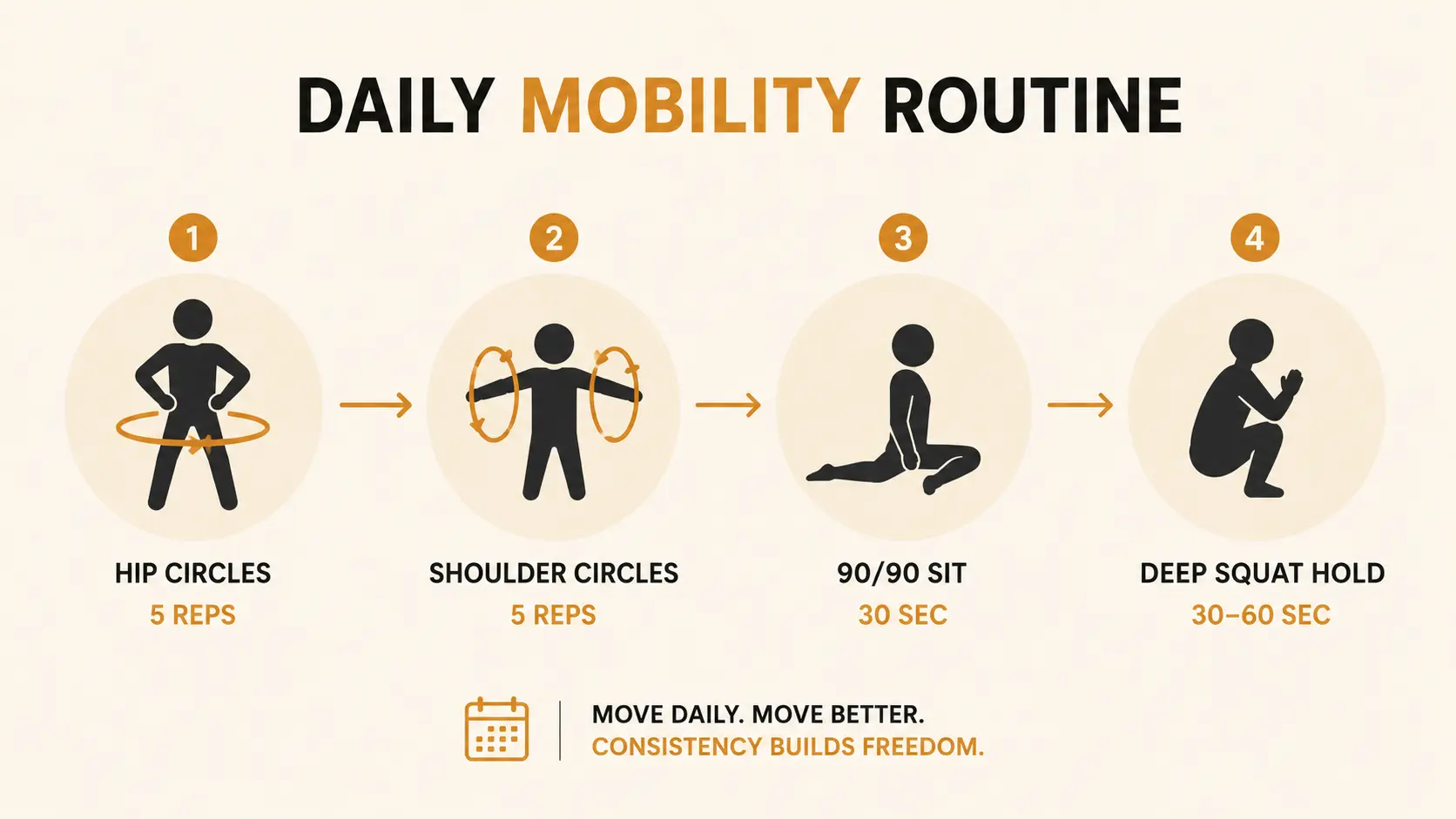
- Hip CARs, 5 reps each direction, each side. Stand tall, raise one knee, trace the largest circle your hip can make under control, then reverse direction.
- Shoulder CARs, 5 reps each direction, each side. Same principle — largest controlled circle the shoulder joint can make, arm relaxed but moving actively.
- 90/90 hip switch, 30 seconds each side. Sit with both knees bent at roughly 90 degrees, one leg rotated in and one rotated out, then switch — targets hip internal and external rotation together.
- Deep squat hold, 30-60 seconds. Sink into the lowest comfortable squat position and hold, actively pressing knees outward — trains mobility and flexibility simultaneously.
If you sit at a desk most of the day, it's worth pairing this routine with posture-specific exercises like chin tucks and scapular retraction — the two target different muscle groups and address different parts of the same desk-related stiffness.
Common Mistakes
- Holding long static stretches right before lifting. This is the one habit most likely to be quietly costing performance — move long holds to after training instead.
- Assuming more stretching fixes a control problem. If you're flexible but still can't control the range under load, the missing piece is strength and motor control, not muscle length.
- Treating mobility work as optional "extra" rather than part of training. A few minutes of CARs on the joints you train most is a higher-leverage use of time than most people assume.
- Chasing dramatic flexibility (splits, extreme backbends) with no functional goal. Extreme passive flexibility unsupported by strength through that range can increase injury risk rather than reduce it.
- Skipping mobility work because "I stretch after every workout." Passive stretching and active mobility training target different mechanisms — doing one doesn't automatically train the other.
Final Thoughts
Flexibility and mobility get used interchangeably in casual conversation, but the distinction is real and testable: one is what a muscle allows passively, the other is what you can actually do with that range under your own control. For most people — anyone who's reasonably able to touch their toes but still struggles with control in a squat, lunge, or overhead position — mobility is the higher-leverage gap to close. The good news is that well-structured strength training through a full range of motion builds both at once, so this rarely needs to be a separate, time-consuming pursuit.
Being able to reach a position and being able to control a position are two different skills. Most movement problems live in the second one.
If soreness or recovery timing is also part of your training questions, DOMS explained covers what's normal versus what needs attention after a session that includes new mobility or flexibility work.
Sources
[1] Mobility vs. flexibility definitions and mechanisms. Available at: hingehealth.com
[2] Why passive flexibility doesn't guarantee movement control. Available at: acefitness.org
[3] Chronic effects of stretching methods on range of motion, systematic review with meta-analysis. Available at: sciencedirect.com
[4] Eccentric training and flexibility gains versus static stretching. Available at: nutrisense.io
[5] Acute effects of static stretching duration on muscle strength and power. Available at: ncbi.nlm.nih.gov