
- Nervous system dysregulation describes a reduced ability to flexibly shift between alert and calm states in response to actual circumstances — it isn't a standalone medical diagnosis.
- The autonomic nervous system has two main branches — sympathetic (mobilizing) and parasympathetic (calming) — that are supposed to work in dynamic balance.[1]
- Polyvagal theory, a widely referenced but partly debated framework, describes three broad states: safety/connection, mobilization, and shutdown.[2]
- Dysregulation commonly shows up as one of two patterns: feeling chronically wired and hypervigilant, or feeling numb, foggy, and disconnected.
- Everyday practices can genuinely support regulation, but persistent or trauma-linked dysregulation usually benefits from working with a trained therapist.
"Nervous system dysregulation" has become one of those phrases that shows up everywhere in wellness content, often without much explanation of what it actually means. It's not a made-up term — it describes something real and well-studied in stress physiology. But it's also frequently used loosely, sometimes as a catch-all for "feeling stressed" or "feeling off," which makes it harder to know what's actually being described and what, if anything, to do about it. This is the plain-English version.
What "Nervous System Dysregulation" Actually Means
Your autonomic nervous system — the part that runs largely outside conscious control — has two main branches that are meant to work in dynamic balance. The sympathetic branch mobilizes you: it raises heart rate, sharpens alertness, and prepares the body to respond to something demanding. The parasympathetic branch does the opposite: it slows things down, supports digestion and rest, and signals the body that it's safe to stand down.[1] In a well-regulated system, you move between these states fluidly and appropriately — alert during something genuinely demanding, calm again once it passes.
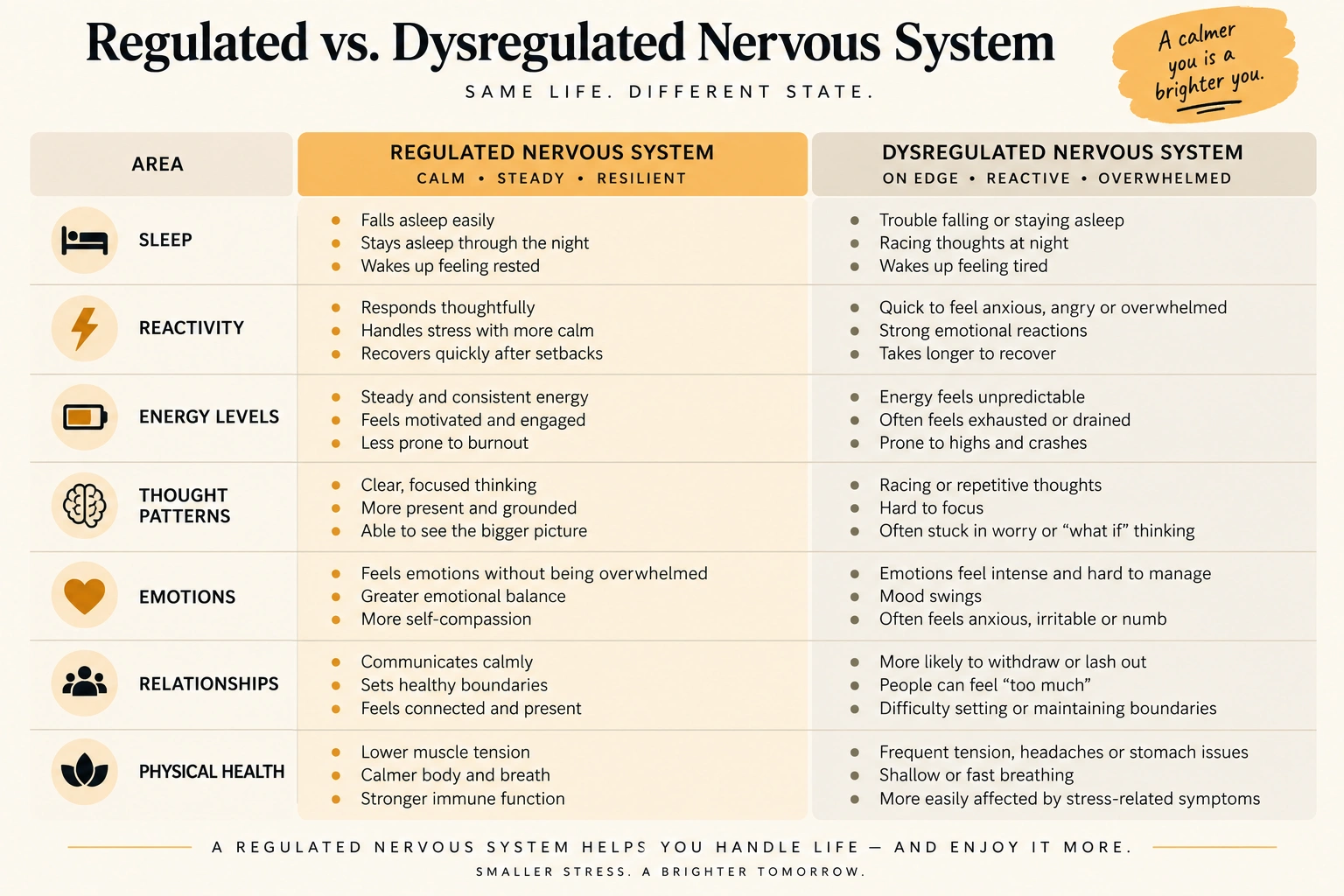
Dysregulation describes a breakdown in that flexibility. Instead of shifting appropriately to match the actual situation, the system either gets stuck in a heightened state (even during ordinary, low-stakes moments) or stuck in a shut-down state (even when engagement would be appropriate), or swings unpredictably between the two. It's less about which state you're in at any given moment and more about the system's reduced ability to accurately read the situation and respond proportionately.
Fight, Flight, Freeze, and Fawn — The Stress Responses
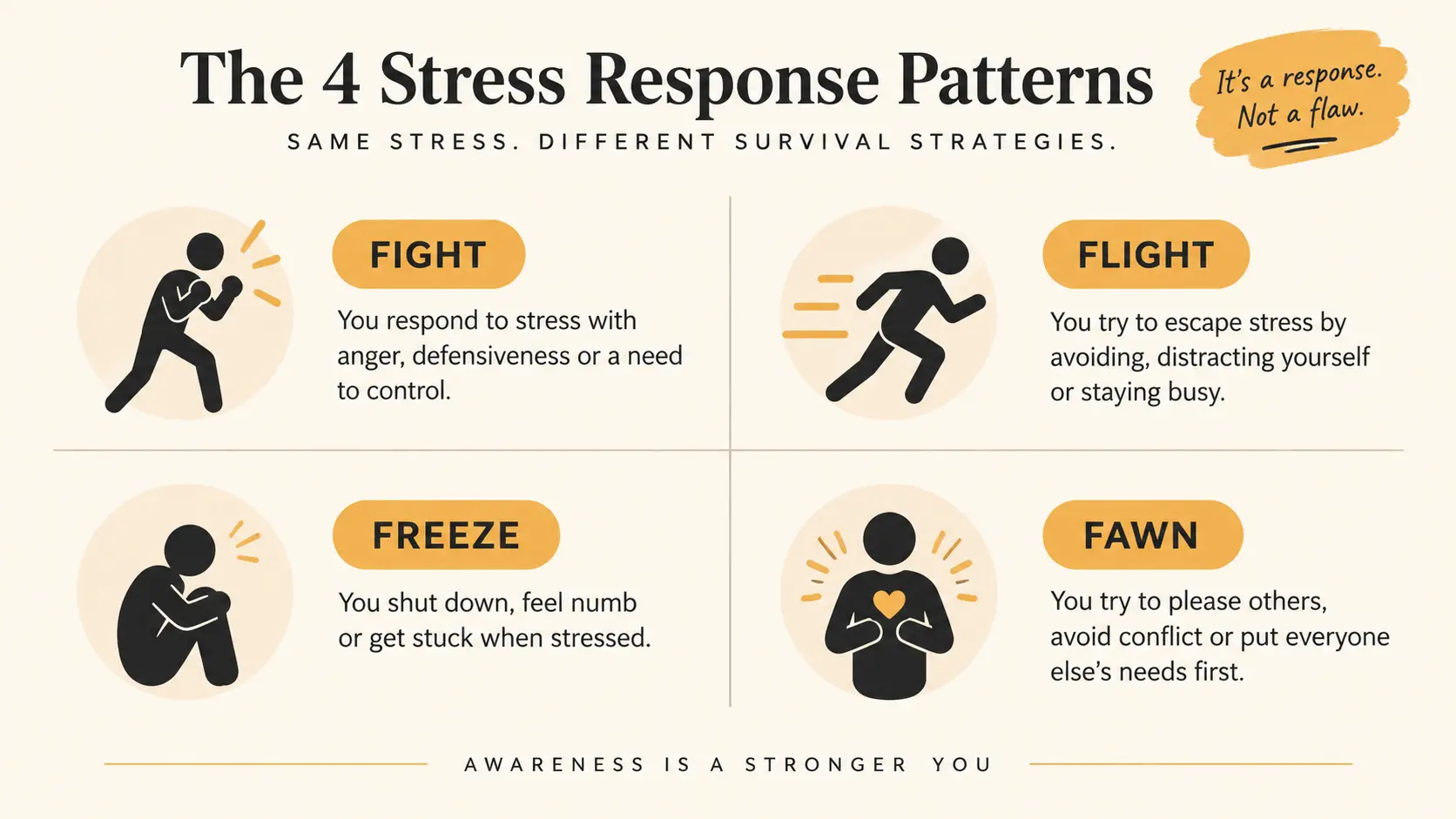
The classic "fight or flight" framing captures only part of the picture. Contemporary stress research generally describes four common response patterns, all driven by the same underlying physiology:
A fourth pattern, "fawn," is increasingly discussed alongside these three — appeasing or people-pleasing as a way to reduce perceived threat by keeping others calm or satisfied. None of these responses are conscious choices; they're the nervous system's fast, automatic assessment of a situation, which is exactly why they can misfire — reacting to a tense email with the same intensity as a genuine emergency.
Where Polyvagal Theory Fits In
Polyvagal theory, developed by Dr. Stephen Porges, has become one of the most widely referenced frameworks in trauma-informed therapy and popular wellness content alike.[2] It proposes that the autonomic nervous system operates across three broad, hierarchically organized states: a ventral vagal state associated with safety and social connection, a sympathetic state associated with mobilization, and a dorsal vagal state associated with shutdown or collapse when neither fighting nor fleeing feels viable.
Where this connects most directly to the vagus nerve is that the vagus nerve is the primary physical pathway carrying much of the parasympathetic "calm down" signaling this theory describes — so practices that support vagal tone are often discussed as ways to support nervous system regulation more broadly, even if the precise theoretical mechanism remains debated.
What Dysregulation Looks Like Day to Day
| Pattern | What it can look like |
|---|---|
| Overactivated (stuck "on") | Feeling wired even when safe, easily startled, racing thoughts, difficulty relaxing or sleeping, irritability over minor things |
| Underactivated (stuck "off") | Feeling numb, foggy, low energy, disconnected from your body or surroundings, difficulty feeling motivated |
| Oscillating | Swinging between wired and shut-down states, sometimes within the same day, with little in between |
| Disproportionate reactivity | Minor stressors (a delayed reply, a small change of plans) triggering a reaction that feels bigger than the situation warrants |
None of these signs, on their own, confirm dysregulation — everyone feels wired or foggy sometimes. What tends to distinguish dysregulation from ordinary stress is persistence and disproportion: the pattern shows up often, across unrelated situations, and out of step with what's actually happening.
What Contributes to It
Dysregulation isn't caused by any single factor, and it isn't exclusively linked to significant trauma, though trauma is one well-documented contributor. Chronic, ongoing stress without adequate recovery time is one of the most common everyday drivers — the same mechanism covered in how chronic stress affects the body. Poor or insufficient sleep, a lack of consistent safety or predictability in daily life, and limited social connection or co-regulation with others can all contribute as well. For many people it's less a single cause than an accumulation of ongoing, unresolved stress with insufficient recovery built in.
How to Support Regulation
- Paced, slower breathing. Extending the exhale relative to the inhale is one of the more consistently supported ways to activate the parasympathetic system in the moment.
- Regular movement. Physical activity helps discharge built-up sympathetic activation in a way that sitting still often can't.
- Consistent sleep and daily rhythm. Predictability itself is a regulating signal to the nervous system, separate from sleep quantity alone.
- Co-regulation with safe people. Calm, attuned social connection is one of the most effective — and most overlooked — regulating inputs available.
- Vagal tone practices. Cold exposure, humming, and specific breathing patterns are covered in more depth in the vagus nerve guide, ranked by evidence strength.
When to Seek Professional Support
Final Thoughts
Nervous system dysregulation is a real, well-grounded concept describing a genuine loss of flexibility in how your body responds to stress — not just a trendy way of saying "stressed out." Understanding the basic mechanism, without overclaiming certainty about every detail of the underlying theory, makes it easier to recognize the pattern in yourself and to know when everyday practices are enough and when it's time to bring in professional support.
Regulation isn't the absence of a stress response — it's the ability to have one, and then genuinely come back down afterward.
If persistent stress is the main driver behind what you're noticing, a tiered approach to stress management is a practical next step, organized from zero-time interventions to bigger structural changes.
This article is for general educational purposes and isn't a substitute for professional mental health diagnosis or treatment. If you're struggling significantly, please reach out to a licensed therapist or your doctor.
Sources
[1] Overview of the autonomic nervous system's sympathetic and parasympathetic branches. Available at: ncbi.nlm.nih.gov
[2] Porges, S. W. — The Polyvagal Theory: neurophysiological foundations of emotions, attachment, communication, and self-regulation. Available at: polyvagaltheory.com
[3] Critical scientific review of polyvagal theory's specific physiological claims. Available at: pmc.ncbi.nlm.nih.gov