
- 58-59% of job seekers accept the first salary offer without countering — despite roughly half of employers deliberately leaving room to negotiate.
- 66% of candidates who negotiate secure a higher offer; one large field study found countering produced an average 12.45% increase.
- 85% of people who countered on salary or benefits received at least some of what they asked for.
- Precise numbers (like 83,500 rather than 85,000) anchor negotiations more effectively than round numbers, according to Columbia Business School research.
- The first offer explains 50-85% of the variance in the final outcome — whoever anchors first has real, measurable influence.
Negotiating your salary is not a confrontation — it's the expected, routine second half of a hiring or review conversation that most people skip, and skipping it is measurably expensive. Just over half of job seekers accept whatever number they're first given, while the minority who counter secure meaningfully more, on average, for a conversation that typically takes under ten minutes.
This guide covers the psychology of why asking feels so uncomfortable, the research on what actually works, and — since strategy alone doesn't help if you freeze in the moment — word-for-word scripts for the specific situations that come up most.
Why This Feels So Much Harder Than It Should
The discomfort around negotiating isn't irrational or a personal failing — it maps to documented psychological and social patterns, some of which are backed by real research rather than just nerves. Negotiating involves genuine rejection risk, and rejection registers as a real, uncomfortable experience regardless of how prepared you are.[1]
The fear has an extra layer for some groups specifically: research has found that women who negotiate their own salary face a measurable social backlash — being perceived as less likable or "too demanding" — that men negotiating the same way do not face to the same degree.[2] A related finding shows candidates from lower-income backgrounds negotiate less often and encounter more backlash when they do.[3] None of this means negotiating isn't worth it — it means the framing in the scripts below is deliberately built around market data and role scope rather than personal need, which research suggests reduces that friction.
The Actual Math: What Asking Is Worth
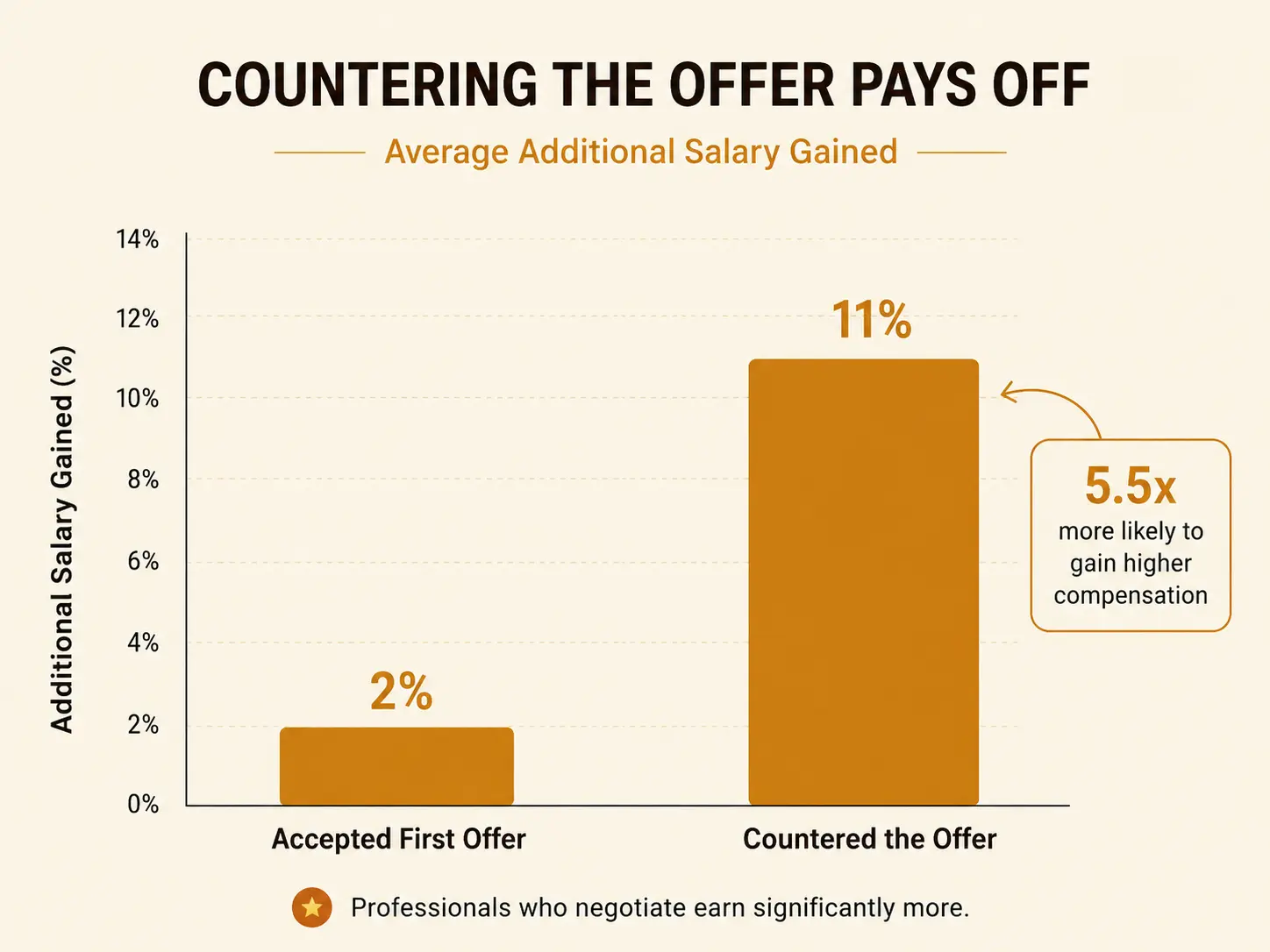
The gap between accepting the first offer and countering it is large enough that "I don't want to seem greedy" is usually the more expensive choice, not the safer one. A large field study following roughly 3,858 tech candidates found that those who countered their initial offer secured an average increase of about 12.45% — meaningfully more than those who didn't ask.[4]
| Behavior | Outcome |
|---|---|
| Accepted first offer, no counter | No increase beyond the initial number |
| Countered the offer | 66% secured a higher offer; average increase ~12-19% depending on the study |
| Countered on salary or benefits broadly | 85% received at least some of what they asked for |
Because future raises and offers are typically calculated as a percentage of current salary, a single successful negotiation compounds across a career in a way that resembles how compound interest works — a small percentage gained early has an outsized effect on the total over many years, not just on the one paycheck it directly touches. That compounding only shows up in your net worth, though, if the raise itself doesn't quietly get absorbed by lifestyle inflation the moment it lands.
The Anchor Effect: Why the First Number Matters So Much
Whoever states the first number in a negotiation exerts disproportionate influence on where it ends up — research estimates the first offer explains between 50% and 85% of the variance in the final outcome.[5] This is why waiting to be asked "what's your expected salary" and then giving a vague or low answer quietly costs more than most people realize.
A specific, research-backed refinement: precise numbers anchor more effectively than round ones. Columbia Business School research found that a figure like ₹18,35,000 functions as a stronger anchor than ₹18,00,000, because precision signals the number is calculated and researched rather than an arbitrary opening ask — the other side is more likely to treat it as a real data point and counter less aggressively against it.[6]
The Scripts: What to Actually Say
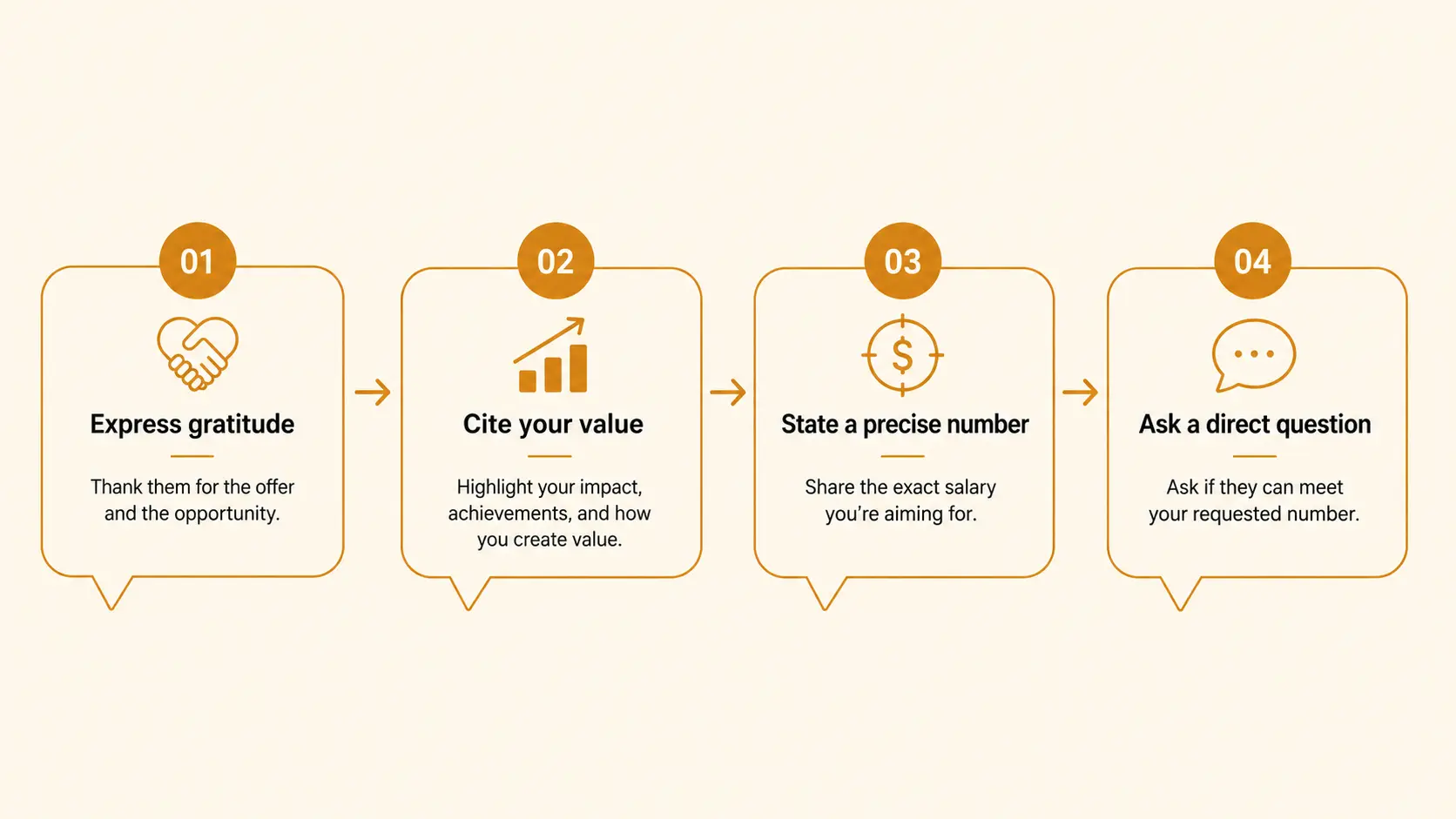
Strategy alone doesn't help if the moment arrives and the words don't come — these five scripts cover the situations that come up most, adaptable to your specific numbers and role.
Whatever CTC figure you land on, remember that CTC and take-home pay are two different numbers — how to read your payslip explains exactly where the gap comes from, which is worth understanding before comparing competing offers.
1. Countering a new job offer
2. Asking for a raise in your current role
3. When they ask your expectations before making an offer
4. When told "there's no room to negotiate"
5. Written version, for when a live conversation feels like too much
Handling the Common Pushback
Common Mistakes
- Giving a round number instead of a precise one. A number like ₹18,00,000 anchors weaker than ₹18,35,000 — precision reads as researched, not arbitrary.
- Justifying the ask with personal need rather than market value. "I need this for rent" is far less persuasive — and research-backed — than "based on market range and this scope."
- Accepting on the spot to avoid the discomfort of a pause. It's always reasonable to say "let me think this over and get back to you tomorrow," even after a verbal offer.
- Only negotiating salary and ignoring the rest of the package. Signing bonus, additional leave, remote flexibility, and an early review date are all negotiable even when base pay genuinely isn't.
- Not researching a range before the conversation starts. Walking in without a specific number means the other side's anchor becomes the only anchor in the room.
Final Thoughts
The single most consistent finding across all the research here is unglamorous but reliable: asking beats accepting, almost every time, for almost everyone. The fear that stops most people is real and sometimes has a documented social basis — but the financial gap between countering and not countering is large enough that the discomfort of one ten-minute conversation is rarely proportional to what staying silent costs over a career. If income growth is part of a bigger financial plan, this pairs naturally with the FIRE movement's emphasis on the savings-rate side — a higher salary and a strong savings rate are the two levers that move a long-term plan fastest.
The worst realistic outcome of asking is hearing "no" and keeping the offer you already had. The worst outcome of not asking is never knowing what "yes" would have gotten you.
If the idea of this conversation is genuinely stressful rather than just uncomfortable, practical stress management techniques covers quick tools — like the physiological sigh — that work well in the few minutes before a conversation like this one.
Sources
[1] Psychology of rejection and negotiation avoidance. Available at: crr.bc.edu
[2] The backlash effect for women negotiators, Program on Negotiation, Harvard Law School. Available at: pon.harvard.edu
[3] Research: employees from lower-class backgrounds negotiate less and face more backlash, Harvard Business Review. Available at: hbr.org
[4] Field experiment on tech candidate counteroffers and salary outcomes. Available at: careery.pro
[5] Anchoring effect and first-offer influence on negotiated outcomes. Available at: pon.harvard.edu
[6] Precise offers as stronger anchors than round numbers, Columbia Business School. Available at: business.columbia.edu