
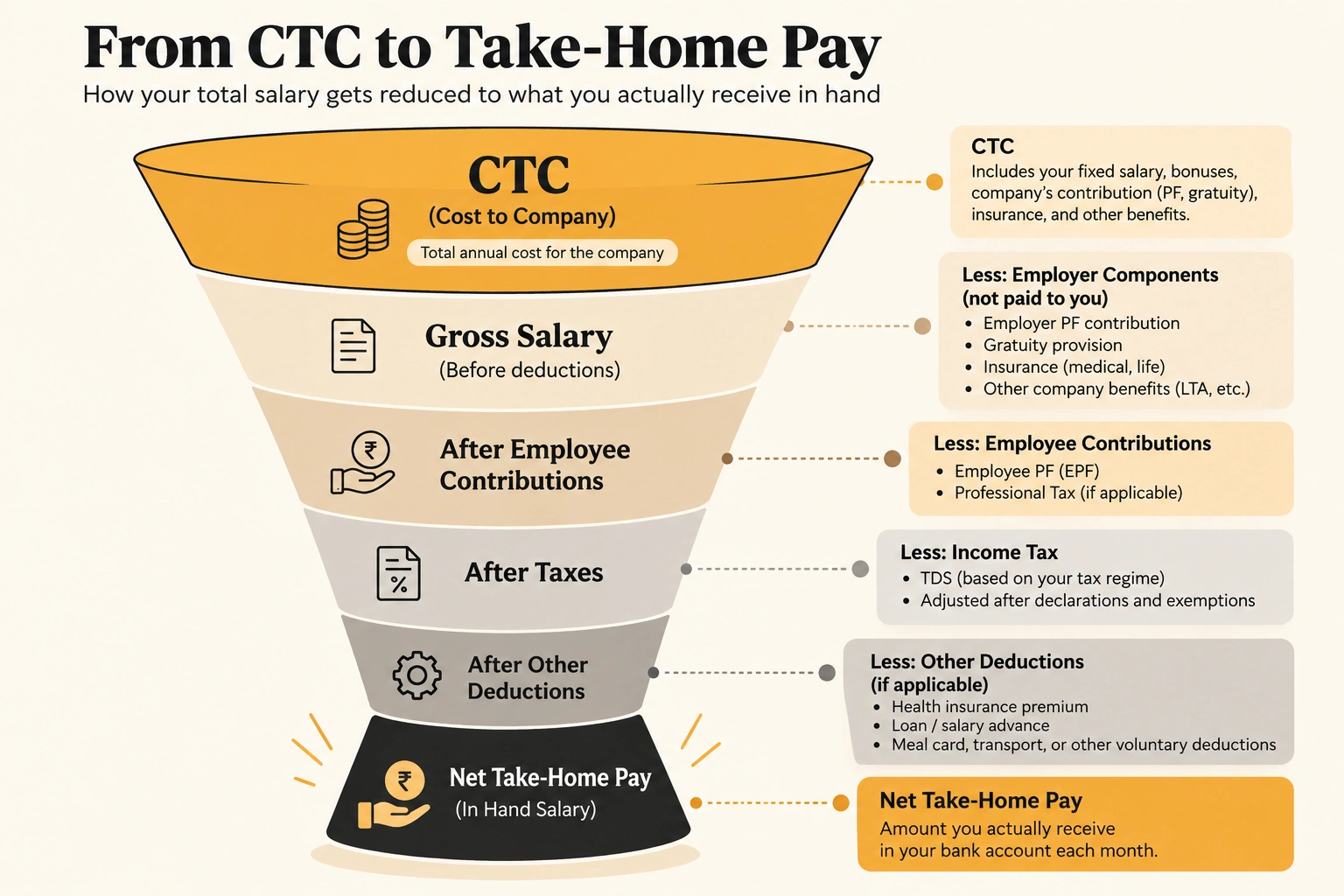
- CTC (Cost to Company), gross salary, and net (take-home) salary are three different numbers — CTC is always the largest, and take-home is always the smallest.
- The gap between CTC and take-home is typically 15-30%, driven mainly by the employer's PF contribution, gratuity provision, and your own PF deduction, professional tax, and TDS.
- PF (Provident Fund) deduction is typically 12% of basic salary, matched by an equal employer contribution.
- Professional tax is a small state-levied tax, capped at ₹2,500 per year, and doesn't apply in every state.
- TDS (Tax Deducted at Source) is your income tax, withheld monthly by the employer based on your projected annual tax liability.
Most first-time earners open their first payslip, look at a wall of abbreviations, and skip straight to the one number that matters to them — what actually landed in the bank account. That's a reasonable instinct, but it also means most people never learn what the other twelve or fifteen lines actually mean, or notice when one of them is wrong. This is the line-by-line version.
CTC vs. Gross Salary vs. Net Pay: The Three Numbers That Confuse Everyone
CTC (Cost to Company) is the total amount your employer spends on you annually — and it's almost always larger than what you'll ever see in your bank account. It includes your gross salary plus items that never touch your hands directly: the employer's PF contribution, gratuity provision, and the value of benefits like insurance. Gross salary is your total earnings before deductions — basic salary, HRA, and other allowances added together. Net salary, or take-home pay, is what's left after your own deductions are subtracted from gross salary — this is the number credited to your account each month.
This three-tier structure is exactly why an offer letter's headline CTC figure can feel misleading once the first payslip arrives — the number was never meant to equal take-home pay, even though it's the number most people mentally anchor to during salary negotiations.
The Earnings Side: What Makes Up Your Gross Salary
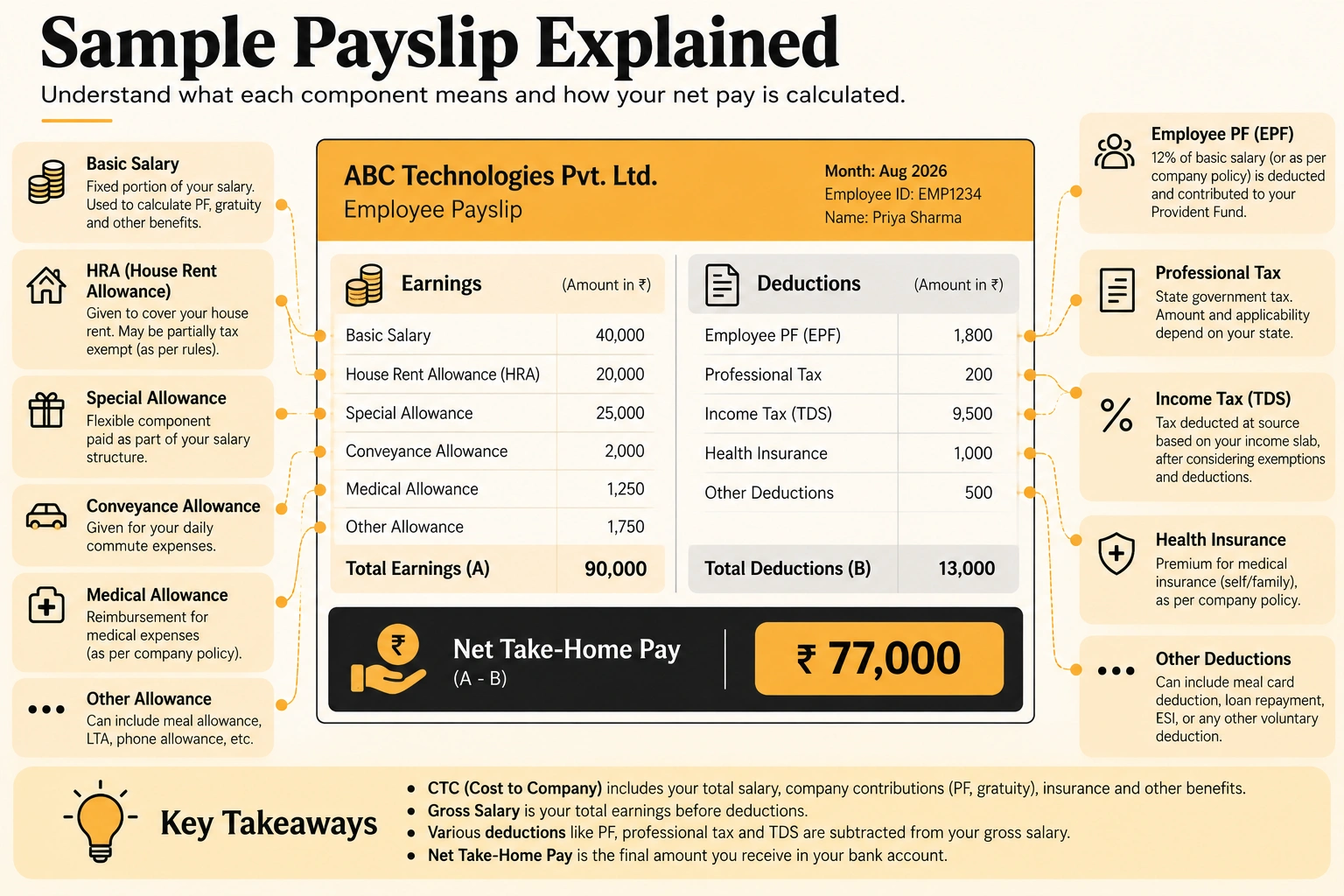
- Basic salary. The foundation figure your other components are often calculated as a percentage of — typically 40-50% of CTC. Fully taxable.
- HRA (House Rent Allowance). Paid to help cover rent; can be partially or fully tax-exempt under the old tax regime if you pay rent and submit proof, but fully taxable under the new regime.
- Special allowance. A catch-all component that makes up the difference between other fixed components and your total offered salary — fully taxable.
- Other allowances. May include conveyance, meal, or communication allowances depending on the employer, each with its own (often minor) exemption rules.
- Performance bonus / variable pay. If applicable, usually paid separately from the monthly cycle and fully taxable in the year received.
For a deeper breakdown of how each of these components is taxed differently under the old versus new tax regime, the full income tax guide covers the salary structure table in detail.
The Deductions Side: Where the Money Actually Goes
| Deduction | Typical amount | What it's for |
|---|---|---|
| Employee PF contribution | 12% of basic salary | Mandatory retirement savings, deposited into your EPF account |
| Professional tax | State-dependent, capped at ₹2,500/year | State government levy on salaried income; not applicable in every state |
| TDS (income tax) | Varies by income and regime | Your income tax, withheld monthly based on projected annual liability |
| Other deductions | Varies | May include employee insurance premium, loan EMI recovery, or one-off adjustments |
Common Payslip Terms Decoded
-
EPF / PF Employees' Provident Fund — a mandatory retirement savings scheme; both you and your employer contribute monthly.
-
TDS Tax Deducted at Source — your income tax, withheld and deposited by your employer on your behalf every month.
-
Gratuity A lump-sum benefit paid on leaving a job after 5+ years of continuous service; usually shown as a CTC component, not a monthly deduction.
-
LWP (Loss of Pay) A deduction applied when you've taken unpaid leave beyond your allotted paid leave for the period.
-
UAN Universal Account Number — a unique ID linked to your EPF account, used to track PF contributions across employers over your career.
Why Your Take-Home Is Less Than Your Offered CTC
The gap between the CTC quoted in your offer letter and what actually lands in your account each month is rarely a surprise once you know where to look — it's the combination of the employer's PF contribution and gratuity provision (never paid to you monthly), plus your own PF deduction, professional tax, and TDS (all subtracted from what's left). A ₹10 lakh CTC offer commonly translates to a monthly take-home in the range of ₹65,000-75,000, depending on your specific salary structure, tax regime choice, and any additional benefits included in the CTC.
What to Actually Check on Your Payslip Every Month
- Basic and gross salary match your offer letter or last revision. A mismatch here usually signals a payroll processing error worth flagging immediately.
- PF deduction is being deposited correctly. Verifiable through the EPFO portal using your UAN — worth checking every few months, not just once.
- TDS aligns with your expected annual tax liability. If you've submitted investment declarations, confirm they're reflected in the TDS calculation.
- No unexplained one-off deductions. A sudden LWP or "other deduction" line without a clear reason is worth raising with HR or payroll directly.
Common Mistakes
- Negotiating purely on CTC without asking about take-home. Two offers with identical CTC can have meaningfully different take-home pay depending on salary structure.
- Never checking the EPFO portal. PF deduction errors can go unnoticed for years if you never verify deposits against your UAN.
- Assuming professional tax and income tax are the same thing. They're separate, unrelated deductions — professional tax is a small state levy, TDS is your actual income tax.
- Ignoring the payslip once direct deposit is confirmed. A payslip reviewed only when something feels wrong misses smaller errors that compound over a year.
Final Thoughts
A payslip isn't designed to be confusing on purpose — it's just describing a genuinely multi-step calculation, from a total cost figure down to a final deposited number. Once you know what each line represents, the gap between your offer letter and your bank balance stops being a mystery and becomes something you can actually plan around.
The CTC number gets you in the door during negotiation. The payslip is where you find out what you actually agreed to.
Understanding your payslip is also the first real step toward building a one-page financial plan — you can't budget accurately against a number you don't fully understand.
This article is for general educational purposes and isn't personalized tax or financial advice. Consult a chartered accountant or tax professional for guidance specific to your situation.
Sources
[1] Employees' Provident Fund Organisation (EPFO) — contribution rates and rules. Available at: epfindia.gov.in
[2] Professional tax rates and applicability by state — Income Tax Department reference. Available at: incometax.gov.in