
The average salaried employee in India has their taxes handled almost entirely by their employer. TDS is deducted each month, Form 16 is issued at year end, and the ITR can be filed using pre-filled data. The entire process can be completed without understanding what any of it means.
The cost of that opacity is real. People who do not understand the basic structure of income tax end up in the wrong regime by default, miss deductions they are entitled to, file later than they should, and sometimes receive a tax notice they do not know how to interpret. More fundamentally, they make investment decisions without understanding the tax implications — which can add up to significant unnecessary tax payments over a working lifetime. If you are also trying to build a broader picture of where your money is going, calculating your net worth is the natural complement to understanding your tax position.
This article covers the foundational understanding that most salaried Indians need: how income tax is calculated, what the new and old regimes are and how to choose between them, which deductions exist and what they are worth, what you need to file your return, and what to do if you have income beyond your salary.
How Income Tax Works: The Basic Structure
Indian income tax is a progressive tax system: you pay a higher rate on higher portions of your income. You do not pay the highest applicable rate on all your income — you pay each rate only on the portion of income that falls within that slab. This is the most common misunderstanding about income tax, and it produces real errors in people's estimates of their tax liability.
The five heads of income
The Income Tax Act classifies all income into five heads: Salaries (your employment income, including basic pay, HRA, special allowances, and perquisites); House property (rental income from property you own, or the notional annual value of a self-occupied property — taken as nil for a single self-occupied property); Business or profession (income from running a business, freelancing, consulting, or professional practice); Capital gains (profits from selling capital assets: shares, mutual funds, property, gold); and Other sources (interest income from savings accounts, FDs, bonds; dividend income; gifts above ₹50,000 from non-relatives).
Your total income is the sum of income across all applicable heads. Tax is calculated on your total income after applicable deductions.
Gross Total Income vs Taxable Income
Gross Total Income (GTI) is the sum of your income across all heads before any deductions under Chapter VI-A (Section 80C, 80D, etc.). Taxable Income (or Total Income) is GTI minus the deductions you are eligible for. This is the figure on which your tax slab rates are applied.
New Regime vs Old Regime: The Choice That Matters Most
Since FY 2020-21, Indian taxpayers have had a choice between two tax regimes. Since FY 2023-24, the New Tax Regime is the default — meaning if you do not explicitly choose the Old Regime by filing the appropriate form, you will be assessed under the New Regime.
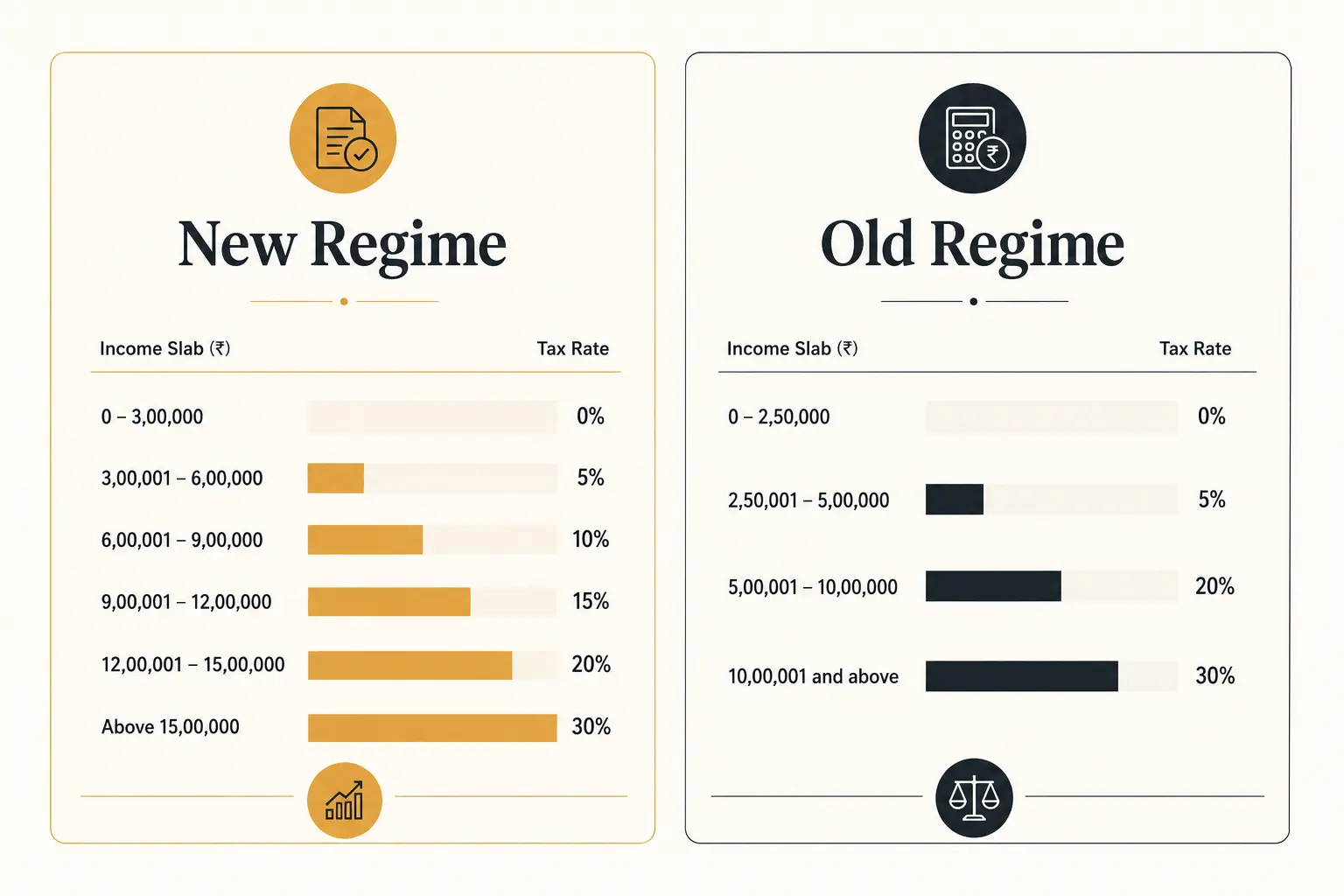
New Tax Regime: the rates (FY 2026-27)
| Income slab | Tax rate (New Regime FY 2026-27) |
|---|---|
| Up to ₹4 lakh | Nil |
| ₹4 lakh to ₹8 lakh | 5% |
| ₹8 lakh to ₹12 lakh | 10% |
| ₹12 lakh to ₹16 lakh | 15% |
| ₹16 lakh to ₹20 lakh | 20% |
| ₹20 lakh to ₹24 lakh | 25% |
| Above ₹24 lakh | 30% |
Key features: lower tax rates across most slabs, a standard deduction of ₹75,000 for salaried individuals and pensioners (revised in Budget 2024 from ₹50,000), a basic exemption limit of ₹4 lakh, and a rebate under Section 87A (₹60,000) that makes the effective tax nil for income up to ₹12 lakh. The New Regime does not allow most deductions and exemptions — no 80C, no 80D, no HRA exemption, no LTA exemption, no home loan interest deduction under Section 24.
Old Tax Regime: the rates
| Income slab | Tax rate (Old Regime) |
|---|---|
| Up to ₹2.5 lakh | Nil |
| ₹2.5 lakh to ₹5 lakh | 5% |
| ₹5 lakh to ₹10 lakh | 20% |
| Above ₹10 lakh | 30% |
Key features: higher tax rates in the middle slabs, a lower basic exemption of ₹2.5 lakh, but full access to all deductions and exemptions — 80C (₹1.5 lakh), 80D (health insurance premium), HRA exemption, home loan interest deduction, LTA, and many others that can substantially reduce taxable income. A rebate under Section 87A makes the effective tax nil for income up to ₹5 lakh.
Which regime is better: the break-even analysis
The right regime depends on how much you save in deductions. The New Regime's lower rates are advantageous if your deductions are modest; the Old Regime's higher rates become worthwhile only if your deductions are large enough to overcome the rate disadvantage.
| Annual income | Deductions needed for Old Regime to win | Typical salaried person has? | Suggested default |
|---|---|---|---|
| Up to ₹12.75 lakh (gross) | Zero tax under New Regime — no comparison needed | Not applicable | New Regime is the automatic choice |
| ₹15 lakh | ~₹5–6 lakh (home loan interest + HRA + 80C + 80D all combined) | Only if paying both HRA and home loan + full 80C + insurance | New Regime better for most; Old Regime wins only with heavy deductions |
| ₹20 lakh | ~₹8–10 lakh — practically difficult to claim | Very unlikely without large home loan interest and NPS | New Regime better for almost everyone |
| Above ₹25 lakh | ~₹10+ lakh | Possible only with very significant home loan + all exemptions + NPS employer contribution | Calculate specifically; New Regime still wins for most |
The most reliable approach: calculate your tax liability under both regimes with your actual figures, and choose accordingly. The income tax department's own portal (incometax.gov.in) has a regime comparison tool. Multiple online calculators also do this in under five minutes.
Key Deductions Under the Old Regime
The value of the Old Regime is entirely in its deductions. If you are going to claim the Old Regime, you need to know what is available and what it is worth to you.
Section 80C: the ₹1.5 lakh deduction
Section 80C allows a deduction of up to ₹1.5 lakh per financial year for investments and payments in specified instruments. This is the most widely used deduction and often the first most people encounter.
| 80C instrument | What it is | Lock-in period | Returns / notes |
|---|---|---|---|
| EPF | Mandatory contribution for employed workers | Until retirement (partial withdrawal available) | Tax-free returns; 8.25% p.a. (FY 2023-24); automatic if salaried |
| PPF | Government-backed savings scheme | 15 years (partial withdrawal from year 7) | Tax-free returns; 7.1% p.a.; very safe |
| ELSS | Tax-saving equity mutual fund | 3 years per SIP instalment | Market-linked; historically 10–14% over 5+ years; best return potential here. Related: how SIPs work |
| Life insurance premium | Premium paid on life insurance policies | Policy-dependent | Value as tax deduction only if policy is genuinely needed; avoid as investment vehicle |
| NSC | Post office savings scheme | 5 years | 7.7% p.a.; interest taxable but auto-reinvestment counts as further 80C deduction |
| 5-year tax-saving FD | Bank FD with 5-year lock-in | 5 years | Current rates 6.5–8.5%; interest taxable. See also: FD vs mutual funds comparison |
| Home loan principal | Principal component of your home loan EMI | Tied to loan tenure | Only the principal portion; not the interest component |
| Tuition fees | Paid for up to 2 children's full-time education | None | School/college fees; hostel fees excluded |
| NPS Tier 1 | National Pension System contribution | Until age 60 | Up to ₹1.5L under 80C; additional ₹50,000 deduction available under 80CCD(1B) |
Section 80D: health insurance premiums
| Who is insured | Deduction limit | Notes |
|---|---|---|
| Self, spouse, and dependent children | Up to ₹25,000 per year | Standard limit for people under 60 |
| Self + family where policyholder is 60+ | Up to ₹50,000 per year | Increased limit for senior citizens |
| Parents (under 60) | Additional up to ₹25,000 | Over and above the self + family limit |
| Parents (60 or above) | Additional up to ₹50,000 | Higher limit for senior parent policy |
| Maximum combined (self < 60, parents 60+) | ₹75,000 per year | Self limit ₹25K + parents limit ₹50K |
| Preventive health check-up | Up to ₹5,000 within above limits | For self, family, or parents; no receipt required below ₹5,000 |
The tax deduction is a nice bonus, but it shouldn't be the reason you buy a policy — health insurance basics: what your policy actually covers breaks down the coverage terms that matter far more than the 80D benefit.
Section 24(b): home loan interest
If you have a home loan on a self-occupied property, the interest component of your EMI is deductible under Section 24(b) up to ₹2 lakh per financial year. For a let-out property, there is no cap on interest deduction, but the net loss from house property that can be set off against other income is capped at ₹2 lakh. This deduction is one of the primary reasons the Old Regime remains better for people with significant home loans — a person paying ₹20,000 per month in home loan interest (₹2.4 lakh per year) saves ₹60,000 in tax at the 30% rate from this single deduction alone.
HRA exemption: House Rent Allowance
If you receive HRA as part of your salary and live in a rented house, you can claim an exemption on part of your HRA. The exempt amount is the minimum of: actual HRA received from employer; rent paid minus 10% of basic salary; or 50% of basic salary if in a metro (Delhi, Mumbai, Kolkata, Chennai) / 40% if non-metro.
The HRA exemption requires that you actually pay rent — it cannot be claimed if you live in your own house. Rent above ₹1 lakh per year requires landlord PAN for the claim.
Other notable deductions
Section 80TTA: Interest up to ₹10,000 on savings bank accounts is deductible (not FD interest). Section 80E: Interest paid on education loans for higher education is fully deductible for up to 8 years. Section 80G: Donations to specified funds and charitable organisations are deductible at 50% or 100% of the donated amount. LTA: Exemption on domestic travel costs twice in a block of 4 years, applicable to self and family.
Understanding Your Salary Structure
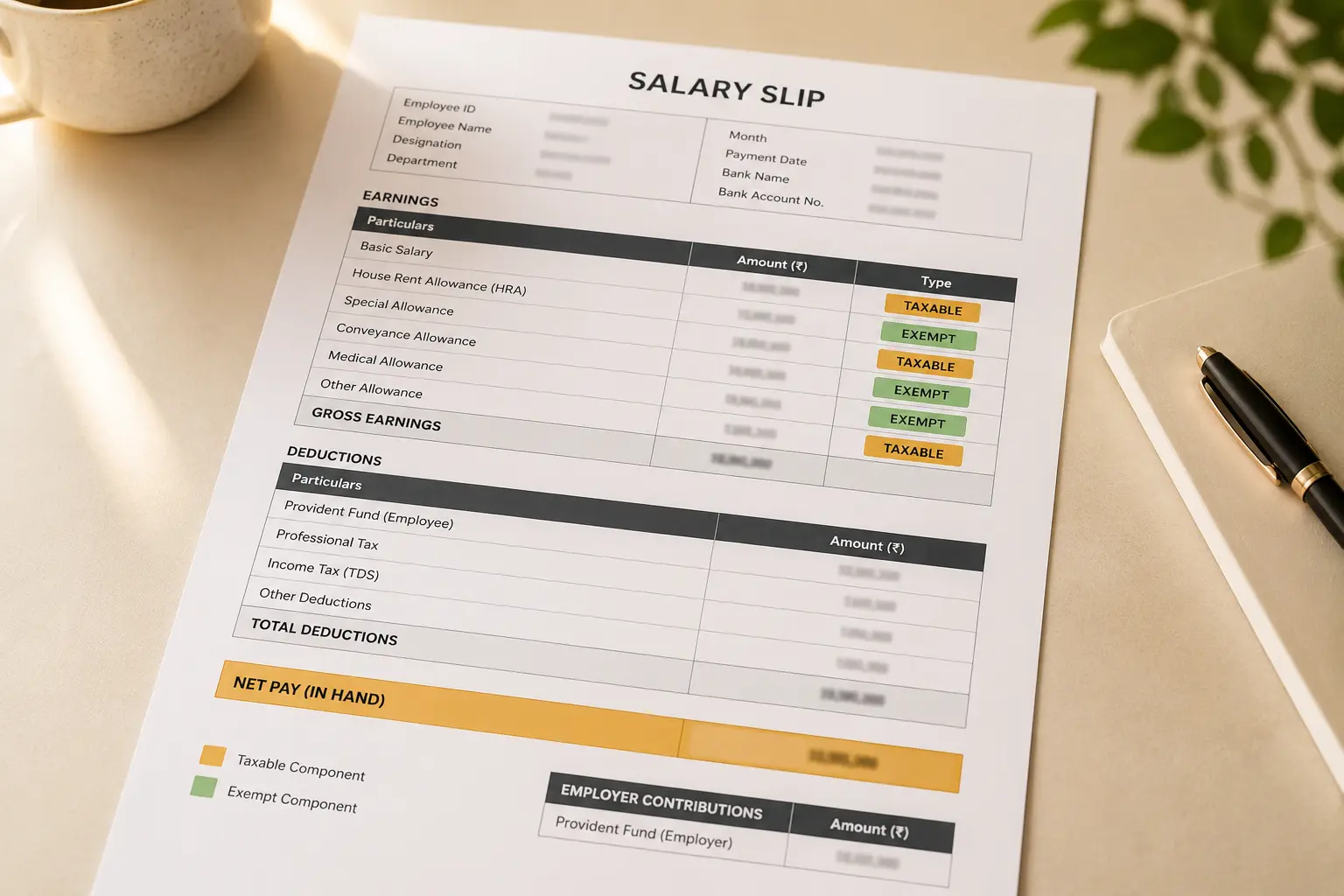
A typical salaried employee's CTC consists of multiple components, each with different tax treatment. Understanding your salary slip is the prerequisite for accurate tax planning — if the terms below feel unfamiliar, how to read your payslip walks through every earning and deduction line by line first.
| Salary component | Tax treatment (Old Regime) | Tax treatment (New Regime) |
|---|---|---|
| Basic salary | Fully taxable | Fully taxable |
| HRA | Partially or fully exempt if rent is paid (Section 10(13A)) | Fully taxable — no HRA exemption |
| Special allowance | Fully taxable | Fully taxable |
| LTA | Exempt for domestic travel costs within exemption rules (twice in 4-year block) | Fully taxable — no LTA exemption |
| Employer PF contribution | Exempt up to 12% of basic salary; excess taxable | Same treatment |
| Performance bonus | Fully taxable in year received | Fully taxable |
| ESOPs (on exercise) | Taxable as perquisite at exercise (difference between FMV and exercise price) | Same treatment — TDS deducted by employer; sale of shares produces capital gains |
| Gratuity | Exempt up to ₹20 lakh on retirement/resignation | Same treatment |
Capital Gains: What You Pay When You Sell Investments
Capital gains tax applies when you sell a capital asset — shares, mutual funds, property, gold — for more than you paid. The rate depends on the type of asset and how long you held it. Budget 2024 introduced the current capital gains tax structure, which continues to apply for FY 2026-27 (no changes in Budget 2025 or Budget 2026). If you invest in mutual funds vs fixed deposits, understanding the capital gains treatment of each changes the after-tax return comparison significantly.
| Asset type | Short-term (STCG) if held < | STCG rate | LTCG rate | LTCG exemption |
|---|---|---|---|---|
| Listed equity shares & equity MFs | 12 months | 20% (was 15% pre-Budget 2024) | 12.5% (was 10% pre-Budget 2024) | ₹1.25 lakh per year |
| Debt mutual funds (post-Apr 2023) | 36 months | Slab rate | Slab rate (indexation removed) | No exemption |
| Property | 24 months | Slab rate | 12.5% without indexation (Budget 2024 change) | Section 54 exemption on reinvestment |
| Physical gold & Sovereign Gold Bonds | 36 months | Slab rate | 12.5% without indexation | No general exemption |
| Unlisted shares | 24 months | Slab rate | 12.5% | No general exemption |
The two most practically significant capital gains rules for salaried investors: the LTCG rate on equity mutual funds and listed shares is 12.5% (still significantly lower than the slab rate); and the LTCG annual exemption is ₹1.25 lakh. Both rates have been unchanged since Budget 2024 — Budget 2025 and Budget 2026 made no further changes to equity capital gains. If you invest via SIPs, understanding how SIPs and capital gains interact is worth reading before you redeem.
What You Actually Need to File Your Return
Filing your Income Tax Return (ITR) is mandatory if your total income exceeds the basic exemption limit, or if you have capital gains, foreign income, or assets above certain thresholds — even if TDS has already covered your tax liability. Filing also creates a formal tax record useful for loan applications, visa applications, and financial documentation.
Documents to gather before filing
- Form 16 from your employer — issued by June 15 of the assessment year. Part A has TDS details; Part B has the salary computation.
- Form 26AS and Annual Information Statement (AIS) — Form 26AS shows all TDS deducted in your name. AIS (introduced 2021) shows all financial transactions the income tax department has data on: interest income, dividends, capital gains, high-value purchases, property transactions. The AIS is now the primary document for verifying your income declaration is complete.
- Interest income certificates — FD interest certificates from all banks; savings account interest statements. Declare even if TDS was deducted at source.
- Capital gains statements — from your broker for equity sales; CAMS or KFintech CAS statement for mutual fund gains/losses.
- Home loan statement — annual interest and principal certificate from your lender (for Section 24(b) and 80C claims in Old Regime).
- Health insurance premium receipts — for Section 80D claims.
- Rent receipts and landlord PAN — if claiming HRA exemption; landlord PAN required if annual rent exceeds ₹1 lakh.
- Pre-validated bank account — account number and IFSC for any refund credit.
The ITR form to use
| ITR form | Who should use it |
|---|---|
| ITR-1 (Sahaj) | Resident individuals with salary income, one house property, and interest/small dividends; total income up to ₹50 lakh; no capital gains; no business income |
| ITR-2 | Individuals and HUFs with capital gains, more than one house property, foreign income or assets, or total income above ₹50 lakh; no business income |
| ITR-3 | Individuals and HUFs with business or professional income (including freelancers) |
| ITR-4 (Sugam) | Individuals with presumptive business income under Sections 44AD, 44ADA, or 44AE; total income up to ₹50 lakh |
Most salaried employees with FD interest and equity mutual fund investments will file ITR-2 if they have capital gains and ITR-1 if they do not. The income tax portal pre-fills much of the return from Form 26AS and AIS data — verify those pre-fills rather than accepting them blindly.
Important dates (FY 2026-27 / AY 2027-28)
| Event | Date |
|---|---|
| Employer issues Form 16 | On or before June 15, 2027 |
| ITR filing deadline (salaried, non-audit) | July 31, 2027 |
| Belated return deadline | December 31, 2027 (penalty: ₹1,000 up to ₹5L income; ₹5,000 above ₹5L) |
| Last date to revise ITR | December 31, 2027 |
| Filing deadline (audit cases) | October 31, 2027 |
| Advance tax Q1 (15% of annual estimate) | June 15, 2026 |
| Advance tax Q2 (cumulative 45%) | September 15, 2026 |
| Advance tax Q3 (cumulative 75%) | December 15, 2026 |
| Advance tax Q4 (100%) | March 15, 2027 |
If You Have Income Beyond Your Salary
Salaried individuals often have income beyond their employment: FD interest, savings account interest, dividends, capital gains from mutual fund redemptions, freelance income, or rental income. Each has specific treatment that many people mishandle.
FD and savings account interest
FD interest is added to your income and taxed at your slab rate. It is not automatically tax-free simply because TDS was deducted at source (10%). If your slab rate is 20% or 30%, you owe additional tax on FD interest beyond the TDS already deducted. This additional tax must be paid as advance tax or self-assessment tax and declared in your ITR. Failing to declare FD interest is one of the most common reasons salaried individuals receive tax notices.
Savings account interest up to ₹10,000 per year is deductible under Section 80TTA in the Old Regime. Above ₹10,000, the excess is taxable at the slab rate.
Dividend income
Since FY 2020-21, dividends from Indian companies and mutual funds are taxable in the hands of the investor at their slab rate. There is no dividend distribution tax at the company level. Dividends are reported in the AIS and must be declared in the ITR. TDS is deducted at 10% on dividends above ₹5,000 per year from a single company or fund house.
Freelance or consulting income
If you receive income from freelance work, consulting assignments, or professional fees in addition to your salary, this is taxed under the 'business or profession' head. The gross fees are your income; you can deduct legitimate business expenses against this income. The ITR form changes from ITR-1 or ITR-2 to ITR-3 once you have any business or professional income. If your annual professional receipts are below ₹75 lakh, you may be eligible to file under the presumptive taxation scheme (Section 44ADA), which simplifies the process considerably. If you are building a side income stream, the best side hustles for Indian income guide covers the tax implications of each type.
Capital gains from mutual fund redemptions
Each time you redeem a mutual fund, you generate a capital gain or loss that must be declared. Most people who do SIPs and periodically redeem have multiple small capital gain transactions across the year. The CAMS or KFintech Capital Account Statement (CAS) provides a consolidated gains report that can be used directly for ITR filing. LTCG on equity mutual funds above ₹1.25 lakh is taxable at 12.5%; LTCG on debt funds (investments made post-April 2023) is taxable at the slab rate.
The Most Common Tax Filing Errors
- Not declaring FD interest. The AIS now shows all FD interest reported by banks to the income tax department. If you do not declare it and it appears in your AIS, you will receive a mismatch notice. Always declare all interest income even if TDS was deducted.
- Not checking Form 26AS for TDS credit. If your employer deducted TDS but did not correctly link it to your PAN, the credit will not appear in Form 26AS. Check that all TDS deductions appear correctly — discrepancies must be resolved with the deductor before filing.
- Using the wrong ITR form. ITR-1 cannot be used if you have capital gains. If you had any mutual fund redemptions, equity sales, or property sales, you must file ITR-2.
- Not verifying the ITR after filing. An ITR that is filed but not verified is treated as not filed. Verification must be done within 30 days of filing, either through Aadhaar OTP (recommended), net banking, bank ATM, or by sending a signed ITR-V to CPC Bengaluru.
- Claiming 80C deductions for post-March investments. Section 80C deductions apply to investments made during the financial year (April 1 to March 31). Investments made in April of the following year do not count for the previous year's return.
- Not declaring rental income on a second property. A second property is deemed to have a taxable annual value even if not actually rented. The notional rent is taxable. This is frequently missed.
Getting a Refund: When It Happens and How Long It Takes
A tax refund arises when total tax already paid — through TDS, advance tax, and self-assessment tax — exceeds the actual tax liability in your ITR. For straightforward salaried returns filed on time with a verified bank account, refunds typically arrive within 15 to 45 days after the CPC processes the return. Refunds above a certain amount carry interest at 6% per annum if processed after the due date.
If a refund is delayed, you can check its status on the income tax portal (e-Filing portal → Income Tax Returns → View Details). Refunds are credited directly to the pre-validated bank account linked to your PAN.
Understanding Your Tax Is Not Optional
The Indian income tax system is complex enough that most salaried people defer entirely to their employer and their CA, which is understandable. The cost of that deference is not just the risk of errors — it is the missed opportunity to make deliberate choices about regime, investments, and timing that can meaningfully reduce legitimate tax outgo over a working lifetime.
The decision between New Regime and Old Regime is worth running the numbers on with your actual figures rather than accepting the employer default. The AIS is worth checking before filing to ensure the income tax department's records match what you will declare. And filing by July 31 is worth doing simply to avoid the late filing penalty and the stress of a December deadline.
None of this requires a chartered accountant for most salaried individuals, though a CA is valuable for complex situations involving business income, capital gains on property, ESOPs, or foreign income. For the majority of salaried taxpayers, a working understanding of the structure described in this article is sufficient to file accurately and to ask the right questions of whoever helps with the filing.
If you want to put this understanding into a broader financial context — knowing your tax liability is one input into knowing your actual savings rate — the Personal Finance Basics course covers everything from tax-efficient investing to building your first budget, starting from wherever you currently are.
This article is an educational overview of Indian income tax principles for salaried individuals, based on rules applicable for FY 2025-26 / FY 2026-27 and Budget 2025 announcements (Budget 2026 made no changes to slab rates). Tax laws change frequently. Always verify current rules at incometax.gov.in or consult a qualified Chartered Accountant before making tax-related decisions. Individual circumstances vary significantly.