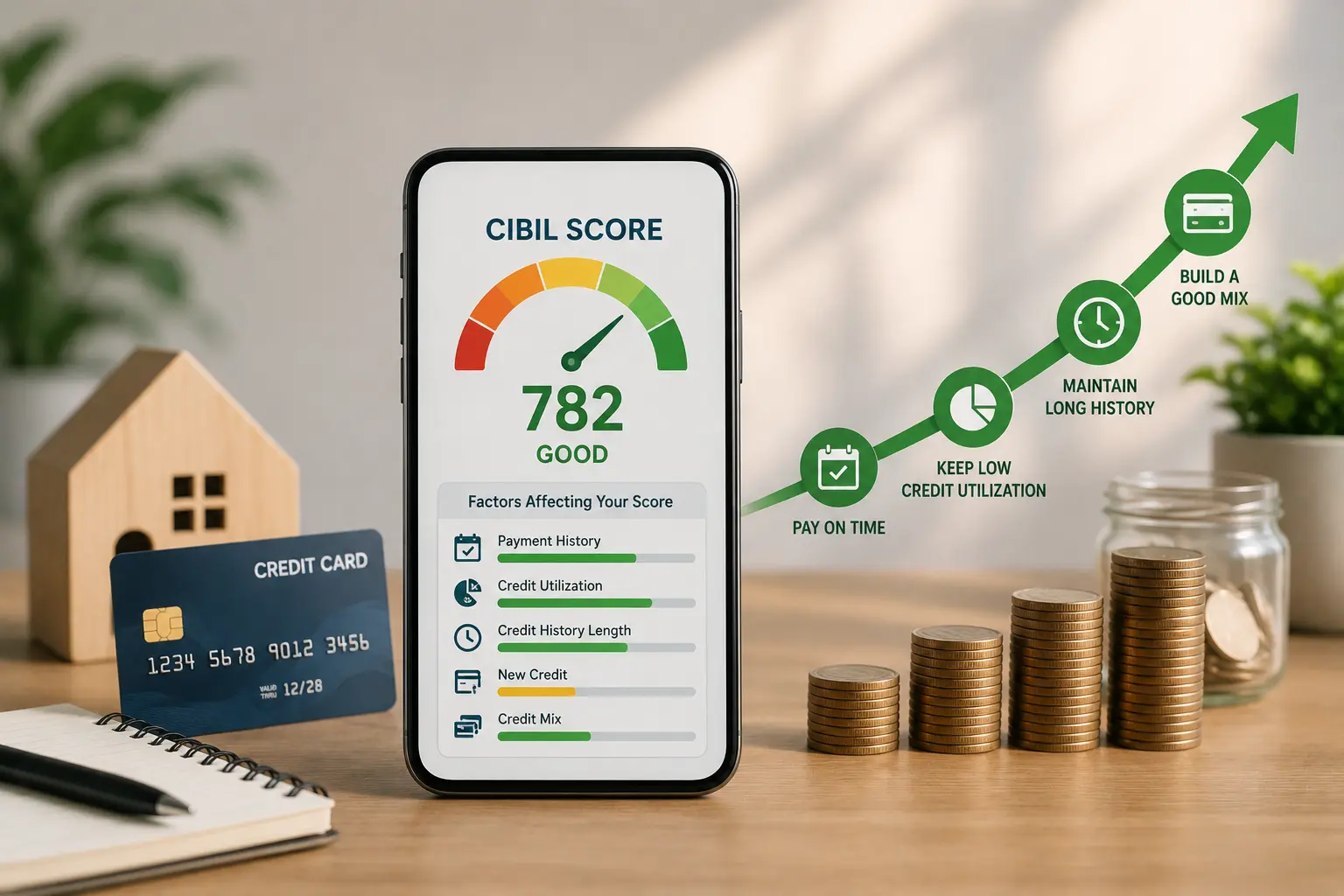
Most people check their CIBIL score when they need a loan, get rejected or offered a high interest rate, and then have a vague idea that they should improve it before the next application. What most people do not have is a working understanding of what the score is built from, why specific actions affect it, and what the realistic timeline for improvement looks like.
That gap matters because credit score improvement is not difficult, but it is specific. Paying your bills on time is the largest single factor — but knowing only that produces a ceiling on how well you can manage the other four factors: credit utilisation, credit history length, credit mix, and new enquiries. These together determine whether good payment history produces a 720 or a 790.
This article explains what the CIBIL score actually measures, how each factor is weighted, which actions improve it fastest, which common actions damage it without people realising, and what realistic timelines look like for different starting positions. The goal is a working model of your credit score that makes every credit-related decision easier to make correctly.
What a CIBIL Score Is and How It Is Generated
CIBIL — TransUnion CIBIL Limited — is India's oldest and most widely used credit bureau. It collects credit data from member financial institutions — banks, NBFCs, credit card companies — and uses that data to generate a credit score for each borrower. The CIBIL score ranges from 300 to 900.
If you've moved abroad or split your financial life across countries, it's worth knowing that this same five-factor logic — payment history, utilisation, history length, mix, and enquiries — drives credit scores almost everywhere, even though the scale changes. How credit scores actually work globally covers the US, UK, and Australian systems side by side, including why your CIBIL history generally won't transfer if you relocate.
India has four credit bureaus licensed by RBI: TransUnion CIBIL, Experian, CRIF High Mark, and Equifax. Each maintains its own data and generates its own score. Your CIBIL score and your Experian score may differ, sometimes significantly, because the reporting of your credit accounts to each bureau may not be identical. CIBIL is the most commonly checked by lenders in India, but checking your score across all four bureaus annually is worth doing to identify discrepancies.
Financial institutions report your credit account activity to the bureaus monthly. Your score is recalculated each time new data is received. This means your score is not static — it changes as your account behaviour changes, with a lag of approximately thirty to sixty days between an action and its appearance in your bureau record.
The Five Factors That Build Your Score
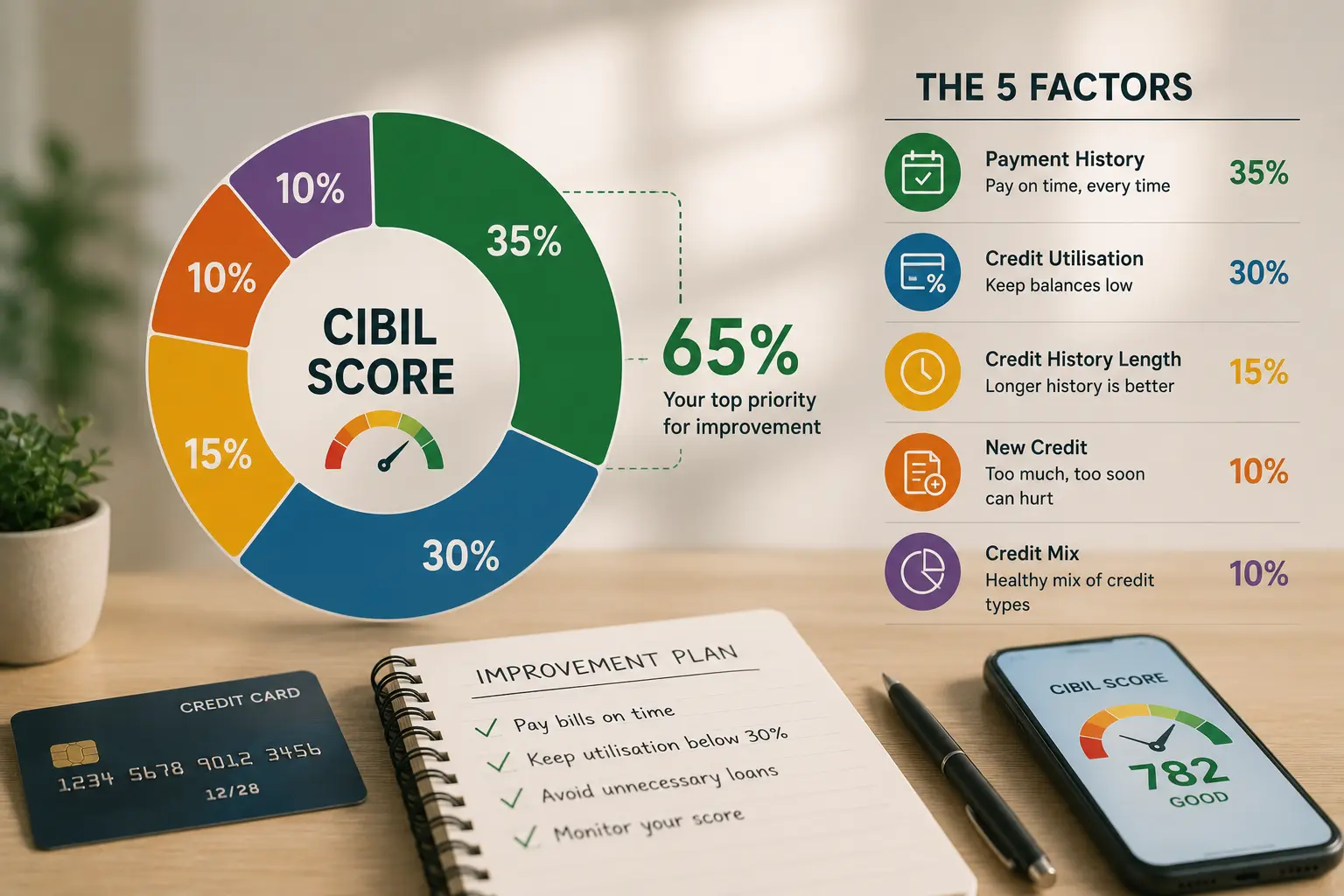
CIBIL does not publish its exact scoring algorithm, but the bureau has disclosed the broad categories and approximate weightings. These align closely with TransUnion's global credit scoring methodology.
Factor 1: Payment History — The 35% That Dominates Everything
Payment history is the largest single component of your credit score and the one that responds most dramatically to both good and bad behaviour. A single missed EMI payment is reported to the bureau as a 'Days Past Due' (DPD) entry. Understanding the DPD classification is essential because the impact is highly asymmetric.
| DPD category | What it means | Score impact | How long it stays on record |
|---|---|---|---|
| 000 (zero DPD) | Paid on or before due date | Positive; builds payment history | Permanent positive record |
| SMA-0 | Overdue 1–30 days | Mild negative; not yet formally delinquent | Reported but least damaging |
| SMA-1 | Overdue 31–60 days | Significant negative mark | 7 years on record |
| SMA-2 | Overdue 61–90 days | Major negative mark | 7 years on record |
| NPA (Sub-standard) | Overdue 90+ days; loan classified as non-performing | Severe; most lenders view very unfavourably | 7 years from settlement |
| Written off / settled | Lender wrote off or accepted less than full amount | Most severe; 'settled' label persists even after payment | 7 years; 'settled' label visible throughout |
The critical insight about payment history is its asymmetry: building a positive payment record takes months and years of consistent on-time payments, while a single missed payment can cause a significant score drop in the following reporting cycle. A person with a 780 score and a pristine payment history who misses one credit card payment can see their score fall to 700 or lower within two months. Recovering from that miss requires another twelve to twenty-four months of perfect payment history.
The practical implication: missed payments are not small events to be recovered from quickly. They are the single most damaging thing you can do to your credit score, and their effects persist for seven years. Automating every minimum payment on every credit account is the single most important credit management action.
Factor 2: Credit Utilisation — The Factor Most People Mismanage
Credit utilisation is the ratio of your current outstanding credit card balances to your total credit card limits across all cards. If you have two credit cards with a combined limit of ₹2 lakhs and your combined outstanding balance is ₹60,000, your credit utilisation ratio is 30 percent.
The general guideline is to keep utilisation below 30 percent. Above 30 percent, the score impact becomes increasingly negative. Above 50 percent, the impact is significant. A maxed-out card (utilisation at or near 100 percent) is a substantial negative signal regardless of whether you pay the balance in full each month.
Why utilisation matters even when you pay in full
The timing of credit bureau reporting creates a situation that surprises many people: your credit utilisation is calculated from the balance reported to the bureau on the statement date, not on the payment due date. If your card statement generates on the 5th of the month and you pay in full by the 25th, the balance on the 5th is what the bureau records. A person who uses their card heavily each month (say, 80 percent utilisation) and pays in full every month will have high utilisation recorded in their bureau report despite never carrying a balance.
"I pay in full so utilisation does not apply to me" is incorrect. If your card balance at statement date is consistently high, your reported utilisation is consistently high, and your score reflects that regardless of your payment behaviour.
The practical management of utilisation
- Keep the sum of balances across all cards below 30 percent of the sum of all limits. This is the most impactful utilisation management action.
- If you regularly spend close to your limit, request a credit limit increase. A limit increase without a corresponding balance increase reduces your utilisation ratio immediately. Most banks offer this through net banking with no hard enquiry for existing customers in good standing.
- Do not close credit cards you do not use. Closing a card removes that card's limit from your total available credit, which increases your utilisation ratio on remaining cards even if your balances do not change. A ₹50,000 limit card sitting unused contributes positively to your utilisation ratio.
- For high spending months, pay down the balance before the statement date. If your statement generates on the 5th and you have had a high-spend month, a payment before the 5th reduces the balance that gets reported to the bureau.
Factor 3: Credit History Length — The Slow Builder
Credit history length measures how long you have been a credit user and takes into account both the age of your oldest account and the average age of all accounts. Longer credit history signals more data for lenders to assess your repayment behaviour, which reduces uncertainty and supports a higher score.
This factor is the one over which you have the least direct control — only time improves it. The practical implication is mostly about avoiding actions that actively reduce it:
- Do not close your oldest credit card account. Your oldest account anchors the upper end of your credit history. If an old card has an annual fee you no longer want to pay, ask the bank to downgrade it to a no-fee version rather than closing it outright.
- Opening multiple new accounts in a short period reduces average account age. Each new account brings the average down — one of several reasons to apply for new credit only when genuinely needed.
- Keeping inactive accounts open is usually worthwhile. As long as the card has no annual fee, an inactive card that you occasionally use for a small purchase and immediately pay off is contributing positively to both history length and utilisation ratio without ongoing effort.
Factor 4: Credit Mix — The Minor Factor That Still Matters
Credit mix refers to the variety of credit products in your bureau record. A portfolio with both secured lending (home loan, car loan, loan against property) and unsecured lending (credit cards, personal loan) is viewed more favourably than one with only one type.
Credit mix carries approximately 10 percent weight — the lowest of the five factors. The practical guidance: do not take on credit you do not need purely to improve your mix. The interest cost and risk of unnecessary borrowing far outweighs the modest score benefit. If you have only credit cards and no loan history, a small personal loan used responsibly and repaid on time will modestly improve your mix — but only if you have a genuine use for the funds.
Factor 5: New Credit Enquiries — The Factor Damaged by Comparison Shopping
Every time you formally apply for a loan or credit card, the lender makes a hard enquiry on your credit bureau record. Hard enquiries reduce your score by a small amount — typically 5 to 10 points per enquiry, with the effect most pronounced in the first six months and diminishing over the following twelve months.
A single hard enquiry is a minor impact. Multiple hard enquiries in a short period signals that you may be in financial difficulty and seeking credit from multiple sources — a pattern lenders interpret as a risk signal. Three to five hard enquiries within three months can meaningfully reduce your score.
| Enquiry type | Triggered by | Visible to other lenders? | Affects score? |
|---|---|---|---|
| Hard enquiry | Your formal application for a loan or credit card | Yes; stays on record 2 years | Yes — 5–10 points per enquiry; multiple in short period more damaging |
| Soft enquiry | Checking your own score; lender pre-screening; some employer checks | No | No effect on score |
| Promotional enquiry | Lenders generating pre-approved offers | No | No effect on score |
How to avoid unnecessary hard enquiries
- Do not apply for multiple credit cards or loans simultaneously. Each application is a separate hard enquiry. Applying to five lenders at once creates five enquiries visible to any subsequent lender.
- Use loan aggregator tools that do soft checks before directing you to specific lenders. Platforms like BankBazaar and PaisaBazaar perform soft pre-checks before formally submitting your application, allowing you to assess eligibility without triggering hard enquiries. Once you identify the best offer, a single formal application creates one hard enquiry.
- Be cautious with 'check your eligibility' buttons on financial apps. Some of these trigger a hard enquiry rather than a soft one. Language like 'we will check your credit report' may indicate a hard enquiry; 'soft check only' or 'pre-qualification check' indicates it is safe.
- Space out genuine credit applications. If you need both a car loan and a credit card, spacing applications by three to six months reduces the appearance of financial stress in your bureau record.
What Your Score Actually Means When You Apply for Credit
The CIBIL score is used by lenders as a first-cut filter before any other assessment. Understanding where you sit on the lender's assessment scale clarifies what a score improvement actually changes for you.
| Score range | Category | What it typically means for a loan | Typical home loan rate impact (illustrative) |
|---|---|---|---|
| 750–900 | Excellent | Most lenders approve; eligible for best available rates; fastest processing | Best rates: typically 8.5–9% from major banks |
| 700–749 | Good | Most lenders approve; rate may be slightly higher; some premium lenders may decline | Moderate premium: typically 9–9.5% |
| 650–699 | Fair | Selective approval; higher rates; stricter documentation requirements | Higher rates: typically 9.5–10.5% |
| 600–649 | Below average | Many lenders decline; approval primarily through NBFCs at higher rates; may need co-applicant | Significantly higher: 10.5–12%+ range |
| 300–599 | Poor | Most institutional lenders decline; very limited options; predatory lender risk increases | Difficult to access mainstream products |
| No history (NH/NA) | No score | No data for lender to assess; some treat similarly to poor score; others have first-time borrower products | Often similar to 650–700 range while history builds |
The interest rate difference between an excellent score and a good-but-not-excellent score may seem small in percentage terms but is significant over a loan lifetime. On a ₹50 lakh home loan over twenty years, the difference between an 8.75 percent rate (excellent score) and a 9.5 percent rate (good score) is approximately ₹24 lakhs in total interest paid. The score difference that produces that rate difference may be a matter of paying down one credit card and waiting six months. These stakes are not abstract — they are the most direct reason to understand and manage your CIBIL score well before any major borrowing. If you are planning to buy a home, the article on the honest maths of renting vs buying is a useful companion for understanding the full financial picture.
How to Improve Your CIBIL Score: Actions by Impact and Timeline
- Pay down credit card balances to bring utilisation below 30%. The improvement shows in your next statement cycle once the reduced balance is reported to the bureau.
- Request a credit limit increase on existing cards. Most banks allow this through net banking without a hard enquiry for customers in good standing. Reduces utilisation by increasing the denominator.
- Dispute errors in your CIBIL report. Approximately 20–30% of credit reports contain at least one error. Common errors include accounts that do not belong to you, incorrect DPD entries, and closed accounts showing as open. A successfully resolved error that was suppressing your score can produce a significant and immediate improvement. Disputes can be raised at www.cibil.com.
- Automate all minimum payments on all credit accounts. Set up standing instructions or auto-pay for every credit card and loan. The goal is to ensure no payment is ever missed due to a busy month or forgotten deadline.
- Stop applying for new credit unless necessary. Allow existing hard enquiries to age past the six-month mark. Avoiding new enquiries during a score-building period prevents additional damage while positive history accumulates.
- Pay down consumer debt systematically. Reducing overall debt levels improves both utilisation and debt-to-income ratios that lenders assess alongside the score itself. If you're carrying balances across several cards or loans, debt snowball vs debt avalanche covers the two standard methods for deciding which one to pay down first.
- Consistent on-time payment history for all accounts. The cumulative effect of twelve to twenty-four months of perfect payment history is the primary driver of score improvement from a moderate starting point. There is no shortcut to this.
- Allow negative entries to age. Negative entries carry diminishing weight as they age. An entry from four years ago is less damaging than one from six months ago, even if both remain on record.
- Build secured credit if you have no credit history. A secured credit card — issued against a fixed deposit as collateral — is an effective way to start building payment history. Use it for a small regular expense, pay it in full each month.
Improvement Plan by Starting Score
| Starting score | What is likely holding it down | Priority actions | Realistic timeline to 750+ |
|---|---|---|---|
| 750+ | Nothing significant — score is good to excellent | Maintain payment history; keep utilisation below 30%; avoid unnecessary enquiries | Already at target — focus on maintaining |
| 700–749 | Moderate utilisation; some new enquiries; average account age may be low | Reduce utilisation below 25%; pause new applications for 6 months; let accounts age | 6–12 months of consistent behaviour |
| 650–699 | High utilisation; some DPD entries in recent 12–24 months; multiple recent enquiries | Bring utilisation below 30%; automate all payments; stop new applications; dispute any errors | 12–18 months with consistent behaviour |
| 600–649 | Recent delinquency (DPD entries); possibly a settled account; high utilisation | Settle or clear any outstanding delinquent accounts; rebuild payment history from zero; reduce utilisation; avoid all new applications | 18–24 months of clean behaviour after resolving delinquencies |
| Below 600 / NPA entries | Defaults, NPAs, write-offs, or settlements on record | Clear all outstanding dues; get 'closed' status on all resolved accounts; begin rebuilding with secured credit card | 24–36+ months; NPA entries persist for 7 years but lose weight over time |
| No history (NH/NA) | Insufficient data; no credit products in use | Get a secured credit card or become an add-on holder on a family member's card; use regularly; pay in full monthly | 12–18 months to build a usable score from no history |
Common Myths: What Does Not Affect Your CIBIL Score
How to Read Your CIBIL Report: What to Look For
A CIBIL report contains more information than just the score. Understanding how to read it lets you identify specific issues affecting your score and catch errors before they affect a loan application.
- Personal information. Verify your name, date of birth, PAN, and address are correct and consistent. Discrepancies in personal information can create confusion in your file and should be corrected.
- Account information. Lists all credit accounts in your name — loans and credit cards. For each: lender name, account type, credit limit or loan amount, current balance, EMI amount, account opening date, date of last payment, and the monthly DPD record.
- The payment history grid. This is the most important section. It shows a month-by-month DPD record for each account, typically covering the last three years. Look for any non-zero entries. Verify all entries match your actual payment behaviour.
- Enquiry information. Lists all hard enquiries on your record, showing the lender, date, and product type. Review to confirm all enquiries are ones you authorised and to understand how many are within the twelve-month window that carries the most score impact.
- Written-off and settled accounts. Any account classified as written-off or settled will appear with that classification. These are the most serious negative entries in the report and will be visible to any lender who checks your file.
Raising a dispute
If you find an error in your CIBIL report — incorrect personal information, an account you do not recognise, an incorrect DPD entry, or a closed account still showing as open — you can raise a dispute at www.cibil.com through the 'Dispute Centre' section. CIBIL is required to investigate with the lender and respond within thirty days. If the lender confirms an error, the report is corrected. If they do not respond within the thirty-day window, the entry may be removed pending resolution.
The Long View: What a Good Credit Score Is Actually Worth
Credit score management can feel abstract until it is measured in the rupees and opportunities it actually affects.
- Lower interest rates on every loan you take. The difference between an 8.75 percent home loan rate and a 9.5 percent rate on a ₹50 lakh loan over twenty years is approximately ₹24 lakhs in total interest paid.
- Faster approval and less documentation. High-score borrowers are processed faster, with less scrutiny, and often with simplified documentation requirements.
- Access to better products. Premium credit cards with travel benefits, lounge access, and high reward rates are typically only available to borrowers with scores above 750.
- Negotiating power. A borrower with a 790 score has legitimate grounds to negotiate rate with a lender. 'My CIBIL is 790 and I have competing offers' is a statement that carries weight. A borrower with a 640 score does not have this option.
- Financial resilience in difficult periods. A person with a good credit score has access to credit at fair rates if a genuine emergency requires it. A person with a poor score is vulnerable to predatory lending at punishing rates when circumstances force them to borrow.
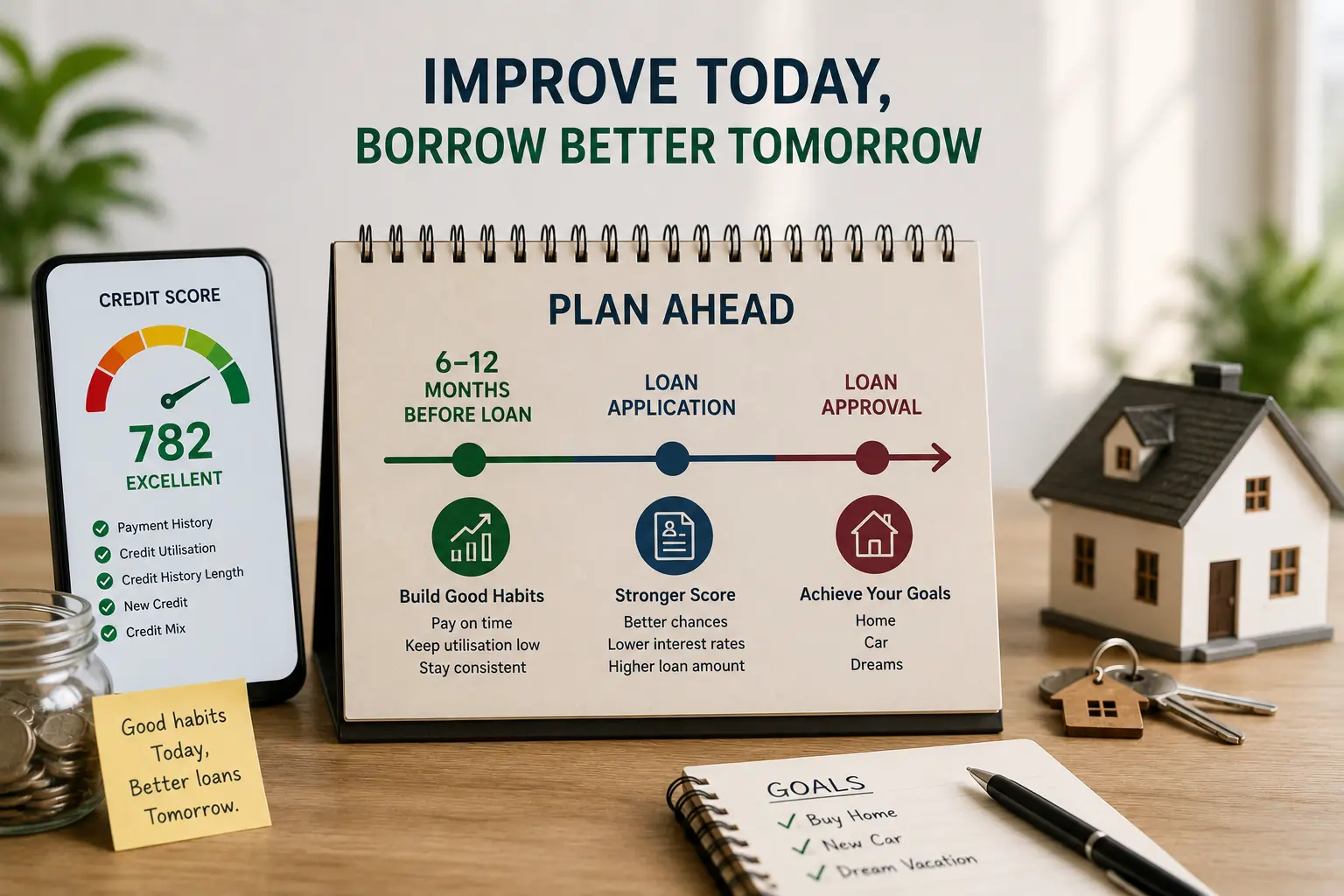
The best time to improve your credit score is before you need a loan, not when you are applying for one. Credit score improvement takes months. Starting six to twelve months before a planned major borrowing — a home purchase, a business loan, a car loan — allows time for the score to reflect the improved behaviour. Starting the week before an application produces no meaningful improvement.
Your Score Is a Live Document
A CIBIL score is not a judgment of your financial worth or a fixed attribute. It is a dynamic calculation based on current data from your credit accounts, recalculated monthly as new information arrives. Every month of on-time payments moves it in one direction. Every period of high utilisation, new enquiry, or missed payment moves it in another.
The people who manage their credit scores well are not doing anything complicated. They automate their minimum payments so nothing is ever missed. They keep their card balances well below their limits. They do not apply for credit products they do not need. They check their reports annually and dispute errors when they find them. They open new accounts deliberately and close old ones reluctantly.
These are not burdensome financial practices. They are mostly defaults that, once set up, require almost no ongoing attention. The score they produce over two to three years of consistent behaviour is the one that determines the interest rate on a home loan, the terms on a car loan, the credit card products you qualify for, and the financial options available in a genuine emergency. To see how your credit score fits within the complete picture of your financial health, the guide to how to calculate your net worth shows exactly where you stand across every asset and liability category. And if you want to build the full financial architecture — budgeting, saving, debt, and investing — the Personal Finance Basics course walks through all of it, free, no sign-up.