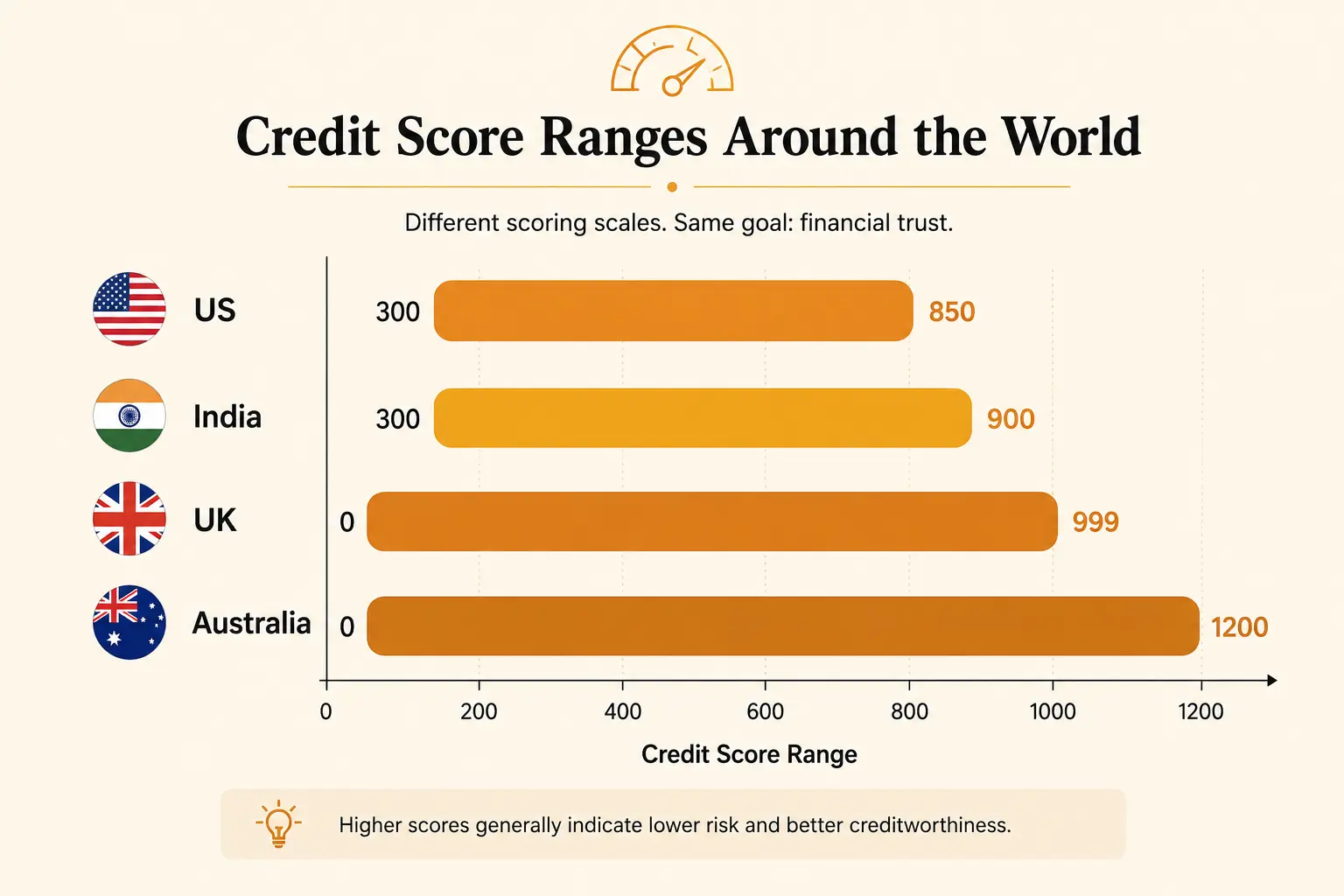
Most explanations of credit scores are written for one country and assume you already live there. If you've only ever seen "CIBIL score" content, or only ever seen "FICO score" content, it's easy to think credit scoring is a completely different system depending on where you are. It isn't. The scales differ — 300-850 in the US, 300-900 in India, three separate scales across three bureaus in the UK — but the underlying logic driving the number is remarkably consistent almost everywhere.
Understanding that underlying logic, rather than memorising country-specific rules of thumb, is what actually lets you manage a credit score well no matter where you live now or move to later.
The Five Factors That Determine Every Credit Score
FICO, the most widely used scoring model in the US and a strong influence on how other countries' bureaus built their own systems, breaks a score down into five weighted categories. The exact percentages shift slightly by model and country, but the five categories themselves show up almost universally.
Whether you've paid bills on time. The single largest factor everywhere — a track record of consistent, on-time payments matters more than any other single input.
How much of your available revolving credit you're currently using, relative to your limits. Lower is generally better, up to a point.
How long you've had credit accounts open, on average. This is why closing your oldest card can quietly hurt your score.
Recent applications and hard inquiries. A flurry of new applications in a short window reads as higher risk.
A mix of credit types — revolving credit like cards, installment loans like a car or education loan — can help marginally.
Payment history and amounts owed together account for roughly 65% of a typical score.[1] If you only ever optimise two things, those are the two — everything else has a real but smaller effect.
Same Logic, Different Scales: Credit Scores Around the World
Where credit scoring genuinely differs by country is the scale and the bureaus, not the underlying factors. This is one of the more common points of confusion for anyone who's moved countries or read scoring advice written for a market they don't live in.
| Country | Main bureau(s) | Score range | Roughly "good" |
|---|---|---|---|
| United States | Experian, Equifax, TransUnion (FICO/VantageScore models) | 300-850 | 670+ |
| India | CIBIL (TransUnion), Experian, Equifax, CRIF High Mark | 300-900 | 750+ |
| United Kingdom | Experian / Equifax / TransUnion (three separate scales) | 0-999 / 0-1000 / 0-710 | Varies by bureau |
| Australia | Equifax / Experian / illion | 0-1200 / 0-1000 / 0-1000 | Varies by bureau |
Notice that a UK Experian score of 881 and an Australian Equifax score of 735 can both represent a "very good" credit standing despite the raw numbers looking completely different.[2] There is no single global score, and — importantly — credit history generally does not transfer across borders when you move countries: arriving in a new country with an excellent score elsewhere usually means starting again from a thin or empty file locally. If you're building credit history in India specifically, the mechanics and score bands are covered in more depth in the CIBIL score guide.
Why Your Score Isn't One Number
Even within a single country, it's common to see a slightly different score depending on which app, bureau, or lender you check. This isn't a bug or a sign something is wrong — it's structural. Different bureaus don't necessarily receive data from every lender, different scoring models (FICO vs VantageScore, for instance) weight the same underlying data slightly differently, and the exact date a score is calculated affects which balances and payments are already reflected.
Credit Utilization: The Factor Most People Get Wrong
Utilization — the second-largest factor — is also the one with the most actionable, immediate leverage, because unlike payment history it doesn't take years to shift. Most guidance recommends staying under 30% of your available credit, with going under 10% providing a further, smaller benefit.[1] This applies both per card and across your total available credit.
The detail that catches people out: utilization is typically calculated from your statement balance on the date it's reported to the bureau, not your balance on the due date. Paying a card down substantially before the statement closes — rather than just before the payment due date — is what actually moves the utilization number that feeds into your score.
Hard vs Soft Inquiries: The Myth That Won't Die
One of the most persistent pieces of credit misinformation is that checking your own score damages it. It does not. Checking your own credit score or report is a "soft inquiry," and soft inquiries have zero effect on your score, no matter how frequently you check.[3] "Hard inquiries" — triggered when a lender checks your credit because you've formally applied for new credit — are the ones that can cause a small, temporary dip, typically a few points, and multiple hard inquiries in a short window compound that effect.
Practically, this means there's no reason to avoid regularly checking your own score. It's one of the simplest ways to catch reporting errors or signs of identity theft early, well before they'd otherwise surface.
How to Actually Build or Improve a Credit Score
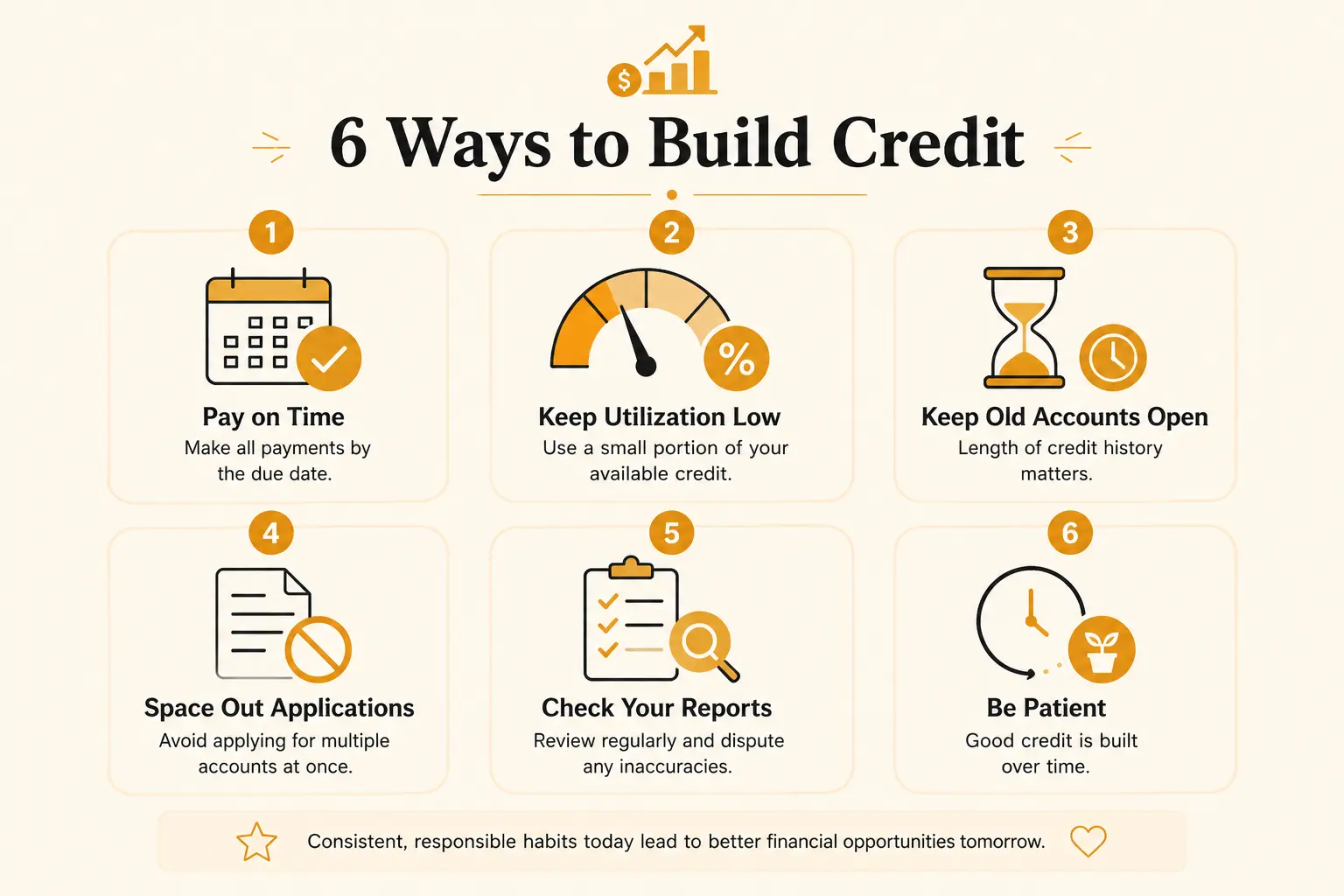
- Never miss a payment, even a small one. Payment history is the single largest factor everywhere. Automating minimum payments removes the single most common way scores get damaged — a forgotten due date, not a lack of money. A budgeting app can flag upcoming due dates before they're missed — see the best budgeting apps compared.
- Keep utilization under 30%, ideally under 10%. Pay down balances before the statement date, not just the due date, since that's the balance typically reported to the bureau.
- Keep old accounts open. Closing your oldest credit card shortens your average account age and can reduce total available credit, both of which can lower a score even if the account itself was rarely used.
- Space out new credit applications. Apply for new credit only when you actually need it, and avoid clustering several applications in a short window.
- Check your own report periodically. A soft inquiry, at no cost to your score, and the best way to catch errors or fraud before they compound.
- Give it time. Length of credit history is a real factor with no shortcut — the single most reliable long-term action is simply managing credit responsibly and letting the history accumulate.
A strong credit score is a supporting piece of a much broader financial picture — it doesn't substitute for tracking what you actually own versus owe. The free Net Worth Tracker is a useful companion for the bigger-picture view, and if debt is part of what's affecting your utilization, debt snowball vs debt avalanche covers the two main strategies for paying it down faster.
Common Credit Score Mistakes
- Closing old, unused credit cards. Feels like tidying up, but it can shorten your average account age and reduce total available credit — both working against you. Consider keeping a no-fee old card open and lightly active instead.
- Applying for several cards or loans in a short window. Each hard inquiry has a small individual effect, but several in a short period compound and signal higher risk to lenders reviewing your file.
- Co-signing without understanding the exposure. A co-signed loan appears on your credit report exactly like your own debt — the other person's missed payment affects your score, not just theirs.
- Chasing a "perfect" score unnecessarily. Most lenders treat scores above a certain threshold (often around 750-800 depending on the country and product) essentially the same. Beyond that point, more score rarely unlocks meaningfully better terms.
- Assuming a good score abroad transfers when you move. Credit history is generally tied to the country's bureaus, not to you globally — moving countries usually means starting a new file, regardless of your standing elsewhere.
Final Thoughts
Credit scores can feel like an opaque, country-specific black box, but the mechanism underneath is more universal than it looks. Payment history and utilization drive roughly two-thirds of the number almost everywhere, length of history and new credit make up most of the remainder, and the specific scale — 850, 900, or 999 — is a labelling detail, not a difference in how the system fundamentally works.
You don't need to memorise a different rulebook for every country's credit system. Pay on time, keep utilization low, leave old accounts open, and give it time — that combination builds a strong score under almost any scoring model, anywhere.
If you're building a complete financial foundation rather than optimising credit in isolation, the Money 101 course covers budgeting, debt, and credit together as one connected system, free.
This article is for general educational purposes and does not constitute financial advice. Credit scoring models, weightings, and regulations vary by country and change over time — always verify current details with your local credit bureau or a licensed financial advisor before making major credit decisions.
Sources
[1] FICO Score factor weighting (payment history ~35%, amounts owed ~30%, length of history ~15%, new credit ~10%, credit mix ~10%). Summary available at: fico.com
[2] Comparison of credit score ranges and "good" thresholds across UK and Australian bureaus. Summary available at: finmasters.com
[3] Soft inquiries (self-checks) vs hard inquiries (lender-initiated) and their effect on credit scores. Summary available at: myfico.com