
If you have more than one debt and any amount of extra money to put toward paying it off, you have to decide which debt gets that extra money first. That single decision has a name on either side of it: the debt snowball method, which pays off your smallest balance first, or the debt avalanche method, which pays off your highest interest rate first.
Personal finance content on this topic tends to pick a side and argue it hard — snowball advocates lean on motivation and momentum, avalanche advocates lean on the math. Both sides are correct about their own strength and usually quiet about the other method's real advantage. This article does the actual math with real numbers, cites the actual psychology research behind why the snowball method works for many people despite costing more, and gives you a straight answer on which to use.
A quick way to feel the urgency: by the Rule of 72, a balance at 24% APR roughly doubles in three years if it isn't paid down. If you want to run your own numbers as you read, the free Debt Payoff Planner calculates both methods for your actual debts and shows your exact payoff date and total interest under each.
What Each Method Actually Is
- List debts from smallest balance to largest, ignoring interest rate
- Pay the minimum on every debt
- Put all remaining extra money toward the smallest balance
- When it's paid off, roll that entire payment into the next-smallest balance
- Repeat until every debt is gone
- List debts from highest interest rate to lowest, ignoring balance
- Pay the minimum on every debt
- Put all remaining extra money toward the highest-rate debt
- When it's paid off, roll that entire payment into the next-highest rate
- Repeat until every debt is gone
Notice what's identical between them: your total monthly payment doesn't change. The minimums on every debt still get paid either way. The only thing that changes is the order in which your extra money attacks each balance — and that ordering decision is the entire debate.
Where These Methods Came From
The debt snowball method was popularized by financial personality Dave Ramsey, who built it into a central pillar of his personal finance teaching, explicitly prioritising psychological momentum over mathematical optimisation.[1] The debt avalanche method has no single credited inventor — it's simply the mathematically obvious strategy once you understand that interest is what makes debt expensive, so eliminating the most expensive debt first minimises the total interest paid over the life of the payoff plan.
The Math: A Real Worked Example
Here is an actual payoff simulation — not a rough estimate — for someone with four common debts, putting a fixed $700 a month total toward all of them combined.
| Debt | Balance | APR | Minimum payment |
|---|---|---|---|
| Medical bill | $900 | 0% | $30 |
| Store card | $2,200 | 27.99% | $60 |
| Credit card | $5,500 | 21.99% | $120 |
| Car loan | $11,000 | 6.5% | $220 |
Total starting debt: $19,600. Total monthly budget: $700 ($430 in minimums + $270 extra). Simulated month by month, with interest compounding monthly on each balance:
| Result | Snowball order (smallest balance first) | Avalanche order (highest APR first) |
|---|---|---|
| Payoff order | Medical bill → Store card → Credit card → Car loan | Store card → Credit card → Car loan → Medical bill |
| First debt eliminated | Month 3 (medical bill) | Month 8 (store card) |
| Total months to debt-free | 33 months | 33 months |
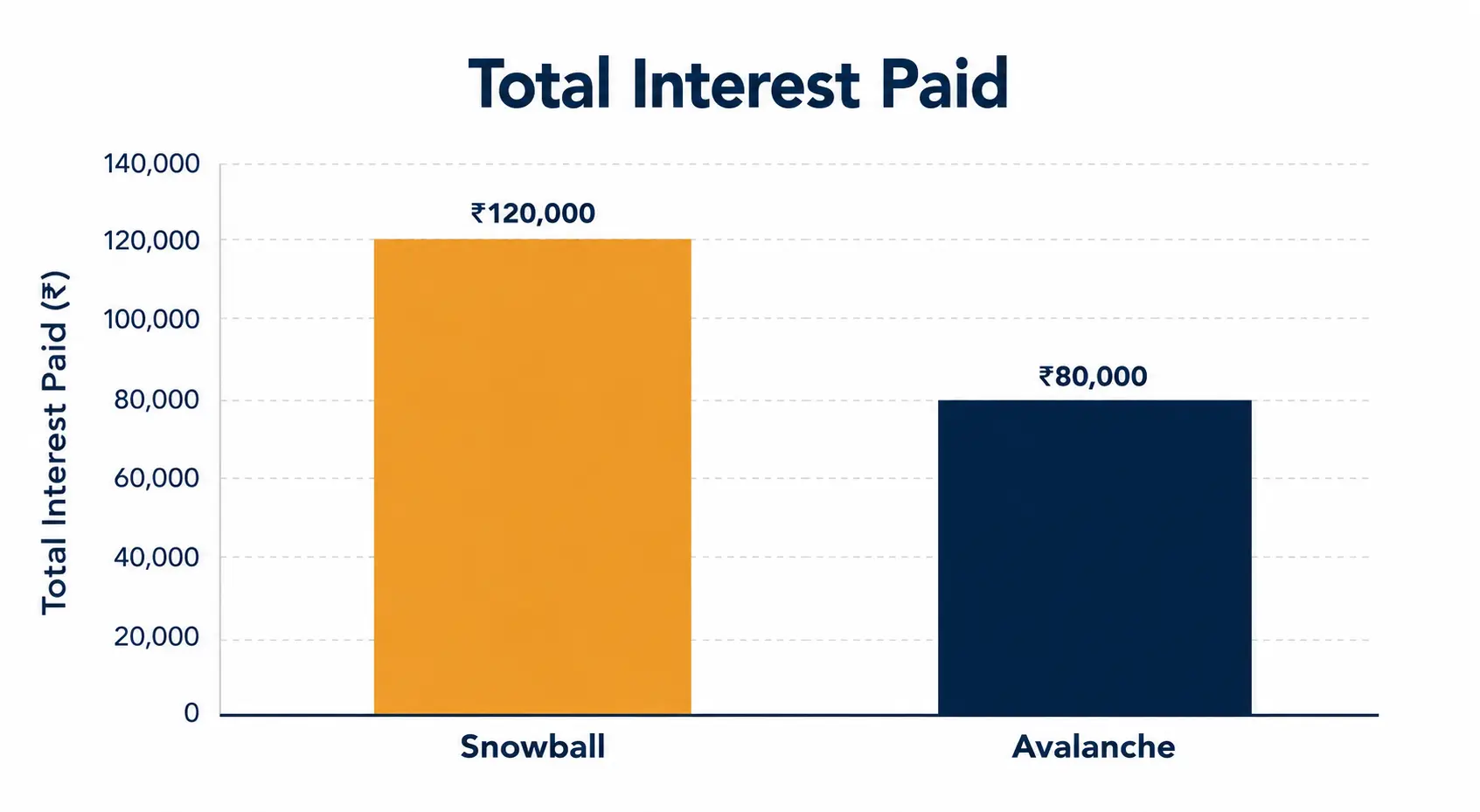
| Total interest paid | $3,312.87 | $3,001.86 |
| Interest saved by avalanche | $311.00 (about 9% less total interest) | |
Two things worth noticing in this specific, realistic example. First, both methods took exactly the same total time to become debt-free — 33 months — because the total payment amount never changed, only the order. Second, avalanche saved $311 in interest, but snowball delivered its first completed payoff five months sooner (month 3 versus month 8), because it happened to knock out a small interest-free medical bill immediately rather than saving it for last.
When the Interest Rate Spread Actually Matters More
The $311 saving above is realistic but modest — about 9% of total interest. That's typical when the interest rate spread across debts isn't extreme. The savings from avalanche get meaningfully larger when a small balance carries a very high rate and a large balance carries a comparatively low rate — a common real-world pattern with credit cards versus auto or student loans.
| Debt | Balance | APR | Minimum payment |
|---|---|---|---|
| Card X | $4,000 | 8% | $100 |
| Card Y | $9,000 | 26% | $200 |
Total debt: $13,000. Total monthly budget: $600. Because the smaller balance (Card X) also happens to carry the lower rate, and the larger balance (Card Y) carries the much higher rate, snowball and avalanche now disagree sharply on what to pay first:
| Result | Snowball (Card X first) | Avalanche (Card Y first) |
|---|---|---|
| Total months to debt-free | 29 months | 27 months |
| Total interest paid | $4,146.31 | $3,049.27 |
| Interest saved by avalanche | $1,097.04 (about 26% less total interest, 2 months faster) | |
The Psychology Research: Why Small Wins Predict Success
The strongest argument for the snowball method isn't about interest rates — it's about the data on who actually finishes paying off their debt. A 2012 study published in the Journal of Marketing Research analysed data from roughly 6,000 people going through a debt settlement program and found that the single strongest predictor of whether someone successfully eliminated all their debt was not the dollar amount paid, the interest rate, or household income — it was the proportion of individual debt accounts closed relative to how many they started with.[2]
In other words, closing accounts — regardless of their dollar size — was what kept people going. The researchers' interpretation directly supports the logic behind the snowball method: completing a discrete, visible subtask (fully closing one account) appears to sustain motivation toward a larger, multi-year goal in a way that pure progress toward the total dollar amount owed does not.

This is a genuinely useful, non-obvious finding: it means the "irrational" snowball method has real behavioural evidence behind it, not just marketing. It also means the honest answer to "which method is better" depends on which failure mode you're more at risk of — running out of money (avalanche minimises this) or running out of motivation (snowball minimises this).
The Head-to-Head Summary
| Dimension | Debt Snowball | Debt Avalanche | Winner |
|---|---|---|---|
| Total interest paid | Always equal to or more than avalanche | Always equal to or less than snowball | Avalanche |
| Time to first debt eliminated | Fastest possible, by design | Can take much longer if highest-rate debt has a large balance | Snowball |
| Total time to debt-free | Usually similar to avalanche; can be identical | Usually similar to snowball; occasionally faster | Roughly tied |
| Motivation / adherence (per research) | Strongly supported by account-closure research | No comparable behavioural evidence of an adherence advantage | Snowball |
| Simplicity to understand | Very simple — smallest number first | Requires comparing interest rates, slightly less intuitive | Snowball |
| Best when rates are similar across debts | Effectively no cost to choosing this | Marginal savings not worth the complexity | Either works |
| Best when rates vary widely | Can cost hundreds or thousands more in interest | Meaningfully cheaper and often faster | Avalanche |
Which Method Should You Actually Use?
The honest, unglamorous answer: use whichever one you will actually stick with for the full payoff period, because a payoff plan abandoned in month six saves zero interest regardless of which method it used. With that as the overriding rule, here's a more specific framework.
- If your interest rates are all fairly close together (within a few percentage points): Use snowball. The interest savings from avalanche will be small, and the motivational benefit of quick wins costs you almost nothing.
- If one or two debts carry dramatically higher rates than the rest (think 25%+ credit cards next to a 6% auto loan): Use avalanche, or at minimum, pay off the highest-rate debt first even if you snowball the rest — you're leaving real money on the table otherwise.
- If you've tried a payoff plan before and abandoned it: Lean snowball. The account-closure research suggests you specifically benefit from an early, visible win more than the average person.
- If you're disciplined with money and unlikely to quit regardless of pace: Lean avalanche. You're the profile the mathematically optimal method was designed for.
- A hybrid that works for many people: Knock out one very small debt first for an early win, then switch to strict avalanche order for everything remaining.
Whichever method you choose, the far bigger lever is the size of your extra monthly payment, not the order. In the four-debt example above, an extra $100 a month beyond the $700 budget would cut the payoff time from 33 months to roughly 26 — a bigger effect than switching methods entirely. Before committing extra dollars to debt, make sure you have a starter emergency fund in place, so an unexpected expense doesn't force you back onto the cards you're trying to pay off.
Common Mistakes in the Debt Payoff Decision
How to Get Started This Week
- List every debt — balance, interest rate, and minimum payment — in one place. The Debt Payoff Planner does this for you and calculates both orders automatically.
- Add up your true minimum monthly payment across every debt combined.
- Decide your total realistic monthly debt budget — minimums plus whatever extra you can commit to consistently, not just this month but for the length of the plan. A budgeting app that shows exactly what's left after fixed expenses makes this number honest instead of guessed — see the best budgeting apps compared.
- Pick your method using the framework above, and write down the payoff order so there's no ambiguity next month.
- Automate the minimums so a missed payment never happens by accident, then manually direct the extra amount to your priority debt each month. This matters beyond the debt itself — payment history is the single largest factor in how your credit score is calculated, so protecting it while you pay down debt keeps both goals moving together.
The Answer That Actually Matters
Debt avalanche will always save you the same amount of interest or more than debt snowball — that part isn't debatable, it's arithmetic. What the research adds is that "will save more money on paper" and "will actually get paid off" are not the same question, and for a meaningful number of people, the method that keeps them going beats the method that's technically cheaper.
The best debt payoff method is the one you're still following in month eighteen. If that's avalanche, use avalanche. If a small early win is what keeps you from giving up, the interest cost of snowball is a fair price for a plan you actually finish.
To see your exact numbers under both methods — payoff date, total interest, and month-by-month order — run your own debts through the Debt Payoff Planner. And if you're building the debt payoff plan into a broader financial system — emergency fund, insurance, then investing — the Personal Finance Basics course covers the full sequence in seven free lessons.
Once minimums are automated and extra payments are flowing to your priority debt, any remaining cash buffer shouldn't just sit idle — high-yield savings accounts explained covers where that money earns the most while staying fully accessible.
Sources
[1] Ramsey Solutions. "Debt Avalanche vs. Debt Snowball: What's the Difference?" Available at: ramseysolutions.com
[2] Gal, D., & McShane, B. (2012). Can Small Victories Help Win the War? Evidence from Consumer Debt Management. Journal of Marketing Research, 49(4), 487–501. See summary at: Kellogg School of Management