
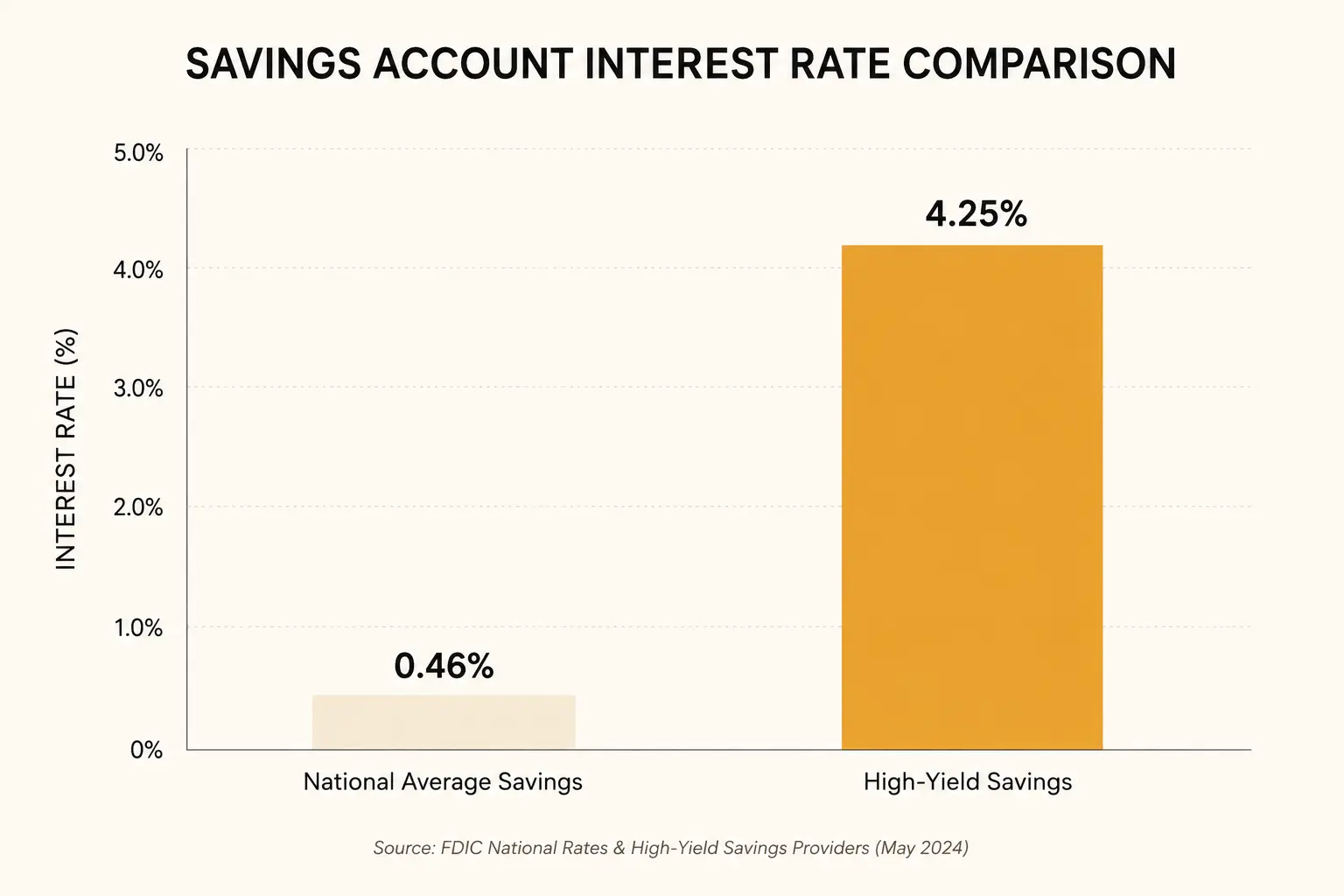
- The national average savings account yield is roughly 0.6% APY as of mid-2026, while top high-yield savings accounts pay around 4-4.2% APY.
- Online banks pay more mainly because they skip the cost of physical branches and pass the savings on as higher rates.
- In the US, deposits are protected up to $250,000 per depositor, per insured bank, regardless of the interest rate offered.
- On a $10,000 balance, the gap between average and high-yield rates is several hundred dollars a year.
- HYSA rates are variable and move with the broader rate environment — unlike a fixed deposit or CD, the rate you open with isn't locked in.
A high-yield savings account is worth switching to for most people holding more than a small buffer in a low-yield account, because the interest gap between a national-average savings account and a top high-yield account is now several times larger than it was a decade ago, for functionally the same product. The switch itself typically takes under 30 minutes online and doesn't require closing your existing checking account.
The honest caveats: the rate is variable, not fixed, and the difference matters less on small balances. This piece breaks down what a HYSA actually is, why it pays more, whether the money is safe, and the real math on whether switching is worth the effort for your specific balance.
What a High-Yield Savings Account Actually Is
A high-yield savings account is a standard, insured savings account that pays a significantly higher interest rate than a traditional bank's savings account — usually because it's offered by an online-only or digital-first bank rather than a branch-based one. It is not a different product category, an investment account, or a higher-risk vehicle. It holds cash, it's liquid, and — when properly insured — it carries no more risk than a savings account at any traditional bank.
As of mid-2026, the national average savings account yield sits around 0.6% APY, while top high-yield accounts pay in the 4% to 4.2% APY range — roughly six to ten times the average, depending on the specific accounts being compared.[1]
| Account type | Typical APY (mid-2026) | What it means on $10,000 |
|---|---|---|
| Traditional bank savings account | ~0.4-0.6% | ~$40-60/year |
| High-yield savings account | ~4.0-4.2% | ~$400-420/year |
Why High-Yield Accounts Pay More
Online banks pay higher rates mainly because they don't operate physical branches, which removes a major fixed cost that traditional banks pass on in the form of lower savings rates. No branch leases, no in-branch staff, no physical maintenance — those savings get passed to depositors as higher APY rather than absorbed as additional profit.[2]
Competitive pressure plays a role too: newer digital banks generally need to offer a meaningfully better rate to pull customers away from institutions with more brand recognition, while large, established banks have comparatively little incentive to raise savings rates when their customer base isn't actively rate-shopping.
Is Your Money Actually Safe?
Yes, as long as the bank is properly insured — the interest rate has no bearing on how safe a deposit is. In the US, FDIC insurance covers deposits up to $250,000 per depositor, per insured bank, per ownership category, which is exactly the same protection a deposit at a traditional brick-and-mortar bank carries.[3]
The Actual Math: Is Switching Worth It?
For most balances above a small buffer, the dollar gain from switching clearly outweighs the roughly 20-30 minutes it takes to open an account online — the exceptions are very small balances and money that genuinely needs regular in-branch access.
| Balance | Traditional account (~0.5% APY) | High-yield account (~4.1% APY) | Annual difference |
|---|---|---|---|
| $1,000 | $5 | $41 | +$36 |
| $5,000 | $25 | $205 | +$180 |
| $10,000 | $50 | $410 | +$360 |
| $25,000 | $125 | $1,025 | +$900 |
This is simple interest for illustration — actual compounding (typically daily or monthly in a HYSA) pushes the real numbers slightly higher still. For the full mechanics of how that compounding effect builds over longer periods, see how compound interest actually works.
The Catch: HYSA Rates Move
Unlike a fixed deposit or CD, a high-yield savings account's rate is variable and can change at any time, typically tracking the broader interest rate environment set by central bank policy. A rate that looks excellent today can decline within months if rates fall generally — this applies across the entire high-yield category, not to any one bank specifically, and isn't a sign that a particular account was a bad choice.[4]
The practical implication: check your rate periodically rather than assuming it's fixed, and don't be surprised if it drifts over time. Even a HYSA at a reduced rate still typically outperforms a traditional savings account by a wide margin.
How to Actually Switch
- Confirm insurance coverage first. Check the bank is FDIC-insured (or the equivalent in your country) through an official register before applying.
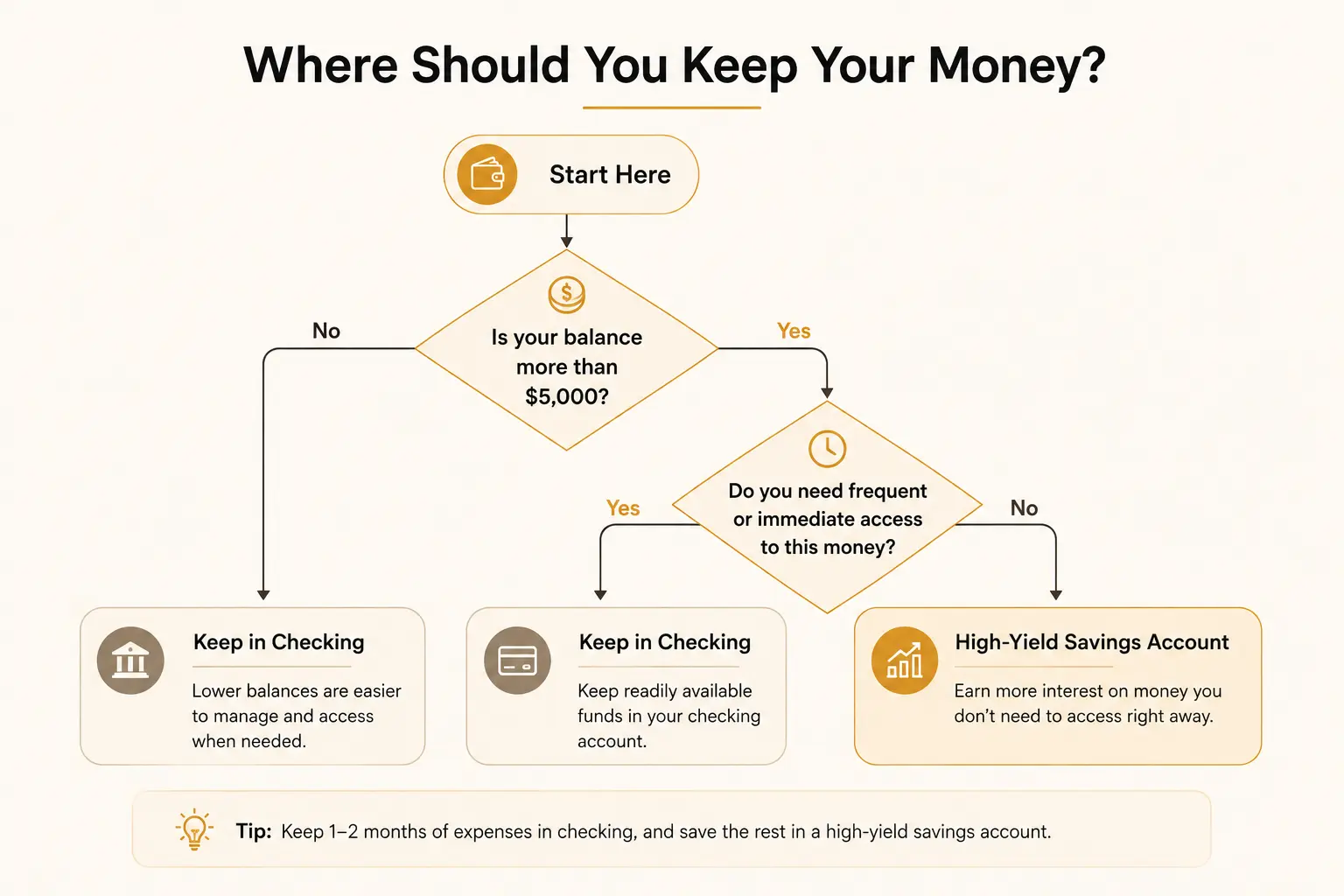
- Open the new account before closing anything. Most online applications take 10-15 minutes and don't require closing your existing checking account.
- Transfer an initial amount, then set up a recurring transfer. Move a starting balance, then automate ongoing transfers so the account keeps growing without manual effort.
- Keep your checking account for daily spending. A HYSA is for money you're not spending imminently — pairing it with the Savings Goal Tracker makes it easy to see progress toward a specific target.
- Revisit the rate every few months. Since rates are variable, a quick periodic check ensures you're not sitting on a rate that's fallen well behind the market.
Common Mistakes
- Chasing the single highest advertised rate. The top rate today may drop soon; a solid, well-reviewed bank with a competitive (not necessarily #1) rate is often a better long-term choice than rate-hopping constantly.
- Not checking insurance coverage. Skipping this step on a newer or less familiar online bank is the one mistake that actually introduces real risk.
- Treating a HYSA like an investment account. It's still a cash-holding vehicle for stability and liquidity, not a substitute for long-term investing.
- Forgetting the rate is variable. Opening an account and never checking the rate again means potentially missing a significant drop relative to the rest of the market.
- Ignoring minimum balance or withdrawal limits. Some accounts reduce the advertised rate or add fees below a minimum balance — read the terms before assuming the headline APY always applies.
Final Thoughts
A high-yield savings account is one of the rare personal finance decisions where the effort-to-reward ratio is genuinely lopsided: a one-time setup of well under an hour, against a recurring, meaningful gain on money that would otherwise sit earning next to nothing. The caveats are real but manageable — confirm insurance, expect the rate to move over time, and don't treat it as a substitute for investing. For most people holding any meaningful cash buffer, the extra interest is worth switching for.
The best time to move idle cash into a higher-yield account was years ago. The second-best time is the next time you check your savings balance.
If you're building or maintaining a cash reserve specifically for emergencies, the emergency fund guide covers how much to hold and how to size it — a high-yield account is one of the most appropriate places to keep that money once you know your target.
Sources
[1] Bankrate. Average Savings Account Interest Rate, July 2026. Available at: bankrate.com
[2] Why online banks offer higher savings rates — overhead cost comparison. Available at: experian.com
[3] FDIC deposit insurance coverage limits. Available at: cnbc.com
[4] 2026 interest rate environment and high-yield savings rate trends. Available at: kiplinger.com