
Somewhere between "quit your job at 35" internet bravado and "pure fantasy for people who don't understand rent" cynicism sits FIRE — a genuinely well-defined financial strategy with real math behind it, real historical evidence, and real, well-documented limitations. Most online discussion of it lands on one of the two extremes. This article tries to land on the actual number.
What FIRE Actually Means
FIRE stands for Financial Independence, Retire Early. It describes a strategy of saving and investing an unusually large share of income — often 40% to 70%, well above the 10-20% typical financial advice — to accumulate enough invested wealth that continuing to work becomes optional, usually decades before a traditional retirement age.
The "retire early" part gets most of the attention, but "financial independence" is the more precise and arguably more useful framing. The actual milestone isn't quitting your job on a specific date — it's reaching a portfolio size where your investments could cover your living expenses indefinitely, whether or not you choose to keep working. Many people who reach FIRE keep working in some form; what changes is that the work becomes optional rather than financially mandatory.
Where FIRE Actually Came From
The movement traces back to Your Money or Your Life, a 1992 book by Vicki Robin and Joe Dominguez that asked readers to calculate their real hourly wage — factoring in commute time, work clothes, decompression time — and then evaluate every purchase against how many real hours of life it cost.[1] The specific "4% rule" math that FIRE calculations rely on today comes from a separate source: a 1998 research paper from three Trinity University finance professors, now known as the Trinity Study.[2]
The 4% Rule and the 25x Rule
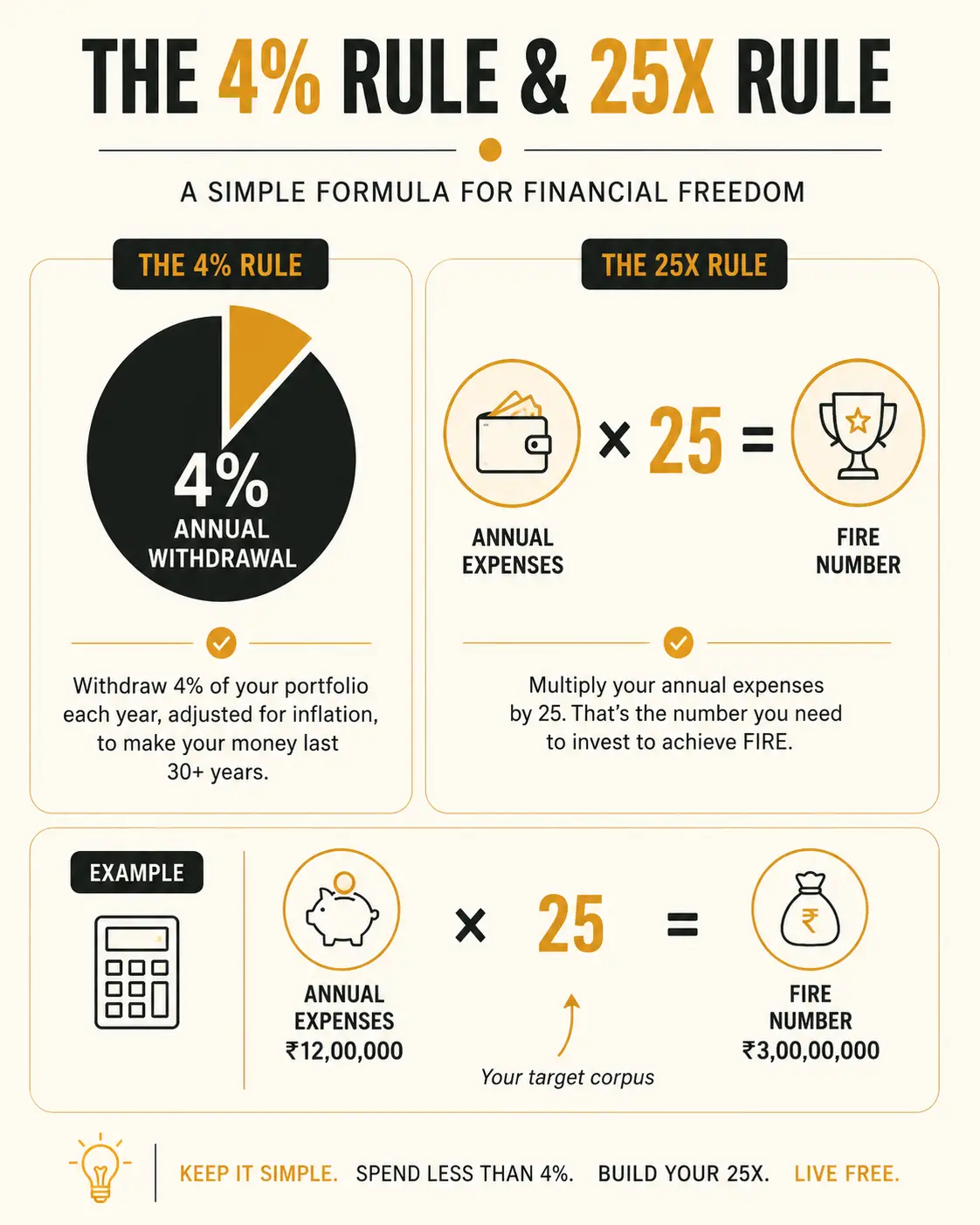
The 4% rule and the 25x rule are the same idea stated two different ways, and together they're what most FIRE calculations reduce to:
The appeal of the 25x rule is that it converts an abstract, intimidating goal ("save for retirement") into a single concrete number you can actually calculate today. It's also, importantly, a simplification — the original Trinity Study modelled a traditional 30-year retirement, not the 50-plus year horizon someone retiring at 35 might need. FIRE-specific research since then has generally suggested a more conservative withdrawal rate, often 3% to 3.5%, for very long retirement horizons — meaning a bigger multiple than 25x, often closer to 28-33x expenses, for anyone planning to be retired for multiple decades.
The Four Main FIRE Variants
"FIRE" isn't one single target — it's a spectrum, and most of the online disagreement about whether FIRE is "realistic" is actually two people picturing different variants without realising it.
| Variant | What it means | Typical target |
|---|---|---|
| Lean FIRE | Financial independence on a minimal, tightly budgeted lifestyle | Often under $1,000,000, expenses under $40,000/year |
| Fat FIRE | Financial independence while maintaining a comfortable or upscale lifestyle | Often $2,500,000+, expenses $100,000+/year |
| Barista FIRE | Enough invested to cover most expenses; work a lower-stress, often part-time job for the rest plus benefits | Partial portfolio + part-time income (named for baristas who work part-time partly for health insurance) |
| Coast FIRE | Saved enough that compound growth alone reaches full FIRE by traditional retirement age with no further contributions | Varies by age; work only enough to cover current expenses |
Coast FIRE and Barista FIRE are, in practice, far more achievable for most people than the "quit entirely in your 30s" version that gets the most social media attention — and they still provide real, meaningful financial flexibility well short of full independence.
The Math: Savings Rate Determines Everything
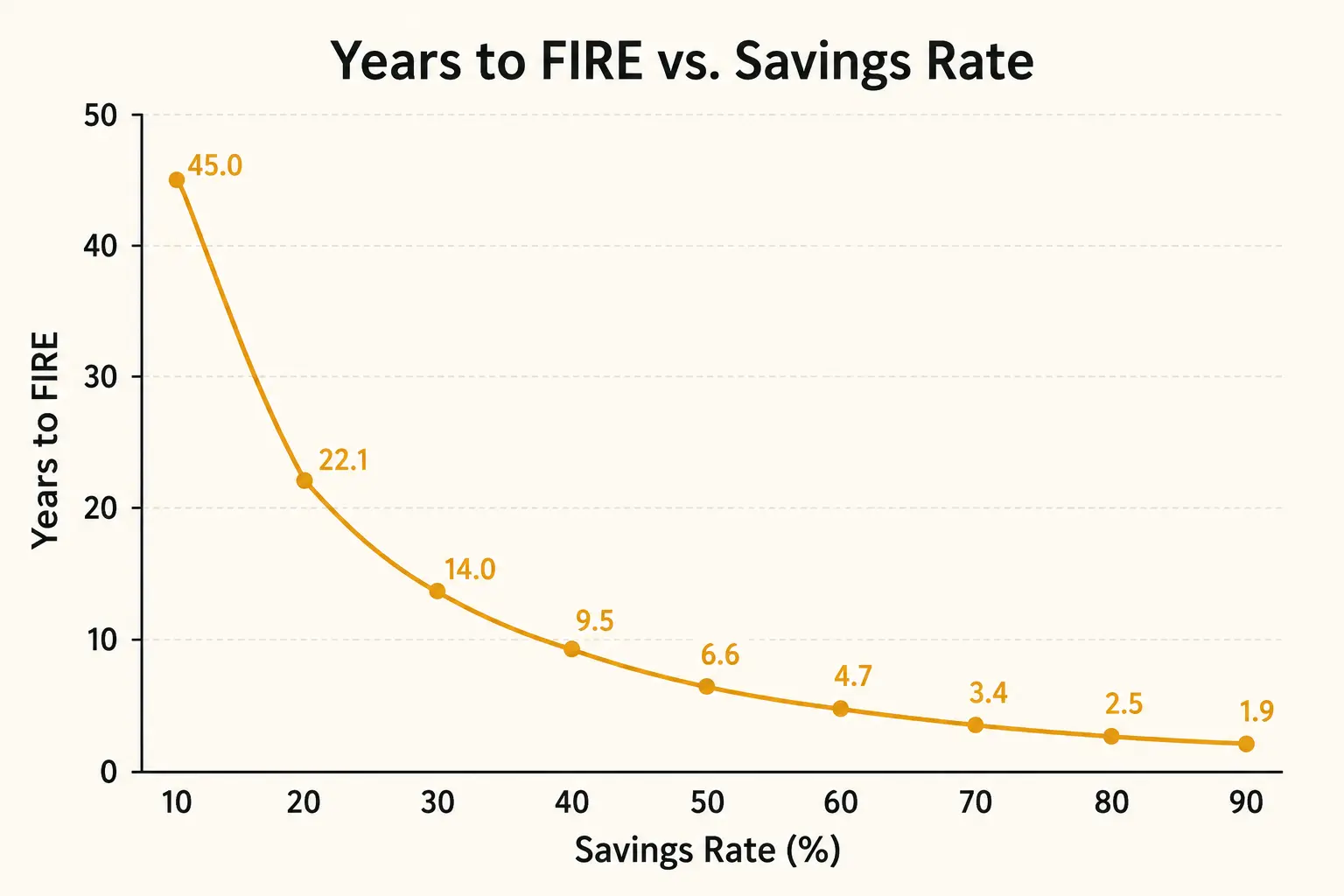
The single biggest lever in any FIRE plan isn't investment returns or picking the right fund — it's savings rate, because it does double duty: a higher savings rate both grows your portfolio faster and shrinks the expenses that portfolio needs to cover. The relationship is dramatically non-linear, assuming a 5% real (inflation-adjusted) investment return and a 4% withdrawal rate in retirement:
| Savings rate | Approx. years to FIRE |
|---|---|
| 10% | ~51 years |
| 20% | ~37 years |
| 30% | ~28 years |
| 40% | ~22 years |
| 50% | ~17 years |
| 60% | ~12 years |
| 70% | ~9 years |
This is also why age-based savings benchmarks tend to compress a lot of nuance into one number — see how much you should actually have saved by 30, 40, and 50 for the standard reference points a FIRE plan is usually accelerating past.
Doubling your savings rate from 20% to 40% doesn't cut your working years in half — it cuts them by nearly two-thirds, from roughly 37 years to 22. This is the actual mechanism behind FIRE's more dramatic-sounding claims: it isn't a secret high-return investment strategy, it's the compounding effect of a much higher savings rate applied consistently over years. Someone earning an ordinary salary at a 40% savings rate reaches FIRE faster than someone earning triple that salary at a 10% savings rate. The other lever, less discussed but genuinely complementary, is growing income itself — negotiating your salary raises the ceiling on how much you can save without touching your spending at all.
Myth-Check: Is FIRE Actually Realistic?
This is the question most FIRE content either dodges or answers with unearned certainty in one direction. The honest answer is: it depends heavily on income, expenses, and which variant you're talking about.
- High or dual-income households with moderate expenses
- People able to sustain a 40%+ savings rate for a decade or more
- Coast FIRE and Barista FIRE targets specifically
- People with low, stable housing costs relative to income
- Anyone treating it as a flexible direction, not a rigid deadline
- Average earners with high, rising housing costs
- People carrying significant debt or supporting dependents
- Full "quit by 35" Lean/Fat FIRE on a typical income
- Anyone assuming the 4% rule guarantees success over 50+ years
- People without access to healthcare independent of employment
A widely cited critique is that FIRE's original assumptions haven't kept pace with reality in many markets: housing costs in many cities have risen well beyond the growth in wages since the framework became popular, and the classic 50-75% savings-rate examples assume a level of expense control that's genuinely difficult once significant debt, dependents, or high cost-of-living housing enter the picture.[3] Survivorship bias also plays a role in how FIRE gets discussed online — the people who reach Lean or Fat FIRE and write about it are, by definition, the successes; the much larger group who tried an aggressive savings rate, hit a wall, and quietly adjusted their plan are far less visible in the conversation.
The Real Risks a Plan Needs to Account For
- Sequence of returns risk. A market downturn in the first few years after you stop earning forces you to sell investments at depressed prices to cover expenses, which can permanently damage a portfolio's ability to recover — even if long-term average returns end up fine. This risk is proportionally larger for someone retiring at 35 with a 50-plus year horizon than for a traditional 65-year-old retiree with a 25-30 year one, simply because there's more time for one bad early sequence to compound.
- Healthcare costs. In countries without universal healthcare, losing employer-provided coverage decades before government retirement healthcare eligibility is one of the most commonly underestimated costs in early FIRE plans.
- Underestimated or changing expenses. Major unplanned costs — home repairs, family emergencies, inflation running hotter than modelled — are the most common reason a theoretically sound FIRE number turns out to be too low in practice.
- Lifestyle creep during the accumulation years. A savings rate that looked achievable on paper often erodes gradually as income rises and spending rises to match it, unless tracked deliberately.
Getting Started, Without Overcommitting to a Deadline
- Calculate your actual FIRE number. Take your realistic annual expenses and multiply by 25 (or 28-33 for a longer, more conservative horizon). This alone turns an abstract goal into something trackable.
- Track your net worth, not just your savings rate. The free Net Worth Tracker shows your progress toward that number over time — the single most motivating number in a long-term plan is watching it move, even slowly.
- Increase savings rate before chasing higher returns. As the table above shows, savings rate has a far larger effect on your timeline than a marginally higher investment return — get the big lever right first. A budgeting app that shows exactly where the gap between income and spending is coming from makes this easier than guessing — see the best budgeting apps compared.
- Understand the mechanism that makes it work at all. FIRE math relies entirely on compound interest doing the heavy lifting over years — the earlier and more consistently you invest, the less total saving you need to reach the same number.
- Build the emergency fund and eliminate high-interest debt first. An aggressive FIRE plan on top of high-interest debt is working against itself — the debt's interest cost typically outpaces likely investment returns.
- Don't let short-term savings sit idle while you plan. Cash you're not investing yet should still be earning a decent rate — see high-yield savings accounts explained for where that money should actually sit.
- Treat it as a direction, not a rigid deadline. The people who sustain an aggressive savings rate for years tend to be the ones who built a plan flexible enough to survive a bad year, not the ones who treated a specific date as non-negotiable.
Common FIRE Mistakes
- Copying a Lean FIRE budget without a Lean FIRE lifestyle tolerance. A tight budget that works for someone who genuinely prefers minimalism becomes miserable and unsustainable for someone who doesn't — sustainability matters more than speed.
- Ignoring healthcare and insurance in the number. A FIRE number calculated purely from current living expenses, without pricing in independent health coverage, is systematically too low in countries without universal healthcare.
- Treating the 4% rule as a guarantee rather than a historical probability. It's a strong guideline built on real data, not a mathematical certainty — building in some flexibility (working part-time in a bad market year, for instance) meaningfully improves the odds.
- Optimising the FIRE number while ignoring the plan for actual retirement. Reaching a number is not the same as having a plan for what fills 40+ years of time and purpose — a detail people who've actually retired early consistently flag as underestimated beforehand.
Final Thoughts
FIRE is neither the guaranteed path to freedom its most enthusiastic advocates present nor the fantasy its critics dismiss it as. It's a well-defined, historically grounded strategy — save aggressively, invest consistently, let compounding do most of the work — that produces genuinely different outcomes depending on income, expenses, and how rigidly someone applies it.
The honest version of FIRE isn't "quit your job in your 30s." It's "know your real number, and let a higher savings rate buy you options you didn't have before" — for some people that means full early retirement, for many others it means Coast FIRE, a career change with less financial pressure, or simply more flexibility than they'd have otherwise had.
If you're working out where your own number fits into a broader plan, the Money 101 course covers the foundational pieces — budgeting, saving, investing basics — that any FIRE plan is built on top of. For the specific math of how your investments actually grow toward that number, how compound interest actually works and the one-page financial plan are the natural next reads.
This article is for general educational purposes and does not constitute personalised financial advice. Investment returns are not guaranteed, and historical performance does not predict future results. Consult a qualified financial advisor before making significant changes to your savings or investment strategy.
Sources
[1] Robin, V. & Dominguez, J. Your Money or Your Life (1992) — the book widely credited with originating the philosophy underlying the FIRE movement.
[2] Cooley, Hubbard & Walz. The "Trinity Study" (1998), analysing historical U.S. portfolio withdrawal rate success over 1926-1995. Summary and modern reapplications available at: thepoorswiss.com
[3] Discussion of modern critiques of FIRE assumptions — rising housing costs relative to wages and savings-rate feasibility. Summary available at: ccfcu.org