
Ask most people how long it takes for an investment to double and you'll get a shrug, or someone reaching for a spreadsheet. There's a faster way that fits in your head: the Rule of 72. It's one of the oldest shortcuts in finance, and it turns the slightly abstract idea of compound interest into something you can picture — a number of years.
This guide covers the rule itself, worked examples in four situations (investing, inflation, fees and debt), how accurate it actually is, and the two small tweaks that make it work at almost any rate.
What Is the Rule of 72?
Use the rate as a whole number — 8, not 0.08. The rule also works backwards: divide 72 by the number of years you have, and you get the annual return you'd need to double your money in that time.[1] Want to double in 10 years? You need roughly 72 ÷ 10 = 7.2% a year.
That's the whole rule. What makes it useful is that it applies to anything that compounds — investment growth, savings interest, inflation, investment fees, and debt.
Worked Examples: Four Ways to Use It
1. Investing: how fast could my money grow?
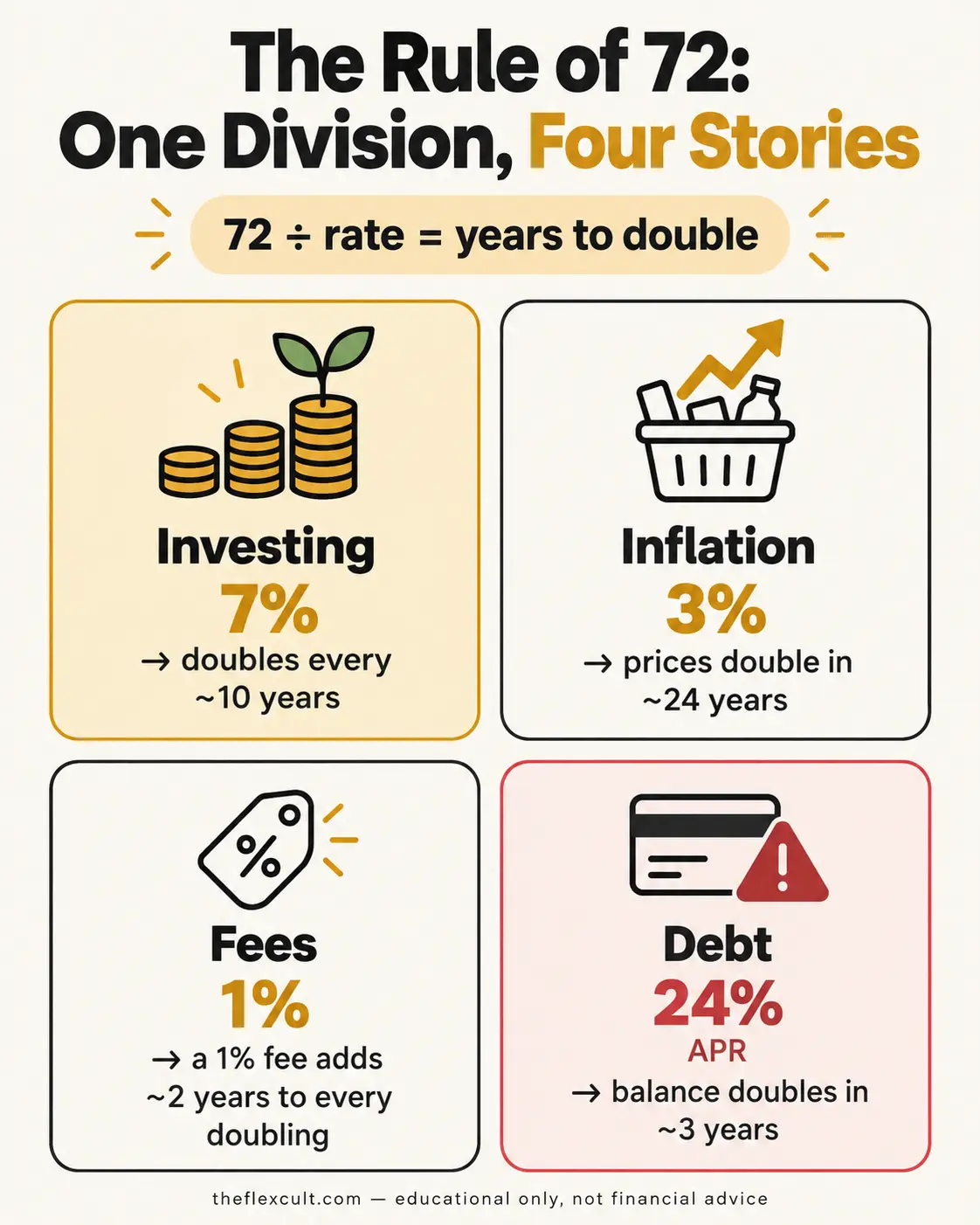
Say you invest $10,000 in a diversified fund and assume a 7% average annual return (an assumption, not a promise — real returns vary year to year). 72 ÷ 7 ≈ 10.3 years per doubling. So:
- After ~10 years: about $20,000
- After ~20 years: about $40,000
- After ~30 years: about $80,000
The exact calculation gives $38,697 after 20 years and $76,123 after 30 — the rule lands within a few per cent with no calculator. Notice the shape: the last decade adds more than the first two combined. That's why time matters more than the amount you start with.
2. Inflation: how fast does cash lose value?
Run the same division on the inflation rate and you get the number of years until prices double — which is the same as your cash losing half its buying power. At 3% inflation, that's about 24 years. At 6%, about 12. Money sitting in a current account at 0% interest is quietly being halved on that schedule. This is the core argument in Why Invest at All — Inflation, Compounding & the Cost of Waiting.
3. Fees: what does 1% really cost?
Fees compound too — they reduce your growth rate every year. Compare a 7% return with the same return minus a 1% annual fee:
| Net return | Rule of 72 doubling time | $10,000 after 36 years |
|---|---|---|
| 7% (low-cost fund) | ~10.3 years | ≈ $114,000 |
| 6% (same fund, 1% fee) | 12 years | ≈ $81,500 |
One percentage point stretches each doubling by almost two years, and over 36 years it costs almost 30% of the final balance. That's the arithmetic behind why fees matter so much in the index funds vs active funds debate.
4. Debt: how fast does a balance grow against you?
The rule doesn't care which side of the transaction you're on. A credit card balance at 24% APR with no payments doubles in roughly 72 ÷ 24 = 3 years. A $2,000 balance becomes $4,000, then $8,000, on that schedule. Compare that with the ~10-year doubling of a typical investment and the priority becomes obvious: high-interest debt usually gets paid off first. The debt snowball vs avalanche guide covers how to do that.
How Accurate Is the Rule of 72?
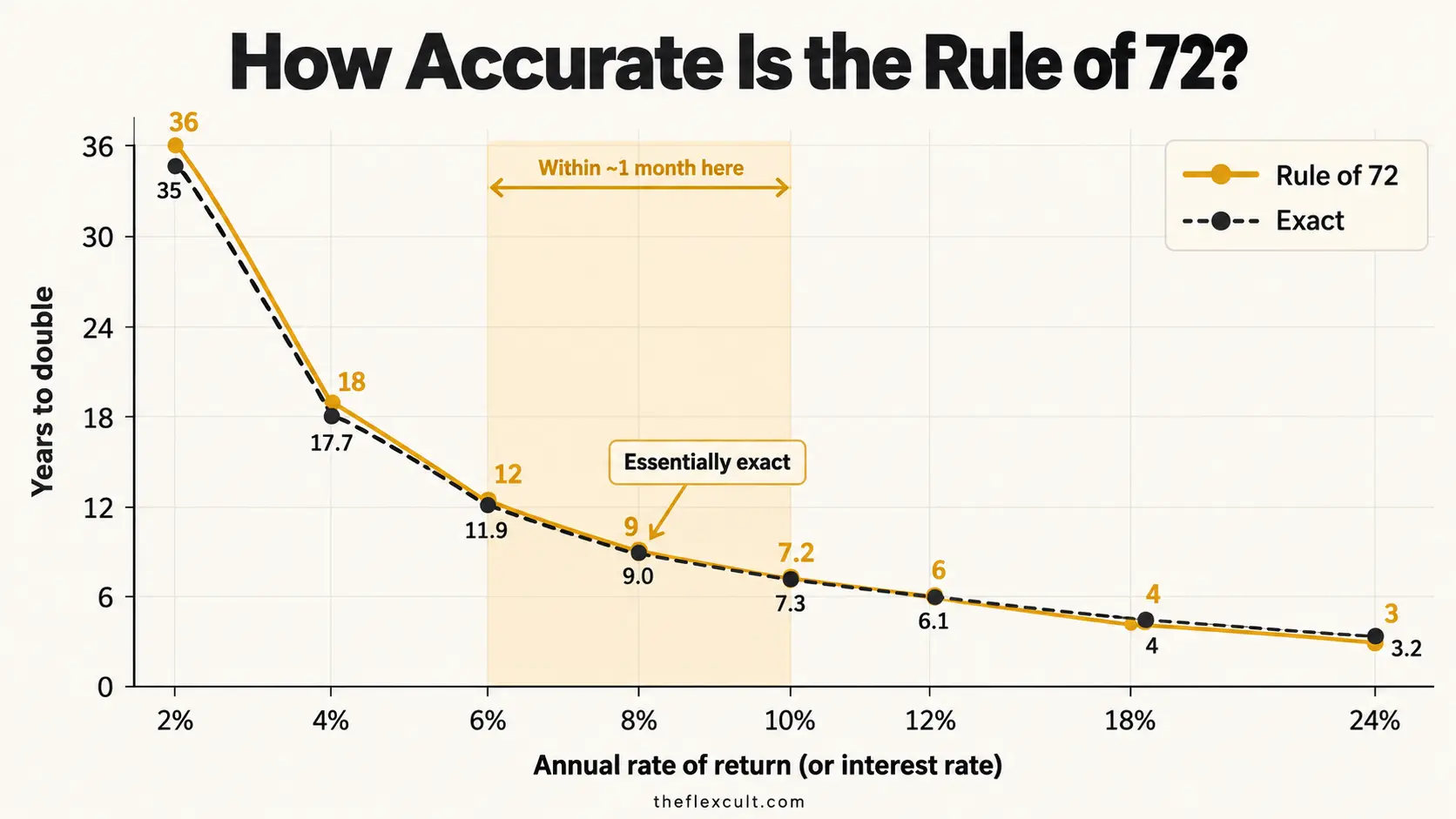
More accurate than most people expect. The table below compares the rule against the exact doubling time for annual compounding (calculated as ln 2 ÷ ln(1 + rate)):
| Annual rate | Rule of 72 | Exact (years) | Difference |
|---|---|---|---|
| 2% | 36.0 | 35.0 | +1 year |
| 4% | 18.0 | 17.7 | +4 months |
| 6% | 12.0 | 11.9 | +1 month |
| 8% | 9.0 | 9.0 | ≈ exact |
| 10% | 7.2 | 7.3 | −1 month |
| 12% | 6.0 | 6.1 | −1.5 months |
| 18% | 4.0 | 4.2 | −2 months |
| 24% | 3.0 | 3.2 | −3 months |
It's essentially exact at 8%, within about a month from 6% to 10%, and drifts at the extremes — slightly too long at low rates, slightly too short at high ones. For everyday decisions, that error is far smaller than the uncertainty in any return assumption you'd plug in.
Why 72 — and When to Use 69 or 70 Instead
The mathematically "pure" number is 69.3, because the natural log of 2 is about 0.693. That figure is exact for continuous compounding. But for the annual compounding most people deal with, 72 fits better in the typical 6–10% range — and it's far easier to divide, because 72 splits cleanly by 1, 2, 3, 4, 6, 8, 9 and 12.[2]
-
Rule of 72 The default. Best for annual compounding at roughly 6–10% — most investment and savings scenarios.
-
Rule of 70 Slightly better for low rates (1–4%), such as inflation or savings-account interest. Economists often use it for GDP and population growth.
-
Rule of 69.3 Exact for continuously compounded growth. Mostly useful in textbooks and finance exams.
-
The 3-point adjustment For rates far from 8%, change 72 by 1 for every 3 points of difference. At 20% (12 points above 8), use 76: 76 ÷ 20 = 3.8 years — matching the exact answer.
The rule is also older than you might think. The Italian mathematician Luca Pacioli included it in his 1494 book Summa de arithmetica — and presented it without explanation, suggesting it was already in common use by merchants.[2]
Bonus: The Rules of 114 and 144
The same idea extends to tripling and quadrupling. Divide 114 by the rate to estimate tripling time, and 144 for quadrupling. At 8%, money triples in about 14.3 years (114 ÷ 8) and quadruples in 18 (144 ÷ 8) — both within a few days of the exact answers. Quadrupling is just two doublings, which is why 144 is exactly 2 × 72.
Where the Rule of 72 Falls Short
- It assumes a steady rate. Real markets swing year to year. The rule tells you what an average return implies, not what any given decade will deliver.
- It ignores new contributions. It tracks a single lump sum. If you invest every month, your balance grows faster than the rule suggests — the Savings Goal Tracker handles regular contributions properly.
- It doesn't include taxes. Use your after-tax, after-fee return for a realistic estimate.
- Nominal vs real. Plugging in a 7% return tells you when your money doubles, not your buying power. For buying power, subtract inflation first: 7% − 3% = 4%, so 72 ÷ 4 = 18 years.
How to Actually Use It
The rule is most powerful as a quick sense-check before money decisions:
- Comparing accounts: a 4.5% high-yield savings account doubles in about 16 years; a 0.5% one takes 144. That gap is worth a 20-minute switch.
- Judging "too good to be true" offers: a pitch promising to double your money in two years implies a 36% annual return — a red flag for almost any legitimate investment.
- Setting goals: if you want to double a lump sum before a milestone 12 years away, you need about 6% a year. Use that to choose a realistic asset mix — and check it against savings benchmarks by age.
- Prioritising debt: any debt doubling faster than your investments grow should usually be cleared first.
The biggest lever the rule reveals isn't the rate — it's how many doublings you give yourself. Starting five years earlier can mean an extra half-doubling by retirement. Freeing up cash to start sooner helps too; the 30-Day No-Spend Challenge is a practical way to find your first lump sum.
Final Thoughts
The Rule of 72 won't replace a proper financial plan, but it's the fastest way to turn a percentage into something you can feel. Seven per cent sounds modest; "doubles every ten years" doesn't. A 1% fee sounds trivial; "two extra years per doubling" doesn't. And 24% interest sounds like a number on a statement — until you realise it means "doubles every three years."
72 divided by the rate. It's the one piece of maths that makes compounding — for you or against you — impossible to ignore.
If you're ready to put compounding to work on your side, the free Investing 101 course walks through the full plan, from why to invest at all to choosing low-cost index funds and staying the course.
This article is for educational purposes only and is not financial or investment advice. Returns used in examples are illustrative assumptions, not predictions; investments can lose value. Consider your own circumstances and, where appropriate, speak to a qualified financial adviser before making investment decisions.
Sources
[1] What is the Rule of 72? How is it used in investing? Personal Finance, Cooperative Extension (USDA NIFA-supported). Available at: personal-finance.extension.org
[2] Rule of 72 — history (Pacioli, Summa de arithmetica, 1494) and choice of 72, 70 and 69.3. Available at: en.wikipedia.org
Doubling-time comparisons and worked examples in this article were calculated by The Flex Cult using the exact compound-growth formula.