
- Roughly 5-8% of health insurance claims in India are rejected outright, and another 25-35% face partial deductions.[1]
- Non-disclosure of a pre-existing condition is the single largest cause of full claim rejection.
- IRDAI caps the pre-existing disease waiting period at 36 months as of 2024 rules.
- After 5 years of continuous coverage, insurers cannot reject a claim on non-disclosure grounds except in proven fraud cases.
- A room-rent sub-limit, if exceeded, typically triggers a proportional deduction across the entire bill — not just the room charge.
Health insurance is one of the most commonly bought and least understood financial products most people own — the sum insured on the brochure is often the least useful number for predicting what actually gets paid. Waiting periods, sub-limits, co-pay clauses, and exclusions do the real work of determining coverage, and most people only discover the specifics of their own policy during a medical emergency — exactly when they're least equipped to deal with a surprise.
The Terms That Actually Determine Your Coverage
A handful of policy terms matter far more than the headline sum insured — understanding them before you need to file a claim is the point of this article.
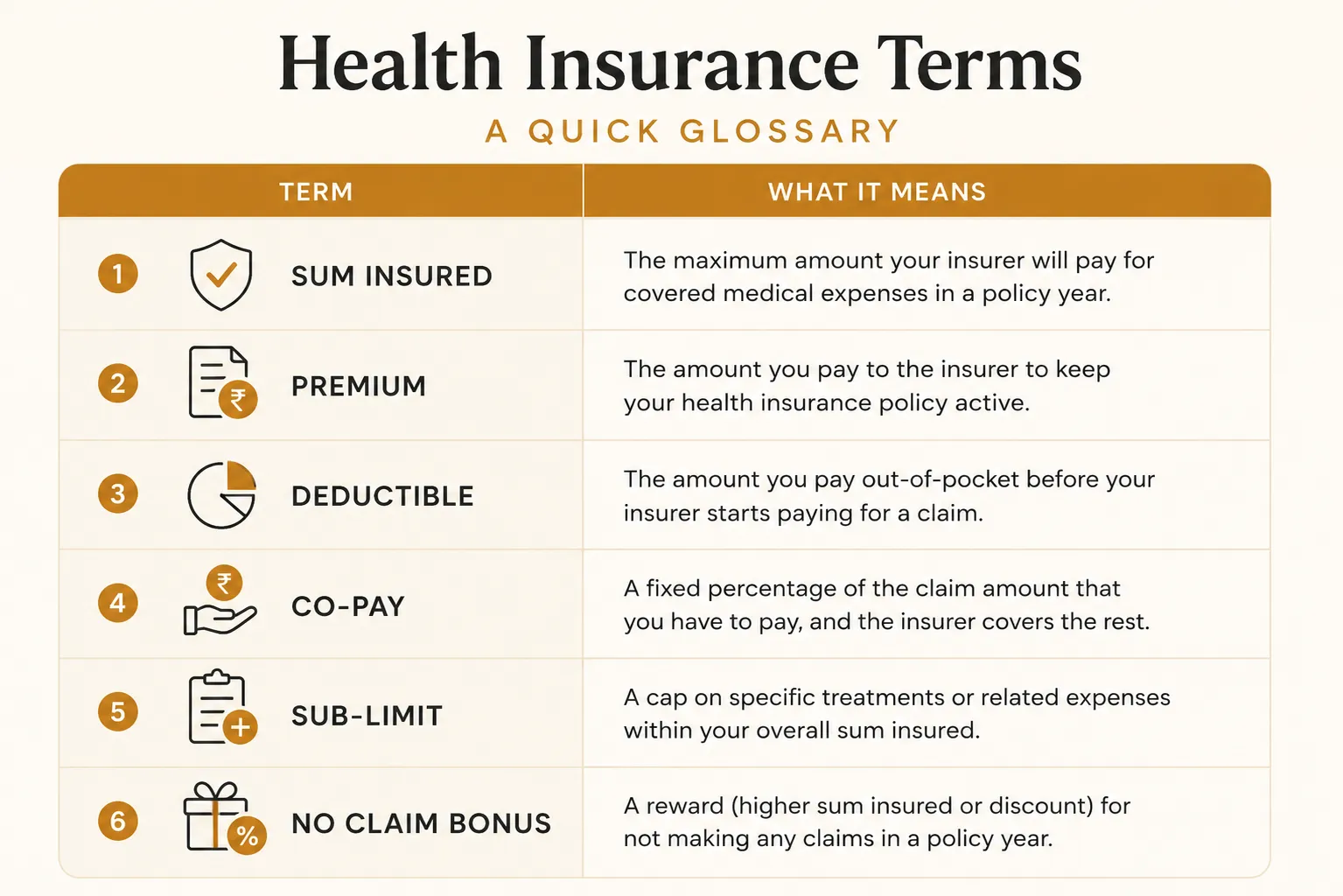
| Term | What it means |
|---|---|
| Sum insured | The maximum amount the insurer will pay across a policy year |
| Premium | What you pay, usually annually, to keep the policy active |
| Deductible | A fixed amount you pay out of pocket before the insurer starts paying, on some policies |
| Co-pay | A fixed percentage of every claim you pay yourself — a 10% co-pay means you bear 10% of every bill |
| Sub-limit | A cap on what's paid for a specific cost category, like room rent, regardless of the total sum insured |
| No Claim Bonus (NCB) | A reward for claim-free years — typically a 10-50% increase to sum insured at no extra premium |
A 10% co-pay might look minor while comparing premiums, but it means bearing 10% of every future bill for as long as the policy is active — on a serious hospitalization, that adds up fast. Weigh it directly against the premium savings it offers.
Waiting Periods: The Coverage You're Paying For But Can't Use Yet
A waiting period is a span of time after buying or renewing a policy during which certain claims won't be paid, even though premiums are being collected in full.[2] There are several distinct types, and conflating them is a common source of confusion.
Cashless vs. Reimbursement Claims
How you actually get paid depends on whether you use a cashless claim or a reimbursement claim, and the two work quite differently.[3] With a cashless claim, the insurer settles the bill directly with a network hospital — show your policy e-card, the hospital and insurer coordinate pre-authorization, and treatment starts without a large upfront payment. This only works inside the insurer's specific network. With reimbursement, you pay the full bill yourself first, then submit documentation to be paid back — this works at any hospital but ties up your own cash and takes longer to settle.
If a cashless network hospital is a realistic option nearby, it's almost always the smoother path during an actual emergency. Knowing your network hospitals in advance — not scrambling during a crisis — is worth five minutes now.
What Your Policy Typically Doesn't Cover
Every policy has exclusions, and knowing them before a claim — not after — is the difference between a smooth process and a rejected one. Common exclusions include cosmetic or elective procedures without medical necessity, dental and vision care, treatment related to self-inflicted injury or substance abuse, and anything still inside its waiting period. Sub-limits are subtler but equally consequential — a room-rent cap, often a percentage of sum insured, doesn't just limit the room charge; exceeding it typically triggers a proportional deduction across the entire bill, including procedures and medication.
Why Claims Actually Get Rejected
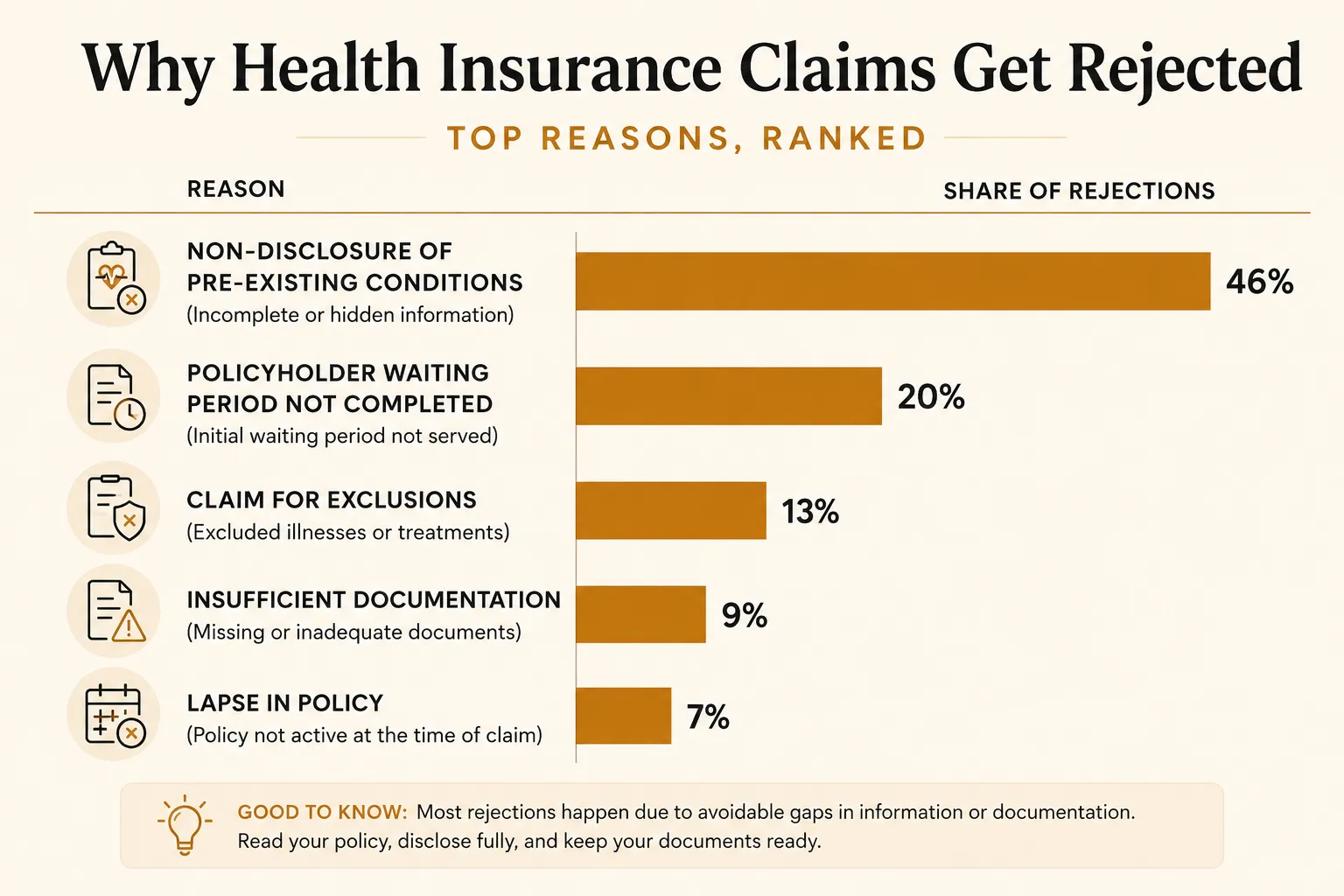
Roughly 5-8% of health insurance claims in India are rejected outright, with another 25-35% facing partial deductions — and the leading causes are more avoidable than most people assume.[1]
- Non-disclosure of a pre-existing condition. The single largest cause of disputed claims, at an estimated 15-25%. Disclose everything at purchase, even conditions that feel minor.
- Claiming during an active waiting period. Check your policy's waiting periods against the condition being treated before assuming coverage applies.
- Treatment falls under an explicit exclusion. Review the exclusions list at purchase, not claim time.
- Exceeding a sub-limit like room rent. A hospital room within the covered rent band avoids the proportional deduction entirely.
- Incomplete or inconsistent documentation. Missing discharge summaries or mismatched bills are a frequent, avoidable cause of delay or rejection.
How Much Coverage Do You Actually Need?
A commonly cited starting benchmark for individuals in Indian metro cities is a minimum sum insured of ₹10 lakh, given how quickly hospitalization costs can escalate — smaller cities may reasonably start lower given generally lower treatment costs. A family floater policy, where the sum insured is shared across everyone covered rather than dedicated to one person, is usually more cost-efficient than separate individual policies, though it's worth stress-testing against two family members needing care in the same policy year. Health insurance works alongside, not instead of, an emergency fund for costs insurance won't cover, like the initial waiting period or a co-pay share.
Common Mistakes
- Buying based on sum insured alone. Waiting periods, sub-limits, and co-pay clauses often matter more than the headline number.
- Hiding or forgetting to disclose a pre-existing condition. Full disclosure protects you, it doesn't disqualify you.
- Switching insurers yearly for a lower premium. This resets some waiting-period clocks and forfeits progress toward the 5-year moratorium protection.
- Never checking the network hospital list until an emergency. Know your nearest cashless-network options in advance.
- Assuming employer group insurance is sufficient long-term. Group cover typically ends with the job — a personal policy avoids a coverage gap.
Final Thoughts
Health insurance genuinely works when the fine print is understood before it's needed — not after a claim is filed. The sum insured is the number insurers advertise, but waiting periods, sub-limits, co-pay clauses, and honest disclosure actually determine whether a claim gets paid in full, partially, or not at all.
The honest version of this advice: the best time to read your policy document closely is the day you buy it, not the day you're sitting in a hospital waiting room.
Health insurance is one piece of a complete financial plan — term insurance vs. whole life insurance and building a one-page financial plan cover the other foundational pieces worth getting right alongside it.
This article is for general information and isn't personalized financial or insurance advice. Policy terms vary significantly between insurers and products — always read your specific policy document and consult a licensed insurance advisor before purchasing.
Sources
[1] Health insurance claim rejection reasons and rates in India. Available at: nyvo.in
[2] Health insurance waiting period types and IRDAI 2024 rule changes. Available at: nivabupa.com
[3] Cashless vs. reimbursement health insurance claims process. Available at: tataaia.com