
- Lifestyle inflation is spending that rises in step with income — so a raise gets absorbed into a marginally nicer version of the same life instead of building savings.
- Hedonic adaptation means people adjust to a new standard of living within months, so an "upgrade" quickly stops feeling like more.[1]
- Savings rate — the percentage of income saved, not the rupee amount — is the number that reveals lifestyle inflation; income can rise for years while this number stays flat.
- A commonly used starting rule: save or invest at least 50% of every raise before it touches regular spending.
- Research on income and wellbeing suggests satisfaction gains from higher income taper off well before most people assume they will.[2]
Your salary has gone up two or three times in the last few years. Your bank balance, somehow, tells a different story. This isn't usually a math problem or a single bad decision — it's a slow, largely invisible pattern called lifestyle inflation, where spending quietly rises to match every increase in income before any meaningfully larger share of it reaches savings. Understanding how it works is most of what it takes to stop it.
What Lifestyle Inflation Actually Is
Lifestyle inflation is the tendency for spending to increase proportionally — or more — with every rise in income, so that a bigger paycheck doesn't translate into a meaningfully bigger savings rate. It rarely looks like one large, obvious splurge. It looks like a slightly bigger apartment, a car upgrade financed by a fresh EMI, more frequent dining out, a few extra subscriptions, and better everything — each individually reasonable, collectively absorbing the entire raise.
The distinguishing feature isn't spending more in absolute terms — that's expected as income rises. It's spending more at roughly the same rate income grows, so the gap between what you earn and what you keep never actually widens. A person earning ₹12 lakh a year and saving 20% who gets promoted to ₹18 lakh but is still saving 20% hasn't built any more of a cushion relative to their new life — they've just built a more expensive one.
Why It Happens — The Psychology Behind It
Two overlapping mechanisms drive most lifestyle inflation, and neither requires poor discipline to take hold. The first is hedonic adaptation — the well-documented tendency for people to quickly adjust to a new standard of living, so that what initially feels like a genuine upgrade becomes the unremarkable baseline within a matter of months.[1] The new apartment stops feeling exciting. The new car is just the car now. The improvement in mood or satisfaction is real, but temporary, which means the next upgrade starts to feel necessary just to recreate that same brief lift.
The second is social comparison. As income rises, the reference group for "normal" spending tends to shift too — from a hostel or shared flat cohort to a peer group with a similar salary, similar expectations, and similar visible spending. What felt like an indulgence at the old income level starts to feel like the baseline at the new one, even though nothing about your actual needs changed. This is closely related to the broader psychology covered in why financial decisions aren't purely rational — lifestyle inflation is a specific, very common case of that pattern.
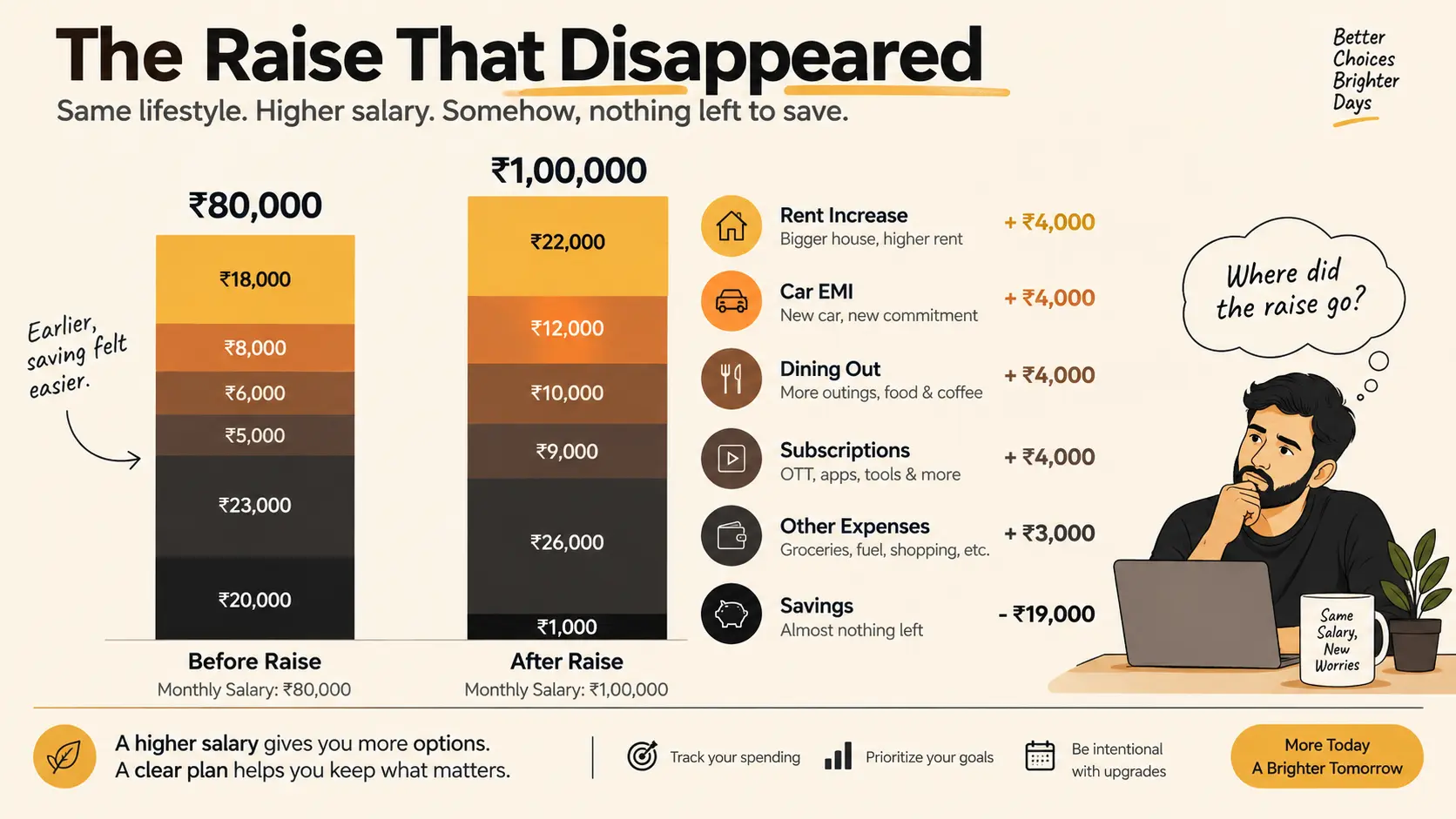
The Math: How a Raise Actually Disappears
It's worth knowing that the raise itself rarely shows up in your account at the full headline percentage — how to read your payslip covers why a raise to your CTC translates to a smaller bump in actual take-home pay, which makes the gap below even easier to miss.
| Change after a 15% raise | Monthly amount | Where it went |
|---|---|---|
| Rent upgrade (1BHK → 2BHK) | ₹8,000 more | "We can finally afford more space" |
| New car EMI replacing older paid-off car | ₹12,000 more | "I've earned an upgrade" |
| Dining out, delivery apps | ₹4,000 more | Convenience, no single decision |
| Subscriptions, memberships | ₹1,500 more | Added one at a time, rarely reviewed |
| Total absorbed | ₹25,500 more | Roughly the entire raise |
None of these individual choices are irrational or even unreasonable in isolation. The problem is that they were never compared against each other or against a savings target — each one just filled the gap the raise created, in the order it happened to arrive. Tracking your net worth over time is one of the few habits that makes this pattern visible before it's been running for years, because a flat or slow-growing net worth despite rising income is the clearest signal lifestyle inflation is happening.
Good Lifestyle Inflation vs. Bad Lifestyle Inflation
Not all increased spending as income rises is a problem — the goal isn't permanent austerity regardless of how much you earn. The distinction that matters is between deliberate and automatic.
A useful test: can you name the specific decision and reason behind each new or increased expense? If yes, it's probably a deliberate choice. If the honest answer is "it just sort of happened," that's the automatic version — and it's the version worth interrupting.
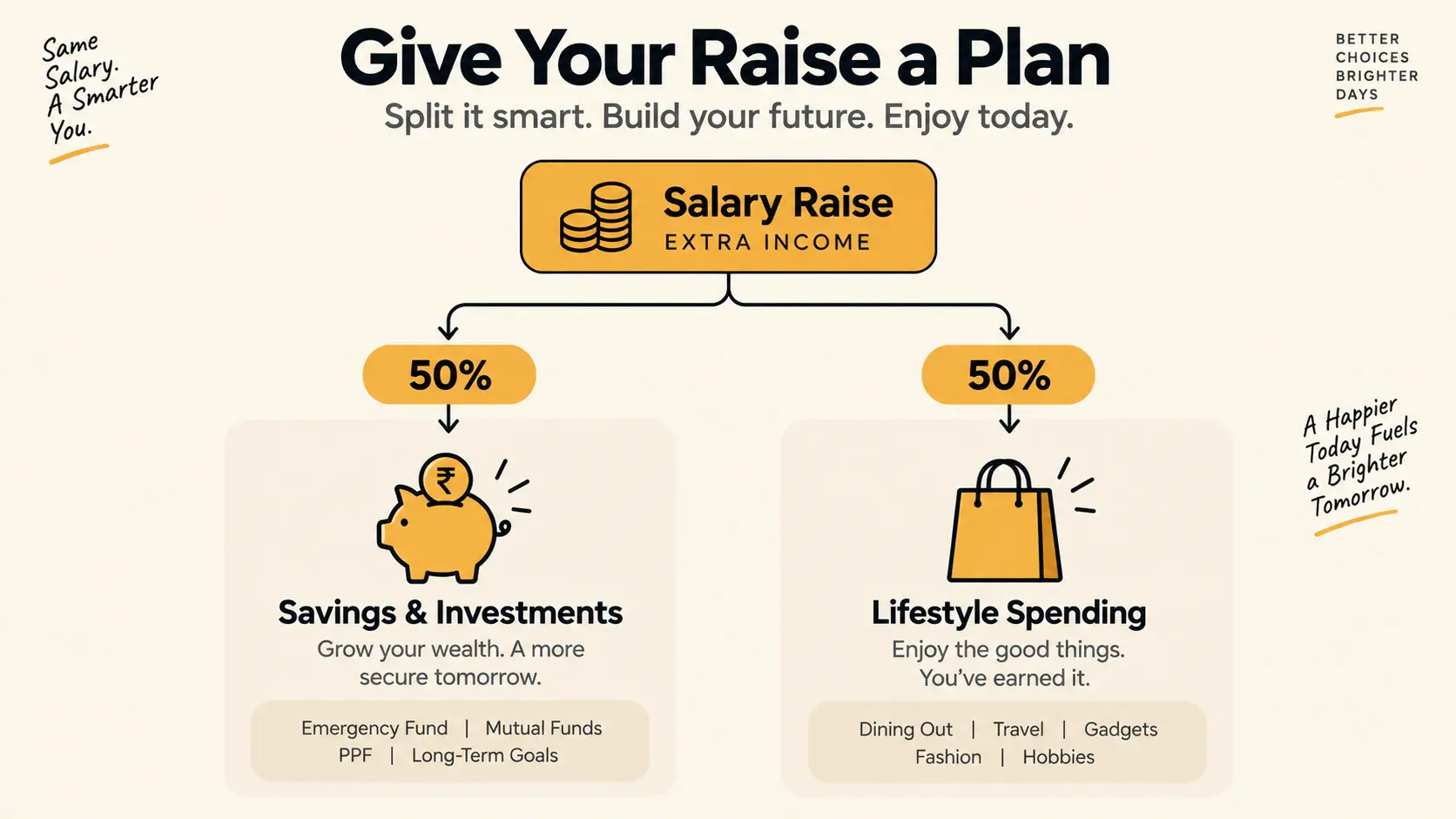
The Save-the-Raise Rule: How to Break the Cycle
- Decide the split before the raise lands, not after. A common starting point is 50% of any raise or bonus automatically increased into savings or investments, with the other 50% free to spend on genuine lifestyle improvements.
- Automate the increase, not just the intention. Raise your SIP or auto-transfer amount the same week the new salary is confirmed — before the higher number in your account has a chance to feel normal.
- Keep one visible, deliberate upgrade per raise. Denying every single lifestyle improvement tends to fail — pick one genuine, planned upgrade you actually value, and let the rest go to savings by default.
- Review recurring expenses annually, not just at raise time. Subscriptions and small recurring costs tend to accumulate independently of any single raise — a periodic review catches creep that a raise-triggered rule alone would miss.
This is the same mechanism behind building a one-page financial plan — deciding the numbers in advance, while you're thinking clearly, rather than in the moment a new expense presents itself as reasonable.
Common Mistakes
- Waiting to "decide later" what to do with a raise. Money left undecided defaults to spending — the decision needs to happen before or at the moment the raise lands.
- Tracking expenses but not the savings rate. Absolute savings can rise while the percentage of income saved stays flat or falls — the percentage is the number that actually reveals inflation.
- Financing lifestyle upgrades through EMIs. This locks in the higher cost of living well beyond the point any of the initial upgrade excitement remains.
- Treating every peer-comparison purchase as a need. A genuinely deliberate upgrade and a socially driven one can look identical from the outside — the test is whether you can articulate the reason without referencing what others have.
- Assuming discipline alone will prevent it. Automating the split removes the need to rely on willpower at the exact moment willpower is weakest — right after a raise, when spending more feels most justified.
Final Thoughts
Lifestyle inflation isn't a failure of discipline — it's a predictable, well-documented response to how humans adapt to new circumstances, made worse by financing tools that lock spending increases in for years. The fix isn't refusing every upgrade as income grows; it's deciding, in advance, what share of every raise goes toward the future before the present has a chance to quietly claim all of it.
A raise you never see is a raise you can't spend. Automating the split is less about discipline and more about removing the decision from the moment you're least equipped to make it well.
Once the save-the-raise habit is in place, tracking your net worth annually is the clearest way to confirm it's actually working — a savings rate that holds steady or climbs alongside your income, year after year, is the real evidence lifestyle inflation has been interrupted.
This article is for general educational purposes and isn't personalized financial advice. Consult a licensed financial advisor for guidance specific to your situation.
Sources
[1] Hedonic adaptation and the "hedonic treadmill" in subjective wellbeing research. Available at: apa.org
[2] Kahneman & Deaton on income and emotional wellbeing. Available at: pnas.org