
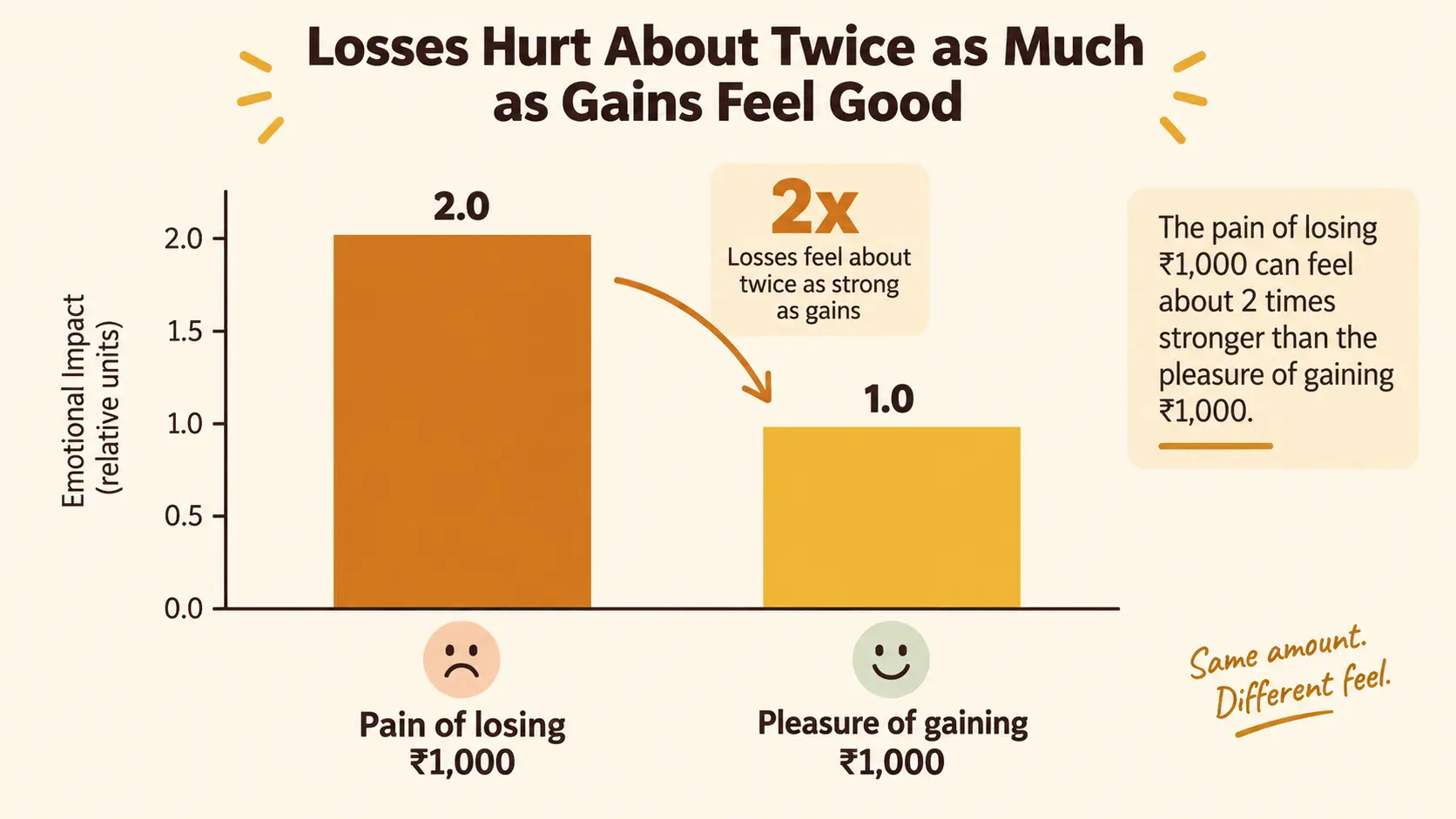
- Nobel Prize-winning research found losses are felt roughly twice as intensely as equivalent gains — a bias called loss aversion.[1]
- Mental accounting causes people to treat a tax refund or bonus differently from salary, even though money is fully interchangeable.[2]
- Present bias makes people consistently undervalue future rewards — including retirement savings decades away — in favor of smaller, immediate ones.[3]
- Financial literacy alone explains only a modest share of variation in actual financial behavior; automatic, low-willpower systems outperform knowledge-based discipline.[4]
- Panic-selling during market downturns is one of the most consistent, well-documented ways loss aversion destroys long-term investment returns.
Intelligence has surprisingly little to do with good financial decisions — and the research on why is uncomfortable, because it applies to everyone equally, regardless of how much you know about money. Behavioral economics has spent decades documenting the specific, predictable ways human psychology overrides rational calculation when money is involved. None of these patterns require ignorance. They show up in economics professors and people who've read every personal finance book on the shelf — because they're wired in at a level facts don't reach.
Why This Isn't About Intelligence
Financial literacy and financial behavior are measurably different things, and the gap between them is where most "dumb" money decisions actually live. Someone can understand compound interest perfectly and still fail to start investing for years, not from lack of knowledge but from present bias and inertia. Someone can know diversification reduces risk and still panic-sell a diversified portfolio during a downturn, because loss aversion operates faster and louder than the rational, knowing part of the brain.
This reframing matters: if bad decisions came from ignorance, more information would fix them. Since they largely come from predictable psychological wiring, the fix is designing systems that work with — or around — that wiring, not fighting it through willpower alone.
Loss Aversion: Why Losing Hurts More Than Winning Feels Good
Daniel Kahneman and Amos Tversky's prospect theory, which won the 2002 Nobel Prize in Economics, found that losses are felt roughly twice as intensely as equivalent gains.[1] Losing ₹1,000 produces more emotional pain than gaining ₹1,000 produces pleasure. This single asymmetry explains a lot of irrational financial behavior: holding a losing stock too long hoping to "get back to even," avoiding a shrinking portfolio during a downturn, and selling in a panic exactly when a rational investor would hold or buy more.
This same loss aversion is a big part of why gold gets treated as an emotional safe haven during uncertain times — a reactive, fear-driven gold purchase often means buying near a local price peak. A more honest look at gold as an investment covers why a small, planned allocation works better than a panic-driven one.
Mental Accounting: Money Isn't as Fungible as It Should Be
Economist Richard Thaler's concept of mental accounting describes how people mentally sort money into separate "accounts" based on its source or purpose, even though money is completely interchangeable.[2] A festival bonus gets spent more freely than salary. A "vacation fund" sits untouched earning modest interest while a credit card balance accrues 30%+ annual interest elsewhere — the same household, treating money inconsistently based on its label.
Present Bias: Why Future You Always Loses the Negotiation
Present bias, also called hyperbolic discounting, is the well-documented tendency to overvalue immediate rewards relative to future ones, even when the future reward is objectively larger.[3] This is the core psychological reason retirement saving is so hard: a rupee spent today feels real and immediate, while a rupee saved for retirement decades away feels abstract and easily deferred "until next month." How SIPs work covers the practical mechanism — automated, recurring investing — that removes this decision from the moment entirely, which is why it beats relying on willpower at each payday.
The same bias shows up in the emergency fund most people know they should have but don't. The emergency fund guide covers why building one automatically, in small recurring amounts, beats intending to build one "when things settle down" — a moment present bias keeps pushing further away.
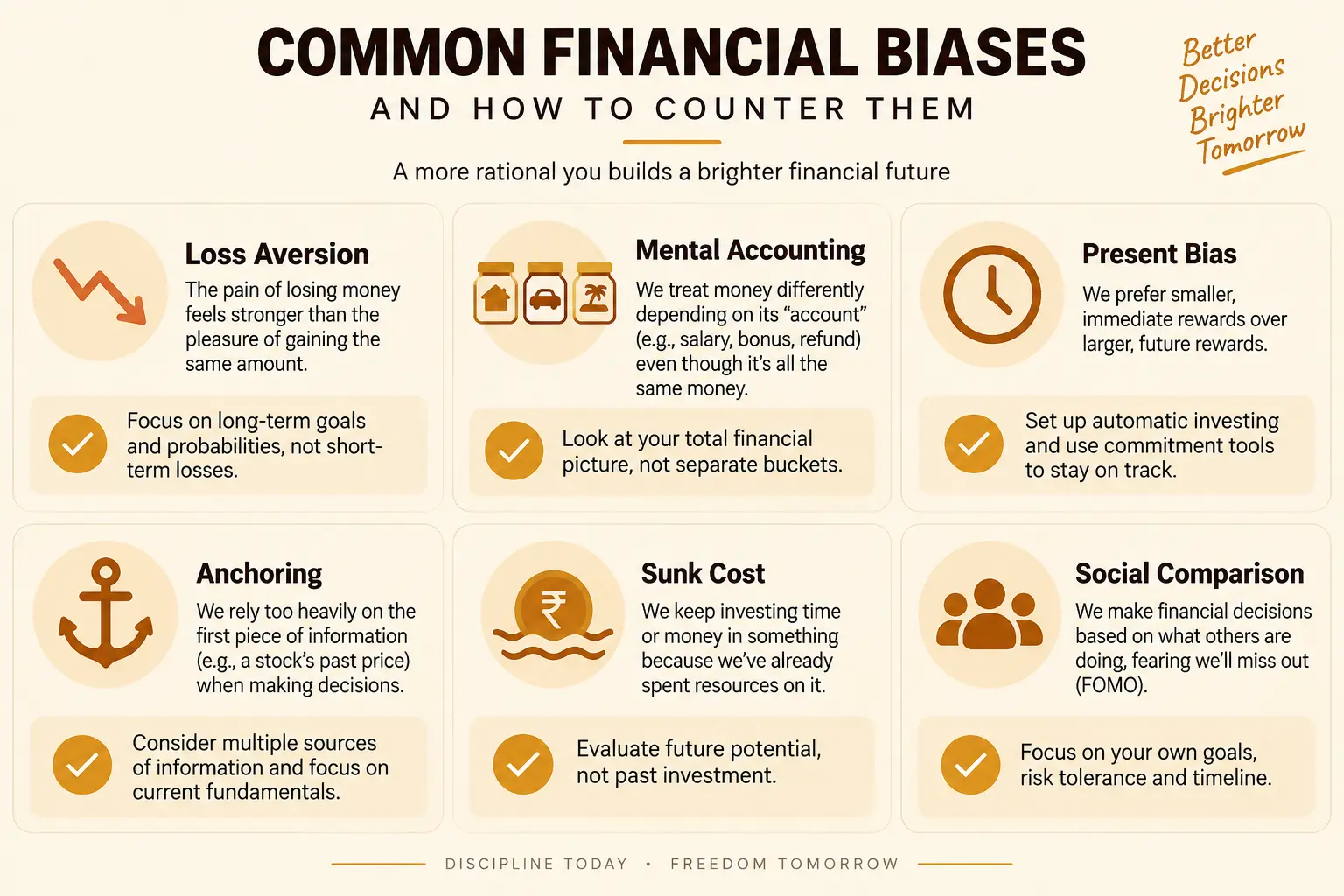
The Biases and What Actually Counters Them
| Bias | How it shows up | Counter-strategy |
|---|---|---|
| Loss aversion | Panic-selling investments during downturns; holding losers too long | Pre-commit to a plan before volatility hits; automate rebalancing |
| Mental accounting | Spending bonuses freely while high-interest debt sits untouched | Treat all money as one pool; pay down highest-interest debt first regardless of source |
| Present bias | Delaying saving and investing indefinitely | Automate SIPs and transfers before money reaches a spendable account |
| Anchoring | Judging prices against an arbitrary first number seen | Research typical prices independently before comparing any single offer |
| Sunk cost fallacy | Continuing a bad investment or habit because money's already spent | Evaluate every decision fresh, ignoring money already spent — it's gone either way |
| Social comparison | Lifestyle inflation driven by peer spending, not personal goals | Set goals against your own plan, not visible peer purchases |
Lifestyle Inflation and Social Comparison
A closely related pattern is lifestyle inflation — spending that rises to match income, driven less by need than social comparison with peers. Every raise gets absorbed into a marginally nicer apartment, car, or wardrobe before any of it reaches savings. A no-spend month is an effective way to interrupt this — not as a permanent lifestyle, but a reset that makes the gap between reflexive spending and genuine need visible again.
What Actually Works: Design Around Your Biases, Not Against Them
The most reliable behavioral finance interventions don't try to out-willpower these biases — they change the environment so the biased decision becomes harder to make. Automating SIPs and savings transfers removes present bias from the moment entirely. A 24-hour rule on non-essential purchases interrupts impulsive mental accounting before it becomes a transaction. Pre-committing to an investment plan, in writing, before volatility hits removes loss aversion from the moment it would otherwise take over. Tracking every rupee in one place, rather than sorting it into separate "accounts," is the simplest way to counter mental accounting directly — which is exactly what the free Budget Planner tool is built for.
Common Mistakes
- Assuming more financial knowledge will fix bad habits. Knowledge helps, but behavior is driven by psychology that facts alone don't override.
- Checking investments constantly during a downturn. This maximizes exposure to loss aversion at the wrong moment — set a review schedule instead of reacting to every dip.
- Treating windfalls differently from regular income. A bonus is worth exactly as much as the same amount from salary — spend or save it the same way.
- Relying on willpower instead of automation. Present bias reliably wins in the moment; automated transfers remove the moment entirely.
- Comparing your spending to visible peers. Social comparison is one of the strongest, least examined drivers of lifestyle inflation.
Final Thoughts
None of the biases covered here are a character flaw — they're well-documented features of human psychology that show up in everyone, regardless of intelligence or financial literacy. The people who consistently make better financial decisions aren't immune to loss aversion, present bias, or mental accounting. They've just built systems — automated savings, pre-committed plans, single-pool budgeting — that route around those biases instead of relying on willpower to defeat them. That's a far more achievable goal than trying to think your way out of wiring that isn't going anywhere.
The honest version of this advice: you're not going to out-discipline your own psychology. You can only make the disciplined choice the automatic one.
For the full system this fits into — budgeting, saving, and building habits that don't depend on daily willpower — the free Money 101: Personal Finance Basics course walks through building that structure from the ground up.
This article is for general educational purposes and isn't personalized financial or investment advice. Consult a licensed financial advisor for guidance specific to your situation.
Sources
[1] Prospect Theory: An Analysis of Decision under Risk, Kahneman & Tversky, 1979. Available at: jstor.org
[2] Mental Accounting Matters, Richard Thaler. Available at: chicagobooth.edu
[3] Present bias and hyperbolic discounting in intertemporal choice research. Available at: nber.org
[4] Financial literacy, financial education, and downstream financial behaviors — meta-analysis. Available at: pubsonline.informs.org