
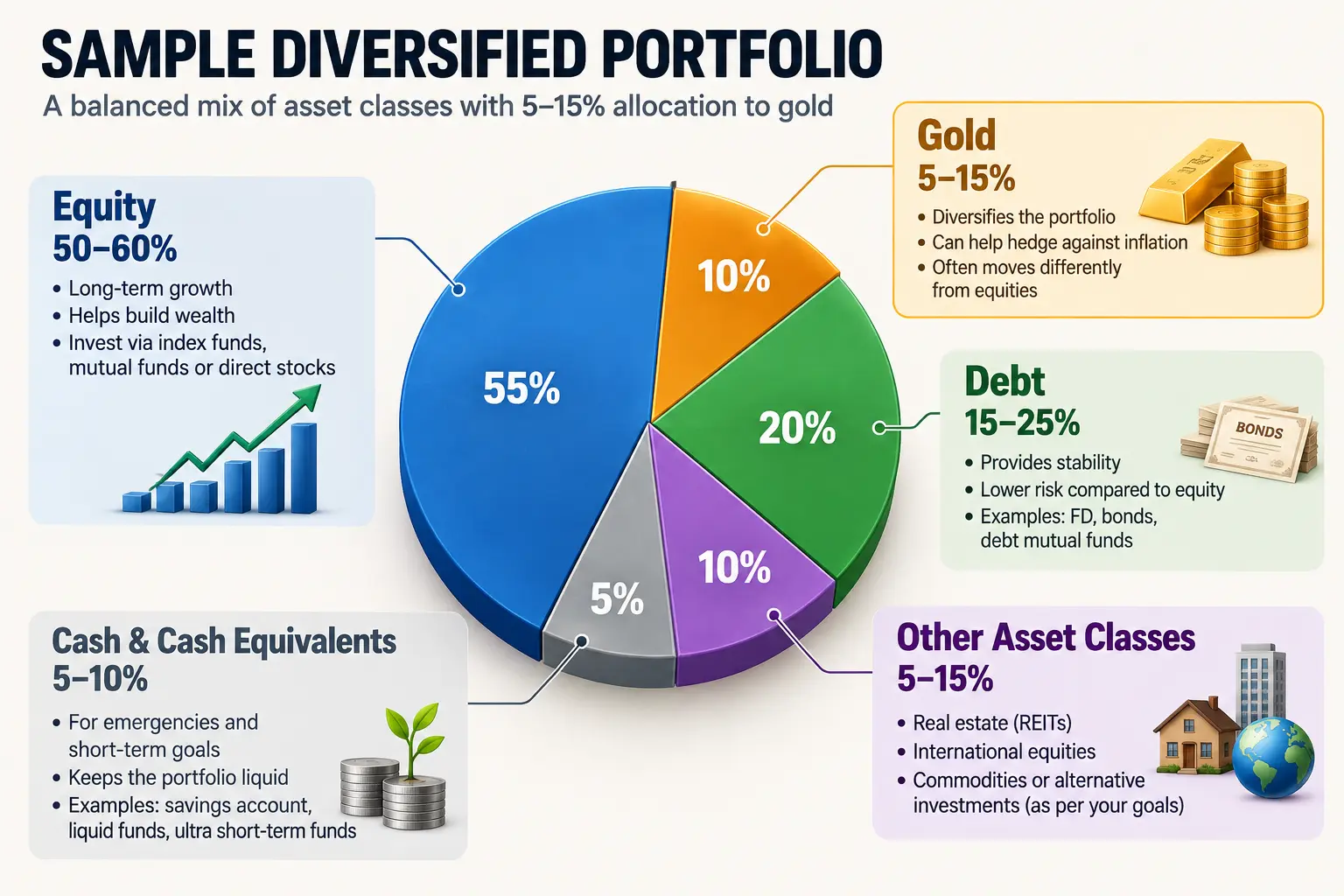
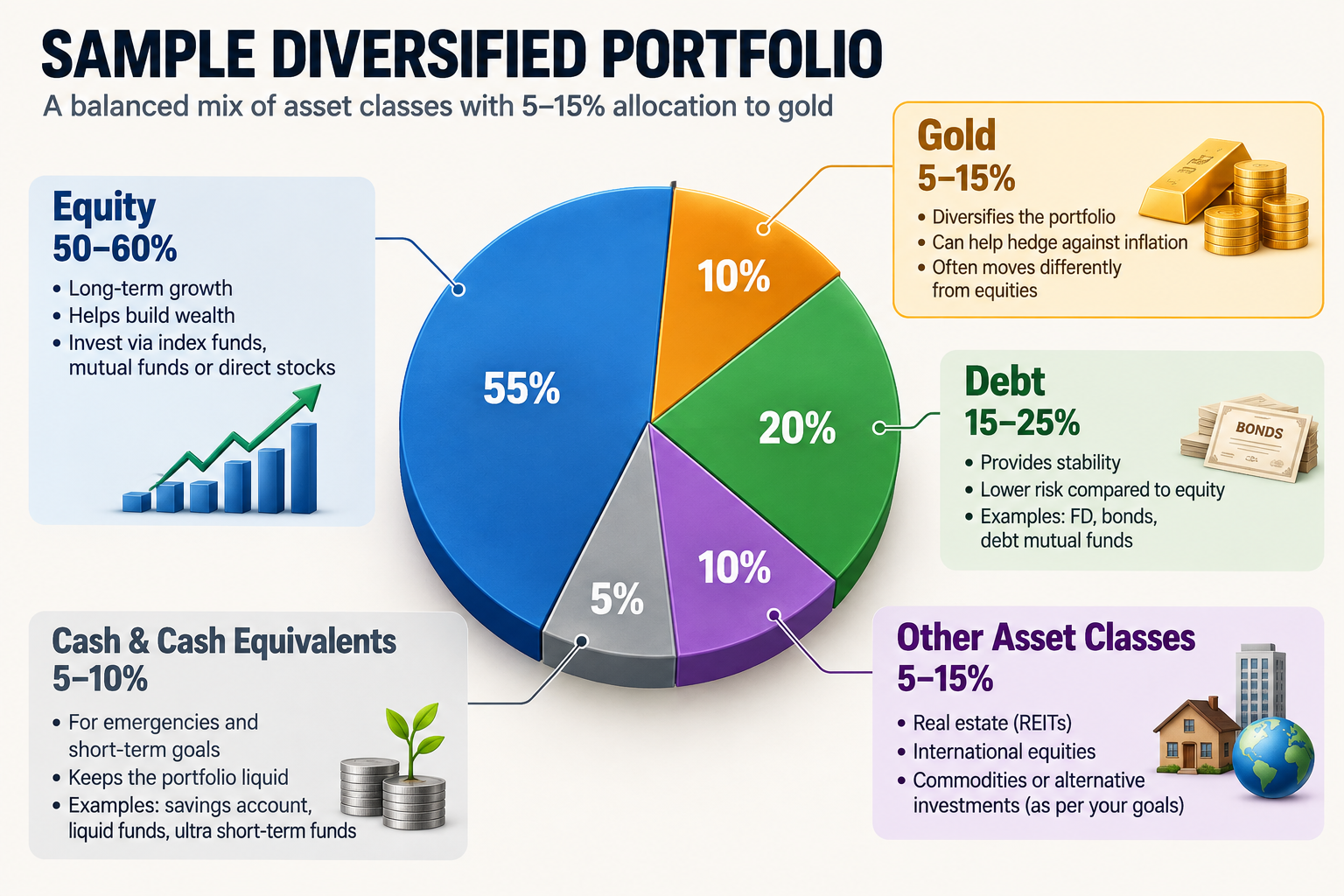
- A commonly cited guideline is a 5-15% gold allocation in a diversified portfolio — as a diversifier, not a primary growth asset.
- Sovereign Gold Bonds (SGBs) offer a small fixed annual interest on top of gold's price movement and are exempt from capital gains tax if held to maturity — a benefit physical gold and gold ETFs don't have.
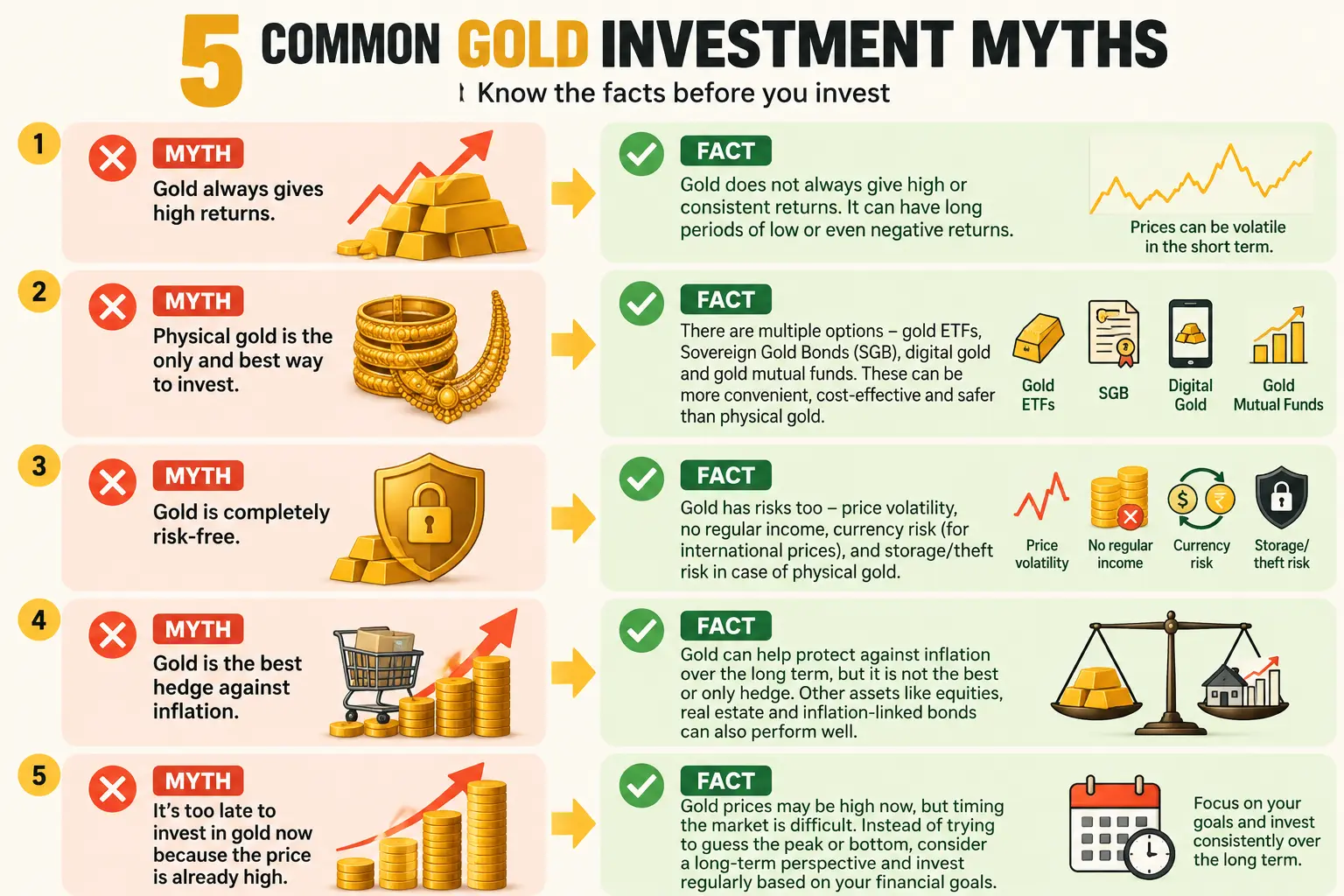
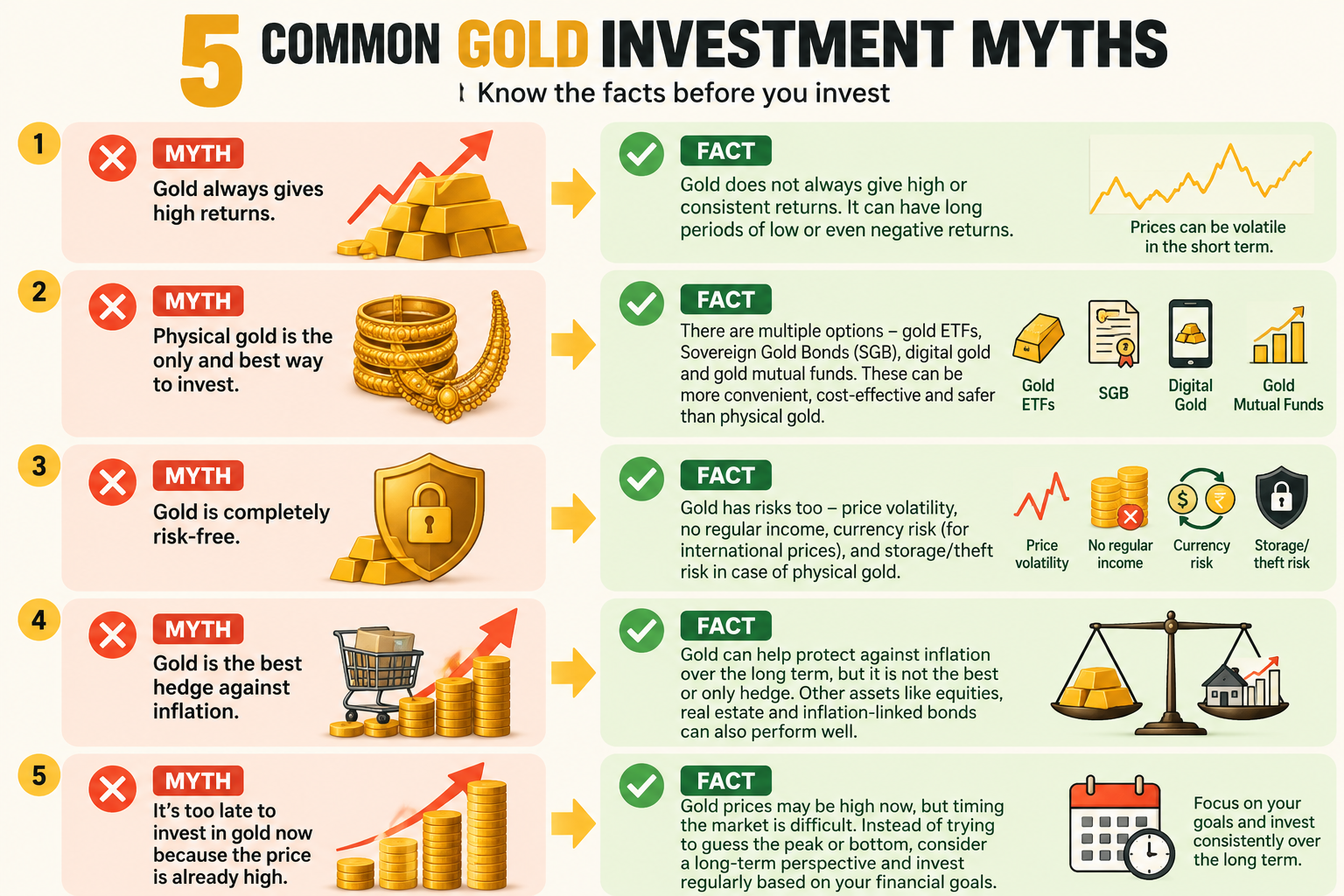
- Gold's long-term returns have historically trailed equity markets, even though gold outperforms in specific shorter stretches, especially during crises.
- Physical gold carries costs — making charges, purity risk, and storage or insurance — that gold ETFs, SGBs, and digital gold mostly avoid.
- Digital gold is convenient but, unlike gold ETFs and SGBs, isn't regulated by SEBI or the RBI.
Gold occupies a strange dual role in Indian household finance — part investment, part tradition, part insurance policy against a world that feels uncertain. That dual role makes it one of the hardest assets to evaluate honestly, because the conversation about whether gold is "a good investment" gets tangled up with culture, family expectation, and genuine financial reasoning all at once. This is an attempt to separate those threads: what gold actually does in a portfolio, what the common claims about it get right and wrong, and how much — if any — genuinely makes sense for you.
Why Gold Has a Special Place in the First Place
Gold's appeal isn't irrational — it's built on a few genuine, historically grounded properties. It doesn't rely on any single government, company, or currency to hold value, which matters during periods of currency instability or geopolitical uncertainty. It's also highly liquid globally — gold can be sold almost anywhere in the world, unlike most other assets. And unlike a stock or a business, gold doesn't depend on continued good management or economic growth to retain worth; a bar of gold from 200 years ago is still a bar of gold today.
What gold doesn't do is produce income. It pays no dividend, no interest, no rent — its entire return comes from price appreciation, which means gold sitting in a locker is not compounding the way a dividend-paying stock or an interest-bearing bond is. That single fact is the root of most of the more overstated claims made about gold as an investment.
The Myth-Check: Common Claims About Gold, Tested
| Claim | What's actually true |
|---|---|
| "Gold always beats inflation" | Gold has tended to hold value over long periods of currency debasement, but this isn't precise or guaranteed — gold prices have fallen for multi-year stretches even during inflationary periods. It's a long-term, portfolio-level tendency, not a reliable short-term guarantee. |
| "Gold is a risk-free investment" | Gold's price is genuinely volatile in the short and medium term — it can and does drop 15-20% or more within a year. "Risk-free" more accurately describes its lack of default or counterparty risk, not price stability. |
| "Gold gives better long-term returns than equity" | Historically, equity markets have outperformed gold over most long time horizons, though with more volatility along the way. Gold has outperformed in specific periods, particularly around crises, but that isn't the long-run historical pattern. |
| "You need to hold physical gold for it to really count" | Sovereign Gold Bonds and gold ETFs track the same underlying gold price without the making charges, purity risk, or storage costs of physical gold — for pure investment purposes, they're generally more efficient, not less "real." |
| "Buying gold jewellery is a good investment" | Making charges (typically 8-25% of value) and purity variance mean jewellery is a poor pure investment vehicle — it's better understood as a hybrid of personal/cultural use and a partial store of value, not an efficient investment. |
The Ways to Actually Invest in Gold in India
| Option | Liquidity | Storage/purity risk | Notable feature |
|---|---|---|---|
| Physical gold (coins/bars/jewellery) | Sell anywhere, but at a discount | Storage cost, theft risk, purity varies | Only form usable for cultural/personal purposes |
| Gold ETFs | High — traded on exchanges like a stock | None — held in demat form | Tracks gold price closely, small expense ratio |
| Sovereign Gold Bonds (SGBs) | Lower — 8-year tenure, tradeable after lock-in | None — held electronically | Fixed 2.5% annual interest + tax-free gains at maturity |
| Digital gold | High — buy/sell via apps | Vaulted by provider, not SEBI/RBI regulated | Convenient, low minimum investment |
| Gold mutual funds | High — bought/sold like any mutual fund | None | Invests in gold ETFs; useful if you don't have a demat account |
-
Sovereign Gold Bond (SGB) A government-issued bond denominated in grams of gold, paying 2.5% fixed annual interest, with capital gains tax-free if held to the full 8-year maturity.
-
Gold ETF An exchange-traded fund that holds physical gold and tracks its price, bought and sold through a demat account like a stock.
-
Digital gold Gold purchased through an app or platform, stored in a vault by the provider on your behalf — convenient, but not regulated by SEBI or the RBI the way ETFs and SGBs are.
How Much Gold Actually Belongs in a Portfolio
The most commonly cited guideline among financial planners is a 5-15% allocation to gold within a diversified portfolio — not as a primary growth engine, but as a diversifier that tends to behave differently from equity and debt during specific kinds of market stress. Gold's main portfolio value isn't its own returns; it's that its price movements don't closely track stock or bond markets, which can smooth out a portfolio's overall volatility even when gold itself isn't the best-performing asset in a given year.
Gold vs. Equity vs. Fixed Deposits: An Honest Comparison
Over most multi-decade stretches, Indian equity markets have historically delivered higher compounded returns than gold, though with meaningfully more volatility along the way. Gold has periodically outperformed equity during specific crisis years — its defining strength is behaving differently when other assets are falling, not out-earning them over the long run. Fixed deposits, by contrast, offer neither gold's crisis-hedge behavior nor equity's growth potential — their role is capital preservation and predictability, not growth. None of the three is a substitute for the other; each serves a different job in a portfolio, which is the actual argument for diversification rather than picking a single "best" asset.
Common Mistakes
- Treating jewellery as a primary investment vehicle. Making charges and purity variance make it one of the least efficient ways to hold gold purely for investment purposes — fine for personal or cultural use, poor as a growth asset.
- Going all-in on gold during a market downturn out of fear. A large, reactive gold allocation during a crisis usually means buying near a local price peak — the diversification benefit comes from a steady, planned allocation, not a panic purchase.
- Ignoring SGBs' 8-year lock-in when you need near-term liquidity. SGBs are excellent for the tax benefit at maturity but a poor fit for money you might need within a few years — a gold ETF or gold fund is more liquid for shorter horizons.
- Assuming digital gold has the same regulatory protection as SGBs or ETFs. It doesn't — check the specific provider's credibility and terms rather than assuming equivalent oversight.
Final Thoughts
Gold isn't a scam, and it isn't a guaranteed wealth-builder either — both framings oversimplify what it actually does. As a modest, deliberate slice of a diversified portfolio, gold offers a genuine diversification benefit and a long-standing (if imperfect) hedge against currency and inflation risk. As a primary growth strategy, or a panic purchase during uncertain times, it tends to disappoint relative to the expectations placed on it. The honest answer to "is gold a good investment" is: a small, well-chosen amount of it, held in an efficient form, is a reasonable piece of a broader plan — not a plan by itself.
Gold's job in a portfolio isn't to make you rich. It's to be the one thing that doesn't move in the same direction as everything else, when everything else is moving the wrong way.
Once you've decided how gold fits into your broader allocation, the next step is usually making sure your core growth investments are actually working as hard as they should be — how SIPs and rupee cost averaging work covers the equity side of that same diversified plan.
This article is for general educational purposes and isn't personalized financial or investment advice. Gold prices, tax rules, and SGB terms can change — consult a licensed financial advisor and verify current details before investing.
Sources
[1] Reserve Bank of India, Sovereign Gold Bond Scheme details and terms. Available at: rbi.org.in
[2] World Gold Council, long-term gold price and portfolio research. Available at: gold.org