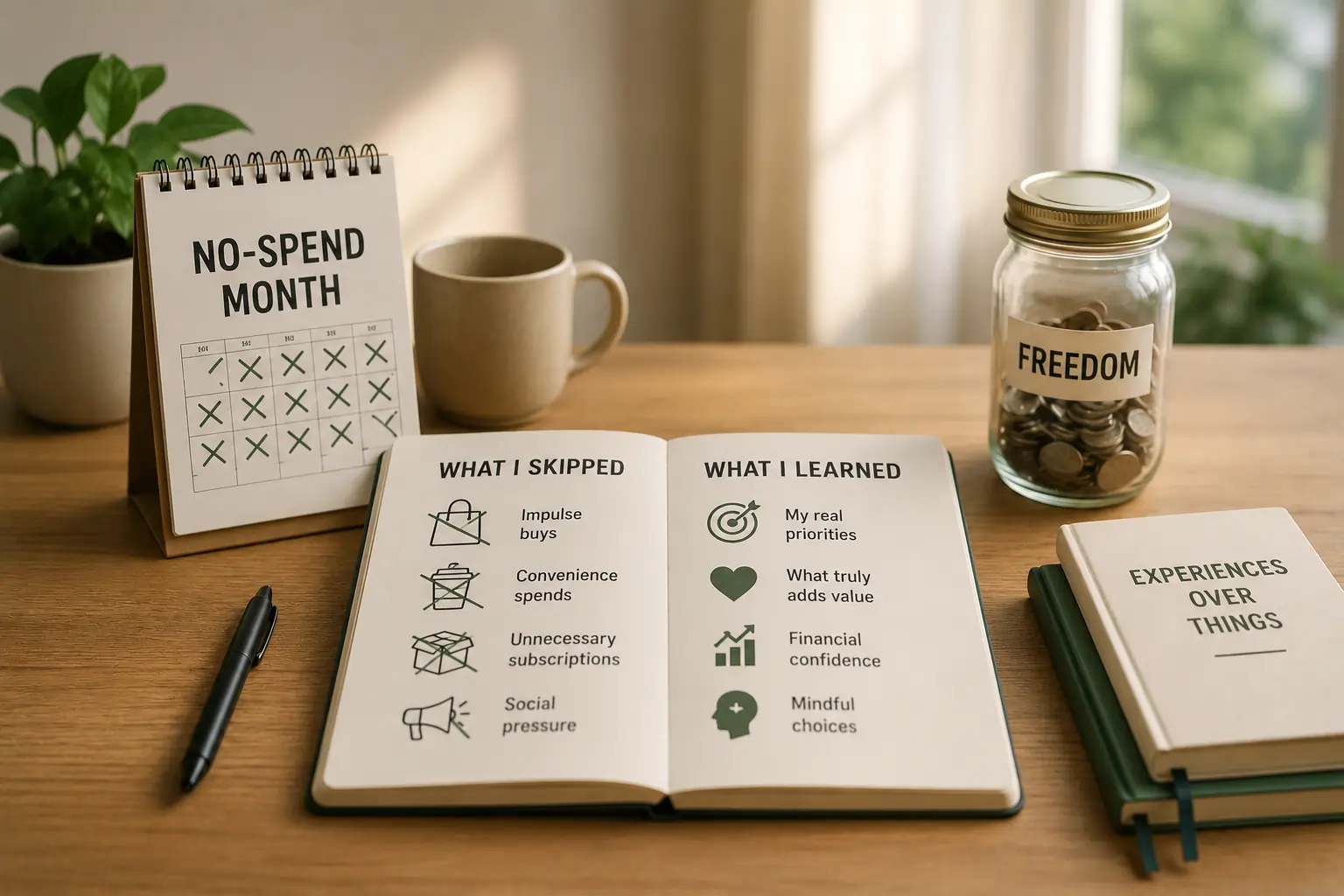
Most people who track their spending already know their numbers. They know roughly what goes out on rent, groceries, the phone bill. What they do not know — and what a budgeting app will never tell them — is why they spend the way they do when they are not paying attention.
A no-spend month is not primarily a savings strategy. The money saved is real and often significant, but it is not the point. The point is the information the month generates about spending patterns that exist below the level of conscious awareness: the purchase that happens automatically when you are bored, the order that gets placed when a difficult conversation has just ended, the subscription that nobody in the household has used in four months but that nobody has thought to cancel because it never comes up.
None of this shows up in a budget review because a budget review tells you what happened. A no-spend month tells you what would have happened if you had not intervened. The gap between those two things is the most useful financial data most people will generate all year.
This article is not a list of rules for completing a no-spend month. It is an explanation of what the month actually teaches, why that information is more durable than a savings target, and how to run it in a way that produces genuine insight rather than just temporary restriction. If you want the structured challenge version with daily tasks and a streak tracker, the 30-Day No-Spend Challenge walks you through it day by day.
What a No-Spend Month Actually Is (and Is Not)
A no-spend month is a defined period — typically thirty days — during which you eliminate all non-essential spending. Essential spending continues: rent or mortgage, utility bills, groceries, transport to work, medication, existing subscriptions that are contractually locked in. Non-essential spending stops: eating out, takeaway, online shopping, entertainment purchases, clothing, home goods, impulse buys, and any other discretionary expenditure.
The definition of 'non-essential' is personal and requires a deliberate decision before the month begins rather than in the moment when the spending urge arrives. Setting the rules in advance is part of the design. An impulsive decision about whether a particular purchase counts as essential, made at the moment of temptation, is not the same cognitive process as a considered decision made at the start of the month.
It is not asceticism. The goal is not to prove you can survive on nothing or to introduce permanent deprivation into your life. It is to create a controlled period of constraint long enough for patterns to surface that normal spending would obscure. A week is not long enough for the patterns to emerge. A month is long enough for the full cycle of triggers and habits to run at least once.
Setting the Rules: What Counts and What Does Not
The rules need to be set specifically enough to be unambiguous in the moment, but not so rigidly that they produce failure by design. The purpose of the rules is to create enough friction around discretionary spending that you notice the impulse before it becomes a transaction. That friction is where the learning happens.
| Category | Allowed (essential) | Not allowed (non-essential) | Borderline — decide in advance |
|---|---|---|---|
| Food | Groceries for home cooking at your normal budget | Restaurants, takeaway, café coffee, food delivery apps, snacks not on the grocery list | Work lunches if genuinely no alternative; pre-purchased meal plan subscriptions already paid |
| Transport | Fuel or public transport for work and committed obligations | Ubers and cabs taken for convenience rather than necessity; ride-sharing when public transport is available | Airport transfers for pre-planned travel; rideshare when public transport is genuinely unavailable |
| Shopping | Replacing a broken essential item (charger that has stopped working, not one you want to upgrade) | Clothing, home goods, tech upgrades, gifts not previously budgeted | Birthday gifts for events within the month — decide rule in advance (buy, make, or experience-based) |
| Entertainment | None required | Streaming services not already subscribed, cinema, concerts, paid apps | Subscriptions that auto-renew during the month and are genuinely used |
| Personal care | Regular haircut if already scheduled; essential toiletries running out | New products, beauty treatments not scheduled before the month | Medication-adjacent personal care products; decide on medical necessity |
| Digital | Existing subscriptions actively used and pre-committed | New subscriptions, app purchases, in-app purchases, digital impulse buying | Annual subscriptions that happen to auto-renew in this month |
The borderline decisions are where the thinking happens. Making the call before the month starts — sitting with a notebook and walking through the likely scenarios — is itself a useful exercise in examining which spending you consider genuinely essential and which you realise, when pressed to defend it, is discretionary habit dressed as necessity.

The Five Things a No-Spend Month Actually Teaches
Within the first week, most people identify an emotional or situational pattern to their non-essential spending that they had not previously articulated. The spending does not happen randomly. It happens at specific times, in specific emotional states, in response to specific triggers that the friction of the no-spend rule suddenly makes visible.
The most common triggers that surface during a no-spend month:
- Boredom spending. The scroll-and-purchase cycle that fills idle time. Browsing becomes buying. The no-spend month forces the boredom to be addressed directly rather than converted into a transaction, revealing how much of daily 'shopping' is actually boredom management.
- Stress spending. The purchase made after a difficult day, a frustrating meeting, or a conflict. Retail therapy is not metaphorical — buying something produces a small dopamine response that temporarily relieves the subjective experience of stress. The no-spend month surfaces how frequently this substitution is happening. Understanding the stress-spending connection also relates to how anxiety and ruminative thinking patterns drive reactive behaviour — the same emotional regulation mechanism is at work.
- Social spending. The spending driven by other people's presence or expectations: the round bought because others are buying rounds, the item purchased to match a friend's purchase, the meal ordered at a restaurant because declining feels socially difficult. This is often the most surprising category for people who thought their spending was primarily individual.
- Reward spending. The 'I deserve this' purchase that follows completing something difficult. The treat after a hard week, the upgrade justified by a recent achievement. The no-spend month forces the examination of what proportion of spending is habitual reward rather than genuine desire.
- Avoidance spending. Buying things to avoid doing something else: ordering delivery to avoid cooking, buying a new planner to avoid starting the project, purchasing something online to avoid a difficult task that is sitting on the desk.
The average person in a household underestimates the number of active subscriptions they are paying for. Individual subscriptions are small enough to be unremarkable in monthly statements — ₹199 here, ₹499 there, a streaming service that nobody has opened in three months but that nobody has thought to cancel because it never comes up. A no-spend month, by creating an explicit audit of what is already being paid, produces a subscription inventory that most people have never assembled.
The inventory typically reveals three categories: genuinely used and worth keeping, used occasionally but not worth the cost, and entirely forgotten. The third category is often the most surprising. Research on subscription management consistently finds that people have significantly more active subscriptions than they believe they do. A 2022 survey by C+R Research found that consumers underestimate their subscription spending by an average of 133 percent — they spend roughly twice what they think they do on recurring charges.[1] If this specific finding is the one that lands hardest, the subscription audit walks through the same discovery process as a standalone, repeatable exercise you don't need a full no-spend month to run.
| Subscription category | Common examples | Questions to ask | Action |
|---|---|---|---|
| Streaming & entertainment | Netflix, Hotstar, Spotify, Apple TV+, YouTube Premium | When did I last use this? Does another service I pay for cover the same need? | Keep, cancel, or consolidate to one streaming service |
| Productivity & software | Adobe Creative Cloud, Microsoft 365, Notion Pro, Canva Pro | Am I actively using the features that justify the paid tier vs the free version? | Downgrade to free tier or cancel if rarely used |
| Health & fitness | Gym membership, fitness apps, meditation apps, nutrition trackers | Have I used this in the past 30 days? Do I have a free alternative? | Use the no-spend month to actually use it — or confirm it can go |
| News & reading | Online newspaper subscriptions, magazine subscriptions, Kindle Unlimited | Am I reading this regularly? Could a library card cover the need? | Audit reading frequency; cancel the ones that exist more as aspiration than use |
| Food & convenience | Swiggy One, Zomato Gold, Amazon Fresh subscription | Does this actually save money, or does it encourage more spending in the category it nominally discounts? | Calculate actual monthly saving versus the subscription fee; often the economics do not work |
| Cloud & devices | iCloud storage upgrades, Google One, cloud backup services | Do I actually need this tier or can I free up space? | Clean up storage; downgrade if manageable |
Spending often functions as a substitute for something else: convenience replaces planning, novelty replaces boredom addressed at source, food delivery replaces a social meal cooked at home, a new purchase replaces the repair of something existing. A no-spend month removes the substitute and makes the underlying need visible.
The most revealing version of this is the takeaway and food delivery category. For many people, food delivery is not primarily about hunger or food preference. It is about avoiding the time and decision-making cost of planning and cooking. When delivery is removed as an option, the food choices that replace it tell you something specific about what you actually want to eat and what you value in eating — information that was being obscured by the availability of the convenient substitute.
Similarly, shopping for new items often functions as a substitute for using what already exists. A no-spend month produces a forced engagement with existing possessions: the clothes in the wardrobe that have not been worn in a year, the kitchen equipment that was bought and unused, the books that were purchased and unread. The inventory of existing possessions that becomes visible during a no-spend month is frequently a revelation about how much value was sitting dormant. This is exactly the logic behind building a functional capsule wardrobe — using what you have with intention rather than buying to fill a perceived gap.
After two to three weeks of not spending on a category, the question of whether to spend on it after the month ends feels different from the question at the start. The desire for something that felt urgent at the beginning of the month often diminishes significantly by the end, particularly for discretionary lifestyle spending: clothing, home decor, technology, entertainment goods.
This is the delayed gratification effect operating as a filter rather than as a discipline. The no-spend month does not require you to permanently forgo the purchase. It requires you to wait. When the month ends, the purchases that still feel worth making are genuinely desired. The purchases that have been forgotten, or that feel less compelling than they did at the start, were never really wanted — they were responding to an impulse that the waiting period extinguished.
This recalibration is one of the most lasting changes a no-spend month produces. The changed relationship with the impulse to buy — the experience of noticing the urge without acting on it and observing whether the desire remains or dissipates — tends to persist after the month ends as a default before-you-buy pause that filters out a meaningful proportion of discretionary spending automatically.
Convenience spending is the category most people systematically underestimate because its individual instances are small and its frequency is high. A cab instead of the metro, a delivery fee on top of a restaurant order, the overpriced coffee at the airport because it is there, the premium for not having planned the grocery run. Each of these is trivial. Aggregated across a month, convenience spending is often one of the largest discretionary categories in a household budget.
A no-spend month makes convenience spending salient in a way that ordinary budgeting does not, because ordinary budgeting categorises these purchases under broad headings — food, transport, miscellaneous — that obscure the convenience premium. A no-spend month produces the experience of not paying that premium and realising, in many cases, that the convenience was not as essential as the habit suggested.
The cab that turned out to be avoidable with ten minutes of planning. The delivery order that was placed because opening the fridge felt like too much effort rather than because there was genuinely nothing in it. None of these are life-changing individually. The pattern they reveal — a consistent willingness to pay a premium to avoid minor inconvenience — often adds up to several thousand rupees per month for a household in an Indian city.
What the Numbers Typically Show
The financial outcome of a well-executed no-spend month varies considerably by household income, urban versus semi-urban context, and baseline discretionary spending. More useful than generalisations is understanding which spending categories typically account for the largest savings, because these point toward the highest-leverage adjustments after the month.
| Spending category | Typical share of discretionary spend | Common no-spend month finding | Post-month opportunity |
|---|---|---|---|
| Food delivery & takeaway | 15–25% for urban households | Often the single largest category; frequency typically higher than self-reported | Shift to weekly meal planning; use delivery as occasional convenience, not default |
| Café & coffee shop visits | 5–10% | Daily habit spending; cost was not salient because individual transactions are small | Home coffee investment; treat café visits as social occasions rather than caffeine delivery |
| Online shopping (clothing, home, misc) | 10–20% | Significant proportion is impulse buying during browsing sessions, not intentional purchasing | Remove saved cards from shopping sites; add friction to purchase path |
| Entertainment & experiences | 8–15% | Often the category people are most reluctant to cut — and most glad they did not cut permanently | Prioritise intentional planned experiences over spontaneous low-value entertainment spending |
| Convenience & subscriptions | 10–15% | Forgotten subscriptions and convenience premium together often exceed what people estimate this category at | Audit and cancel; consolidate services; build planning habits that reduce convenience premium |
| Social spending | 5–15% | Often higher than people expect; driven by social norms around rounds, group meals, and keeping up | Normalise alternatives within social groups; no-spend month often improves financial conversations with partners |
How to Run a No-Spend Month That Produces Insight
The difference between a no-spend month that changes your relationship with money and one that feels like a month of misery and deprivation lies largely in how it is framed and set up. The approach below is built around maximising diagnostic value rather than simply maximising savings.
Week zero: the setup
The week before the month begins is as important as the month itself. This is where the rules are set, the inventory is conducted, and the household is prepared for the friction that the month will produce.
- Set the rules in writing. Ambiguous rules produce rationalised exceptions. Write out your allowed and not-allowed categories specifically. Share them with any household members involved. The writing process itself often reveals assumptions worth examining.
- Conduct a subscription audit now. Go through your bank statements from the past two to three months. List every recurring charge. Make a go/keep/cancel decision before the month starts so that subscription decisions are not made under the emotion of the month.
- Stock the essentials. The no-spend month is not a test of how uncomfortable you can make yourself. Buying a larger grocery shop in week zero that reduces the need for top-up grocery runs during the month is sensible preparation, not cheating.
- Set up a spending diary. A simple notebook or notes app where you record every purchase impulse you do not act on. The impulse diary — what you wanted to buy, when, and what you were feeling at the time — is where the most valuable data of the month is generated. This is more important than tracking what you do spend.
- Tell the people it affects. A no-spend month that affects shared social spending needs to involve the people sharing those social contexts, at minimum to the extent of saying "I am not spending on [category] this month" so that social situations do not become pressure points.

During the month: what to track
The impulse diary is the primary instrument of the month. Every time you want to buy something and do not, note: what you wanted to buy, what time and situation prompted the urge, what you were feeling at the time, and what you did instead. This four-field entry takes less than thirty seconds and accumulates into a dataset about your spending psychology that is worth more than the savings.
Track the genuine difficulty points. Which categories were hardest to abstain from? Which social situations created the most pressure? Which emotional states most reliably generated spending urges? The patterns in these answers determine where to focus after the month ends.
End-of-month review: extracting the learning
The review is where the month's value is converted into lasting change. Without a structured review, a no-spend month is a temporary restriction that reverts. With one, it is a diagnostic that informs spending choices for months afterward.
| Review question | What you are assessing | How to use the answer |
|---|---|---|
| Which category was hardest to abstain from? | Your highest-value discretionary spending; where habit and genuine preference are most intertwined | Do not try to eliminate this category; instead, make the spending in it intentional rather than automatic |
| Which category was easiest to abstain from? | Spending that was habit rather than value; where you found the friction minimal after the first week | Reduce or eliminate this category; the low friction confirms it was not meeting a real need |
| What did I miss genuinely versus what did I just habitually reach for? | The distinction between genuine preference and conditioned behaviour | The genuinely missed things are worth spending on after the month; the habitual reaches are candidates for permanent reduction |
| What did I find I already owned and had forgotten about? | Existing assets made visible by the constraint | Inventory and use these before buying replacements; a wardrobe or kitchen audit post-month is often its own savings exercise |
| What impulses came up most frequently, and in what situations? | Your primary spending triggers | These are the patterns to design around: removing saved cards, changing routes, building alternative responses to trigger situations |
| What would I pay for now that the month is done? | Post-constraint desire versus pre-constraint impulse | Only buy things that still feel clearly worth it 48 hours after the month ends; let the rest go |
What to Do With What You Learned
The no-spend month is a diagnostic. The action it points toward is structural change in how spending is set up, not ongoing willpower applied to the same unchanged environment. Most financial behaviour is not the result of values and intentions meeting real-time decisions. It is the result of default settings: what is easy, what is available, what has been set up to happen automatically. A no-spend month reveals the defaults. The post-month work is redesigning the defaults.
Redesigning the environment for the highest-friction categories
For the categories where the no-spend month was hardest — typically food delivery, online shopping, and entertainment spending — the most durable intervention is adding friction to the path between the impulse and the purchase. Friction is more effective than willpower because it does not deplete.
- Remove food delivery apps from the home screen of your phone. Not delete them permanently, but move them to a folder two screens away. The additional step is enough to interrupt the automatic reach.
- Remove saved payment details from shopping sites. Requiring the manual entry of card details converts a one-click impulse purchase into a fifteen-second considered one. The conversion rate from 'wanting to buy' to 'completing the purchase' drops significantly.
- Unsubscribe from retail marketing emails. A large proportion of online shopping is driven by email promotions and sale announcements. Removing the trigger removes a significant share of the impulse.
- Introduce a 24- or 48-hour rule for non-essential purchases above a threshold. Set a value threshold — ₹1,000, ₹2,000, whatever is meaningful for your income level — above which a mandatory waiting period applies. The waiting period is not a veto. It is a pause that filters out the impulse purchases from the considered ones.
Making the savings structural, not effortful
The money not spent during the no-spend month should be directed somewhere specific immediately, not left in a current account where it will be absorbed by subsequent spending. The most effective destination is a savings target that was identified during the month — an emergency fund, a debt repayment, a specific goal that became clearer during the month because spending less made the allocation available. The Personal Finance Basics course covers exactly this — building the structural savings habits that convert one-month insights into permanent change.
Automating the saving is more durable than intending to save. Setting up a standing instruction to transfer the average monthly saving identified during the no-spend month into a separate account on payday converts the insight into a structural change that does not require ongoing willpower. For the broader picture of structural financial decisions — insurance, investment — see our guide to term insurance vs whole life as one example of the kind of considered allocation that a clearer spending picture enables.
The categories worth spending on more deliberately
A no-spend month often produces a counterintuitive outcome: it identifies not just where spending should be reduced but where spending is genuinely underweighted. The experiences that were missed most acutely during the month — a meal with specific people, a particular kind of leisure activity, something that contributes to wellbeing rather than comfort — are worth spending on with more intention after the month ends.
The quality of spending matters as much as the quantity. A well-designed financial life is not about spending as little as possible. It is about spending on what actually produces the life you want and not spending on the rest. The no-spend month is the most efficient tool available for discovering which is which. This connects directly to the principles in sustainable living on a budget — the goal is never deprivation but intentionality.
The Emotional Dimension: What the Month Reveals About Money and Identity
Most personal finance frameworks treat spending as a rational allocation problem. The experience of a no-spend month consistently reveals that it is not primarily rational. Spending is wrapped up with identity, social membership, self-soothing, reward, and the management of emotions that have nothing to do with the product being purchased — the same territory covered in the psychology of money, where biases like social comparison and mental accounting operate well below the level of conscious calculation.
This is not a criticism. It is a description of how spending works for most people in a consumer economy specifically designed to exploit these associations. Retail environments and digital shopping experiences are engineered to convert emotional states into transactions. The no-spend month is one of the few ways to observe this mechanism operating in your own life rather than as an abstract fact about other people.
The most commonly reported emotional revelation from no-spend month participants: spending was performing a regulating function that the person had not previously acknowledged. The purchase was not about the product. It was about mood management, identity reinforcement, or social belonging. When the purchase is removed, the underlying need becomes visible, and for the first time it becomes available to be addressed on its own terms. This emotional regulation pattern closely mirrors what CBT research on ruminative thinking identifies as behavioural avoidance — using an action to suppress an emotion rather than processing it directly.
Variations: When a Full Month Is Not the Right Tool
A thirty-day no-spend month is the most effective format for generating comprehensive insight, but it is not the only useful format and may not be the right entry point for everyone.
| Variation | Format | Best for | What it reveals |
|---|---|---|---|
| No-spend weekend | Two days of no non-essential spending | Entry point; lower commitment; builds the habit of impulse logging | Weekend spending patterns specifically; boredom and social spending |
| Single category no-spend | Eliminate one category for 30 days (e.g. no food delivery, no clothing) | Targeted insight into one problematic category; less disruptive to social life | The trigger patterns and alternatives specific to that category |
| No-spend January / post-holiday reset | Full no-spend month after the high-spending holiday season | Rebalancing after elevated holiday spending; high motivation context | The contrast between holiday-season spending and a sustainable baseline |
| Couple no-spend month | Both partners agree to rules and track independently, then compare | Households with misaligned spending habits; improving financial communication | Where spending values diverge; productive for financial goal alignment conversations |
| No-spend light (reduced spend) | Set a cap of 20–30% of normal discretionary spending | People for whom full elimination feels too restrictive; also useful as a permanent mode post-diagnostic | The difference between needs and wants becomes visible at 30% of normal spending without the full deprivation framing |
The Month Is a Mirror
A no-spend month does not fix your finances. It shows them to you — specifically, the parts that do not show up in bank statements and budgeting apps because they exist at the level of habit, impulse, and emotional pattern rather than at the level of deliberate decision.
What most people find when they complete one is that the money part, while meaningful, is not the primary thing they take away. The primary thing is a clearer picture of why they spend: the triggers, the substitutions, the social dynamics, the categories where genuine value is being generated and the ones where a habit is running on autopilot consuming money without return.
That picture — of your actual relationship with spending rather than the one you assume you have — is worth considerably more than the ₹10,000 or ₹15,000 typically saved in the month itself. The savings are a one-time benefit. The understanding, applied to subsequent spending decisions, compounds.
Sources & citations
- C+R Research (2022). Subscription Service Survey. Consumers underestimate their monthly subscription spend by an average of 133%. crresearch.com
A no-spend month often reveals that the wardrobe itself needs attention — not just future spending habits but the existing accumulation of unworn items. The 60-minute wardrobe audit is a natural companion to the no-spend reset: where the no-spend month interrupts the purchasing cycle, the audit clears out what the cycle already produced.
One of the spending categories that surprises people most during a no-spend month audit is clothing. Fast fashion's per-item pricing makes each individual transaction feel small while the annual aggregate runs to $1,500 or more. For a full accounting — global spending data, wear rate research, cost-per-wear comparisons across quality tiers, and the psychology of why the model keeps working — see The True Cost of Fast Fashion: What You're Actually Spending.
This article is for informational purposes only and does not constitute financial advice. Individual financial circumstances vary — consider speaking with a qualified financial advisor before making significant changes to your spending or saving habits.