
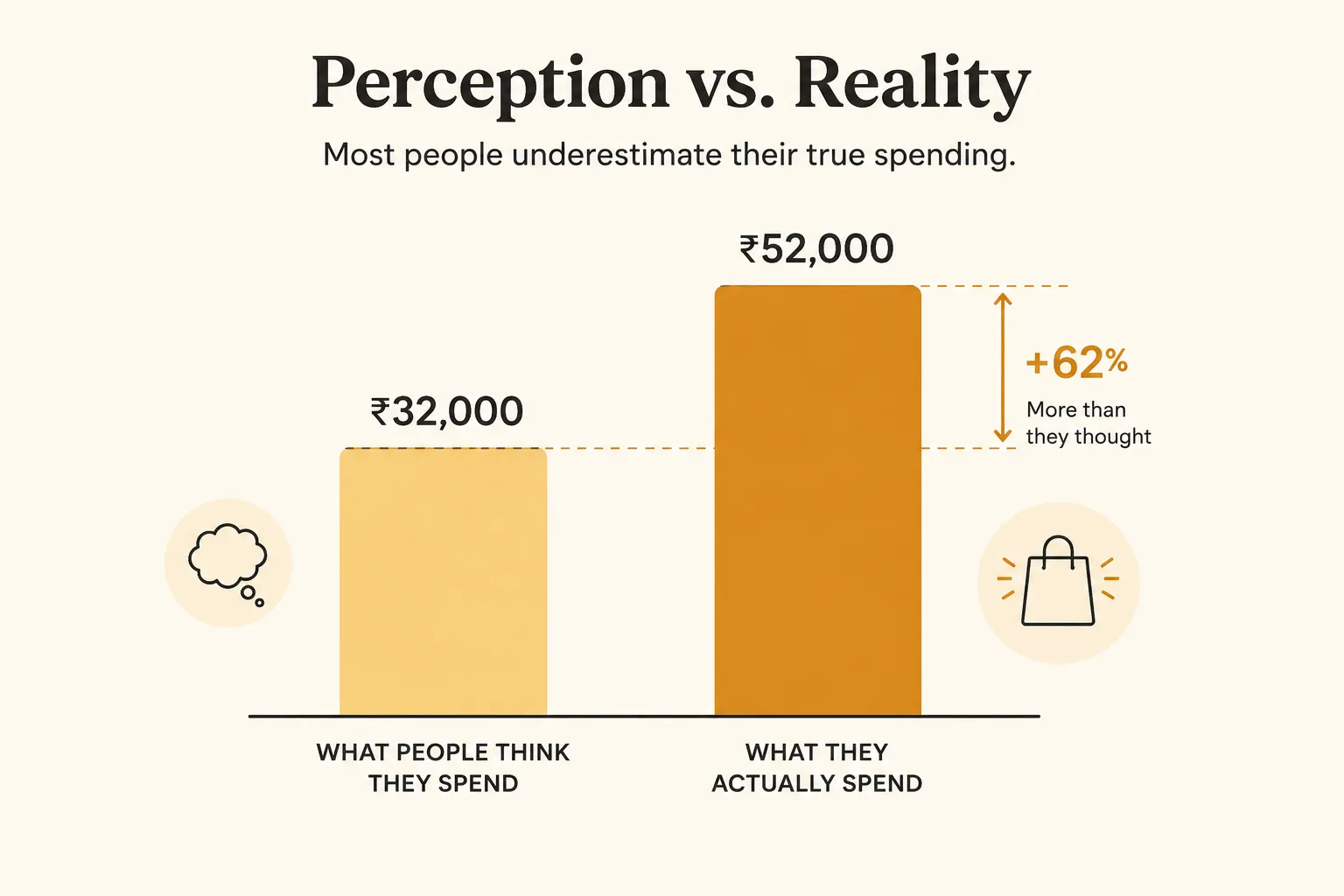
- People estimate their monthly subscription spend at roughly $86, but itemized totals average around $219 — a 2.5x gap.[1]
- 42% of people have forgotten about a subscription while still being charged for it.
- Around 70% of people have forgotten to cancel a free trial before it converted to a paid plan.
- Studies estimate 30-42% of subscription spending goes to underused or completely forgotten services.
- The average person holds somewhere between 3-12 active subscriptions, depending on how broadly "subscription" is counted — many undercount because they forget annual renewals and app-store charges bundled with other purchases.
Subscription creep is one of the quietest ways money leaves a household — not through one bad decision, but through dozens of small, individually reasonable ones that nobody ever reviews together. A ₹199 app here, a ₹499 streaming service there, an annual charge that only shows up once a year and gets forgotten by the time it renews. None of it looks like a problem in isolation. Added up, it consistently turns out to be far more than anyone expects — which is exactly why an audit, not just vague awareness, is the tool that actually works here.
The Gap Between What You Think You Spend and What You Actually Spend
The single most consistent finding across subscription research is the size of the gap between perceived and actual spending. One widely cited study found people estimated their monthly subscription spend at around $86, while itemized statements averaged $219 — a roughly 2.5x underestimation, and more than half of consumers underestimate by at least $100 a month.[1] The mechanism is straightforward: each individual charge is small enough to be unremarkable on a statement, so the brain never adds them up the way it would a single large purchase.
Why Cancelling Is Sometimes Harder Than It Should Be
Subscription creep isn't purely a memory problem — some of it is by design. Certain services intentionally make sign-up effortless while making cancellation slower, more confusing, or hidden behind extra steps — a pattern regulators have started actively targeting. In the US, the FTC's "click-to-cancel" rule aims to require that cancellation be no harder than sign-up: if you can subscribe online in one step, you should be able to cancel online in a similarly simple step, without being routed to a phone call or a retention agent.[2] The rule's legal status has shifted through 2025 and 2026, but several regions have since passed their own versions — regardless of where the law currently stands, checking your phone's app-store or platform-level subscription settings is usually a faster route to cancellation than a service's own website.
Where Subscription Money Usually Hides
Some categories of recurring charges are far more likely to be forgotten than others — knowing where to look first makes the audit faster and more thorough.
| Category | Why it's easy to forget | What to check |
|---|---|---|
| Streaming services | Multiple platforms with overlapping content; easy to keep "just in case something good comes on" | Last actual watch date, not last login |
| Cloud storage | Auto-renews annually; upgraded once for a specific file transfer and never downgraded | Actual storage used vs. plan size |
| Fitness and wellness apps | Signed up with New Year motivation; usage drops off within weeks but billing continues | Sessions or logins in the last 30 days |
| News and content subscriptions | Often annual, paid once and forgotten until the next renewal | Articles actually read per month |
| Software and productivity tools | Started for a single project; project ended, subscription didn't | Whether the original use case still exists |
| Old free trials | The exact pattern behind the ~70% forgotten-trial statistic — converted to paid and never noticed | Charges with unfamiliar or unclear merchant names |
The "unfamiliar merchant name" check is worth calling out specifically — many subscription charges appear on statements under a billing processor's name rather than the actual service, which is part of why they're so easy to overlook during a normal scan of a bank statement. A quick search of any unrecognized line item before writing it off usually reveals exactly what it is.
How to Run a Subscription Audit
The audit works because it replaces vague awareness ("I should probably check my subscriptions sometime") with a specific, one-sitting process that surfaces every recurring charge at once. Set aside about 30-45 minutes — most of that time is just gathering information, not making decisions.
- Pull three months of statements, not one. A single month's statement will miss quarterly and annual charges entirely — three months gives a much more complete picture of what's actually recurring.
- Check app store subscriptions separately. Charges through Apple's App Store or Google Play often appear on bank statements as a generic platform charge, not the actual service name — open your phone's subscription management screen directly to see the real list.
- Build one master list. For every recurring charge found, record the service name, amount, billing frequency, and roughly when you last actually used it.
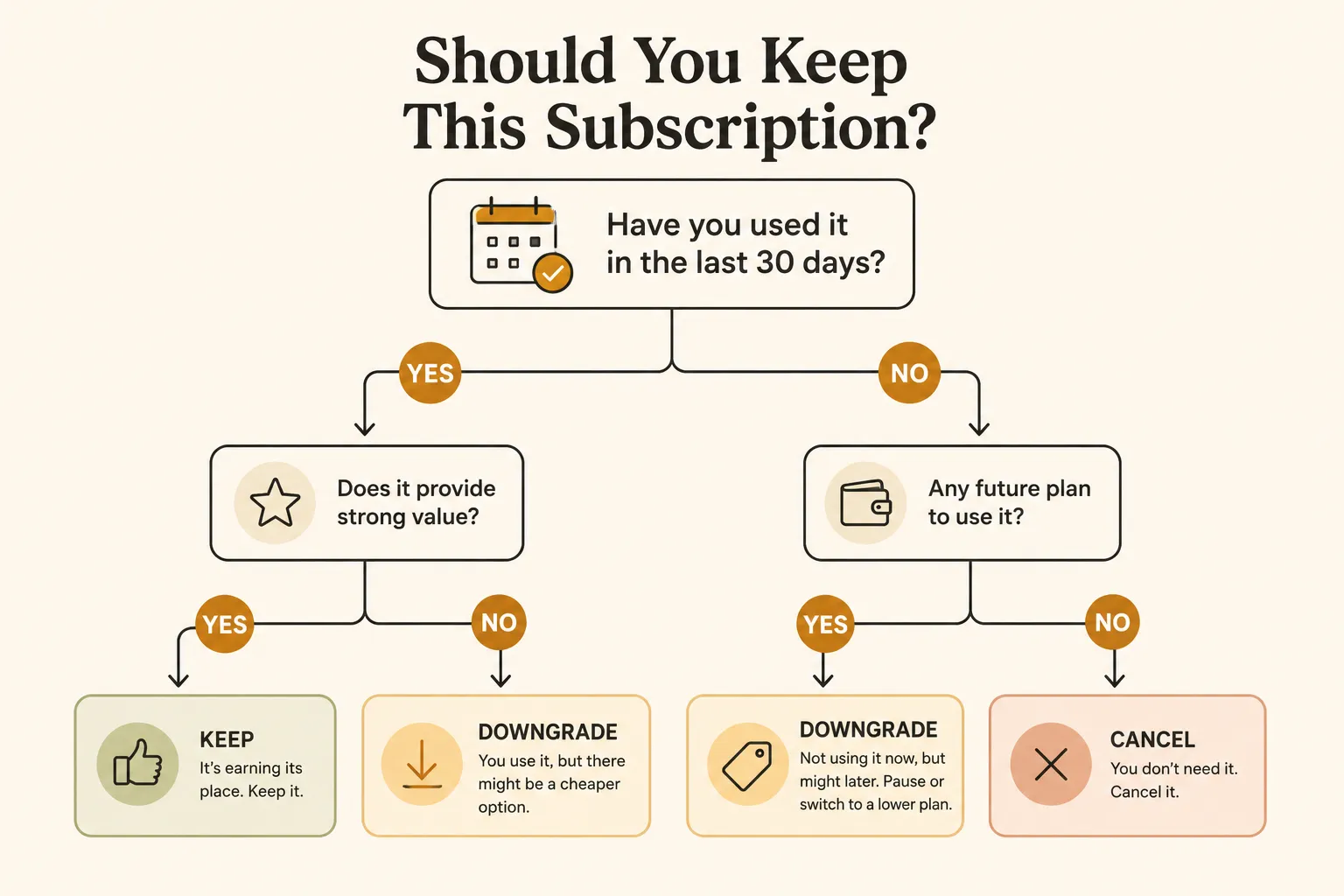
- Sort honestly into keep, downgrade, or cancel. Be specific about "last used" — a service you opened once three months ago to check something isn't meaningfully in use, even if you technically logged in.
- Cancel the unused ones immediately, not "later." Cancelling now usually still gives you access until the current paid period ends — there's no benefit to waiting for a renewal date.
- Set a recurring reminder to repeat this quarterly. Subscription creep rebuilds itself within a few months of any cleanup, so a one-time audit without a repeat schedule only delays the problem.
Deciding What to Keep, Downgrade, or Cancel
| Situation | Verdict | Why |
|---|---|---|
| Used meaningfully in the last 30 days | Keep | Genuine, current value — no action needed |
| Used occasionally, but a cheaper tier exists | Downgrade | Same core value at lower cost — check the plan settings |
| Not opened in 60+ days | Cancel | You can almost always resubscribe later if a genuine need returns |
| Signed up during a free trial, forgot about it | Cancel | The exact pattern behind the ~70% forgotten-trial statistic above |
| Overlapping services doing the same job | Cancel one | Two subscriptions rarely add twice the value of one |
The "might need it later" instinct is usually the biggest thing standing between people and a meaningful cut to their subscription bill. In most cases, resubscribing later takes minutes and costs nothing extra compared to paying monthly "just in case" — the math almost always favors cancelling now.
Building the Habit Beyond a One-Time Cleanup
A single audit typically surfaces real, immediate savings — but the bigger win is catching the next round of creep before it compounds again. Building the quarterly check into a wider money system makes it far more likely to actually happen; the free Budget Planner is a natural place to log recurring charges as a dedicated category rather than letting them blend into general spending. The same instinct that drives a good subscription audit — noticing what's quietly accumulating without adding real value — is also the core idea behind the one-in-one-out rule for physical belongings.
Common Mistakes
- Only checking one month of statements. Annual and quarterly charges will be invisible — always pull at least three months.
- Forgetting app-store subscriptions. These often don't show the actual service name on a bank statement — check your phone's subscription settings directly.
- Keeping something "just in case" for months at a time. The ongoing cost of "just in case" usually exceeds the minor friction of resubscribing later.
- Treating the audit as a one-time fix. Without a recurring reminder, subscription creep rebuilds within a few months.
- Not checking for overlap. Two services covering the same need rarely justify their combined cost — pick one.
Final Thoughts
The subscription audit isn't really about becoming a minimalist about apps and services — it's about making sure every recurring charge is a decision you're still actively making, rather than one you made once and never revisited. The gap between perceived and actual spending is large enough, and common enough, that it's worth treating as a genuine blind spot rather than a minor annoyance. Thirty to forty-five minutes, a few statements, and an honest "have I actually used this" question is most of what it takes.
The honest version of this advice: nobody signs up for twelve subscriptions on purpose in one sitting. It happens one reasonable decision at a time — which is exactly why it takes a deliberate audit, not just good intentions, to catch.
If this resonated, mindful consumption: buy less, enjoy more and the no-spend month both dig into the same underlying pattern of spending that's easy to not notice until someone actually adds it up.
This article is for general information and isn't financial advice. Review your own statements and account terms directly, and consult a financial advisor for guidance specific to your situation.
Sources
[1] Subscription spending statistics — perceived vs. actual monthly spend. Available at: self.inc
[2] FTC "click-to-cancel" rule and subscription cancellation regulation. Available at: jonesday.com