- Mindful consumption means buying less and using more of what you own — not buying nothing.
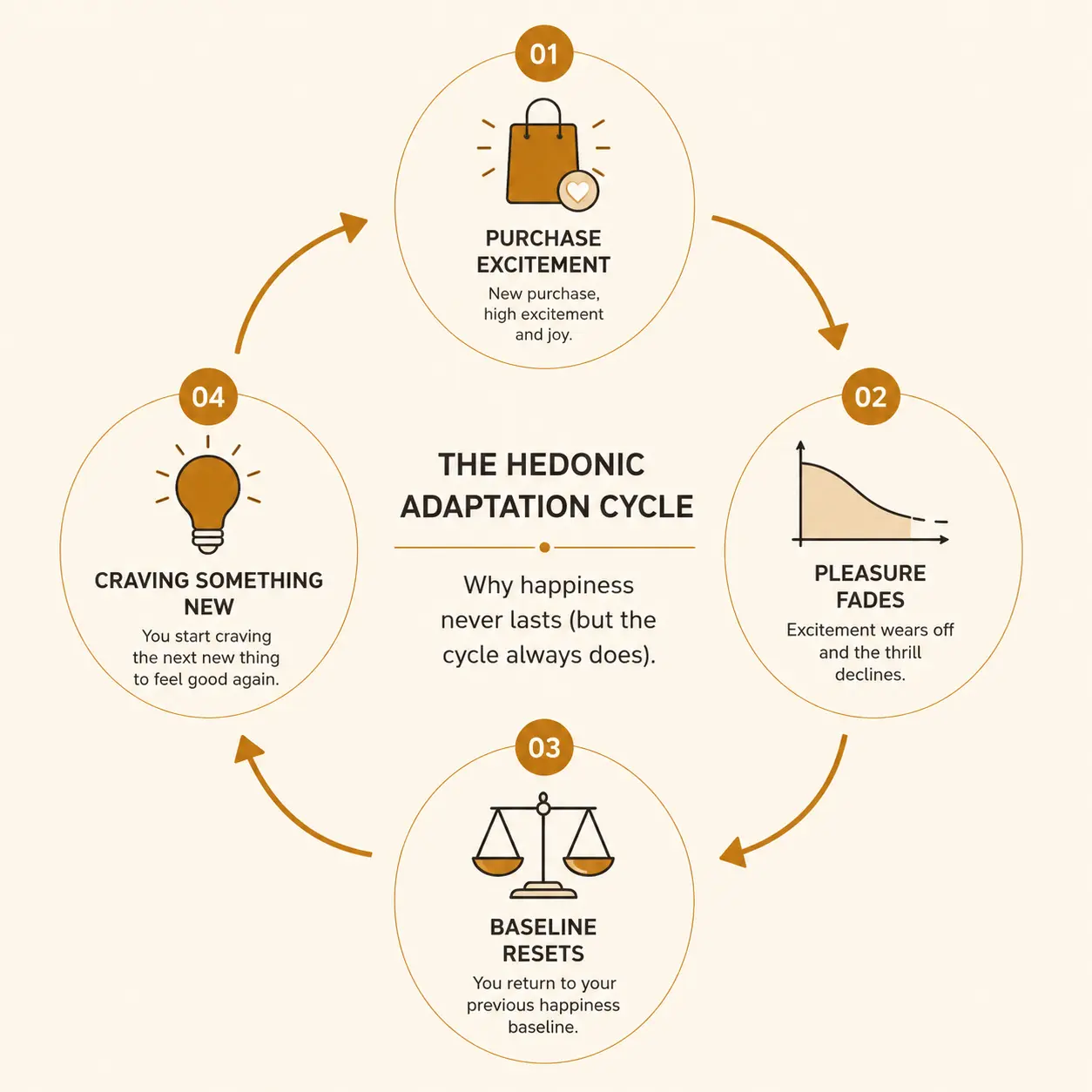
- Hedonic adaptation is the psychological process that makes the pleasure of a new purchase fade quickly, driving the urge to buy again.
- Research by Gilovich and Van Boven found experiential purchases produce more lasting happiness than material purchases, across every category studied.
- The average garment is worn only around 7 times before being discarded, even as people buy roughly 60% more clothing than in 2000.
- The 30-day rule works by giving the initial "want" impulse time to fade, revealing whether interest was genuine or momentary.
Mindful consumption means buying less overall and actually using and enjoying what you already own — it is not a rejection of buying things, and it doesn't require austerity or guilt about wanting nice things. The goal is closing the gap between what ends up in your cart and what ends up genuinely used in your life, a gap that for most people is far larger than they realize.
The reason this gap exists isn't a personal failing — it's a predictable psychological pattern with a name, and understanding that pattern is the first step toward a framework that actually changes buying behavior rather than just adding more willpower to the same broken system.
Why We Buy More Than We Use
A major driver of overbuying is hedonic adaptation — the psychological process by which the pleasure from a new purchase fades quickly as it becomes part of your normal baseline, creating pressure to buy something new to recreate that initial spike of satisfaction. This isn't a flaw specific to undisciplined people; it's a well-documented feature of how human reward systems work, and research indicates it actively encourages overspending and indebtedness.[1]
Combined with the low friction of modern shopping — one-click checkout, algorithmically targeted ads, manufactured sale urgency — hedonic adaptation creates a cycle: buying feels good briefly, the feeling fades faster than expected, and the response to that fading feeling is often to buy again rather than to notice the pattern itself.
Why Experiences Tend to Outperform Objects
Research by psychologists Thomas Gilovich and Leaf Van Boven found that experiential purchases produced more happiness than material purchases across every category studied, regardless of cost. Experiences are less subject to negative social comparison, tend to become a more positive part of a person's identity and personal story over time, and often build or strengthen social connections — all factors that make them more resistant to hedonic adaptation than an object sitting in a drawer.[2]
This doesn't mean material purchases are worthless or that objects can't bring real, lasting satisfaction — well-chosen, well-used possessions clearly do. It means the default assumption that a new thing will reliably produce lasting happiness is worth questioning specifically, given how consistently the research points the other way. It's also worth remembering on the way out the door, not just the way in — the same emotional weight that makes an object feel necessary to buy is often what makes letting it go later feel so much harder than it needs to.
The Cost Nobody Actually Calculates
The average garment is worn only around 7 times before being discarded, and clothing overall is worn about 36% fewer times than it was 15 years ago — even as people buy roughly 60% more clothing than they did in 2000. This gap between purchase volume and actual use is a useful proxy for mindless consumption more broadly, well beyond clothing specifically.[3]
| Metric | What the data shows |
|---|---|
| Average wears before discarding a garment | ~7 wears |
| Change in clothing purchase volume since 2000 | +60% |
| Change in times clothing is worn vs. 15 years ago | -36% |
For a deeper look at exactly what this pattern costs — financially and environmentally — the true cost of fast fashion breaks down the full accounting specifically for clothing. The same "purchased but barely used" pattern shows up in digital spending too — see the subscription audit for the equivalent exercise applied to apps and services instead of physical goods.
A Framework for Buying Less: Pause, Cost, Fit
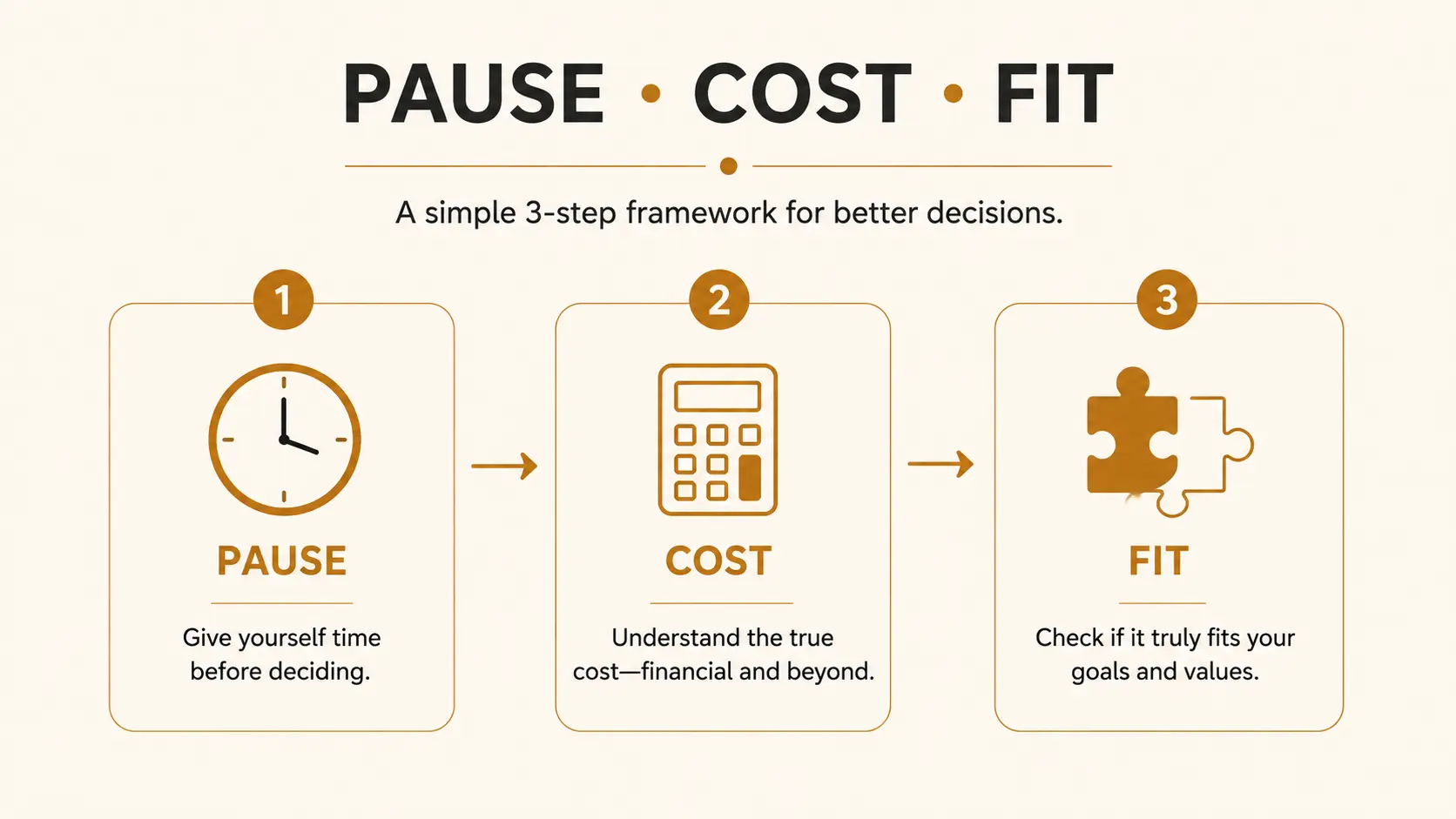
A simple three-step check before any non-essential purchase interrupts the adaptation cycle at the point where it's easiest to interrupt — before the purchase happens, not after.
- Pause. Apply a waiting period scaled to the price: a day or two for small purchases, a full 30 days for larger ones. The intensity of wanting something reliably decays over time — what feels urgent today often feels unnecessary in a week, and the 30-day rule works specifically because it gives that decay time to happen before money changes hands.[4]
- Calculate the real cost. Estimate cost-per-use, not just sticker price: an item worn or used 100 times at ₹2,000 costs ₹20 per use; the same ₹2,000 item used twice costs ₹1,000 per use. This single calculation reframes a huge share of impulse purchases immediately.
- Check the fit. Does this integrate with what you already own and actually do, or does it require a new habit, outfit, or lifestyle to justify itself? Purchases that fit an existing pattern get used; purchases that require inventing a new pattern usually don't.
On the other side of the same coin, the 90/90 rule applies this same logic in reverse — instead of pausing before a purchase, it checks whether something you already own has actually earned its place based on real use.
If wardrobe purchases specifically are the recurring pattern, building around a fixed rotation makes the "fit" question almost automatic — see the capsule wardrobe budget guide for a structured starting point. For a simpler, more mechanical guardrail that works alongside this framework rather than replacing it, the one in, one out rule caps accumulation directly at the point of purchase.
How to Actually Enjoy What You Already Own
Deliberately savoring existing possessions, introducing variety in how they're used, and practicing gratitude toward them are the three strategies research on hedonic adaptation prevention consistently points to.
- Savor deliberately. Actively noticing and appreciating an item — rather than letting it fade into background noise — measurably slows adaptation.
- Introduce variety in use, not in ownership. Wearing the same jacket with different combinations, using a kitchen tool for a new recipe, or rearranging how a space is used recreates novelty without a new purchase.
- Make what you own visible and accessible. Items buried in storage are effectively unavailable for enjoyment even though you technically own them — decluttering room by room often surfaces items worth rediscovering rather than replacing.
- Practice gratitude toward existing items specifically. A brief, genuine acknowledgment of why something is useful or meaningful counters the baseline-shifting effect of adaptation.
Common Mistakes
- Treating mindful consumption as a purity test. The goal is closing the gap between buying and using, not eliminating all purchases — an all-or-nothing framing tends to collapse quickly.
- Applying the pause only to big purchases. Small, frequent impulse buys often add up to more waste than the occasional large purchase — the pause is most valuable exactly where it feels least necessary.
- Replacing instead of rediscovering. Buying a "better" version of something you already own but rarely use, without first asking why it wasn't used, usually repeats the same pattern with a new object.
- Underestimating storage as a hiding place. An item you can't see or reach isn't meaningfully "owned" for enjoyment purposes — it's functionally already gone.
- Ignoring the cost-per-use math. A cheap item used once is more wasteful, financially and otherwise, than an expensive item used for years — price alone is a poor proxy for value.
Final Thoughts
Mindful consumption isn't about wanting less — it's about noticing that the gap between what you buy and what you actually use is usually much larger than it feels, and that closing it requires interrupting a specific, well-understood psychological pattern rather than trying to out-discipline it. A simple pause before buying, an honest cost-per-use calculation, and a deliberate effort to savor what you already own do more, collectively, than any amount of post-purchase guilt.
The goal isn't a smaller life. It's a life where what you own actually gets used, worn, and appreciated — which usually means owning less, not because less is a virtue, but because less is what you can actually pay attention to.
This same underlying idea — doing less, more deliberately — runs through what slow living actually means, and the free Minimalism Score Calculator is a useful starting point for seeing where the gap between buying and using is largest in your own life right now.
Sources
[1] Hedonic adaptation and consumption research. Available at: sonjalyubomirsky.com
[2] Van Boven, L. & Gilovich, T. Experiential vs. material purchases and happiness. Summary available at: news.utexas.edu
[3] Clothing wear-rate and purchase-volume statistics. Available at: panaprium.com
[4] The 30-day rule and impulse-spending psychology. Available at: bankrate.com