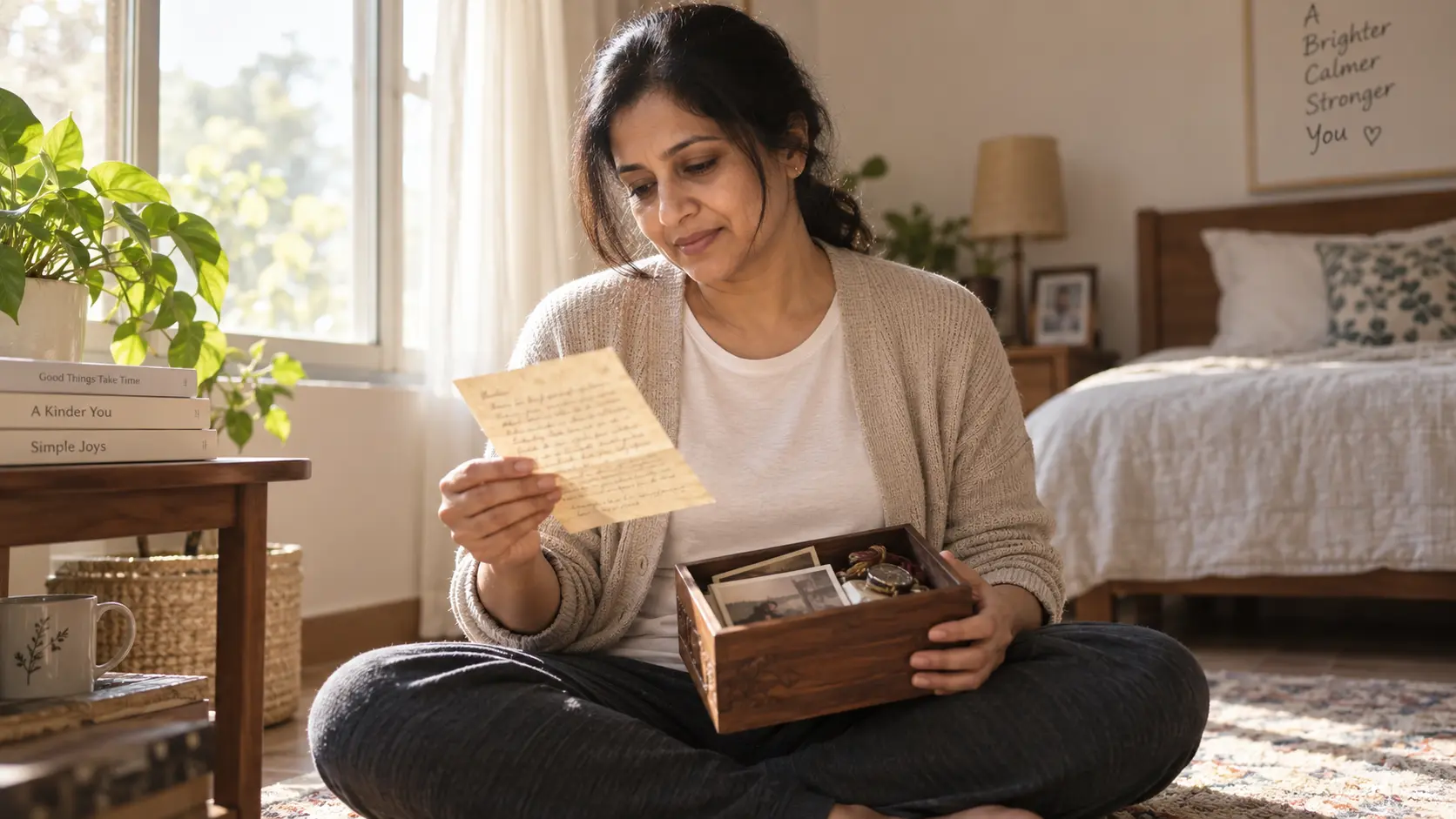
- Sentimental clutter is a leading reason decluttering attempts stall — not lack of time or system, but the emotional weight of specific categories of items.
- People consistently overvalue items they already own compared to identical items they don't, a pattern known as the endowment effect.[1]
- The memory or relationship an item represents exists independently of the physical object — this distinction is the basis of most effective sentimental-decluttering approaches.
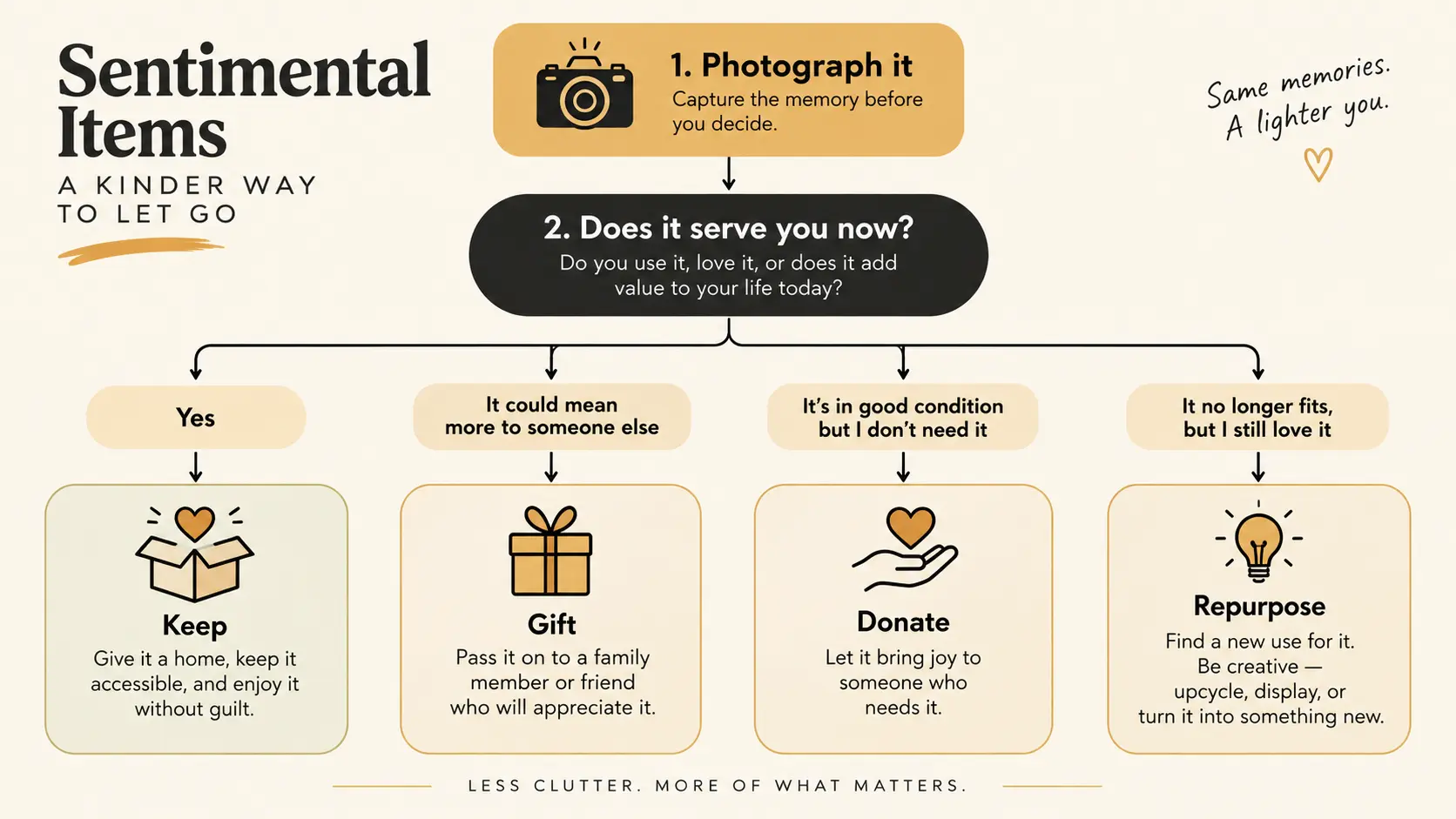
- Photographing an item before letting it go is one of the most consistently recommended strategies for preserving the memory without the physical accumulation.
- Guilt about discarding gifts is one of the most common — and most avoidable — blockers, since a gift's purpose is generally considered fulfilled at the moment it's given.
Almost nobody struggles to throw away a broken umbrella. The category of belongings that actually stalls a declutter — the box in the back of the closet, the drawer nobody opens, the shelf that never gets sorted — is almost always sentimental. Kids' artwork. Cards from people who've passed away. A sweater that belonged to someone. Gifts you never liked but can't seem to discard. Most decluttering advice focuses on process — bins, categories, the four-box method — and quietly skips over this part, because it's genuinely harder. This is the part that's usually missing.
Why Sentimental Items Are Different From Ordinary Clutter
With most belongings, the decision is functional: do I use this, do I need this, does this fit. Sentimental items bypass that logic entirely. The question your brain is actually asking isn't "is this useful" — it's "does getting rid of this mean I don't care about the person, the memory, or the version of myself it represents." That's a much heavier question, and it's also usually the wrong one, because it conflates the object with what the object represents.
This is closely related to a well-documented pattern in behavioral psychology called the endowment effect — people assign disproportionately higher value to things they already possess, and that effect gets stronger, not weaker, when the item carries emotional meaning.[1] It's not a character flaw or a sign of being "too sentimental." It's a predictable, near-universal response, which is exactly why generic decluttering advice ("just ask if it sparks joy") often isn't specific enough to actually work on this category.
The Guilt Trap — Why "Just Throw It Away" Doesn't Work
Most of the resistance to letting go of sentimental items isn't really about the object — it's about a rule you've quietly set for yourself about what keeping it means. Common versions of that rule: "getting rid of this means I'm ungrateful," "keeping it is how I honor them," "if I throw this away I'll forget," "a good parent keeps all of this." None of these rules were handed to you by the person who gave the gift or the memory itself — they're internal, and once you notice that, they're much easier to question.
The goal isn't to feel nothing about these items — that's neither realistic nor necessary. The goal is to separate the emotional weight of the decision from the practical one, so you can make a clear-eyed choice instead of defaulting to "keep everything" simply because deciding feels too hard.
A Framework for Sentimental Items
The same underlying approach applies across almost every category of sentimental clutter — it's just applied with different specifics depending on what the item is.
- Separate the memory from the object. Ask directly: am I keeping this because I need the physical object, or because I'm afraid of losing the memory if I don't? These require very different solutions.
- Photograph it if the memory is what matters. A clear photo, saved somewhere you'll actually see it again — not buried in an unsorted camera roll — preserves the memory without the physical space or maintenance. This is especially useful if you're working through this category ahead of a move, where a moving-specific declutter timeline gives sentimental items their own dedicated, unhurried time slot rather than squeezing them in at the last minute.
- Ask whether it serves your current life, not your past one. An item can have been meaningful once and not need a permanent place in your home now. That's not a betrayal of the memory — it's just accurate.
- For collections, keep one representative item instead of all of them. A drawer of concert ticket stubs becomes a single favorite, framed or kept somewhere visible, instead of a box nobody opens.
- Choose the destination with the same intention as the decision. Where the item goes next matters — see the section below on what to actually do with items you're releasing.
Category-by-Category: Common Sentimental Clutter
| Category | What usually works | Watch out for |
|---|---|---|
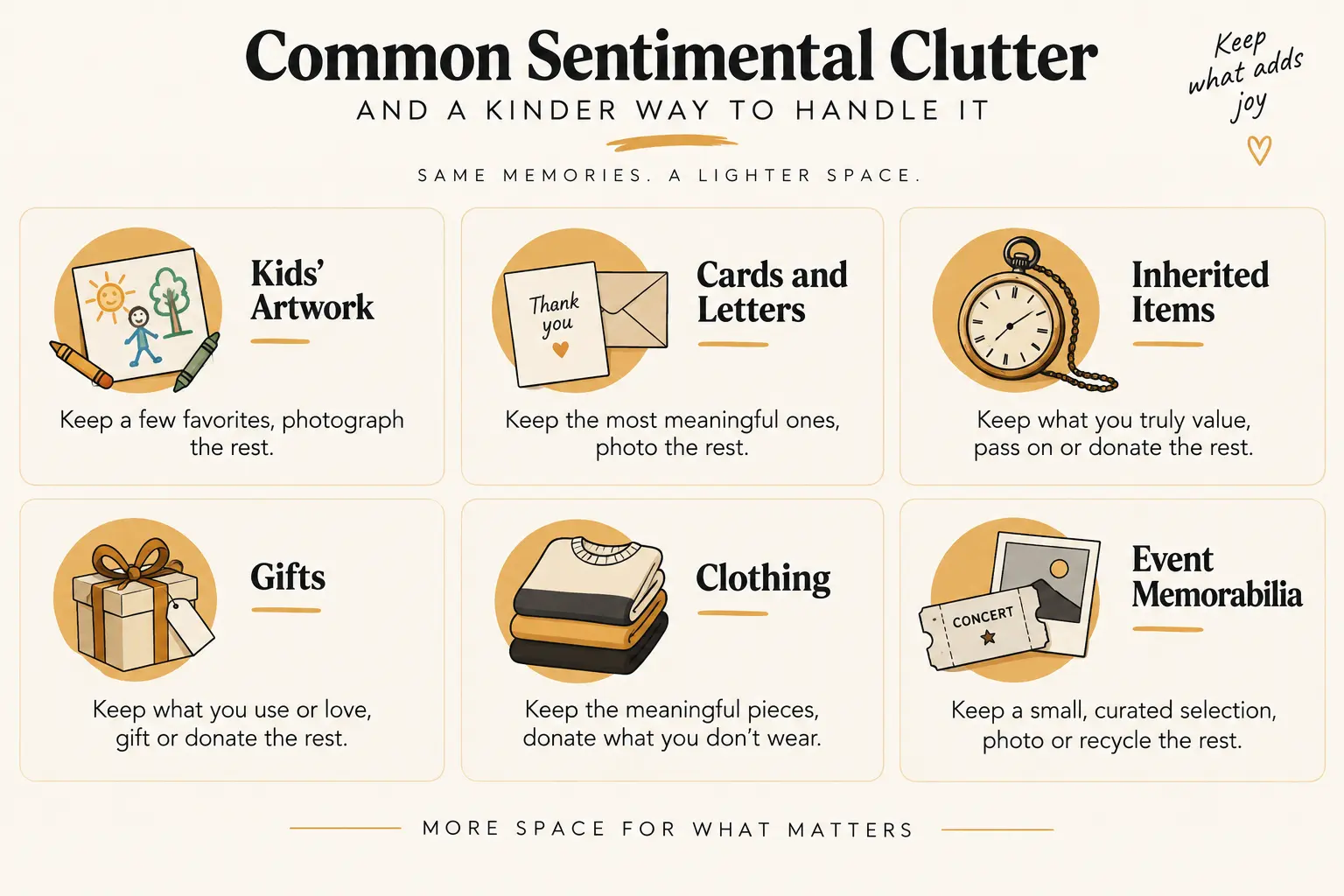
| Kids' artwork & schoolwork | Photograph everything; keep a small favorites folder per child per year | An "everything" box that grows every year and is never revisited |
| Cards & letters | Re-read once, keep only the ones with real specific meaning, photograph the rest | Keeping generic cards out of obligation ("Happy Birthday, love Aunt R") |
| Gifts you didn't want | Donate or regift with no guilt — the gesture was completed when it was given | Storing unused gifts "in case they ask about it" |
| Inherited items | Keep a few genuinely meaningful pieces; photograph and release the rest | Keeping everything to avoid feeling like you're erasing the person |
| Clothing tied to a memory or past self | Keep one or two signature pieces; repurpose fabric into something used (a cushion, a quilt square) | A closet section that hasn't been worn or looked at in years |
| Event memorabilia (tickets, programs, medals) | Keep the one best representative item; photograph the collection as a whole | A box that keeps every stub "just in case" |
What to Actually Do With Items You're Letting Go Of
Where a sentimental item goes next often determines whether letting go of it feels like loss or like care. Throwing something meaningful directly into general waste can feel dismissive even after you've made peace with releasing it — but there are usually better destinations that make the decision feel more resolved.
-
Gift it to someone who wants it A family member or friend who will actually use or display the item often turns a hard decision into an easy one.
-
Donate meaningfully A specific charity, school, or community group that will put the item to use tends to feel more resolved than a generic donation bin.
-
Repurpose into something used Old fabric into a cushion cover, letters scanned into a digital keepsake book — the material continues in a form you'll actually engage with.
-
Photograph and let it go with intention Take the photo somewhere with good light, write a short caption or memory alongside it, then release the object itself.
When to Keep It — Sentimental Isn't Always Wrong
None of this is an argument for keeping nothing. A small, deliberately curated set of genuinely meaningful items — a grandmother's ring, a child's first pair of shoes, a specific letter you reread every year — is a completely reasonable outcome. The distinction that matters is between a deliberate, considered keep and an automatic one made out of guilt or avoidance. If you can articulate specifically why an item matters and you'd choose to keep it again today, that's a real keep, not clutter. This is exactly where a fast test like the 90/90 rule falls short for sentimental items specifically — usage in the last 90 days was never the point.
Common Mistakes
- Treating "sentimental" as a blanket reason to keep everything. Not every item connected to a memory is equally meaningful — some carry real weight, most don't.
- Storing items instead of deciding on them. A box in the attic labeled "sort later" often means "avoid indefinitely" — set a real date to revisit it.
- Feeling obligated to keep every gift forever. A gift's purpose was fulfilled when it was given and appreciated, not by being stored unused for decades.
- Deciding everything in one emotional sitting. Sentimental items are genuinely more tiring to process — spread the decisions across several shorter sessions rather than one long one.
- Skipping the photograph step. A quick photo before releasing an item resolves most of the "but what if I forget" anxiety at almost no cost.
Sentimental items are where professional organizers lean hardest on client-centred skills — pacing, consent, and never deciding for someone. Our free CPO® Exam Prep course covers how organizers handle these conversations, if you're curious about the professional side.
Final Thoughts
Sentimental clutter is hard precisely because it isn't really about the objects — it's about what you've decided keeping them means. Separating the memory from the item, choosing intentional destinations, and allowing yourself to keep a genuinely meaningful few rather than an obligatory many turns an emotionally exhausting task into a manageable one. This is usually the missing piece in a stalled declutter, more than any bin system or schedule. Both Swedish death cleaning and KonMari save sentimental items for last for exactly this reason.
You don't owe an object your storage space just because it once mattered. The memory stays with you either way — the question is only whether the physical item needs to stay too.
Once the sentimental layer feels more manageable, the 7-Day Home Declutter Sprint walks through the rest of the home zone by zone, or the room-by-room weekend guide covers the faster version if you're ready to keep moving.
This article offers general organizational guidance and isn't a substitute for grief counseling or professional support if letting go of items feels connected to a significant loss.
Sources
[1] Kahneman, Knetsch & Thaler on the endowment effect and loss aversion. Available at: jstor.org
[2] Possessions and the extended self — research on objects, identity, and meaning. Available at: journals.uchicago.edu