
If you've ever decided to "finally sort the house out", you've probably met two names: Marie Kondo, whose KonMari method made "does it spark joy?" a household phrase, and Margareta Magnusson, whose gentler Swedish death cleaning asks you to think about what you'd leave behind. Both promise a lighter, calmer home. They get there in almost opposite ways.
This is a head-to-head comparison: how each method works, the question at its heart, how long it takes, who it suits, and where each one tends to go wrong. By the end you should know which to start with — or how to borrow the best of both.
The Short Answer
How the KonMari Method Works
Marie Kondo's method rests on six rules: commit to tidying, picture your ideal lifestyle, finish discarding before you organise, tidy by category rather than by location, follow a set order, and ask whether each item sparks joy.[1]
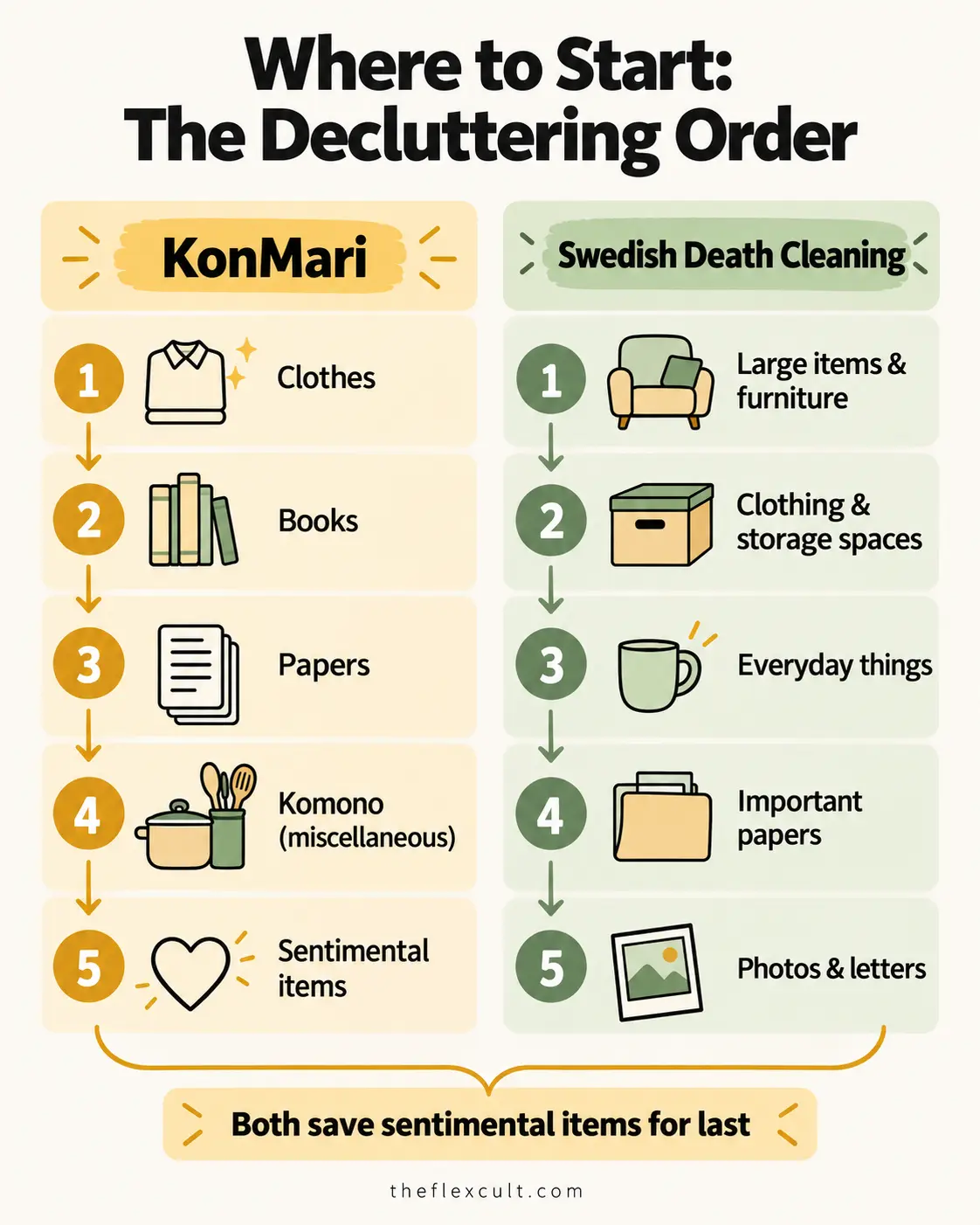
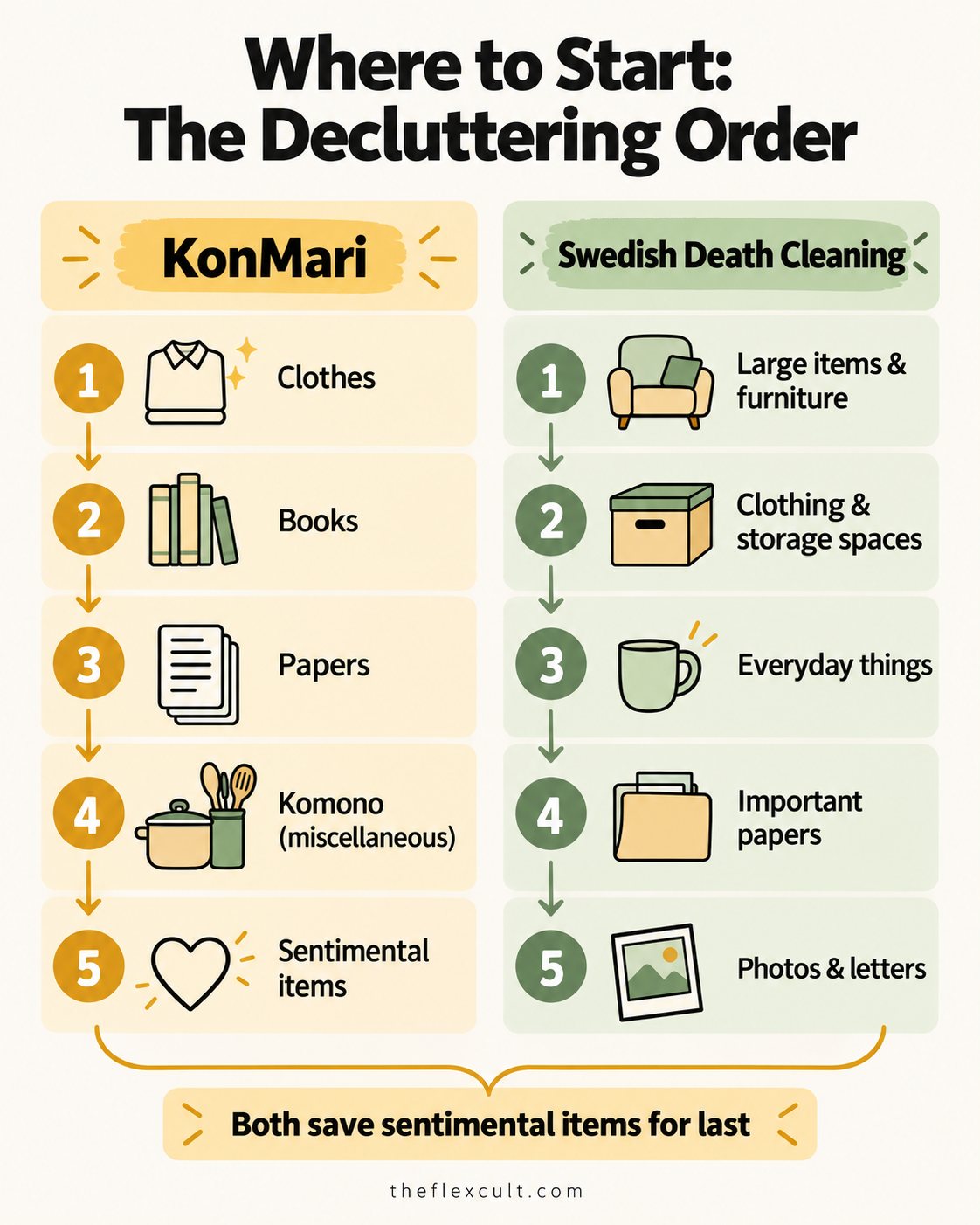
The category order is the backbone:
- Clothes — the easiest place to practise making quick decisions
- Books
- Papers
- Komono — miscellaneous items: kitchen, bathroom, garage, cables, gadgets
- Sentimental items — saved for last, when your "keep or let go" judgement is sharpest
For each category, you gather everything from every room into one pile, then pick up each item and ask whether it sparks joy. Items that do stay; items that don't are thanked and let go.[1] Only after discarding do you organise what's left — with Kondo's well-known vertical folding and "everything has a home" storage.
The defining feature: it's meant to be done as one concentrated event, not a little at a time. The dramatic before-and-after is part of the point.
How Swedish Death Cleaning Works
Swedish death cleaning — döstädning, from the Swedish for "death" and "cleaning" — was popularised by artist Margareta Magnusson in The Gentle Art of Swedish Death Cleaning. Despite the name, it's not morbid. It's a practical, even affectionate idea: reduce your belongings gradually so that the people you love aren't left to sort through a lifetime of things after you're gone.
The approach is gentle and steady:[2]
- Start big and impersonal. Begin with larger, less emotional things — furniture, clothing, the storage room — before anything sentimental.
- Leave photos and letters for last. Sentimental items take the most time and energy, so they come at the end.
- Give things away thoughtfully. Offer items to family and friends who'll genuinely use them; sell or donate the rest.
- Digitise where it helps. Scan photos and letters, then pass on or let go of the physical copies.
- Keep a "throw away" box. Private things that matter only to you go in a clearly labelled box your family can discard without opening.
- Talk about it. Part of the method is an open conversation with loved ones about what you have and what should happen to it.
The defining feature: it's an ongoing practice, not an event. You chip away over months or years.
Head-to-Head Comparison
| KonMari | Swedish death cleaning | |
|---|---|---|
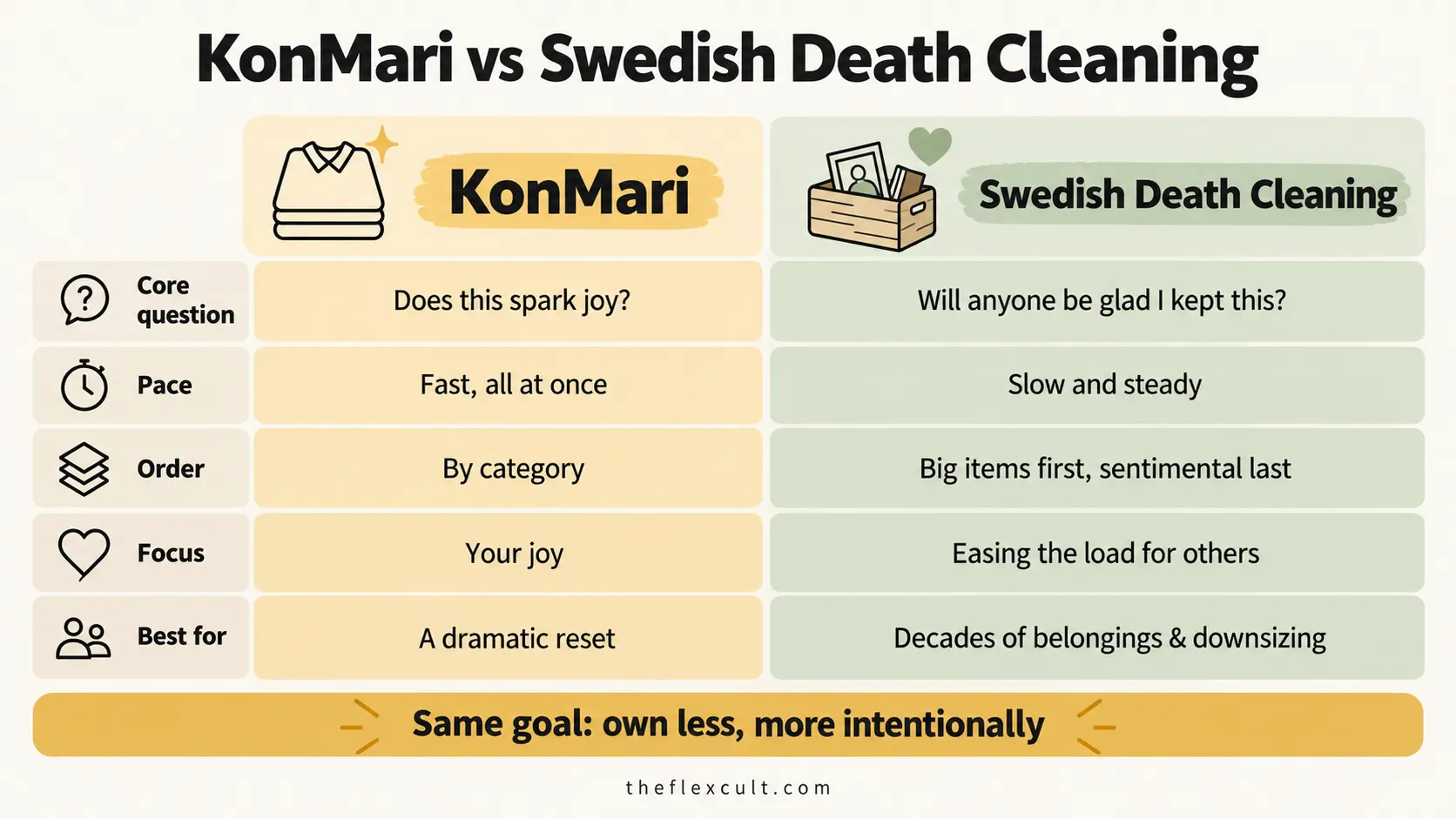
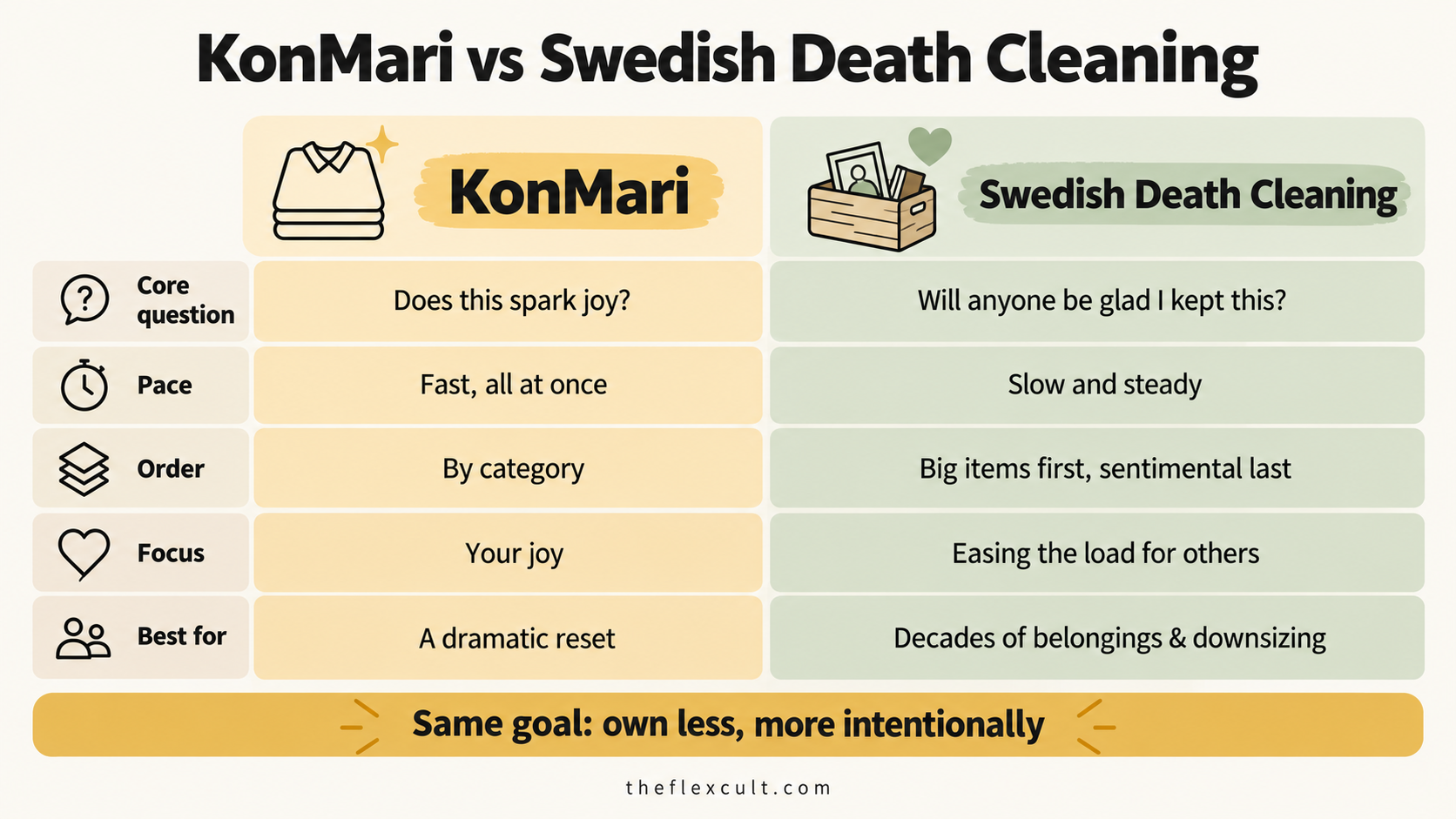
| Core question | "Does this spark joy for me?" | "Will anyone be glad I kept this?" |
| Pace | Fast and intensive — one concentrated tidying event | Slow and ongoing — a little at a time |
| Organising principle | By category, in a fixed order | Big and impersonal first, sentimental last |
| Focus | Your own joy and ideal lifestyle | Practicality, and the burden on others |
| Sentimental items | Last category; keep what sparks joy | Last of all; digitise, pass on or keep a small selection |
| Emotional tone | Energising, celebratory | Reflective, calm, practical |
| Time commitment | Big block of time up front | Small, regular sessions over months |
| Best for | A dramatic reset; people who like momentum | Large accumulations, downsizing, gentle pace |
Why Decluttering Is Worth the Effort
Whichever method you choose, there's reason to think the effort pays off beyond looks. In a study of 60 dual-income couples, women who described their homes using more stressful words — "cluttered", "chaotic", "unfinished" — showed less healthy daily cortisol patterns and more depressed mood over the day than women who described their homes as restful.[3] It's a correlation in a small sample, not proof that clutter causes stress, but it fits what many people feel: a home that's hard to live in is quietly draining.
Both methods address that — just with a different emotional engine. KonMari runs on joy. Swedish death cleaning runs on care: for your future self and for the people around you.
Pros and Cons of Each
KonMari
- Pro — fast, visible results. Seeing a whole category at once makes the scale of overbuying obvious and the transformation dramatic.
- Pro — a clear system. The fixed order removes decisions about where to start.
- Con — overwhelming for big homes. Piling every item of clothing on the bed can be paralysing if you have decades of stuff, health limits, or little free time.
- Con — "joy" doesn't fit everything. A tax folder, a plunger or a winter coat rarely sparks joy, but you still need them. Most people quietly add "…or is genuinely useful".
Swedish death cleaning
- Pro — gentle and sustainable. Small sessions fit around real life and are easier to keep up.
- Pro — thinks beyond you. It naturally covers what decluttering methods often skip: important documents, passwords, and what happens to heirlooms.
- Con — slow to see. Progress can feel invisible, which makes it easy to drift.
- Con — the name puts people off. Some people find it difficult to think about mortality, even in a practical way. If that's you, call it "gentle decluttering" and keep the method.
Which Method Fits You?
-
Start with KonMari if… You can set aside a few full days or weekends, you're motivated by big visible change, your home is a manageable size, and you're decluttering mainly for yourself.
-
Start with Swedish death cleaning if… You have decades of accumulated belongings, you prefer short, steady sessions, you're planning to downsize or move, or you're helping a parent — or yourself — think about what will be left behind.
-
Combine them if… You want KonMari's momentum for everyday categories but Swedish death cleaning's calm, practical lens for papers, heirlooms and sentimental items.
Not sure? The free Minimalism Score Calculator gives you a quick read on how much you're living with right now, and the method-chooser in the downloads below scores which approach fits your situation.
How to Combine Both: A Practical Hybrid
Many people get the best results by borrowing from both:
- Use KonMari's order for everyday things. Clothes, books and komono in one focused burst — it builds decision-making muscle fast. Our room-by-room declutter plan works as an alternative if gathering a whole category in one place is impractical.
- Swap "joy" for a two-part test. Keep it if it sparks joy or it's genuinely useful — and ask the Swedish question too: would anyone want this after me?
- Slow down for papers. Treat documents the Swedish way: gather the important ones (identity, insurance, property, accounts, a will) in one clearly labelled place and tell someone you trust where it is. A one-page financial plan is a good companion to this step.
- Take sentimental items last, and slowly. Both methods agree here. The guide to letting go of sentimental clutter helps with the hardest decisions, and decluttering digital photos keeps scanned memories from becoming a new mess.
- Keep a "throw away" box. It's one of Swedish death cleaning's most useful ideas, and it works at any age.
- Protect the result. Once you're done, simple rules stop clutter creeping back — the one in, one out rule and the 90/90 rule are the easiest to stick to.
Getting Started This Weekend
Whichever method you choose, the first session matters most. Keep it small enough to finish:
| KonMari first weekend | Swedish death cleaning first weekend | |
|---|---|---|
| Saturday | Gather every item of clothing in one place. Decide on each piece; fold and store what stays. | Pick one storage space — a wardrobe top shelf, the loft, under the bed. Clear only that. |
| Sunday | Books. Pile them, decide, and box up donations the same day. | List five larger items you no longer need and message family or friends who might want them. |
| By next week | Drop off donations and book a date for papers. | Start your "throw away" box and a folder for important papers. |
Common Mistakes With Either Method
- Buying storage before decluttering. Both methods say discard first, organise second. Containers bought too early just hide the problem.
- Starting with sentimental items. It's the hardest category, and starting there is the fastest way to stall.
- Decluttering other people's things. Work on your own belongings. Shared or family items need a conversation, not a bin bag.
- Letting the "donate" pile live in the hallway. Book the drop-off or pick-up the same week, or it quietly moves back in.
- Treating it as one and done. Even KonMari's single event needs simple habits afterwards to last.
If you want a structured start, the free 7-Day Home Declutter Sprint gives you one focused task a day — a good way to test which pace suits you before committing to either method.
Final Thoughts
KonMari and Swedish death cleaning are often presented as rivals, but they're better seen as two tools. KonMari is the burst of energy that shows you what's possible. Swedish death cleaning is the calm, steady practice that keeps a home — and a life's worth of belongings — manageable for you and for the people you love.
Joy is a good reason to keep something. Kindness to the people who come after you is a good reason to let it go.
And if organising homes is something you'd like to do for other people, the free Certified Professional Organizer (CPO®) exam prep covers how professionals assess a space and help clients sort, categorise and let go.
This article is for general information only. If decluttering feels overwhelming in a way that affects your daily life, or you're helping someone who struggles to let go of possessions, consider speaking to a doctor or a qualified professional organiser. The Flex Cult is not affiliated with KonMari Media or with Margareta Magnusson.
Sources
[1] About the KonMari Method — the six basic rules and category order. KonMari (official site). Available at: konmari.com
[2] Review: The Gentle Art of Swedish Death Cleaning by Margareta Magnusson. Shelf Awareness, 2018. Available at: shelf-awareness.com
[3] Saxbe DE, Repetti R. No place like home: home tours correlate with daily patterns of mood and cortisol. Personality and Social Psychology Bulletin, 2010. Available at: pubmed.ncbi.nlm.nih.gov