
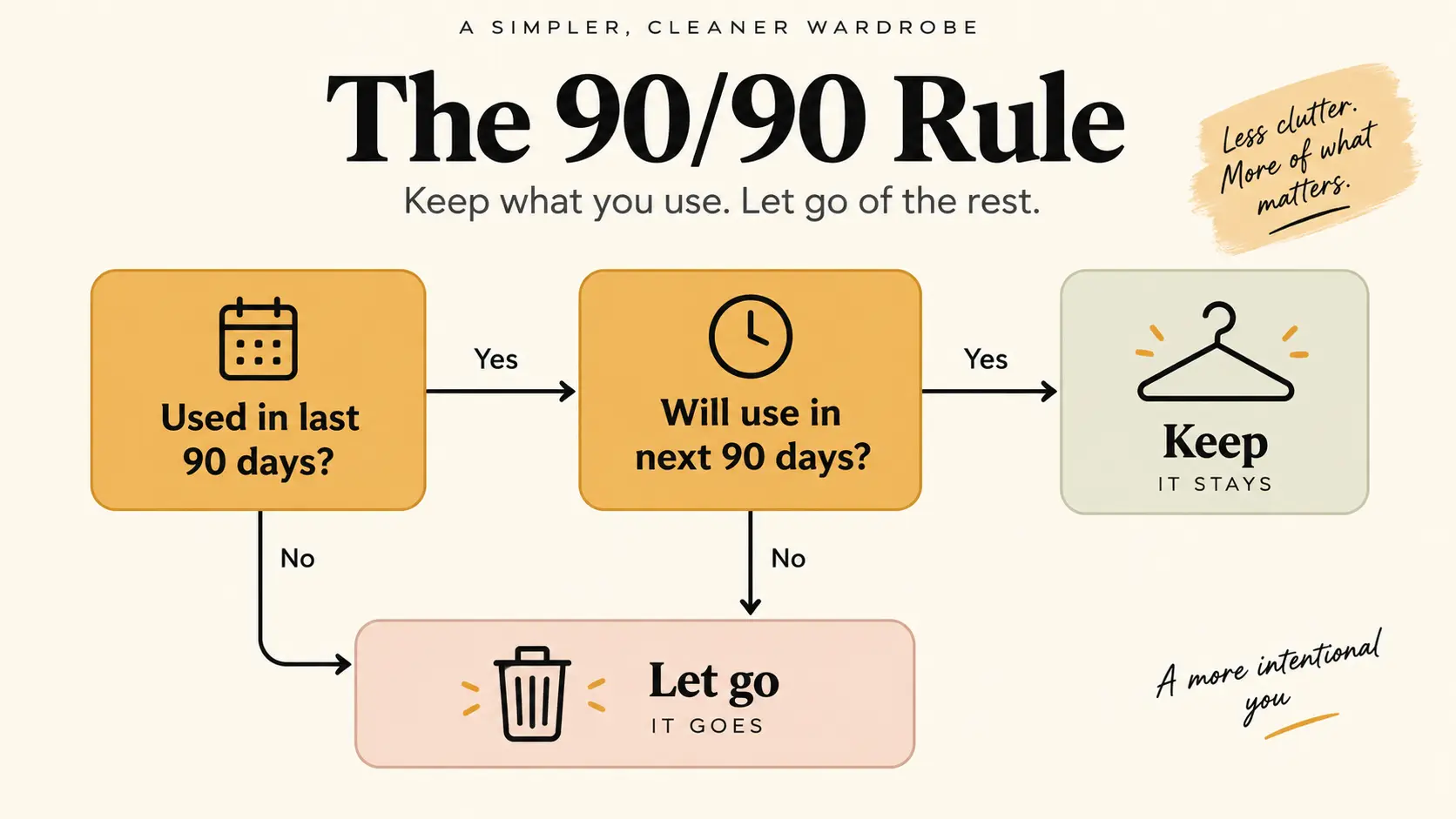
- The 90/90 rule asks two questions per item: used in the last 90 days? Will you genuinely use it in the next 90 days?
- If the honest answer to both is no, the item is a strong candidate to let go of.
- The rule was popularized by minimalism writers Joshua Fields Millburn and Ryan Nicodemus (The Minimalists) as a fast, repeatable decision heuristic.
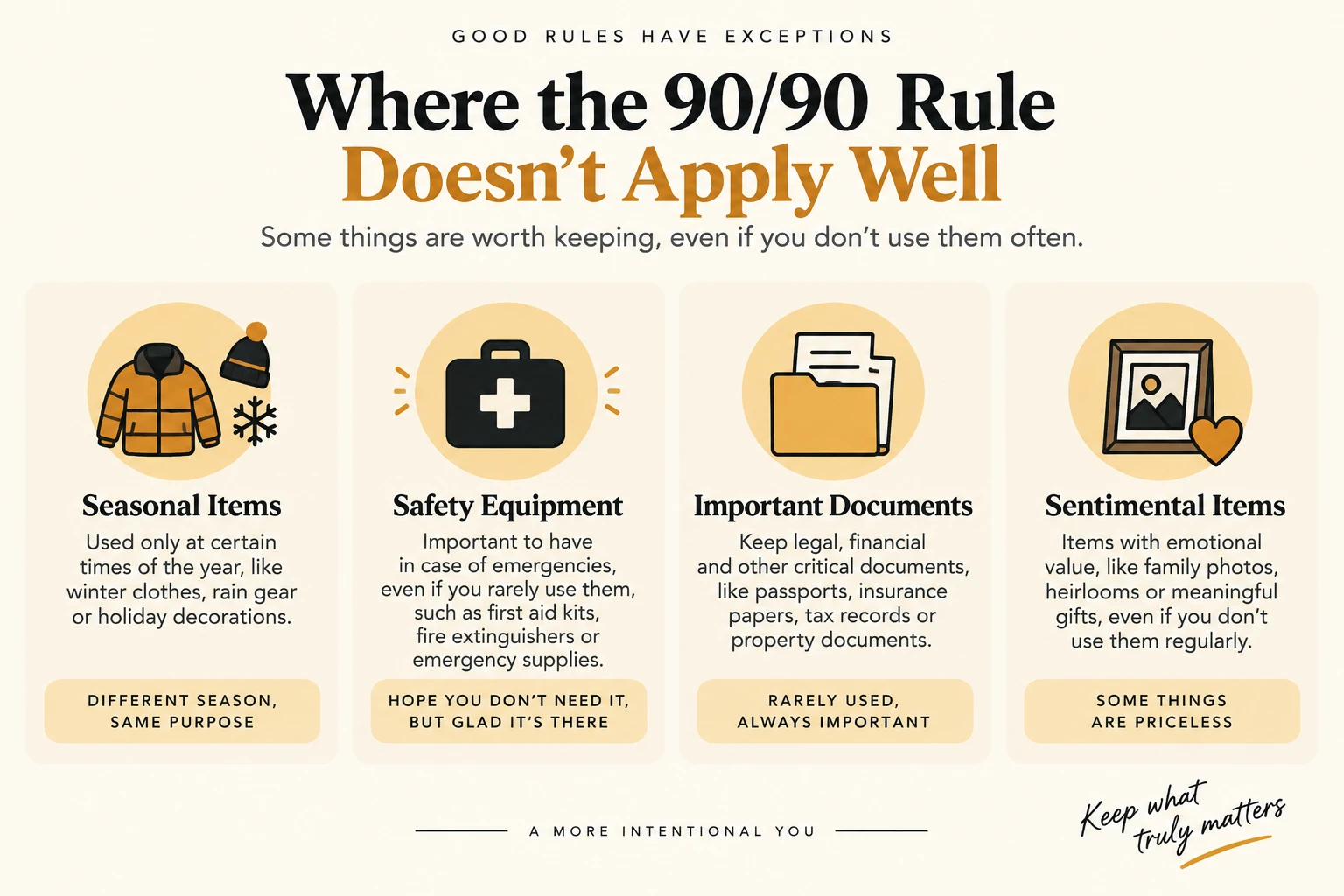
- It works best on everyday, replaceable items — clothing, kitchen tools, decor — and works poorly on seasonal, safety, and sentimental items.
Most decluttering advice asks you to think too hard about too many things at once — sentimental value, potential future use, what it cost, whether you "might need it someday." The 90/90 rule strips all of that down to two concrete questions you can answer in about ten seconds per item. It won't work for everything, but for the bulk of ordinary household clutter, it's the fastest genuinely useful test available.
What the 90/90 Rule Actually Is
For any item you're unsure about, ask: have you used it in the last 90 days? And will you genuinely use it in the next 90 days? If the honest answer to both is no, it's a strong candidate to donate, sell, or discard. If either answer is yes, it earns its place — for now.
The power of the rule is in how it replaces a vague, emotionally loaded question ("could I need this someday?") with a specific, checkable one ("did I actually use this recently, and do I have a real reason to expect I will soon?"). Almost anyone can answer the second version honestly; almost no one can answer the first without talking themselves into keeping everything.
How to Apply It, Item by Item
| Item | Used in last 90 days? | Will use in next 90? | Verdict |
|---|---|---|---|
| Jacket worn once since spring | No | Unlikely this season | Let go |
| Blender used weekly | Yes | Yes | Keep |
| "Someday" craft supplies | No | No specific plan | Let go |
| Formal outfit for a wedding next month | No | Yes, specifically | Keep |
Notice the wedding outfit: the rule isn't purely mechanical. "Will use in the next 90 days" only counts as yes when there's a specific, real reason — not a hypothetical one. A vague "I might dress up sometime" doesn't qualify the same way a wedding on the calendar does. For a full method rather than a single rule, see Swedish death cleaning vs KonMari.
When the 90/90 Rule Doesn't Work Well
The rule breaks down for a handful of categories where "recent use" is a misleading signal:
- Seasonal items. A winter coat or holiday decorations can easily sit unused for well over 90 days while still being exactly the right thing to keep.
- Safety and emergency items. A fire extinguisher, spare fuses, or a first-aid kit are supposed to go unused — that's the point.
- Important documents. Passports, property papers, and similar documents aren't used often but are essential when needed.
- Sentimental items. These need a different kind of evaluation entirely — see how to let go of sentimental clutter for a framework built specifically for this category.
If you're applying this rule specifically while preparing for a move, sorting by category rather than room tends to work better with how packing actually happens — the moving-specific declutter timeline covers that adapted approach in full.
Common Mistakes
- Applying it to sentimental or seasonal items without adjusting. The rule assumes ordinary, replaceable items — not everything fits that assumption.
- Counting a vague "maybe someday" as a yes. The second question needs a specific, real reason, not just a hypothetical one.
- Using it once and stopping. A periodic re-check — every few months — catches items that quietly stopped being used since the last pass.
Decision rules like this one are part of a professional organizer's everyday toolkit. If you're considering organizing as a career, our free CPO® Exam Prep course covers how organizers guide clients through keep-or-release decisions.
Final Thoughts
The 90/90 rule works because it replaces an emotional question with a factual one — and factual questions are much easier to answer honestly. It won't solve every category of clutter, but for the everyday items that make up most of a cluttered home, it's fast, repeatable, and hard to argue your way around.
The rule isn't asking whether an item has value. It's asking whether it has value to you, right now, based on what you've actually done — not what you might someday.
Once you've cleared the easy items with 90/90, the one-in-one-out rule is the natural next step for keeping the level you've reached from creeping back up.
Sources
[1] The Minimalists — origin and explanation of the 90/90 rule. Available at: theminimalists.com