
Most decluttering attempts fail for the same reason diets do: they start with too much ambition and no order. "This weekend I'm going to declutter the whole house" turns into two hours of pulling everything out of one closet, a mountain of stuff on the bed, a wave of decision fatigue, and a room that is now worse than when you started.
Decluttering an entire home is not actually a big task. It is a sequence of small, specific tasks, done in an order that keeps you moving instead of stuck. Skip the order and it becomes overwhelming. Follow it and a full home declutter fits into a single weekend.
This is that sequence — room by room, with a fixed sorting rule, a realistic two-day schedule, and a system for keeping it from filling back up the following month. (Prefer to work by category instead, or at a slower pace? Compare Swedish death cleaning vs KonMari.)
Why Most Decluttering Attempts Don't Stick
There are three specific reasons a decluttering weekend usually falls apart before it finishes.
No fixed order. Starting wherever feels "worst" usually means starting with the hardest room — the garage, the storage cupboard, the room everyone avoids. Hard decisions early on burn motivation before momentum has a chance to build.
A fourth pile called "maybe." Every item should go into one of three categories. The moment a "maybe" or "sort later" pile appears, it absorbs half of everything you touch, and that pile sits in a corner for six months, at which point it just becomes new clutter. A fast way to resolve a "maybe" on the spot is the 90/90 rule — two quick questions that turn most maybes into a clear yes or no.
No plan for where things actually go after. Bags of donations left by the front door for "next time you're out" have a way of quietly working their way back into the house. Without a same-week destination, decluttered items just relocate.
This room-by-room approach works well for a general reset. If you're decluttering specifically ahead of a house move, the moving-specific declutter timeline uses a slightly different, category-based approach that lines up better with how you'll actually be packing.
Which Room to Start With — And Why Order Matters
The order below moves from easiest decisions to hardest, so your motivation is highest exactly when the choices get harder. It also roughly mirrors the sequence used in the 7-Day Home Declutter Sprint, compressed from seven days into one weekend for anyone who wants the same result faster.
| Zone | Why this position | Typical time | Difficulty |
|---|---|---|---|
| 1. Bedroom surfaces | Collects daily-transit clutter — items set down "temporarily." Fast, visible win. | 45–60 min | Very easy |
| 2. Closet & wardrobe | Clear rules exist (fit, wear frequency), so decisions are fast once you start. | 90–120 min | Medium |
| 3. Bathroom | Mostly expiry dates and duplicates — low emotional attachment, quick decisions. | 30–45 min | Easy |
| 4. Kitchen | More categories (gadgets, containers, pantry), so it takes longer but pays off daily. | 90–120 min | Medium |
| 5. Living room & shared spaces | Involves other people's things — slower, more negotiation, save for when you have momentum. | 60–90 min | Medium |
| 6. Digital & paper clutter | No physical fatigue but real decision fatigue — better placed once you're "in the zone." | 45–60 min | Easy |
| 7. Entryway + prevention system | The last zone builds the structure that protects everything you just cleared. | 20–30 min | Very easy |
If you want the slower, more thorough version of this exact sequence — one zone a day with daily prompts and a tracker — the 7-Day Home Declutter Sprint walks through it at a gentler pace. This guide condenses the same seven zones into two focused days.
The Realistic Weekend Plan: Two Days, Room by Room
This assumes roughly five to six focused hours each day — not twelve. Trying to do the entire house without breaks is exactly the kind of over-ambition that causes people to quit halfway.
- Clear every flat surface — nightstands, dresser top, floor
- Strip the bed, sort under-bed storage
- Empty the closet onto the bed, sort with the keep/donate/bin rule
- Return only what you're keeping, folded or hung properly
- Empty the cabinet and under-sink storage completely
- Check every expiry date — bin anything expired
- Consolidate duplicates (three half-used shampoos become one)
- Bag donations and load them into the car immediately
- Clear counters down to only what you use daily
- Sort one drawer and one cupboard fully — don't try all of them
- Check the pantry for expired or duplicate items
- Remove gadgets unused in the last six months
- Edit shelves and surfaces — return fewer items than you removed
- Clear the entryway drop zone and assign a home for keys, bags, shoes
- Run the phone and desktop declutter (30 minutes, see below)
- Drop donations that day or the next morning — no delay
By Sunday evening, every zone in the seven-zone sequence has been touched once. That is a genuinely complete first pass — not a perfect house, but a decluttered one.
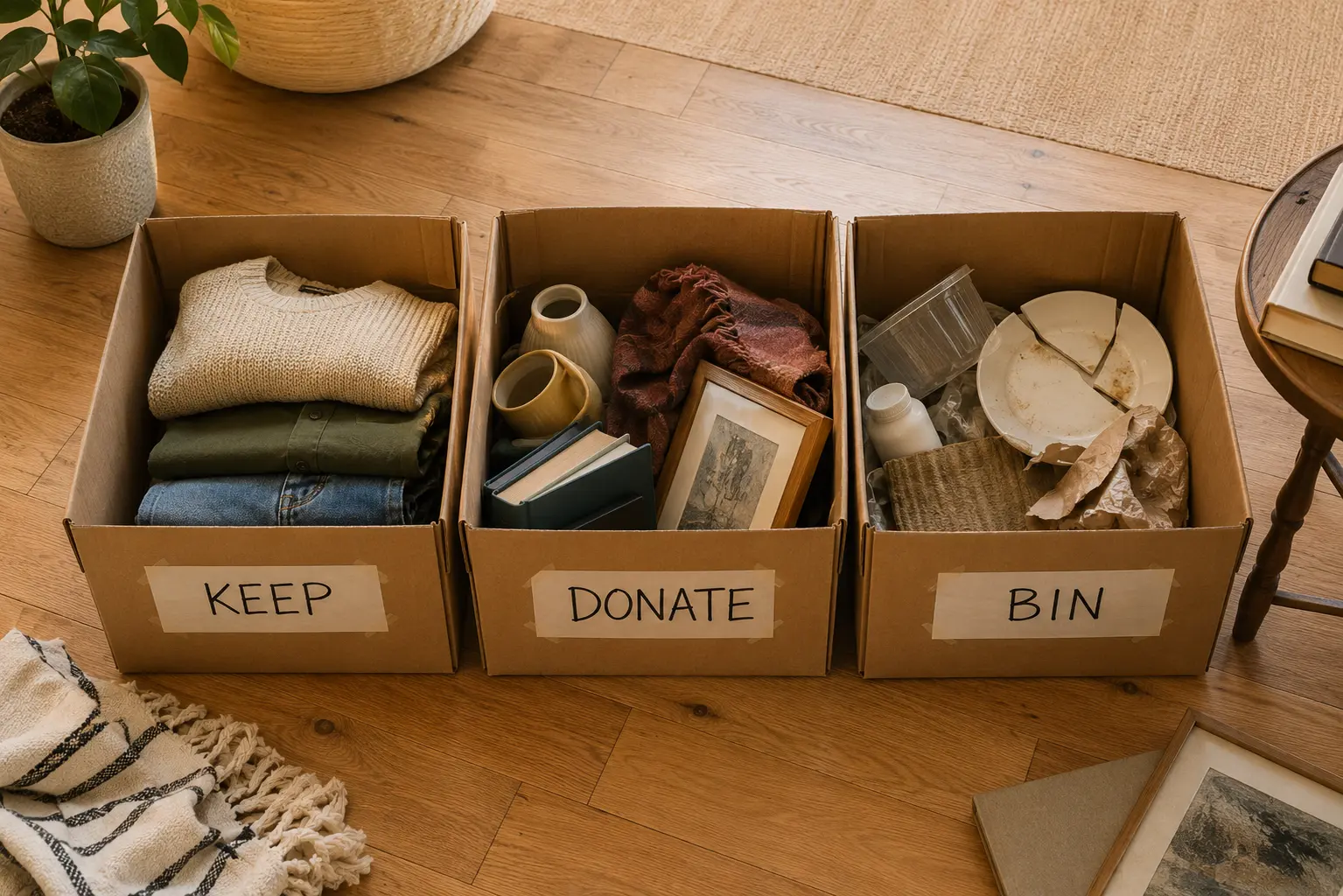
The Keep, Donate, Bin Framework
This is the single rule that makes the whole weekend work. Every item you pick up goes into exactly one of three categories — immediately, without a fourth "maybe" option.
Room-by-Room: What Actually Matters in Each Zone
Bedroom: Start Here, Always
The bedroom collects the most low-effort, high-reward clutter of any room — things set down "just for a second" that never move again. Clear every flat surface first: nightstands, dresser tops, the chair that has quietly become a clothes rack. This alone produces a disproportionate sense of calm relative to the actual time spent, which is exactly why it belongs first — the early win carries you into harder rooms.
Closet & Wardrobe
Most people remove 15–30% of their wardrobe on this pass, and the immediate effect is counterintuitive: a smaller wardrobe feels like more choice, not less, because everything left is something you'd actually wear. If you want a structured, deeper version of this specific task — including how to identify genuine gaps versus impulse buys — the 60-minute wardrobe audit and the capsule wardrobe budget guide both build directly on this step.
Bathroom
This is the fastest room to sort because most decisions are objective, not emotional: is it expired, is it a duplicate, have you used it in the last six months. Check every bottle, tube, and jar in the cabinet and under the sink. Most people find five to ten forgotten products and at least one duplicate they bought because they couldn't find the original.
Kitchen
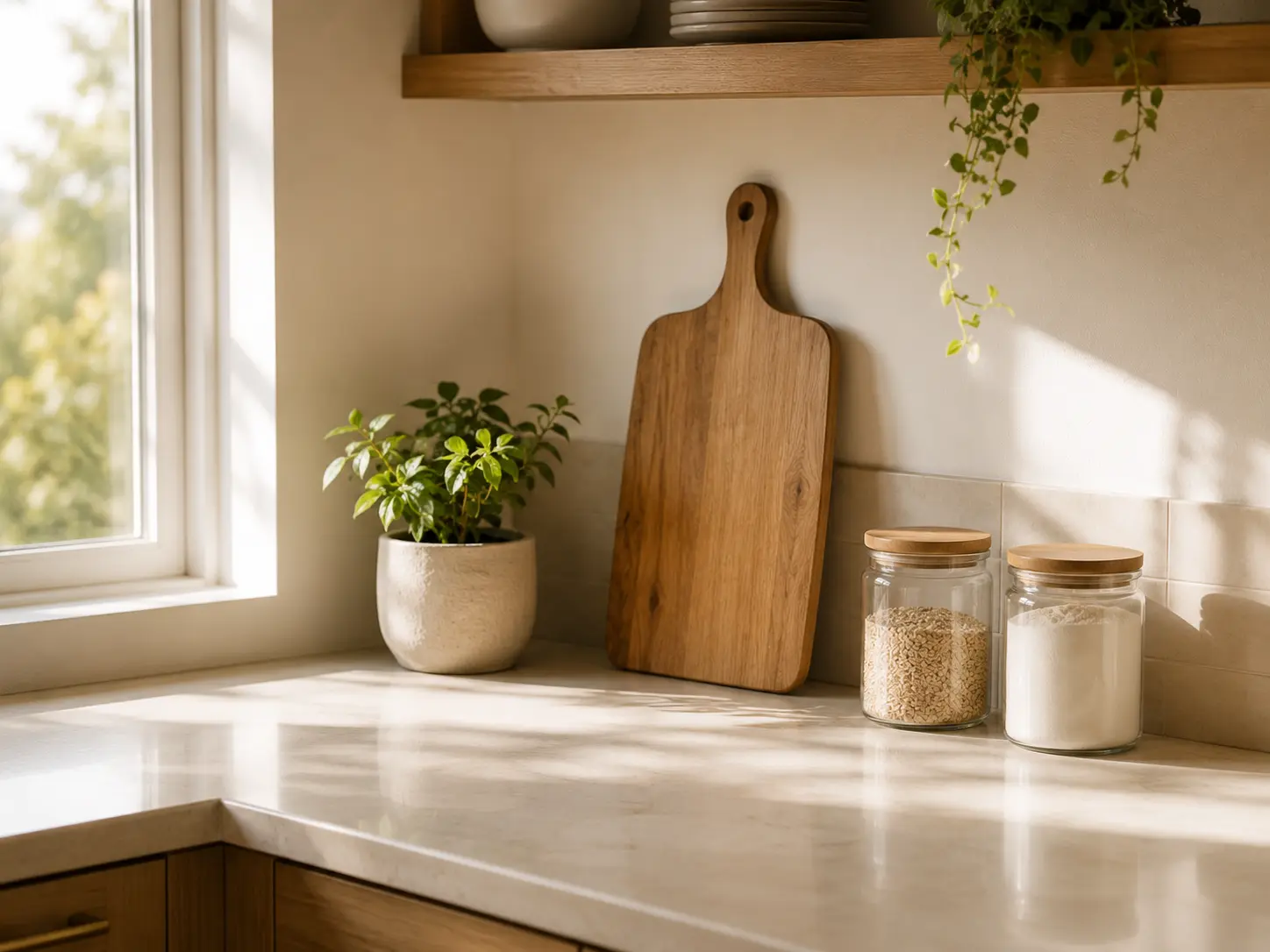
A cleared kitchen counter changes behaviour, not just appearance — people who cook on clear counters cook more often and order in less, because the space itself signals that cooking is possible. Don't try to sort the entire kitchen in one pass; clear the counters fully, then pick one drawer and one cupboard to sort completely rather than doing a shallow pass across all of them.
A decluttered kitchen also makes it much easier to see what food you actually have — which is the foundation of wasting less of it. The zero-waste kitchen starter guide covers the specific habits worth building once the counters and cupboards are clear.
Living Room & Shared Spaces
This zone moves slower because it usually involves other people's belongings, which means negotiation rather than unilateral decisions. Edit shelves rather than emptying them completely — the difference between a curated shelf and a full one isn't the quality of what's on it, it's the space between the objects. Empty space is not wasted space; it's what makes everything else visible.
Digital Files & Paper Clutter
Physical clutter isn't the only kind worth clearing in the same weekend. Most people find their phone's home screen and inbox produce an identical feeling of relief once cleared — a lightness they hadn't associated with digital space before. If you want the full 30-minute system for your phone specifically, see how to organise your phone in 30 minutes, or run through the complete Digital Declutter Checklist, which covers phone, email, files, subscriptions, and social apps in one pass. For the longer-term framework that stops digital clutter from quietly rebuilding after the weekend, digital minimalism covers the values-based approach to deciding what stays.
For paper: keep only documents you're legally or financially required to keep (tax records, warranties still in coverage, ID documents), scan anything you might need for reference, and recycle or shred the rest.
What to Actually Do With What You Remove
Everything removed needs a same-week destination, or a meaningful share of it quietly re-enters the house. This is the step most decluttering guides skip, and it's the one that decides whether the weekend actually reduced clutter or just relocated it.
| Category | Best destination | Timing |
|---|---|---|
| Wearable clothing, working household items | Local NGO, thrift store, or a neighbourhood exchange group | Same week — bag it and drop it, don't stockpile "for later" |
| Higher-value items in good condition | Second-hand marketplace apps or a local consignment store | List within a few days while the motivation is fresh |
| Broken appliances, scrap metal, e-waste | A kabadiwala or a certified e-waste collection point | Whenever convenient — these don't need to leave the house instantly |
| Genuinely unusable items | Bin — no sentimental exceptions | Immediately |
| Sentimental items you're unsure about | One labelled memory box, size-limited | Once — don't let this become a second "maybe" pile |
The consumption side of this — why things accumulate in the first place, and how to buy less going forward — is worth understanding as its own system. Sustainable living on a budget covers the buy-less, buy-better thinking that keeps a decluttered home from refilling within a year.
How to Keep It From Coming Back
A weekend declutter without a maintenance system typically drifts back to its starting clutter level within six to twelve months. Three habits prevent that, and none of them take more than a few minutes a day.
1. The one-in-one-out rule
Nothing new enters the home without something old leaving it. This sounds almost too simple to matter, but it changes what you choose to bring home in the first place — every new item now requires a decision about what it's replacing, and that friction is the entire prevention mechanism. See the full breakdown of how this rule works category by category for the practical version, or mindful consumption for the deeper reasoning behind why that friction works before you buy, not just after.
2. A 10-minute daily reset
At the end of each day, spend ten minutes returning items to their designated homes — before surfaces have a chance to fully re-accumulate. This is dramatically easier than a monthly deep clean, because it never lets clutter get past a manageable amount. A habit tracker makes this easy to keep consistent for the first few weeks, until it stops requiring conscious effort. For a slightly bigger check-in a few times a year, the seasonal home reset covers a 2-hour routine that catches what the daily reset alone doesn't.
3. A designated home for every category
Clutter accumulates fastest in places without an assigned purpose — the chair that becomes a clothes pile, the counter corner that becomes a mail pile. If a category of item doesn't have an obvious home, decide one now, while the motivation from the weekend is still fresh.
If you find you enjoy this kind of work enough to consider doing it for other people, our free CPO® Exam Prep course covers how professional organizers run room-by-room projects with clients — assessment, sorting decisions, and keeping systems in place afterwards.
Final Thoughts
You don't need a perfectly organised home, matching storage bins, or a Pinterest-worthy pantry. You need a fixed order so you're not deciding what to do next while standing in the middle of a mess, a three-category rule so nothing lingers in limbo, and a same-week plan for where everything you remove actually goes.
Decluttering is really the physical expression of a broader principle — quality over quantity, chosen deliberately rather than accumulated by default. If that idea resonates beyond just your closets and drawers, What Slow Living Actually Means extends it into how you eat, work, and spend your mornings.
Start with the bedroom this weekend. Clear the surfaces, sort the closet, and see how far the momentum carries you into Sunday. If the two-day pace feels rushed, the 7-Day Home Declutter Sprint spreads the exact same seven zones across a full week, with a daily items-cleared tracker to keep you on pace.
A decluttered home isn't a finished state you arrive at once. It's a fixed order and a few small habits, repeated. The weekend gets you there the first time — the maintenance system is what keeps you there.
Sources
[1] Saxbe, D. E., & Repetti, R. (2010). No place like home: Home tours correlate with daily patterns of mood and cortisol. Personality and Social Psychology Bulletin, 36(1), 71–81. Available at: journals.sagepub.com