
- A seasonal reset is a short, repeatable routine — not a full deep clean — designed to take about two hours, 3-4 times a year.
- Behavioral research on "temporal landmarks" shows natural turning points like a season change genuinely boost motivation for habit resets, more than an arbitrary date.
- A neglected HVAC/AC filter can increase energy use by 5-15% and is the single most commonly forgotten seasonal maintenance task.
- Standard filters are recommended for replacement every 60-90 days; more often with pets or allergies.
- Running a smaller reset every season, rather than one annual deep clean, prevents the buildup that makes an annual overhaul feel overwhelming.
A seasonal home reset is a fixed, repeatable 2-hour routine — not a full deep clean — built around three things: a quick declutter pass through a few key zones, the maintenance tasks that are easy to forget because they're never visually obvious, and a wardrobe swap for the season ahead. Run 3-4 times a year at each season change, it prevents the kind of accumulation that eventually forces a much bigger, more dreaded weekend project.
This guide breaks the two hours into four 30-minute blocks, covers the specific maintenance tasks people consistently forget, and shows how to turn it into an actual recurring habit rather than a one-time good intention.
Why a Seasonal Trigger Actually Works
Behavioral research on "temporal landmarks" — meaningful turning points like a new season, a new year, or a birthday — shows they genuinely increase motivation to reset habits and start fresh, more reliably than picking an arbitrary date on the calendar. A season change gives the routine a natural, recurring cue that doesn't require remembering an app reminder or a specific date — the weather itself does the reminding.[1]
There's a secondary benefit beyond the calendar cue: a calmer, less cluttered home measurably reduces visual noise, which supports a slower, more settled nervous system state — the same underlying idea behind what slow living actually means day to day, just applied on a seasonal rhythm rather than a daily one.
Before You Start
- Block two uninterrupted hours. Doing it in one sitting keeps momentum; splitting it across multiple days tends to mean it doesn't get finished.
- Have three containers ready: a donate/sell box, a trash bag, and a "belongs elsewhere in the house" basket.
- Check what maintenance items you'll need — a spare HVAC/AC filter, batteries for smoke detectors — before you start, so the routine doesn't stall on a supply run.
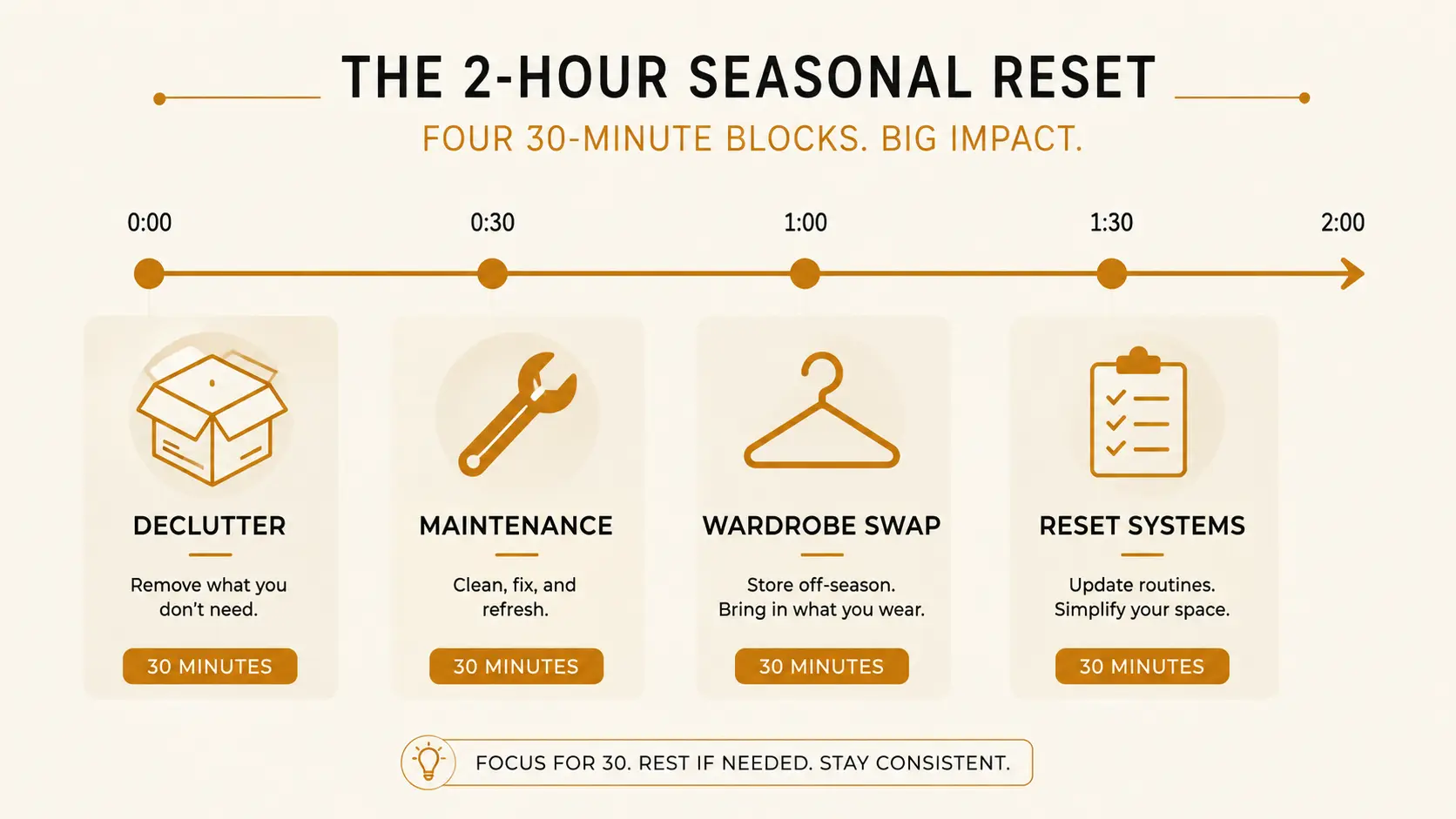
The 2-Hour Routine, Block by Block
- Block 1 (0:00-0:30) — Quick declutter pass, three zones only. Pick the three zones that accumulate the most between resets — usually an entryway, a kitchen counter, and a bedroom surface — and clear anything that's drifted there without a purpose. This isn't a full room-by-room declutter; it's a fast surface-level pass on the spots that show wear fastest.
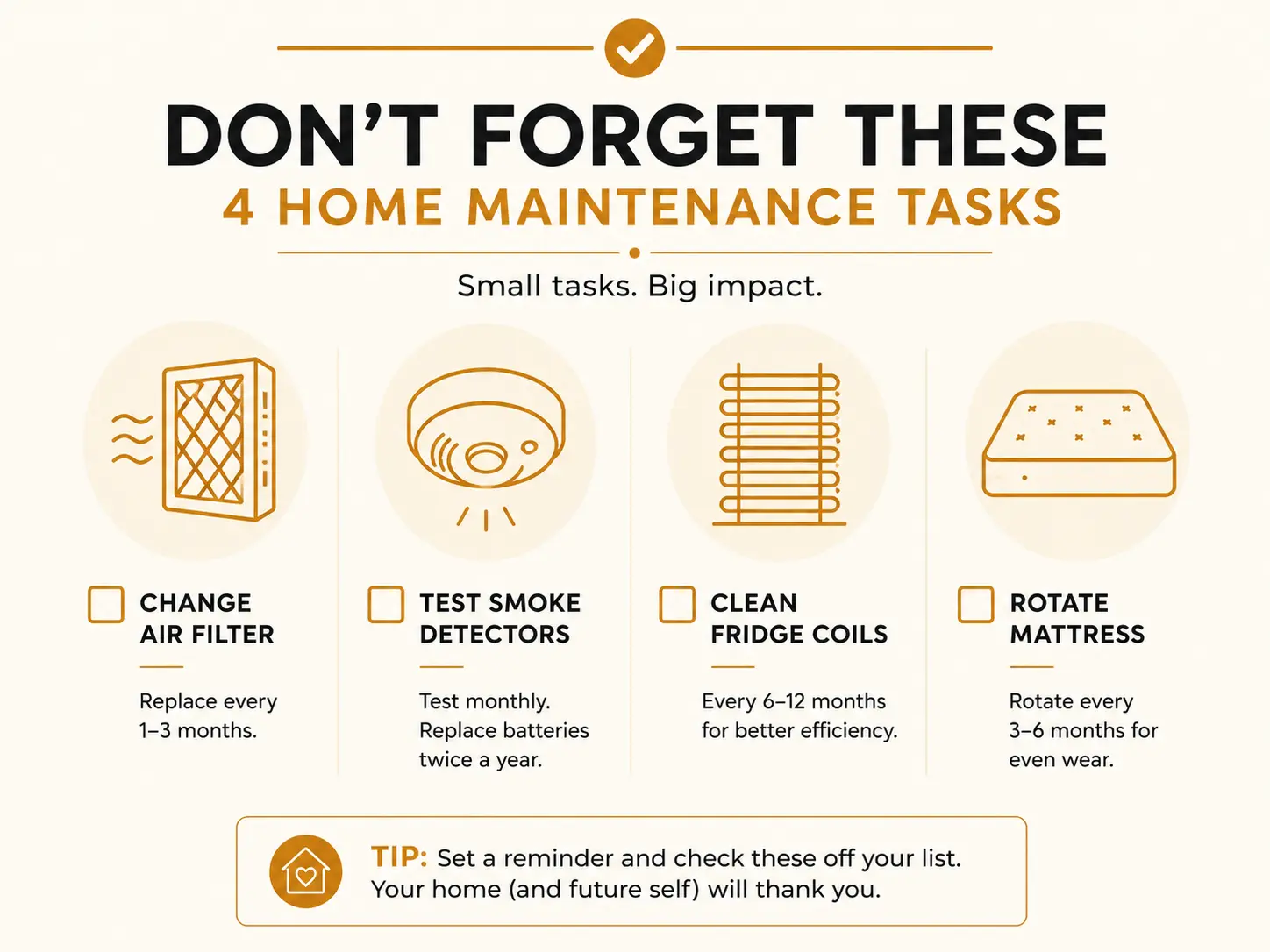
- Block 2 (0:30-1:00) — The maintenance tasks nobody remembers. Change the HVAC/AC filter, test smoke detector batteries, wipe refrigerator coils, and flip or rotate the mattress. None of these are visually obvious the way clutter is, which is exactly why they get skipped without a scheduled trigger.
- Block 3 (1:00-1:30) — Wardrobe swap. Rotate out-of-season clothing to storage and bring the coming season's pieces forward. If a capsule wardrobe approach appeals, the capsule wardrobe guide covers how to keep this rotation genuinely minimal rather than storing everything indefinitely.
- Block 4 (1:30-2:00) — Reset shared systems. Empty and reset any household donation box, restock a basic cleaning caddy, and do a final walkthrough with the "belongs elsewhere" basket to return items to their actual homes.
The Maintenance Tasks People Actually Forget
The tasks that get skipped most consistently share one trait: none of them are visible the way a messy counter is, so nothing prompts you to notice until there's a problem — a musty smell, a higher power bill, a dead smoke detector at the worst possible moment.
| Task | Recommended frequency | What happens if skipped |
|---|---|---|
| HVAC/AC filter change | Every 60-90 days (more with pets/allergies) | 5-15% higher energy use; strain on the system |
| Smoke detector battery test | Every season change | Silent failure — the one you only discover during an actual emergency |
| Refrigerator coil cleaning | Every 6-12 months | Reduced cooling efficiency, higher energy bills |
| Mattress flip/rotation | Every season (if flippable) | Uneven wear, reduced mattress lifespan |
Each of these takes five to ten minutes on its own — the reason they get missed isn't the effort, it's the lack of a trigger. Bundling them into a seasonal routine gives them the reminder they'd otherwise never get.[2]
Turning It Into an Actual Recurring Habit
The single biggest reason a good seasonal routine stops happening after year one is the lack of a fixed trigger — "whenever I get around to it" quietly becomes never. Attaching the reset to the same weekend each season, and tracking completions somewhere visible, closes that gap.
If you want to build this into a broader household rhythm rather than a single seasonal event, the 7-Day Home Declutter Sprint is a good complementary structure for the one or two rooms that need more than the two-hour reset can cover.
Common Mistakes
- Trying to turn it into a full deep clean. The moment the two-hour reset expands to cover every room in depth, it becomes overwhelming enough to skip entirely next season.
- Skipping the maintenance block because it's less visually satisfying than decluttering. The invisible tasks are precisely the ones that cause real problems when neglected.
- Storing every out-of-season item indefinitely during the wardrobe swap. Use the swap as a natural checkpoint to also let go of anything that didn't get worn the previous cycle.
- Not scheduling the next one before finishing the current one. Set the next season's date on the spot, while the routine is still fresh, rather than trusting future memory.
- Doing it without tracking completions. A routine this infrequent is easy to quietly abandon after a busy season — a visible log is what catches that before it becomes a habit that's fully lapsed.
Building maintenance routines that last is a core part of what professional organizers hand over at the end of a project. Our free CPO® Exam Prep course covers that handover and the rest of the Certified Professional Organizer exam outline.
Final Thoughts
A seasonal home reset works because it's small enough to actually finish and recurring enough to prevent the buildup that makes an annual deep clean feel like a weekend-long ordeal. Two hours, four blocks, three to four times a year — decluttering, the maintenance tasks nobody remembers, a wardrobe swap, and a quick system reset. The version that survives past the first season is the one with a fixed trigger and a visible tracker, not the one that depends on remembering.
The goal isn't a perfect home. It's a home that never gets far enough behind to need a dreaded weekend to fix.
If sustainability is part of what motivates the reset for you, sustainable living on a budget covers how to handle the donate box and reduce what enters the home in the first place — a natural complement to a routine that's fundamentally about maintaining rather than accumulating.
Sources
[1] Temporal landmarks and motivation for habit resets and fresh starts. Available at: comfortalife.com
[2] HVAC/AC filter replacement frequency and energy impact of neglect. Available at: filterbuy.com