
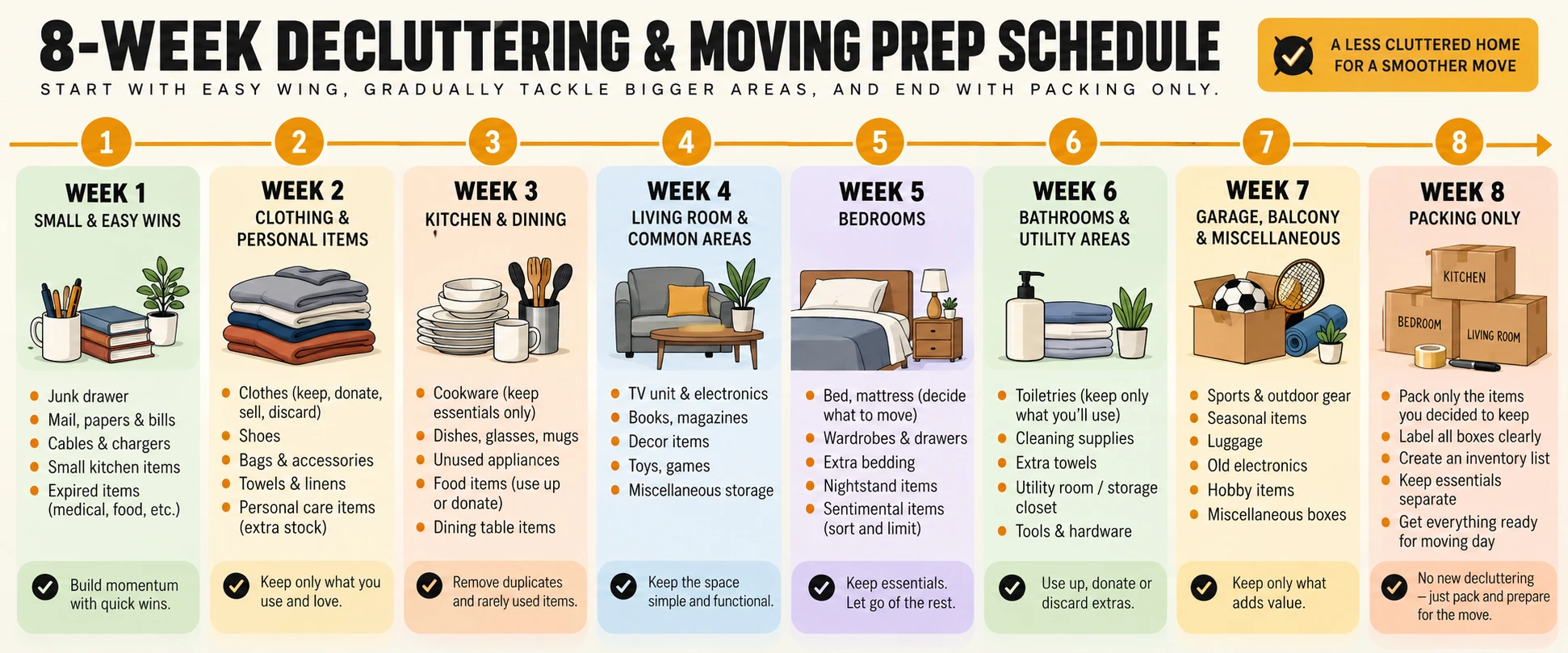
- Starting 6-8 weeks before moving day gives enough time to sort methodically instead of rushing decisions in the final week.
- Decluttering before packing — not after — is what actually saves boxes, truck space, and money if you're paying movers by weight or volume.
- Sorting by category (clothes, books, kitchen) works better for a move than the room-by-room approach used for a general declutter, since packing itself is organized by category.
- Sentimental items and documents should be scheduled later in the timeline, with dedicated time — not squeezed in during the final rushed days.
- A simple keep/donate/sell/toss framework, applied consistently, prevents the most common moving-day trap: boxes labeled "sort later" that never get sorted.
The week before a move is the worst possible time to figure out what you actually own. By then, boxes are due, the truck is booked, and every decision about whether to keep something gets made under time pressure — which is exactly how unwanted things end up getting packed, moved, and unpacked again in the new place, no closer to being dealt with. Decluttering before a move isn't an optional nice-to-have on top of packing; done at the right time, it's what makes packing faster, cheaper, and considerably less stressful.
Why Decluttering Before a Move Actually Matters
Every item you pack costs you three times: once to pack it, once to move it (in truck space, in your own energy carrying it, or in money if movers charge by weight or volume), and once to unpack and find a place for it in your new home. Decluttering before you pack removes an item from all three costs at once — it's the single highest-leverage moment to get rid of something you don't need, because you'll never have a better, more concrete reason to ask "do I actually want to carry this to the next place?"
The Realistic Timeline: When to Start
The single biggest driver of a calm move versus a chaotic one is start date, not effort. Decluttering spread across six to eight weeks takes roughly the same total time as decluttering crammed into the final week — but it removes the deadline pressure that causes rushed, regretted decisions.
| Timeframe | Focus | Why this order |
|---|---|---|
| 8 weeks before | Easy categories: clothes, books, kitchen duplicates | Low sentimental weight, fast decisions, builds momentum |
| 6 weeks before | Garage, storage, seasonal items, rarely-used equipment | Time-consuming to sort but rarely urgent — do it while you have slack |
| 4 weeks before | Documents and digital-adjacent physical clutter (old files, manuals, cables) | Requires focus but not much emotional weight |
| 2-3 weeks before | Sentimental items, memorabilia, gifts you don't use | Needs unhurried time and a clear decision framework — see below |
| Final week | Packing only — no new sorting decisions | By now everything remaining should already be a "yes, this is coming" |
Sort by Category, Not Room, When You're Moving
A general home declutter often works best room by room, because the goal is a tidier version of the space you're already living in. Moving changes the goal: you're not tidying a room, you're deciding what gets boxed and labeled, and boxes are almost always organized by category (kitchen, clothing, books) rather than by which room something happened to be sitting in. Sorting by category from the start means your decluttering pass and your packing pass are the same pass, instead of two separate rounds of handling the same objects.
- Clothes — every piece gets tried on or at minimum looked at; anything unworn in the last year is a strong donate candidate.
- Books, media, and paperwork — decide keep/donate before boxing, since re-sorting a sealed "books" box later almost never happens.
- Kitchen — duplicates (a second can opener, three sets of measuring cups) are the easiest, fastest wins in the entire house.
- Bathroom and toiletries — expired products and half-used items rarely survive a move intact anyway; this category is close to a free pass to declutter aggressively.
- Sentimental and memorabilia — deliberately scheduled later, treated as its own category with its own time budget rather than folded into "general stuff."
The Keep, Sell, Donate, Toss Framework
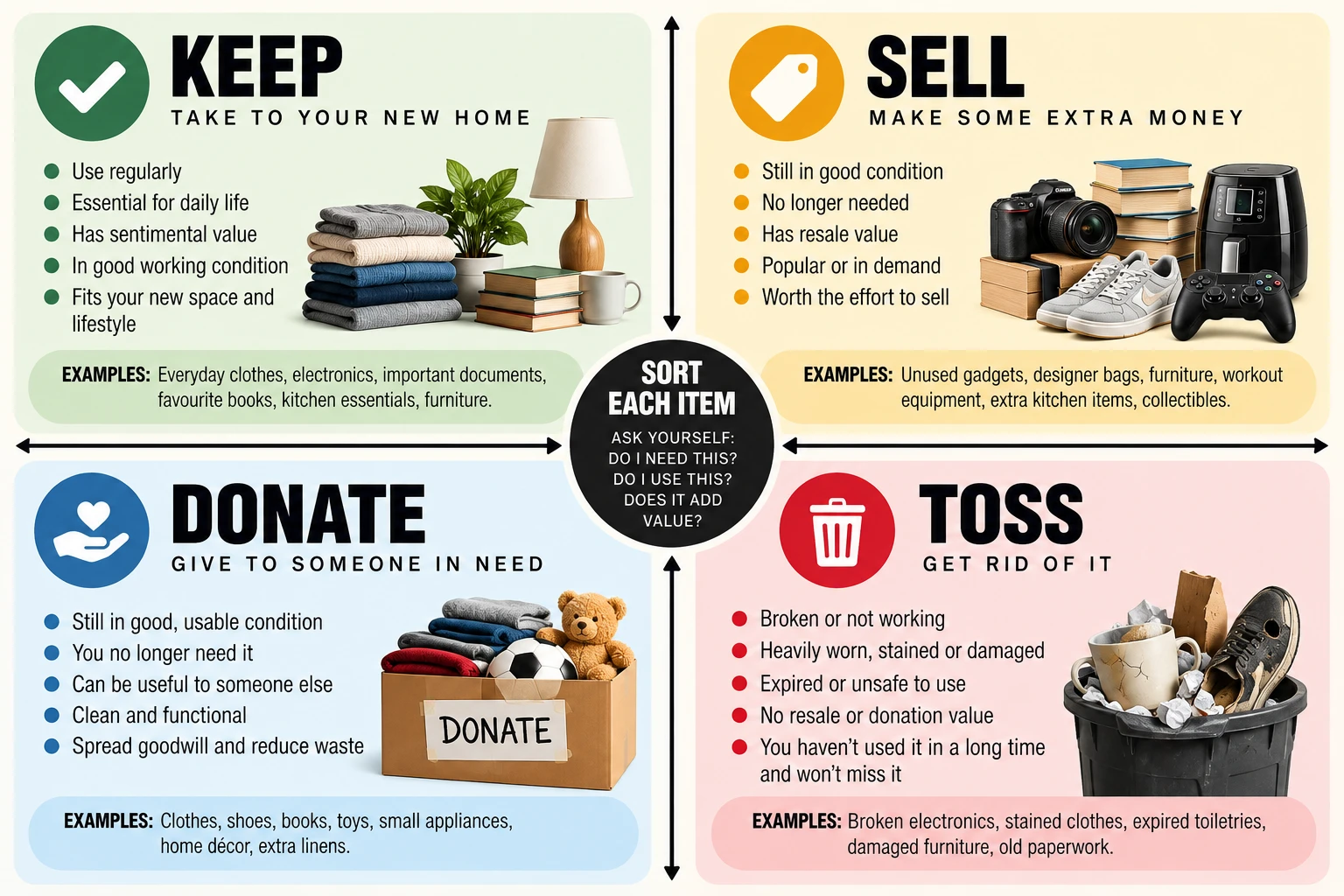
A moving-specific version of the standard decluttering framework adds one category that a general home reset doesn't always need: sell. Moving is one of the few times most people seriously consider selling furniture or larger items rather than just donating them, since the alternative — paying to move something you're not sure you want — makes the extra effort of a quick sale worth it.
- Keep: you've used it in the last year, or it has a specific, named upcoming use — not a vague "might need it someday."
- Sell: furniture, electronics, or larger items in good condition where the resale value justifies the extra listing effort — worth it before a move specifically because you'd otherwise pay to transport it anyway.
- Donate: good condition, no realistic resale value or not worth the effort, but useful to someone else.
- Toss/recycle: broken, expired, or genuinely unusable — no home is worth boxing this for.
Packing Light: What to Digitize, Downsize, or Skip Entirely
Packing light isn't about owning less in some abstract sense — it's about being honest with yourself about which physical objects are actually doing something for you versus which ones you could recreate in a smaller, lighter form.
-
Physical photos Digitize the ones that matter rather than moving boxes of loose prints — a scanning app on your phone handles this well enough for most purposes.
-
Paper documents Scan and shred anything that isn't legally required in physical form (tax records, property deeds, and similar documents are the main exceptions worth keeping physical).
-
Kids' artwork and school papers Photograph a representative selection rather than keeping every single piece — this is one of the most common places a "just in case" box quietly becomes ten boxes.
-
Bulky sentimental items with a digital equivalent A large trophy collection, ticket stubs, or event programs can often become a single photographed collage instead of a full box.
For sentimental items specifically, the psychology of why this feels harder than it should — and a fuller decision framework for exactly this category — is covered in letting go of sentimental clutter, which is worth reading before you hit that part of the timeline above.
The Final Week: A Checklist, Not a Sorting Session
By the final week, no new keep-or-toss decisions should be happening — only packing what you already decided to keep. If you find yourself still debating whether to keep something during the last week, that's a sign the earlier timeline slipped, not a reason to rush the decision anyway. A few practical final-week habits:
- Pack a clearly labeled "first night" box — toiletries, chargers, a change of clothes, basic kitchen items — so you're not digging through everything the first evening in the new place.
- Take a final donate/sell run to drop-off points before moving day — don't let "I'll deal with it after" become boxes that move with you and just get unpacked into the new place unsorted.
- Photograph anything you're leaving for a landlord or the next occupant — useful for both your own deposit and their reference.
- Confirm your donation drop-off or pickup is scheduled before the truck arrives — a donate pile with no plan to actually leave the house often ends up back in a box by accident.
Common Mistakes
- Starting to declutter and pack at the same time, in the same pass. This is what causes "sort later" boxes — decide first, then pack what's left, as two distinct steps even if they happen close together in time.
- Saving everything sentimental for "when I have more time." That time reliably doesn't materialize until the final week, when there's the least time and the most pressure — schedule it deliberately, earlier.
- Packing "maybe" items instead of deciding. A box of maybes just becomes a box you move, store, and eventually declutter again in the new place — with none of the decisions actually made.
- Not confirming donation logistics in advance. A donate pile with nowhere booked to go by moving day frequently gets loaded onto the truck by default, simply because it's easier than leaving it behind unsorted.
Move management is a specialty many professional organizers offer. If helping others through moves appeals to you, our free CPO® Exam Prep course covers project planning, timelines, and working with clients during transitions.
Final Thoughts
Decluttering before a move isn't extra work layered on top of an already stressful process — done on the right timeline, it's what removes most of the stress in the first place. Every item you sort out ahead of time is one less thing to pack, carry, unpack, and eventually deal with again in the new place. Start eight weeks out, work through categories in order of difficulty, and by the final week, packing is the only decision left.
The goal isn't to arrive at your new home owning less for its own sake — it's to arrive having already made every decision about what you own, instead of making them one exhausted box at a time in the last 48 hours.
Once you're settled into the new place, keeping that clarity from returning to clutter is its own separate habit — the one-in-one-out rule is a simple, low-effort way to maintain what a move-driven declutter just built.
This guide covers general decluttering and moving practices. If you're navigating a particularly stressful or emotionally difficult move — such as downsizing after a loss or a sudden relocation — it's completely reasonable to move at your own pace and ask for help rather than following any timeline exactly.