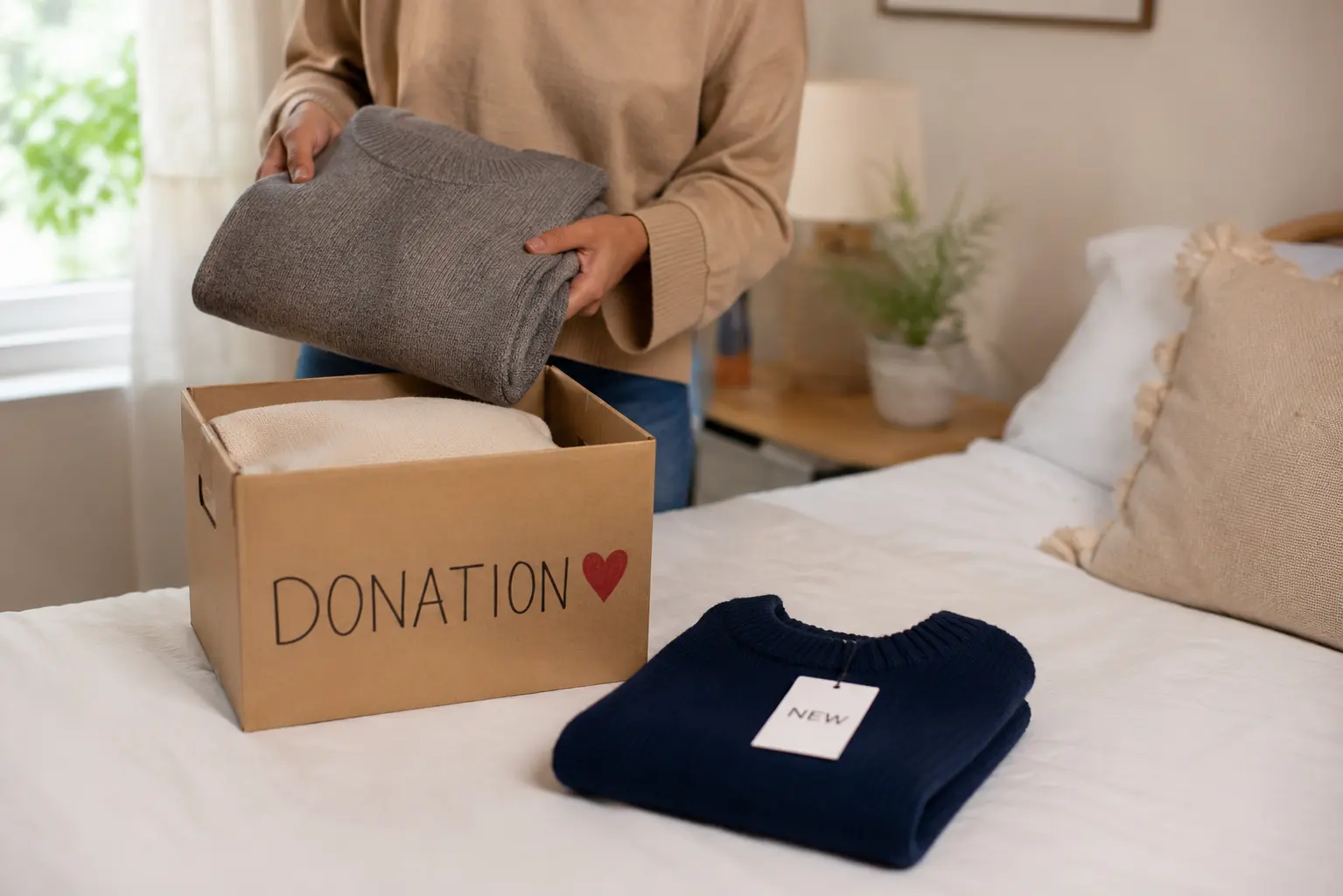
- UCLA research on family homes found clutter measurably raises cortisol, the body's primary stress hormone — especially in the person managing the household.
- The average American household contains an estimated 300,000 items when every drawer, shelf, and storage box is counted.
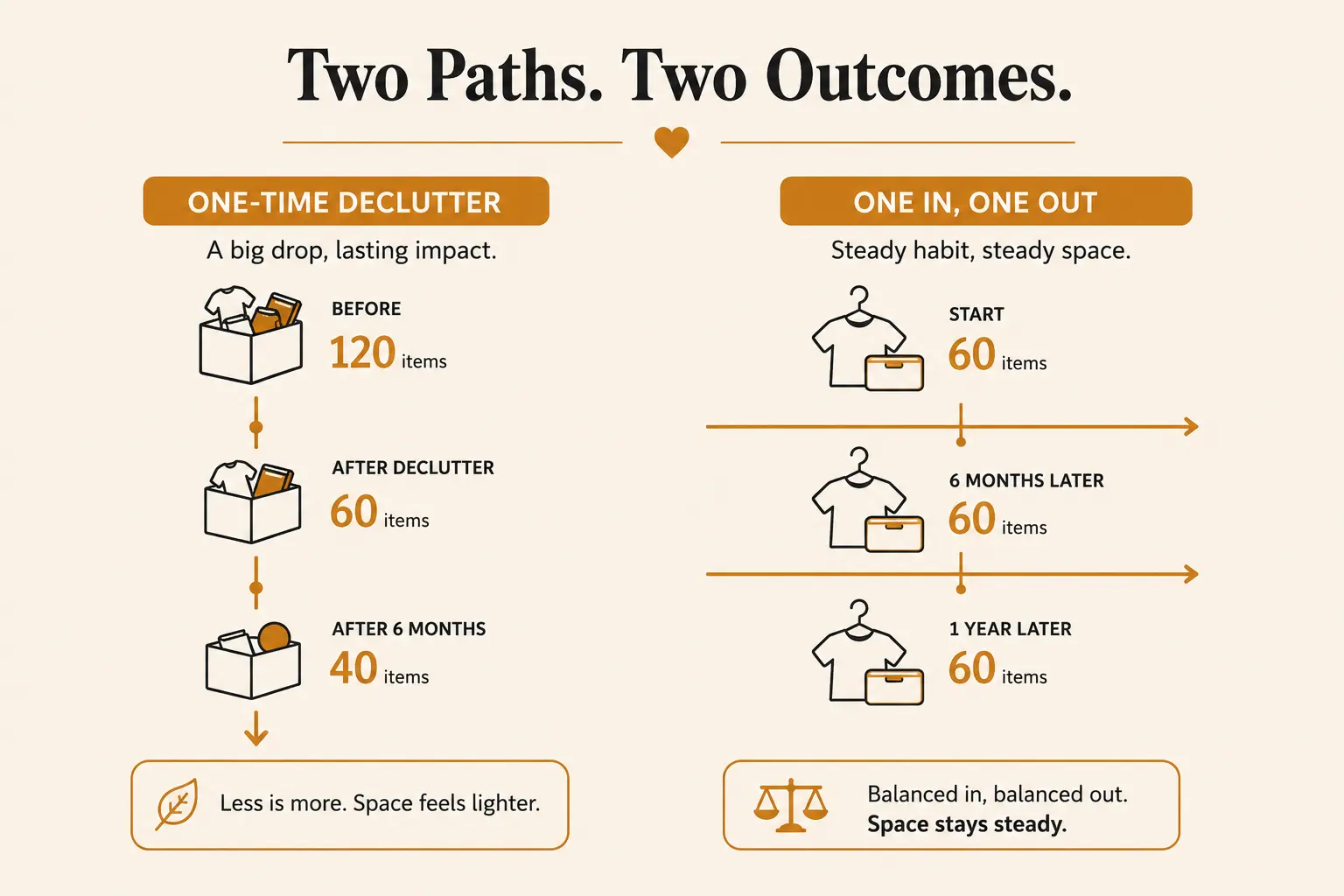
- One in, one out is a maintenance rule, not a decluttering method — it stops accumulation but doesn't reduce a backlog you already have.
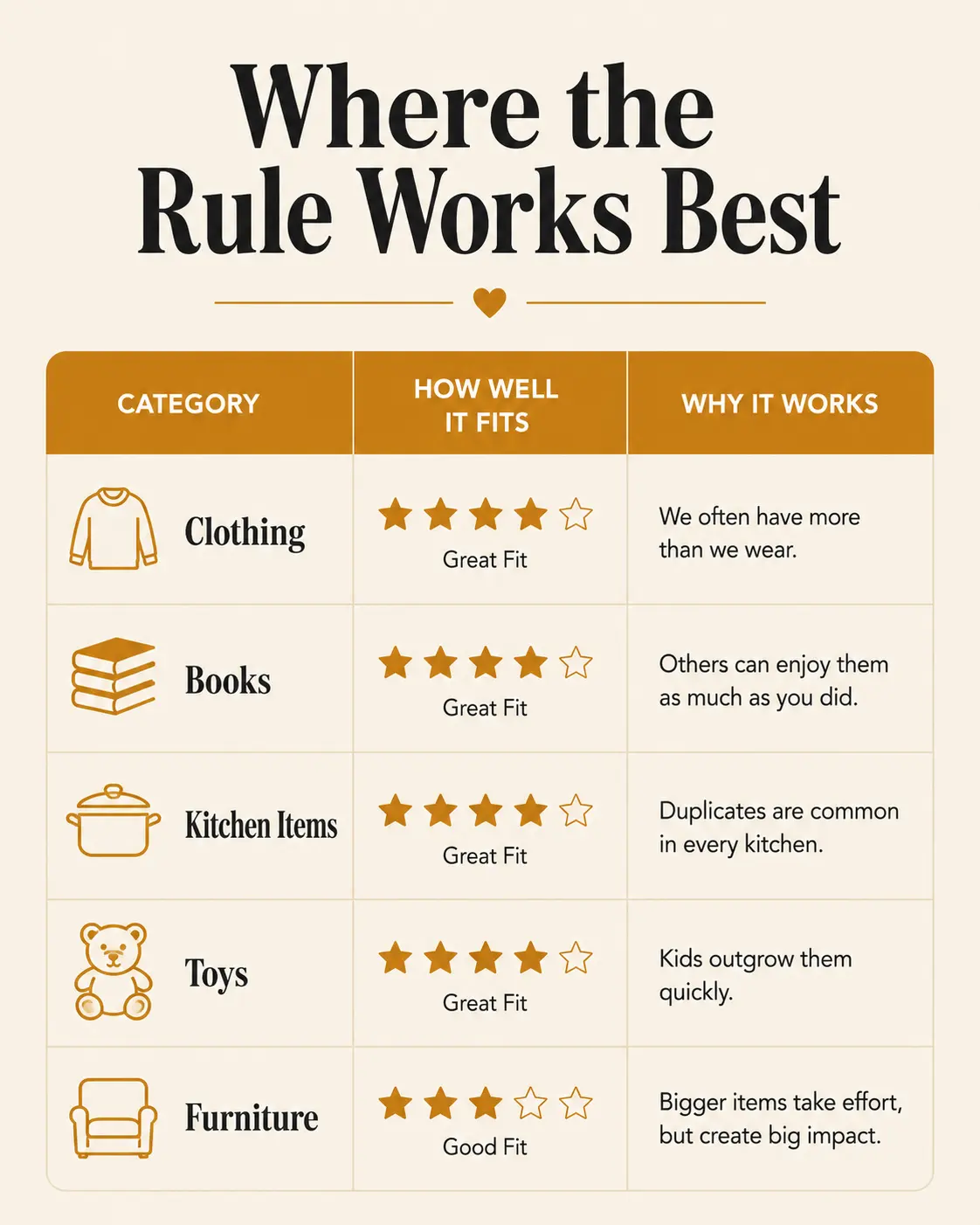
- It works most cleanly for categories with a natural substitute: clothing, shoes, books, kitchen gadgets, and toys.
- People who start with small, low-effort decluttering habits are meaningfully more likely to sustain the practice long-term than those who attempt a single dramatic purge.
One in, one out is about as close to a foolproof household rule as minimalism gets: for every new item you bring home, an equivalent item has to leave. No spreadsheets, no annual decluttering weekend, no willpower marathon — just a single mechanical swap that quietly caps how much you own, applied at the moment it actually matters: the point of purchase.
The Rule, Exactly As It Works
The mechanics are deliberately boring: when something new comes into a category you already own things in, something old from that same category goes out — donated, sold, recycled, or binned, whichever fits. Buy a new pair of shoes, a pair leaves. Buy a new mug, a mug leaves. The trigger is the purchase itself, not a weekend clean-out three months later when the pile has already grown unmanageable.
This is what makes it different from most decluttering advice: it's not a project with a start and end date. It's a standing rule that runs quietly in the background of ordinary shopping decisions, for as long as you keep it. For deciding what the "something old" should actually be, the 90/90 rule is a fast, two-question test that pairs well with this habit. It's also a good habit to put in place right after a move — once a moving-specific declutter has already cleared out what you didn't need, one-in-one-out is what keeps it from creeping back.
Why This Specific Rule Works
Clutter isn't just a tidiness problem — a UCLA study of family homes found that visible household clutter measurably raised cortisol levels, particularly in the person primarily responsible for managing the space.[1] The accumulation itself carries a physiological cost, not just an aesthetic one.
One in, one out works because it intervenes at the one moment that actually determines whether your total possessions grow: the purchase decision. Most decluttering methods try to fix the problem after the fact, once things have already piled up — this rule stops the pile from forming in the first place, which is a fundamentally easier problem to solve than reversing years of accumulation.
Where to Apply It — and Where to Bend It
| Category | Fit for strict swap | Notes |
|---|---|---|
| Clothing & shoes | Excellent | The clearest one-to-one match — a new item almost always replaces an old item's function |
| Books | Excellent | Especially effective if you keep a shelf that's visibly full at capacity |
| Kitchen gadgets & tools | Good | Works well since duplicate tools (a second whisk, a third mug set) are easy to spot |
| Kids' toys | Good, with care | Effective for volume control; involve the child in choosing what leaves where possible |
| Furniture & electronics | Weak | Rarely a true one-to-one swap — use "one in, one reviewed" instead of a strict rule |
| Sentimental items | Poor | Don't force this category into the rule — it needs its own, slower process |
For a genuinely accurate read on where your own home currently stands before applying the rule going forward, the free Minimalism Score Calculator walks through 20 questions across home, digital life, wardrobe, and lifestyle and flags exactly where the friction is highest. Recurring digital subscriptions don't fit the one-in-one-out swap logic at all, but they build up in a similar way — the subscription audit is the equivalent process for that category.
The Catch Nobody Mentions
A useful variant once the initial backlog is genuinely gone: "one in, two out" for a defined stretch — say, three months — to actively shrink your total volume before switching back to the standard 1:1 version once you're at a level you're happy with.
One category tends to resist this rule entirely, no matter how consistent you are otherwise: sentimental items, which rarely get pushed out by something new arriving because they were never evaluated on usefulness in the first place. It's worth handling that category separately rather than expecting one-in-one-out to touch it.
Making It Actually Stick
- Apply it at the moment of purchase, not later. Decide what's leaving before the new item even reaches your home — waiting invites the "I'll deal with it eventually" trap.
- Keep the swap within the same category. A new sweater should push out an old sweater, not an old book — cross-category swapping lets your fastest-growing category balloon unchecked.
- Have a default exit route ready. A donation bag by the door or a standing "to sell" shelf removes the friction of deciding where the outgoing item actually goes.
- Treat "nothing to remove" as information. If you can't find anything worth removing in that category, pause on the purchase rather than working around the rule.
- Don't apply it to sentimental or one-off categories. Forcing the rule where it doesn't fit is the fastest way to abandon it everywhere else too.
Common Mistakes
- Expecting it to declutter an already-overwhelmed home. It's a maintenance rule — pair it with an actual decluttering pass if you're starting from a backlog.
- Letting the "out" item sit in a pile "for later." An item that hasn't physically left your home hasn't left — set a firm timeline, like leaving by end of week.
- Swapping across unrelated categories. This quietly defeats the purpose in your most impulsive category while another shrinks for no reason.
- Applying it rigidly to sentimental items. Forcing an emotional category into a mechanical rule usually backfires and causes people to abandon the habit entirely.
- Treating it as a permission slip to buy more. The rule prevents growth — it isn't a justification for a new purchase just because something old is due to go anyway.
Final Thoughts
One in, one out earns its place as the simplest rule in minimalism precisely because it asks so little: one decision, applied consistently, at the one moment that actually determines whether your possessions grow. It won't undo years of accumulation on its own, but paired with a single decluttering pass to clear the existing backlog, it's the rule most likely to actually stick — because it never asks for a dramatic weekend of effort, just a small habit repeated at checkout.
The honest version of this rule: it doesn't make your home minimal. It just makes sure it never gets further from minimal than it already is.
If this is your entry point into decluttering more broadly, what slow living actually means and mindful consumption both cover the deeper habits this rule is a lightweight entry point into. For the digital side of accumulation — specifically the thousands of photos most people never review — the digital photo declutter guide applies a similar keep-what-matters approach to camera rolls.
Sources
[1] UCLA Center on Everyday Lives of Families — clutter and cortisol in family homes. Available at: newsroom.ucla.edu