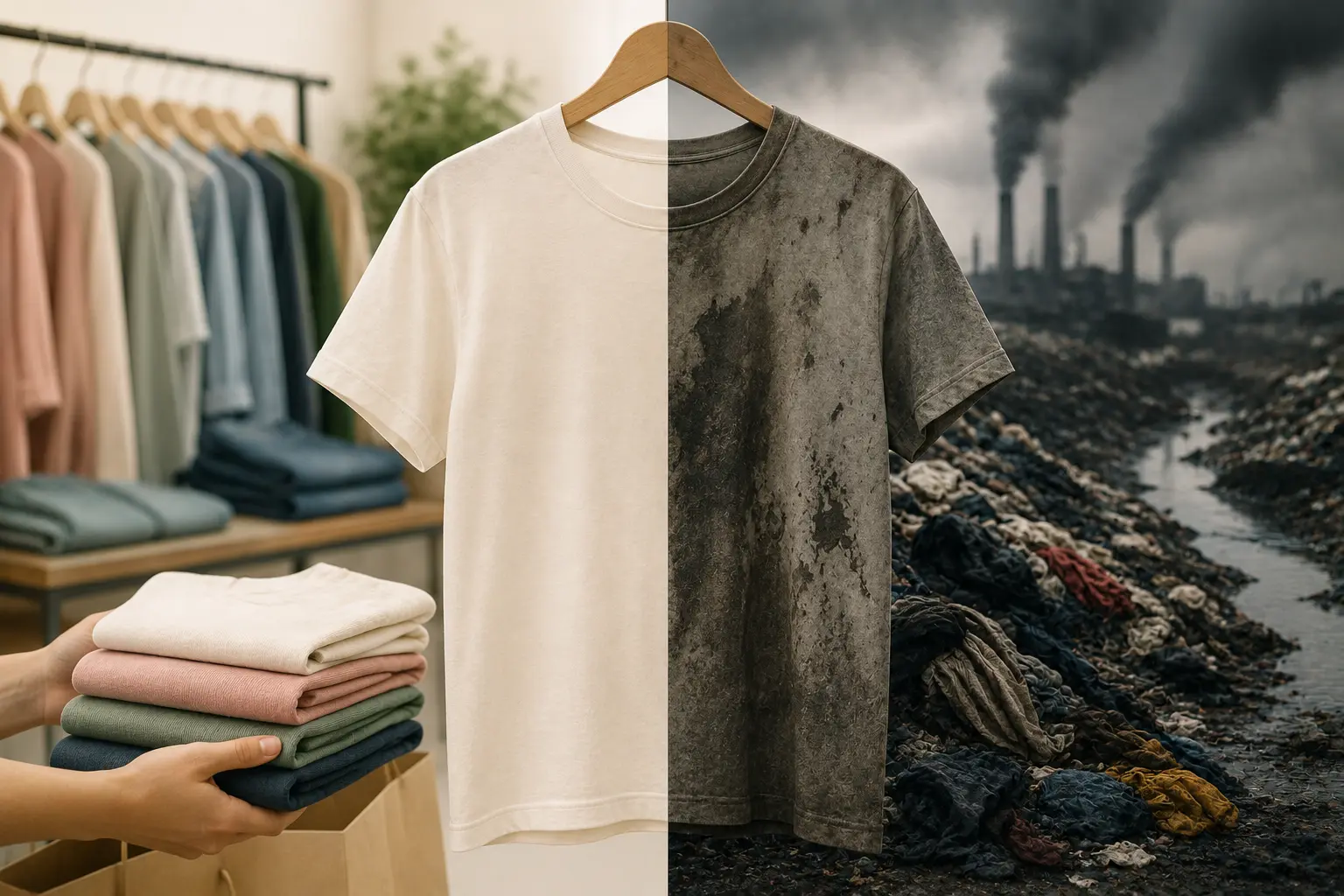
The modern relationship with clothing has a fundamental accounting problem. People experience clothing purchases as a series of individual transactions — a $15 top here, a $25 dress there, a three-for-$30 deal on t-shirts — each of which feels cheap enough to justify. They do not experience their clothing spending as the aggregate it actually is: for the average consumer in a high-income country, between $1,500 and $2,500 per year, much of it for items worn fewer than five times.
Fast fashion — the model of producing clothing rapidly, cheaply, and in high volume with short trend cycles and low price points — is specifically designed to exploit this accounting gap. It makes each individual transaction feel like good value while ensuring that the pattern of transactions produces significant aggregate spending, significant waste, and a wardrobe full of items that are individually cheap and collectively expensive.
This article is about what fast fashion actually costs: the full accounting, not the per-item price. It covers what consumers globally spend on clothing, what proportion of that spending results in garments that are actually worn, how cost per wear compares across quality tiers, the external costs that do not appear on any price tag, and what research on psychology says about why the model is so effective at extracting money from people who believe they are saving it.
The Global Scale: What the Data Shows
The global apparel market was valued at approximately $1.7 trillion in 2023, according to Statista. Of this, the fast fashion segment — characterised by high volume, low price points, and rapid trend turnover — represents a substantial and growing share. Zara introduces approximately 10,000 new styles per year; H&M releases up to 12,000. Shein, the ultra-fast fashion platform that emerged as a dominant global player through the early 2020s, is reported to list between 2,000 and 10,000 new items per day.
The demand side is equally striking. A 2022 report by the UK's Environmental Audit Committee found that British consumers bought more clothing per person than any other country in Europe — approximately 26.7 kilograms of clothing per person per year, or roughly 65 to 70 individual garments. Americans buy approximately 65 pounds (about 30 kilograms) of clothing per person per year, according to data from the American Apparel and Footwear Association. The average American spends approximately $1,700 per year on clothing and footwear.
| Country / region | Average annual spend per person | Garments purchased / year | Online return rate |
|---|---|---|---|
| United States | ~$1,700 | 65–70 items | 25–40% |
| United Kingdom | ~£1,042 (~$1,300) | 65–70 items | 30–40% |
| Germany | ~€900 (~$980) | 55–60 items | 40–50% (highest in Europe) |
| Australia | ~A$2,100 (~$1,370) | 50–60 items | 20–30% |
| China (urban) | ~CNY 2,500–4,000 (~$350–560) | Rapidly growing; ultra-fast fashion penetration highest | 25–35% |
| Global average (high-income countries) | ~$1,000–1,500 | 50–70 items | 20–40% |
Return rates this high are not a sign of a well-calibrated purchasing process. They are a sign of purchases made with low confidence, often driven by the low price point reducing the felt risk of the transaction, and frequently ending in a return that costs the consumer time and the platform significant logistics expense — costs that are eventually recovered through higher prices, not absorbed.
The Wear Rate Collapse: What Is Actually Getting Used
The most economically significant fact about fast fashion is not the price point. It is the wear rate. Price per item is visible at the point of purchase. Wear rate — how many times an item is actually worn — is invisible at purchase and rarely assessed afterwards. The combination of low price and low wear rate is what makes fast fashion, in aggregate, surprisingly expensive for the people consuming it.
The data on wear rates is striking. A 2017 report by McKinsey & Company on the state of fashion found that the average number of times a garment is worn before disposal had fallen by 36 percent over fifteen years. In 2000, the average garment was worn approximately 200 times in its lifetime. By 2015, that figure had fallen to approximately 160 times globally, and to as few as 7 to 10 times for ultra-fast fashion items in high-consumption markets. The same research found that clothing utilisation — the percentage of owned garments worn regularly — had fallen significantly, with surveys suggesting that the average consumer wears approximately 20 percent of their wardrobe 80 percent of the time.
The cost-per-wear gap between quality tiers
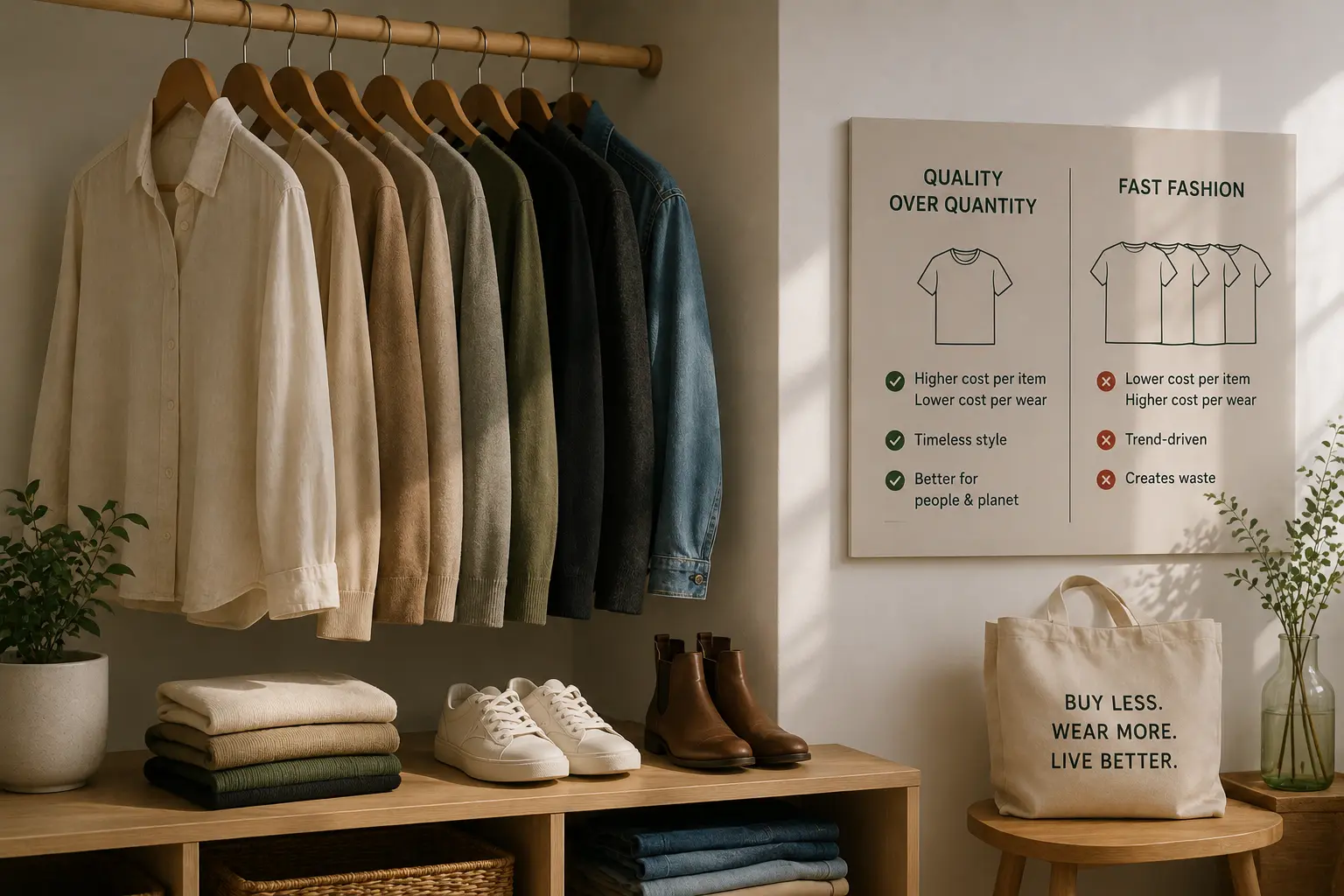
The relationship between purchase price and cost per wear is not what the fast fashion model suggests. A lower purchase price produces a lower cost per wear only if the item is worn as many times as a higher-priced alternative. When low-price items are worn significantly fewer times, the cost-per-wear advantage disappears and may reverse.
| Item type | Purchase price (USD) | Avg times worn | Cost per wear |
|---|---|---|---|
| Ultra-fast fashion top (Shein / Temu) | $8–15 | 4–7 | $1.50–3.75 |
| Fast fashion top (H&M / Zara) | $25–45 | 8–15 | $2.00–5.60 |
| Mid-range quality top (versatile, well-fitting) | $60–100 | 40–80 | $1.00–2.50 |
| Investment piece (quality fabric, classic cut) | $150–300 | 100–200 | $0.75–3.00 |
| Fast fashion dress (seasonal trend) | $30–50 | 3–6 | $6.25–16.67 |
| Versatile well-fitting dress (quality purchase) | $120–200 | 50–100 | $1.50–4.00 |
The Hidden Personal Costs That Do Not Appear on Any Price Tag
Wardrobe overflow and cognitive load
A wardrobe significantly larger than what is actually being worn carries costs that are not financial in the direct sense but have financial dimensions. Physical space occupied by unworn clothing has an opportunity cost in the form of storage required, time spent managing and maintaining it, and the cognitive overhead of a cluttered environment. Research by the Princeton Neuroscience Institute found that visual clutter reduced the quality of sustained attention available for other tasks — the messy wardrobe is not just aesthetically uncomfortable but functionally distracting.
More directly, the decision fatigue produced by a large wardrobe of low-quality items is a real phenomenon. Barry Schwartz's research on the paradox of choice demonstrated that consumers with more options reported lower satisfaction with their choices than consumers with fewer, because the unchosen options created a background regret. A wardrobe of 80 barely-distinguishable items produces more morning friction and less dressing satisfaction than a wardrobe of 30 items in which every piece is genuinely liked.
The time cost of fashion consumption
Time spent browsing, purchasing, returning, and managing clothing is real time that has real value. Research on online shopping behaviour suggests that the average consumer in a high-income country spends between thirty and sixty minutes per week browsing fashion platforms. At fifty weeks per year and forty-five minutes per week, that is approximately thirty-seven and a half hours per year — nearly a full working week — devoted to fashion browsing, much of which does not result in a purchase and most of which does not result in a garment that is worn regularly. Return logistics add further time: packaging, initiating returns through apps, dropping items off, waiting for refund credit.
The sale trap: spending more by saving money
Sales events — Black Friday, Cyber Monday, seasonal clearances, flash sales — are one of the most financially consequential features of the fast fashion model because they reliably produce spending that would not otherwise have occurred. The psychological mechanisms are well-understood: loss aversion (the crossed-out price creates a sense that not buying is losing the saving), artificial urgency (timer countdowns and "limited stock" signals), and anchoring (the crossed-out price becomes the reference point, not the actual value of the item to the buyer).
The financial outcome of sale participation for most consumers is not net savings. It is net additional spending. A person who spends $200 during a sale and "saved" $150 off original prices has still spent $200. The saving accrues only if the item purchased during the sale is one that would have been purchased anyway at the regular price. For most sale purchases, the honest assessment is that the purchase was triggered by the sale, not by a pre-existing genuine need for the item.
The Annual Clothing Spending Audit: Finding Out What You Actually Spend
Most people significantly underestimate their annual clothing spend. The diffuse, frequent nature of fashion purchases — individually small transactions spread across the year across multiple platforms — prevents the aggregate from becoming visible in the way that a single large annual expense does. A mortgage payment or a car insurance renewal is a single confronting number. The equivalent annual clothing spend is assembled from 50 individual transactions that each felt manageable.
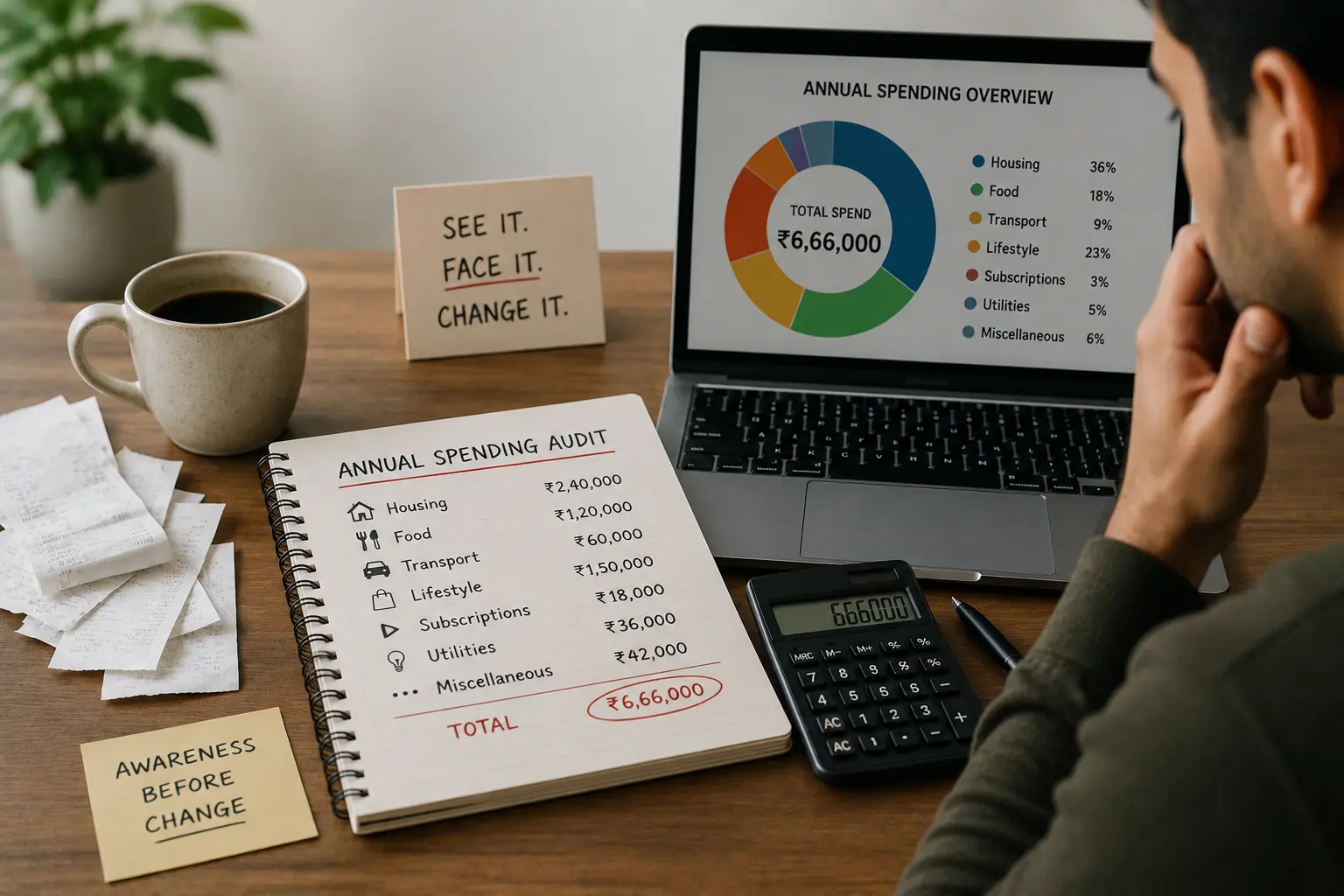
How to run the audit
- Export or review twelve months of bank and credit card statements. Filter for clothing, footwear, and accessories transactions across every channel: physical stores, brand websites, Amazon, ASOS, Zara, H&M, any fast fashion platform, and subscription boxes. Most banking apps allow filtering by merchant category.
- Add up the total. Do not subtract returns. Returns represent time spent and platforms' logistics costs; the gross spend tells you about your purchasing volume.
- Count the number of individual transactions. The purchase frequency is often more revealing than the total spend.
- Estimate what proportion of purchased items you wear regularly. "Regularly" means at least once a month or appropriately seasonal. What percentage of what you bought this year will you still be wearing this time next year?
- Divide the total spend by the number of regularly worn items. This is your effective cost per garment that provides genuine value. Compare it to what you paid per garment on individual purchases.
The Costs That Are Not on Your Bill: The External Accounting
A complete account of the cost of fast fashion includes costs that do not appear in the consumer's transaction but are borne elsewhere. These externalities clarify why the price point of fast fashion is not its actual cost — it is the cost to the consumer after the industry has transferred other costs onto the environment, producing countries, and workers.
Labour cost suppression
The low prices of fast fashion are partially produced by labour cost suppression in manufacturing. A $15 top from an ultra-fast fashion retailer requires that the cost of fabric, manufacturing, logistics, marketing, and retail margin all be contained within a unit economics that leaves little room for fair labour compensation. The majority of the world's garment workers work in Bangladesh, Vietnam, Cambodia, Indonesia, and India, where minimum wages are a fraction of those in consuming countries and labour rights enforcement is variable.
The Rana Plaza factory collapse in Bangladesh in 2013, which killed 1,134 garment workers producing clothing for numerous Western fast fashion brands, became the most visible symbol of the labour cost of the fast fashion model. A decade later, the structural conditions that produced it have improved marginally in some respects and not at all in others. The Fashion Transparency Index, produced annually by Fashion Revolution, consistently finds that the majority of major fashion brands do not publish the names and addresses of their supplier factories, making accountability difficult to enforce.
Environmental externalities
The fashion industry's environmental footprint is among the largest of any consumer goods sector. The United Nations Environment Programme estimates that the fashion industry accounts for approximately 8 to 10 percent of global carbon emissions — more than aviation and shipping combined. It is the second largest consumer of water globally, using approximately 93 billion cubic metres annually. Cotton cultivation accounts for approximately 16 percent of global insecticide use.
Synthetic fibres — polyester, nylon, acrylic — which dominate fast fashion because of their low cost, shed microplastic fibres with every wash. Research published in Environmental Science and Technology found that a single polyester fleece jacket sheds approximately 1.7 grams of microplastic fibres per wash. These fibres pass through wastewater treatment systems and enter waterways, oceans, and eventually the food chain. Microplastics have been detected in human blood, breast milk, placentas, and lung tissue.
The disposal problem is significant at scale. The Ellen MacArthur Foundation estimates that the equivalent of one garbage truck full of textiles is landfilled or incinerated every second globally. Approximately 87 percent of the material used for clothing ends up in landfill or incineration. A small and growing percentage is recycled, but fibre-to-fibre recycling at scale remains technically and economically challenging. For a practical guide to reducing the environmental footprint of everyday consumption, the sustainable living on a budget guide covers both the fashion and broader household dimensions.
The Atacama Desert: fast fashion's most visible symptom
The Atacama Desert in northern Chile has become one of the most documented symbols of fast fashion's disposal problem. Chile's port of Iquique is a free trade zone that imports secondhand and unsold clothing from around the world. The volume that cannot be sold or processed ends up in informal dumps in the desert: an estimated 39,000 tonnes of clothing per year, visible from satellite imagery as a landscape of multicoloured fabric hills spread across one of the driest places on Earth. The clothes take centuries to decompose. The synthetic fibres never fully decompose.
The Psychology: Why the Model Keeps Working Despite the Evidence
Fast fashion's persistence as a consumer behaviour pattern, despite growing consumer awareness of its costs, is not primarily a knowledge problem. Most consumers in high-income countries have heard that fast fashion is bad for the environment and for workers. They buy it anyway. Understanding why requires looking at the psychology of the model rather than the information deficit.
The per-item framing prevents aggregate assessment
Each fast fashion purchase is evaluated as an individual transaction. The $12 top is cheap; the $8 trousers are a bargain; the three-for-$20 t-shirts represent obvious value. The aggregate annual figure — $1,700, or $2,200, or whatever the actual total is — is never shown to the consumer at the point of any individual purchase. The framing is designed to prevent the aggregate from being visible, because the aggregate would produce a different purchasing decision than the individual transaction evaluation does.
The novelty drive and the hedonic treadmill
Novelty is intrinsically rewarding. The brain's dopamine system responds to new stimuli; the hedonic adaptation that quickly normalises the pleasure of a new purchase means that the reward from a new garment is at its peak at the moment of acquisition and diminishes rapidly thereafter. Fast fashion exploits this by making the acquisition of new garments very low-friction and very cheap: the novelty reward is available continuously at a low cost per instance, and the rapid devaluation of each item is addressed not by wearing it more but by acquiring something new.
The hedonic treadmill effect — the documented tendency of human well-being to adapt rapidly to both positive and negative changes, returning to a stable baseline regardless of acquisitions — means that the cumulative ownership of many garments produces no more lasting happiness than the ownership of fewer. The pleasure of the acquisition is real and temporary; the accumulated spending is real and permanent.
Identity and self-expression through consumption
Clothing is one of the primary vectors of identity expression and social signalling. Fashion functions as a language, communicating group membership, aesthetic sensibility, status, and values. The fast fashion model makes this language affordable to participate in: anyone can wear the current trend for minimal financial commitment, which is genuinely democratising in some respects. The cost is that the participation becomes compulsive — the language updates constantly (by design, because trend acceleration drives purchase frequency) and staying current requires continuous purchasing. Social media accelerates this further: research consistently shows that higher platform exposure correlates with higher outfit-purchase frequency, a pattern explored in detail in how social media makes you feel like you need more clothes.
What the Alternatives Cost: A Comparative Framework
The case against fast fashion is not a case for expensive fashion. The relevant comparison is between the true cost of the fast fashion model (aggregate spend, effective cost per wear, time cost, cognitive load) and the true cost of alternative approaches. The alternatives are more diverse than the framing of "fast fashion vs. luxury" suggests.
| Approach | Annual spend | Items / year | Wear rate | Effective cost per used item |
|---|---|---|---|---|
| High-volume fast fashion | $1,500–2,000 | 60–80 | 15–25% | $75–215 per genuinely used item |
| Moderate fast fashion | $800–1,200 | 30–40 | 40–50% | $50–100 per genuinely used item |
| Selective mid-range buying | $700–1,000 | 10–15 | 80–90% | $52–125 per item; ~$18–42 per item over 3-year lifespan |
| Second-hand / thrift | $200–500 | 15–25 | 50–70% | $12–67 per genuinely used item |
| Capsule-style deliberate wardrobe | $600–1,200 | 8–12 | 90–95% | $60–150 per item; ~$30–60 per item over 2–3 years |
The table illustrates a consistent pattern: the effective cost per genuinely used garment is broadly similar across most approaches when actual wear rates are factored in. High-volume fast fashion is not the cheapest option on a cost-per-wear basis despite being the cheapest on a per-item basis. The selective and capsule approaches, while more expensive per item, produce costs per used item and per year of use that are comparable to or lower than the high-volume model once lifespan is accounted for. For the specific case for building a small, versatile wardrobe, the capsule wardrobe on a budget guide covers the practical approach in detail.
Second-hand clothing: the underutilised option
Second-hand clothing — via platforms like ThredUp, Depop, Vinted, eBay, and local charity shops — is the approach that most directly decouples access to clothing from new production. Its economic argument is straightforward: the same or similar garments at a fraction of the new price, with no additional environmental cost of production. Its limitations are real: sourcing is more time-intensive than new purchases, sizing consistency is variable, and the most on-trend items are rarely available second-hand at the right moment.
For items where trends matter less — classic basics, outerwear, occasion wear, high-quality versatile pieces — second-hand purchasing is often the highest-value option available. A well-maintained second-hand wool coat at a fraction of its new price is a better financial and environmental outcome than a new synthetic fast fashion coat at any price.
A Framework for Changing the Pattern
The goal is not to spend less on clothing in absolute terms. It is to get genuine value from what is spent: a higher proportion of items worn, a lower effective cost per wear, a smaller cognitive overhead from wardrobe management, and a reduced contribution to a supply chain with externalities that have real costs to real people and real ecosystems.
The Real Price of a $15 Top
A $15 top worn three times has a cost per wear of $5. A $90 top worn sixty times has a cost per wear of $1.50. The relationship between price and cost — between what you pay at the register and what you actually pay for the use you receive — is consistently misrepresented by the fast fashion model's emphasis on per-item price.
The full accounting of what fast fashion costs includes the aggregate personal spend (typically far higher than the consumer estimates), the effective cost per worn item (typically far higher than the per-item price suggests), the time cost of browsing, purchasing, and returning, the cognitive overhead of wardrobe overflow, and the external costs — labour suppression, environmental externalities, disposal volume — that are borne not by the consumer but by the people and ecosystems on the other side of the supply chain.
None of this makes cheap clothing morally impermissible or requires a dramatic restructuring of one's relationship with clothing. It does require an accurate account of what is actually being paid, by whom, and for what. Once that account is made visible, the per-item price of the $15 top looks considerably less like good value than it does at the point of purchase.
If the broader question of where your spending goes — not just on clothing but across all categories — is something you want to address systematically, the Personal Finance Basics course provides a complete framework for understanding and redirecting your money, starting from wherever you currently are.
The cost-per-wear logic above is really a specific case of a broader pattern — see mindful consumption: how to buy less and actually enjoy what you own for the same framework applied beyond clothing, plus the psychology of why we overbuy in the first place.
If the data in this article has prompted you to take stock of your own wardrobe, the practical next step is a structured audit. The 60-minute wardrobe audit framework walks through a four-category decision system that can be completed in a single focused session — and produces a specific, actionable list of what to keep, mend, donate, or discard.
Data cited in this article draws on publicly available reports from Statista, McKinsey & Company, the American Apparel and Footwear Association, the UK Environmental Audit Committee, the United Nations Environment Programme, the Ellen MacArthur Foundation, and Fashion Revolution. Figures are approximate and based on available research at time of writing. Individual circumstances vary significantly by country, income level, and spending patterns.