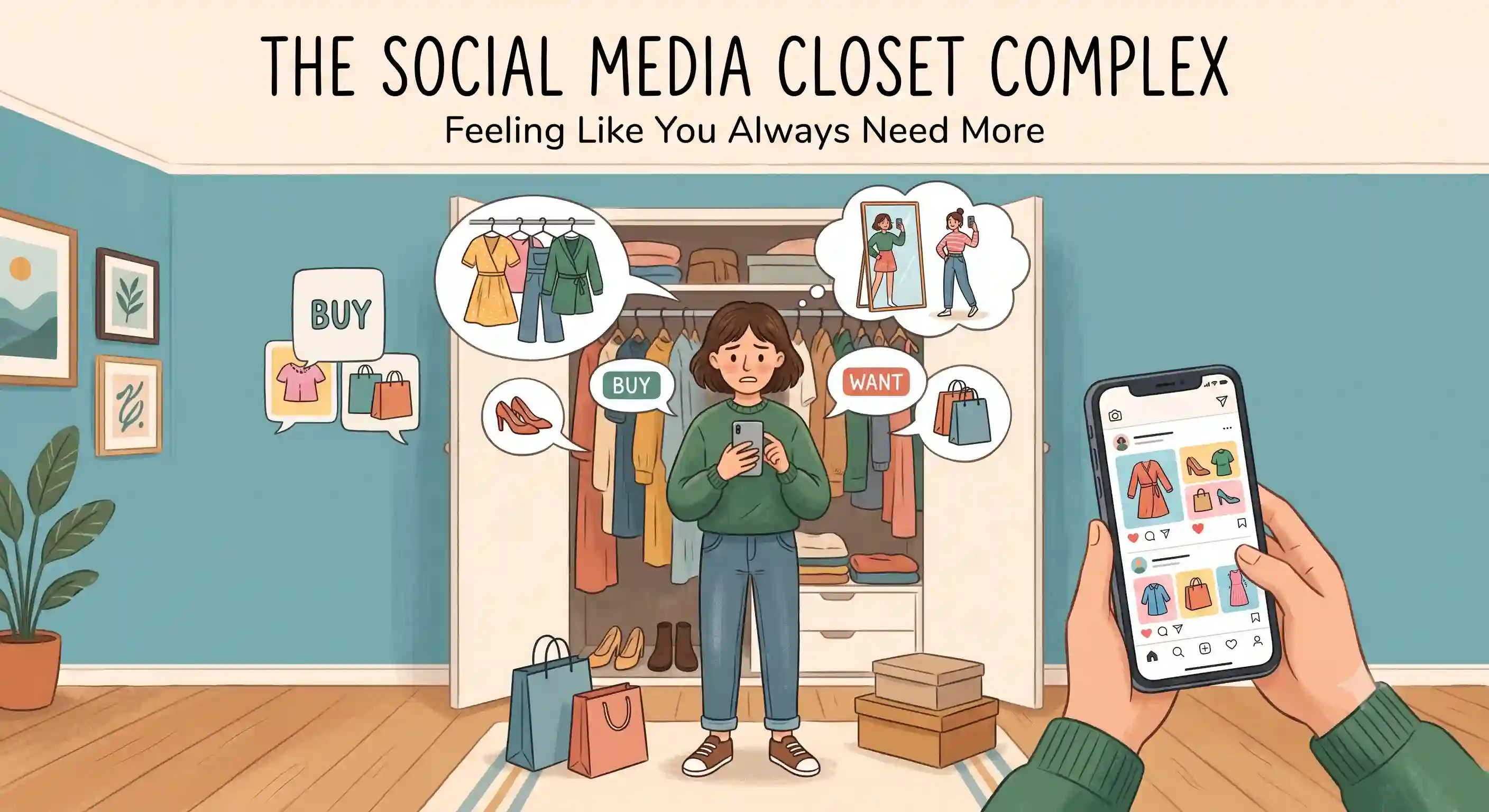
You open your wardrobe, which is reasonably full, and feel that you have nothing to wear. This feeling is common enough to be a cliché, but its cause is worth examining specifically, because the explanation most people reach for — "I just don't have the right things" — is usually wrong, and the actual cause is more recent and more identifiable than most people realise.
Until roughly the last fifteen years, the volume of other people's clothing that any individual was exposed to in a given day was limited to whoever they physically encountered: family, colleagues, people on the street, occasionally a magazine or a television programme. The modern smartphone user scrolling a social media feed is exposed to hundreds, sometimes thousands, of curated outfit images per week — influencers, brands, friends documenting their lives, algorithmically surfaced content from strangers with large followings. This is an unprecedented volume of comparison material, delivered continuously, and it is having a measurable effect on how people feel about their own wardrobes.
This article is about the specific psychological mechanisms through which social media exposure produces the feeling of wardrobe inadequacy, what the research says about the relationship between social media use and clothing consumption, and what can be done about the feeling that does not require either quitting social media entirely or buying your way out of the discomfort it produces.
The Comparison Volume Problem: A Genuinely New Phenomenon
Social comparison — evaluating yourself relative to others — is not a new psychological mechanism. Leon Festinger's social comparison theory, developed in 1954, established that humans routinely and largely automatically assess their own attributes, including appearance and possessions, against the people around them. What has changed is not the mechanism but the input: the volume, frequency, and selectivity of the comparison material available to that mechanism.
Before mass social media, the comparison set for clothing was largely local and limited: people you actually knew, generally seen in ordinary contexts (work, social events, daily life) where most people are wearing some rotation of a finite wardrobe. The comparison set now includes a continuously refreshing stream of curated images from an effectively unlimited number of people, virtually none of whom you know personally, almost all of whom are presenting their most considered, photogenic, and frequently sponsored or incentivised outfit choices.
Why the comparison is structurally unfair
The comparison most people are unconsciously running — their actual, everyday wardrobe versus the curated outfit content in their feed — is not a fair comparison, for several specific reasons that are worth naming explicitly, because naming them is part of what defuses their psychological power.
The outfit you see online was selected, by the wearer, from among many other options that were not photographed or posted because they were judged less successful. You are seeing someone's best output, not their average daily reality.
Content creators with sponsorship or affiliate income have a structural incentive to be seen in different outfits frequently. The volume of "different outfits" you see from any one creator vastly exceeds what an equivalent real-life acquaintance would actually wear in the same period.
A meaningful proportion of clothing shown by mid-size and large content creators is gifted, sponsored, or provided free in exchange for promotion. The financial reality underlying an extensive, ever-changing online wardrobe is frequently not representative of what an ordinary income would support.
Lighting, angles, semi-professional photography, and photo editing all contribute to how appealing an outfit appears in a posted image — conditions that do not apply to how the same outfit would look in an ordinary mirror or passing daylight.
Platforms surface content that performs well, which means the outfit content reaching you is disproportionately drawn from the most visually striking, most engagement-generating end of the distribution — not a representative sample of how people actually dress.
What the Research Actually Shows
The relationship between social media exposure and clothing consumption behaviour is an active area of consumer psychology research. The findings are consistent enough to be taken seriously, though the field is younger and the effect sizes more moderate than some popular coverage implies.
Social comparison and appearance dissatisfaction
A substantial body of research establishes that social media use — particularly image-based platforms like Instagram — is associated with increased body dissatisfaction and appearance comparison, especially among young women. A 2016 meta-analysis by Fardouly and Vartanian found consistent associations between social media use, particularly appearance-focused use, and lower body satisfaction. The mechanism most consistently identified is upward social comparison: comparing oneself to images that represent an idealised or unrepresentative standard.
Clothing dissatisfaction operates through a closely related mechanism. The same upward comparison dynamic that produces body dissatisfaction from appearance-focused content produces wardrobe dissatisfaction from outfit-focused content — the comparison is not only about the body wearing the clothes but about the clothes themselves, the styling, the apparent variety and currency of the wardrobe on display.
Influencer exposure and purchase intent
Research specifically examining fashion influencer content has found direct links between exposure and purchase intent. A 2019 study published in the Journal of Retailing and Consumer Services found that parasocial relationships with influencers — the one-sided sense of familiarity and connection that develops from regularly consuming someone's content — significantly predicted purchase intentions for products shown by that influencer, independent of the product's actual merits. The parasocial relationship functions similarly to the trust placed in a friend's recommendation, despite the commercial and curated nature of influencer content.
Research on "haul" content specifically — videos and posts showing large quantities of recently purchased clothing — found that this content format is associated with increased purchase intentions in viewers, attributed to the combination of social proof (many items being validated as worth buying), normalisation of high-volume purchasing as an ordinary behaviour, and the parasocial trust effect described above.
The outfit-repeating anxiety
A specific and increasingly documented phenomenon is anxiety about being seen wearing the same outfit twice, particularly among younger social media users who document significant portions of their lives online. Survey research by Barclaycard (2017) found that a meaningful proportion of young adults reported feeling pressure not to be photographed in the same outfit more than once on social media, and that this pressure influenced purchasing behaviour.
This represents a genuinely new psychological pressure. Prior to the documentation of ordinary life on social media, outfit repetition was invisible because there was no comprehensive visual record of what someone had worn and when. The creation of that visual record makes repetition visible and therefore subject to a social evaluation that did not previously exist in the same form.
The Specific Psychological Mechanisms at Work
The availability heuristic applied to wardrobe variety
The availability heuristic — the cognitive tendency to judge the frequency or normality of something based on how easily examples come to mind — applies directly to the perception of how much wardrobe variety is normal. After substantial exposure to social media outfit content, a large and constantly varying wardrobe becomes cognitively available as the normal reference point, even though it does not reflect the actual clothing consumption patterns of the median person. The constant availability of examples of extensive, ever-changing wardrobes makes such a wardrobe feel like the baseline expectation rather than an unusual or resource-intensive outlier.
FOMO applied to trend cycles
Fear of missing out applies to trend participation with equal force as it does to social events. Fashion trend cycles have been accelerated significantly by social media's rapid content turnover — a trend can emerge, peak, and be declared "over" within weeks on platforms like TikTok, compared to seasonal cycles of the pre-digital fashion calendar. This creates a continuous stream of trends that one could be "missing" by not participating. The psychological pressure is not about any specific garment but about the broader sense of falling behind a continuously updating social and aesthetic conversation.
Identity construction through visible novelty
Clothing serves an identity-expression function beyond its practical purpose. As covered in the piece on the true financial cost of fast fashion, the combination of low price points and social media has created a consumption loop where identity expression requires constant newness. Social media adds a specific dimension: the documented, externally visible nature of identity expression on a public platform creates a continuous performance context that did not exist for previous generations' private daily dressing. Each outfit posted is not just worn but presented, inviting a more self-conscious and comparison-sensitive relationship with what one owns and wears.

How Specific Platform Features Amplify the Effect
| Platform feature | How it amplifies clothing dissatisfaction | Why it works |
|---|---|---|
| Algorithmic feed curation | Surfaces content calibrated to maximum engagement, skewing toward visually striking, aspirational, and comparison-triggering outfit content rather than representative everyday dressing | Personalisation increases relevance and comparison intensity; the feed feels tailored to you specifically, increasing its psychological weight |
| Shoppable posts & integrated checkout | Reduces the gap between seeing an appealing outfit and purchasing a similar item to a few taps | Removes the friction that previously interrupted the impulse, giving less time for the comparison-driven desire to fade before a purchase decision is made |
| "Get the look" & outfit tagging | Directly links admired outfits to purchasable equivalents, converting passive viewing into an active purchase pathway | Closes the loop between aspiration and acquisition almost instantly |
| Haul & unboxing formats | Normalises high-volume, frequent purchasing as an entertaining and socially validated activity | Social proof effect: seeing purchasing modelled as normal and rewarded increases the viewer's own purchasing comfort |
| Stories & disappearing content | Encourages frequent, low-effort posting of daily outfits, increasing the total volume of comparison material and normalising documentation of every outfit | Lower production bar than permanent posts means far more outfit content is generated and consumed per person per day |
| Influencer affiliate & gifting programmes | Creates a structural incentive for frequent outfit changes and high apparent purchase volume that does not reflect ordinary financial constraints | Viewers compare their actual spending capacity to a wardrobe that was substantially subsidised or free — an unfair comparison neither party usually makes explicit |
What to Actually Do About It
Addressing this does not require deleting social media accounts or disengaging from fashion as an interest, both of which are unrealistic asks for most people and unnecessary as solutions. The more effective approach is a combination of feed curation, cognitive reframes, and behavioural friction — the same general toolkit that works for other forms of social-media-driven compulsive consumption.
Audit and curate your feed deliberately
- Unfollow or mute accounts that reliably produce comparison discomfort. If a specific account consistently leaves you feeling that your own wardrobe or appearance is inadequate after viewing it, that is sufficient reason to remove it regardless of how aesthetically appealing the content is. The discomfort is information.
- Actively follow accounts that model the behaviour you actually want to adopt. Slow fashion advocates, wardrobe re-wear content, cost-per-wear focused creators, and people who openly discuss repeating outfits provide a counterbalance to the high-turnover content that otherwise dominates fashion-adjacent feeds.
- Notice and interrupt haul and unboxing content specifically. Given the research connecting this format to increased purchase intention, treating it with particular scepticism — or simply consuming less of it — is a targeted intervention rather than a blanket restriction.
Apply the source-check before any purchase prompted by social content
Before purchasing anything prompted by something seen on social media, explicitly ask: would I want this if I had not just seen it presented this way? This is the same anchoring test used for sale purchases, applied to socially-triggered desire instead of price-triggered desire. If the appeal evaporates once removed from the curated presentation context, the desire was manufactured by the context, not a genuine and durable preference. A no-spend month is a useful structured way to run this test across an entire month of impulses.
Build a visible record of your own cost-per-wear champions
As a direct counter to the algorithmic feed's presentation of novelty as the norm, keep your own visible record — a phone album, a note — of the items in your wardrobe that you wear most often and feel best in. Reviewing this list periodically provides a personal, accurate comparison set to counteract the externally-sourced, unrepresentative one the feed provides. Your own fifteen-times-worn favourite jacket is a more relevant comparison point for your actual satisfaction than any single outfit post. If you have not done a full wardrobe stock-take recently, the 60-minute wardrobe audit is the fastest way to know what you actually own and wear.
Practise and normalise outfit repetition publicly, if you post
- If you document your own outfits on social media, consider deliberately reposting or re-photographing the same pieces. This is a small act that pushes back against the repetition anxiety both for yourself and for anyone who sees your content, modelling a more sustainable and accurate relationship with clothing consumption.
- Be transparent about gifted or sponsored items if you are a content creator. Beyond legal disclosure requirements in many jurisdictions, this transparency helps your audience calibrate the comparison accurately rather than assuming an extensive wardrobe reflects ordinary spending.
The Broader Reframe: Comparing to a Standard That Doesn't Exist
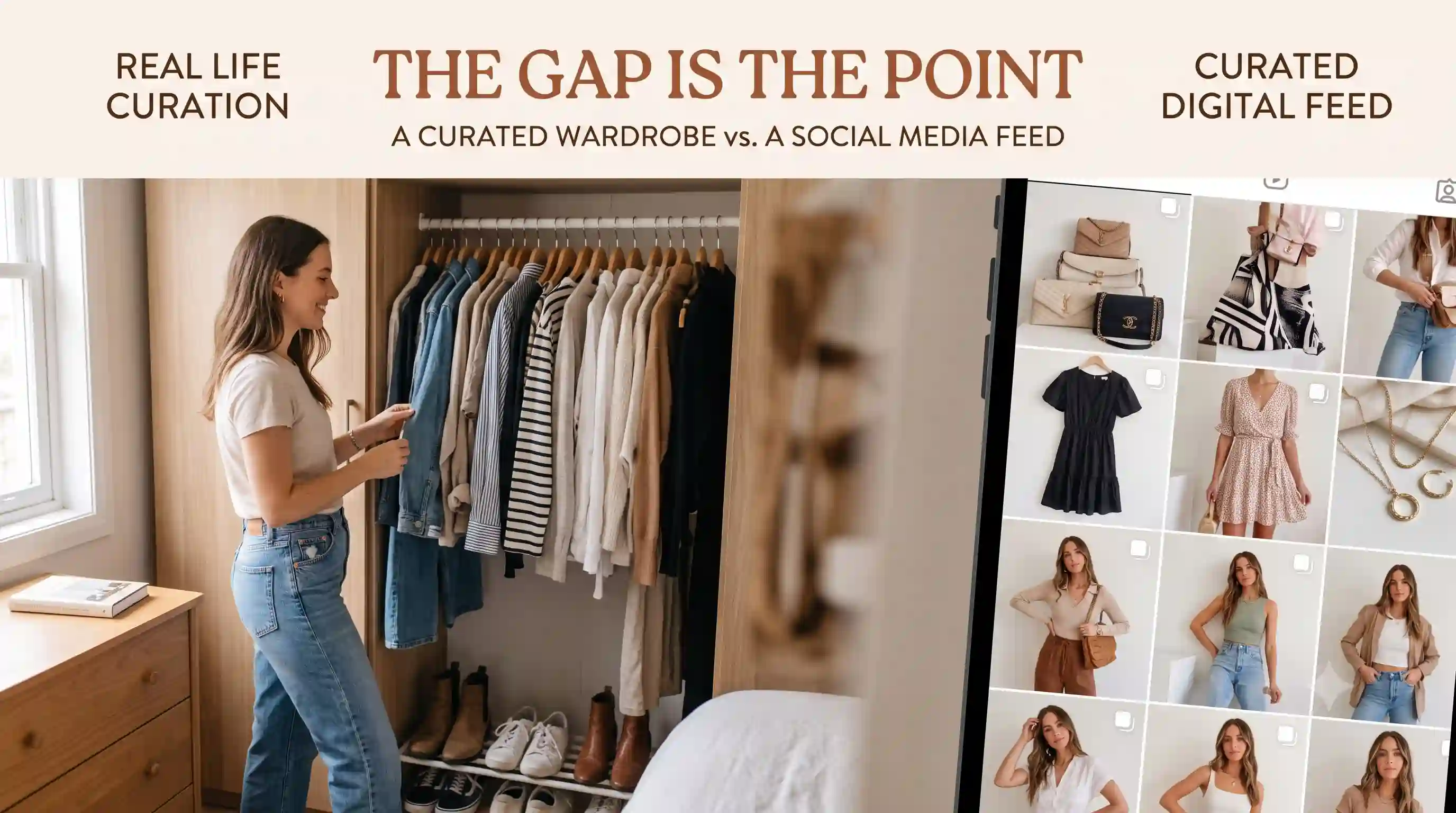
The most durable shift available here is not a specific tactic but a change in framing: the wardrobe you are comparing yourself against — the continuously varied, always-current, photographically optimised wardrobe suggested by a typical social media feed — does not actually exist as the lived reality of any specific person, including the people posting it. It is an aggregate, algorithmically curated composite drawn from the most photogenic moments of many different people's most considered choices, assembled by a system optimised to maximise your engagement rather than to give you an accurate picture of normal.
No single person lives inside that composite. The influencer posting daily outfit content is not actually wearing a different, perfectly styled outfit every single day in their private, undocumented life — they are documenting a curated selection of moments for public consumption, the same way a magazine fashion spread was never a record of someone's ordinary Tuesday. The difference now is volume, personalisation, and the blurred line between documentary and performance that makes the curated content feel more like real life than a magazine spread ever did.
Recognising this does not require cynicism about fashion as an interest or about the people who create content within it. It requires holding the accurate fact that the comparison standard is a constructed composite, not a population of real people actually living that way, and that measuring your own ordinary, repeated, comfortable wardrobe against it is not a fair test of whether your wardrobe is adequate. For a practical route out of the cycle, building a capsule wardrobe on a budget reorients the question entirely — from "what's new" to "what works repeatedly."
Your Wardrobe Was Probably Fine Before You Opened the App
The feeling of wardrobe inadequacy that prompts a scroll through shopping apps is, more often than the person experiencing it realises, downstream of the scrolling itself rather than an accurate signal about the wardrobe. The exposure to curated, high-frequency, professionally presented outfit content creates a comparison standard that no ordinary wardrobe, however full or well-chosen, can meet — because the standard is not actually achievable by anyone living an ordinary life, including the people who appear to be living it online.
Addressing this does not require rejecting fashion, style, or social media as interests. It requires recognising the specific mechanisms — selection bias, algorithmic amplification, parasocial trust, the manufactured anxiety of outfit repetition — that convert an interest into a compulsion, and applying deliberate friction and reframing at the points where those mechanisms operate most strongly. The wardrobe that felt insufficient an hour into a scrolling session is very often the same wardrobe that felt entirely adequate before the session began. The wardrobe did not change. The comparison standard did.
If you have ever felt that stepping away from social media for a week made you feel more content with what you already own — that is not a coincidence. It is the comparison mechanism switching off. The experiment is worth running deliberately.