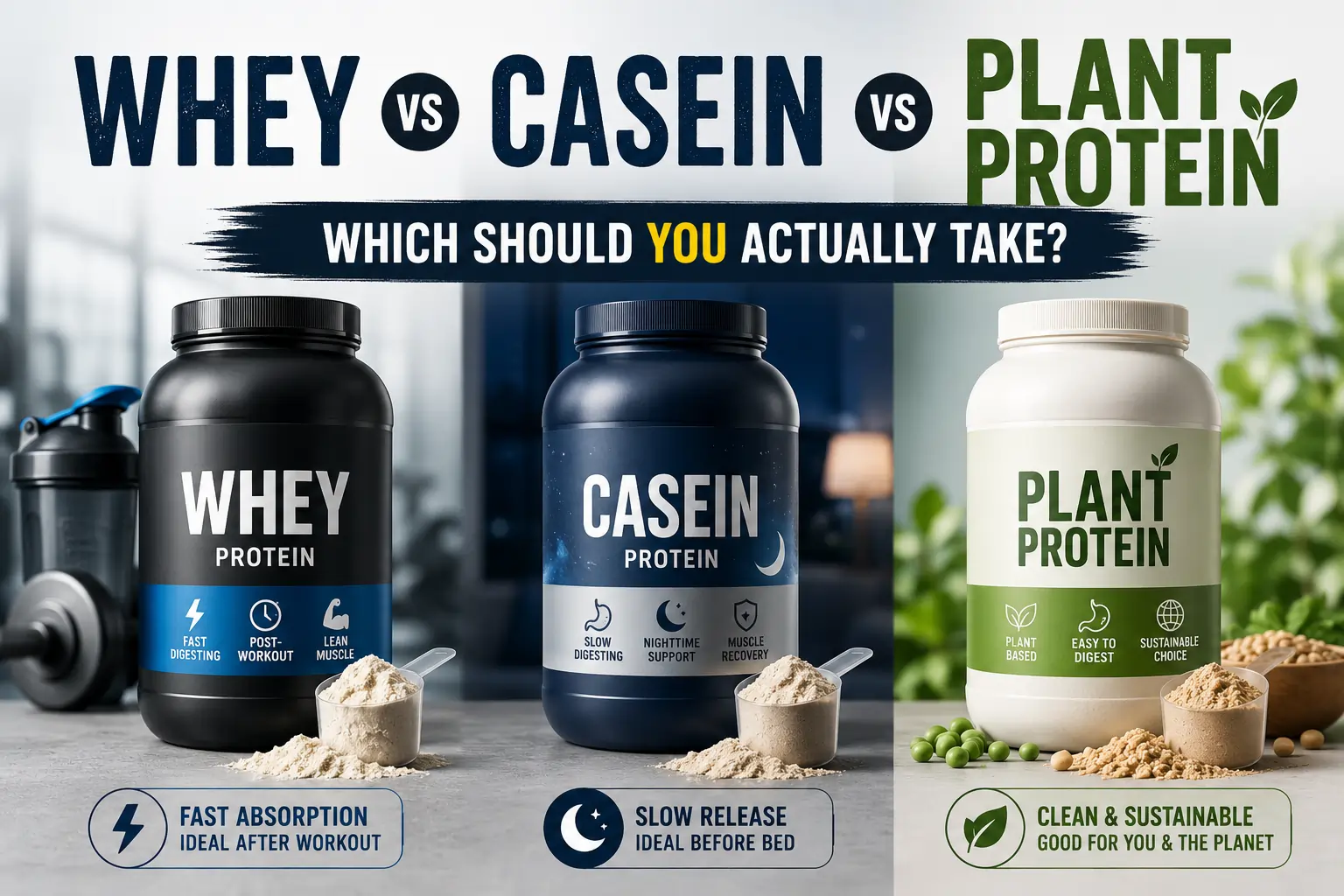
Walk into any supplement shop and you will be met with an entire wall of protein tubs, each promising faster recovery, more muscle, and better performance than the last. The choice between whey, casein, and plant protein sounds like it should have a clean answer. It does not — but it does have a clear framework.
The right protein supplement depends on three things: your goal, your body, and your diet. Most guides skip the nuance and just tell you whey is best. This one gives you the full picture — what each type actually does in your body, where the research is solid, where it is overhyped, and how to pick the one (or combination) that actually fits your life.
One thing upfront: supplements are called supplements for a reason. If your total daily protein intake is low, the type of protein you supplement with matters far less than simply getting enough. We will come back to this.
What Protein Supplements Actually Do
Protein supplements are a convenient source of dietary protein. That is it. They are not magic muscle builders. They do not trigger anabolic processes that food protein cannot trigger. They do not contain special ingredients that accelerate recovery beyond what equivalent dietary protein would achieve.
What they do is make it easier to hit a daily protein target when whole food sources are inconvenient, expensive, or simply not enough to close the gap. For most people who train seriously, the gap is real: getting 140 to 180 grams of protein per day from food alone requires careful planning, and a protein shake fills that gap efficiently.
This applies just as much to cardio training as it does to lifting. If your week includes regular running or cycling — see running vs cycling for cardio and fat loss for how to structure that — recovery between sessions still depends on adequate protein intake, even if muscle growth isn't the primary goal.
How much protein do you actually need? It depends on your goal and training load. If you are just starting a home workout routine, 1.4–1.6g per kg is a good target — see our Complete Beginner's Guide to Working Out at Home for a full 4-week programme to pair with your nutrition.
| Activity Level | Daily Protein Target |
|---|---|
| Sedentary (no training) | 0.8g per kg of bodyweight |
| Recreational training (2–3x per week) | 1.4–1.6g per kg |
| Serious training (4–5x per week) | 1.6–2.0g per kg |
| Muscle building phase | 1.8–2.2g per kg |
| Fat loss with muscle retention | 2.0–2.4g per kg (higher to preserve muscle in a deficit) |
Whey Protein: The Benchmark
Whey is the most studied protein supplement in existence. It is a byproduct of cheese production — the liquid separated from milk during cheesemaking is dried and concentrated into powder. It is a complete protein, containing all nine essential amino acids your body cannot synthesise on its own.
Whey's defining characteristic is its speed: it is digested and absorbed rapidly, producing a fast spike in blood amino acid levels. This makes it particularly effective at triggering muscle protein synthesis — the process by which your body builds new muscle tissue — in the period immediately after training.
Whey Concentrate vs Isolate vs Hydrolysate
| Type | Protein per 100g | Lactose | Processing | Best for |
|---|---|---|---|---|
| Whey Concentrate | 70–80% | Moderate (4–8%) | Least processed | Most people — budget-conscious, tolerates it fine |
| Whey Isolate | 90–95% | Very low (<1%) | Filtered further | Lactose intolerance; calorie deficit; slightly faster absorption |
| Whey Hydrolysate | 90–95%+ | Very low | Pre-digested (enzymatically) | Fastest absorption; most expensive; minimal real-world advantage for most |
For most people, whey concentrate is entirely adequate and significantly cheaper. Whey isolate is worth it if you are lactose-sensitive or in a calorie deficit. Hydrolysate offers marginal benefits over isolate at a considerably higher price.
What the research says about whey
- Muscle protein synthesis: Whey consistently outperforms slower-digesting proteins in stimulating acute muscle protein synthesis post-workout. This effect is well-established across dozens of studies.[1]
- Leucine content: Whey is exceptionally high in leucine, the amino acid that most directly triggers the muscle-building signalling pathway (mTOR). Per gram of protein, whey has more leucine than most plant proteins.
- Recovery: Studies show whey supplementation reduces muscle damage markers and soreness after resistance training compared to carbohydrate placebos — though the practical effect on next-day performance is modest.[2]
- Weight management: Whey has a high satiety effect relative to its calorie content, and some research suggests it slightly favours fat loss over muscle loss during calorie restriction.
Whey's limitations
- Not suitable for vegans or those with dairy allergies
- Some people experience bloating or gas with concentrate — isolate usually resolves this
- Environmental footprint is higher than plant-based alternatives
- Quality varies significantly — protein spiking (adding cheap amino acids to inflate the listed protein content) is a documented industry problem

Casein Protein: The Slow Release
Casein is the other major protein in milk — it makes up about 80% of milk's protein content (whey is the remaining 20%). Unlike whey, casein forms a gel-like structure in the stomach, which slows its digestion and produces a sustained, steady release of amino acids into the bloodstream over several hours rather than a fast spike.
This slow-release profile is casein's defining property and the source of both its primary use case and its limitations.
Where casein has a genuine advantage
- Before sleep: The most well-supported use case for casein. Muscle protein synthesis continues during sleep, and research shows that consuming 30–40g of casein before bed meaningfully increases overnight muscle protein synthesis compared to no protein. This is the one area where casein has a clear, evidence-backed advantage over other protein types.[3]
- Satiety: Casein is among the most satiating protein sources per calorie. Its slow digestion keeps you full longer — useful during calorie restriction or when hunger management matters.
- Anti-catabolic effect: The sustained amino acid release means blood amino acid levels stay elevated longer, which may help reduce muscle protein breakdown during extended periods without food (overnight, or during a long gap between meals).
Whey vs Casein — the accurate summary
- Whey produces a higher acute spike in muscle protein synthesis post-workout
- Casein produces lower but more sustained amino acid levels over 5–7 hours
- Over a 24-hour period, when total protein intake is equal, the difference in muscle protein synthesis between whey and casein is small
- The pre-sleep use case for casein is the most robustly supported application in the literature
Casein's limitations
- Not suitable for vegans or those with dairy allergies
- Thicker texture that many people find less palatable than whey
- Slower absorption makes it less ideal as a sole post-workout protein
- More expensive per gram than whey concentrate
- Less leucine per gram than whey, so slightly less effective at triggering acute muscle protein synthesis
Plant Protein: The Category, Not the Product
Plant protein is not a single thing. It is a category that includes pea, rice, hemp, soy, pumpkin seed, sunflower seed, and various blends. The quality and amino acid profile of different plant proteins varies significantly — and the blanket statement "plant protein is inferior to whey" is both oversimplified and, in some cases, outdated.
The amino acid completeness problem — and the solution
The traditional criticism of plant proteins is that most are not complete proteins — they are low or deficient in one or more essential amino acids.
| Plant Protein Source | Limiting Amino Acid(s) | Protein per 100g (typical) |
|---|---|---|
| Pea protein | Methionine (low) | 75–85% |
| Brown rice protein | Lysine (low) | 70–80% |
| Hemp protein | Lysine, leucine (both low) | 45–60% |
| Soy protein isolate | None — complete protein | 85–90% |
| Pumpkin seed protein | Lysine (low) | 55–70% |
| Sunflower protein | Lysine (low) | 70–80% |
The solution is blending. Pea protein is high in lysine but low in methionine. Brown rice protein is high in methionine but low in lysine. Combined in roughly a 70:30 or 80:20 ratio, pea and rice protein together produce an amino acid profile comparable to whey. Most commercial plant protein blends use this combination for exactly this reason.
Soy protein isolate is the exception: it is a complete protein on its own, with an amino acid profile closer to animal proteins than most other plant sources. The concerns about soy and hormones (specifically phytoestrogens) are frequently overstated — the research does not support meaningful hormonal effects from normal dietary intake of soy protein in healthy adults.[4]
Pea + Rice: the blend that changed the comparison
The 2015 Babault et al. study is frequently cited as a turning point in plant protein research: it found that pea protein produced equivalent gains in muscle thickness to whey protein over a 12-week resistance training programme.[5] More recent studies on pea-rice blends have similarly found minimal differences from whey in muscle-building outcomes when total protein intake is matched.
The honest current state of the evidence: a high-quality plant protein blend (pea + rice, or soy isolate) is not meaningfully inferior to whey for muscle building when you consume enough of it. The caveat matters: you typically need approximately 20–30% more plant protein per serving to match whey's leucine content and acute anabolic response.
What plant protein is good for
- Vegans and vegetarians: For people who do not consume dairy, a quality plant protein blend is the most effective protein supplement available.
- Digestive sensitivity: Many people who experience bloating or discomfort with whey concentrate find plant proteins — particularly pea — easier to digest.
- Environmental preference: Plant proteins have a considerably lower environmental footprint than dairy-derived proteins.
- Mixed-diet users: Plenty of people who eat dairy choose plant protein for reasons of preference, digestive comfort, or variety.
Plant protein's real limitations
- Lower leucine content per gram than whey — you need more of it to trigger equivalent muscle protein synthesis signalling
- Taste and texture: historically a weakness, though formulations have improved significantly
- Hemp protein is too low in protein content and amino acid quality to recommend as a primary supplement
- Price: quality plant protein blends are often comparable to or more expensive than whey isolate
- Heavy metal contamination: some plant proteins, particularly rice protein, have tested higher for lead and cadmium in independent lab tests — third-party testing certification matters here
Head-to-Head: The Full Comparison
| Factor | Whey | Casein | Plant (Pea+Rice or Soy) |
|---|---|---|---|
| Protein completeness | Complete | Complete | Complete (blended/soy); incomplete (single-source) |
| Leucine content | Highest | High | Moderate (lower than dairy) |
| Absorption speed | Fast (2–3 hrs) | Slow (5–7 hrs) | Moderate (3–5 hrs) |
| Post-workout | ★★★★★ Optimal | ★★★ Adequate | ★★★★ Very good (blended) |
| Pre-sleep | ★★★ Adequate | ★★★★★ Optimal | ★★★ Adequate |
| Digestibility | Good (isolate: excellent) | Good | Very good (pea); variable (hemp) |
| Dairy-free / Vegan | No | No | Yes |
| Satiety | High | Very high | High |
| Taste / mixability | Excellent | Thick — acquired taste | Good to excellent (modern blends) |
| Environmental footprint | Moderate | Moderate | Low |
| Price (quality product) | Low–moderate | Moderate–high | Moderate–high |
| Third-party testing availability | Wide | Wide | Variable — check carefully |
The Decision Framework: Which One Should You Take?
| Your Situation | Reasoning | Take This |
|---|---|---|
| You eat dairy, train hard, want the simplest effective option | Whey is fast, complete, high-leucine, and well-studied | Whey |
| You are vegan or vegetarian | No animal proteins available; quality plant blend matches whey for outcomes | Plant |
| You are lactose intolerant | Isolate removes nearly all lactose; if still sensitive, switch to plant | Whey Isolate |
| You want to optimise overnight recovery | Casein's slow release sustains amino acids during sleep — well-supported | Casein |
| You eat dairy but have digestive issues with whey | Pea protein has a cleaner digestive profile for many people | Plant |
| You are on a budget | Whey concentrate gives the best protein per rupee | Whey Concentrate |
| You train twice a day or have very high protein needs | Use whey post-workout and casein before bed for full-day coverage | Whey + Casein |
| You care about environmental impact | Plant proteins have a significantly lower footprint than dairy | Plant |
| You are choosing between hemp and pea+rice | Hemp is low in protein content and amino acid quality for the price | Skip hemp — choose pea+rice |
| You are buying for the first time | Whey concentrate from a reputable certified brand is the lowest-risk starting point | Whey |
How Much to Take and When
How much per serving
The muscle protein synthesis response to a single serving plateaus at roughly 20–40 grams of high-quality protein, depending on body size. More than this in a single serving does not significantly increase the anabolic response — excess protein is oxidised for energy.
- Smaller frame (under 65kg): 20–25g per serving is adequate
- Average frame (65–85kg): 25–35g per serving
- Larger frame (85kg+): 30–40g per serving
- Plant protein: Add approximately 20–30% more than the above to match leucine content (30–50g for most people)
Timing: what actually matters
| Timing | Evidence | Practical Guidance |
|---|---|---|
| Post-workout (within 1–2 hours) | Strong | The most impactful single moment for a protein dose. Whey or plant protein here. |
| Pre-sleep (30–60 min before bed) | Strong (for casein) | 40g casein before sleep meaningfully increases overnight muscle protein synthesis. Well-supported. |
| Pre-workout (1–2 hours before) | Moderate | Useful if you train fasted or it has been 4+ hours since your last meal. Not necessary if you ate recently. |
| Between meals | Moderate | Spreading protein across 3–4 meals optimises synthesis better than front- or back-loading. |
| Morning (if training fasted) | Moderate | Breaking a fast with protein reduces morning muscle protein breakdown. |
The 'anabolic window' — the idea that you must consume protein within 30 minutes of training or the session is wasted — has been significantly walked back by more recent research.[6] The window is real but wider than once thought: 1–2 hours post-workout is equally effective.
Total daily protein: the number that matters most
If your total daily protein intake is adequate (1.6–2.2g per kg of bodyweight for someone training seriously), the precise timing and type of protein you use becomes a secondary optimisation. If your total intake is low, no amount of whey-vs-casein deliberation will make a meaningful difference.
Get the total right first. Then optimise timing and type.
What to Look for When Buying: The Quality Problem
The protein supplement industry has a genuine quality problem. Protein spiking — adding cheap amino acids (glycine, taurine, creatine) to inflate the nitrogen count and therefore the listed protein content — is documented and ongoing. A product can list 25g of protein per serving while delivering significantly less functional protein.
What to check before buying
- Third-party testing certification: Look for Informed Sport, NSF Certified for Sport, or Labdoor certification. These programmes independently verify that what is on the label is in the tub. This is the most important quality signal.
- Amino acid profile on label: A reputable brand lists the full amino acid breakdown. If it is not there, be sceptical.
- Leucine content: Should be at least 2g per serving for whey. If it is significantly lower, the product may be protein-spiked.
- Ingredient list length: Shorter is generally better. A quality protein powder does not need ten filler ingredients.
- Price as a signal — but not the only one: Very cheap protein is almost always a quality compromise. Very expensive protein is often paying for marketing. The middle of the market, with third-party certification, is where the best value typically sits.
For plant proteins specifically
- Check for third-party heavy metal testing results — rice protein in particular has had documented contamination issues
- Look for a pea + rice blend rather than a single-source plant protein (unless choosing soy isolate)
- Avoid proprietary blends where individual ingredient quantities are hidden
Common Myths Worth Clearing Up
| The Myth | The Reality |
|---|---|
| "Plant protein is much less effective than whey for muscle building" | Outdated for quality pea+rice blends or soy isolate. The gap exists but is small and bridgeable with slightly higher serving sizes. |
| "You need protein within 30 minutes of training" | The anabolic window is real but 1–2 hours post-workout is equally effective. Total daily protein matters more than precise timing. |
| "More protein per serving means more muscle" | Muscle protein synthesis plateaus at 20–40g per serving. More in a single dose is largely wasted — distribute across meals instead. |
| "Casein before bed will make you fat" | Protein has the lowest tendency of all macronutrients to be stored as fat. Pre-sleep casein is supported by research for muscle gain without meaningfully affecting body composition negatively. |
| "Soy protein raises oestrogen levels in men" | Phytoestrogens in soy are not equivalent to human oestrogen. Research does not support meaningful hormonal effects from normal dietary intake in healthy men. |
| "Whey is only for bodybuilders" | Protein targets are relevant for anyone who trains — recreational gym-goers, runners, cyclists. The benefits of adequate protein intake are not specific to bodybuilding. |
| "Expensive protein is better protein" | Price does not reliably correlate with quality. Third-party certification is a better quality signal than price or brand story. |
The Practical Summary
- Total daily protein intake is the variable that matters most. Hit your target (1.6–2.2g/kg for active people) before worrying about type or timing.
- Whey is the default for most dairy-eating people. Fast-absorbing, high-leucine, well-studied, relatively affordable. Concentrate for most; isolate if lactose-sensitive.
- Plant protein (pea+rice blend or soy isolate) is a genuine, effective alternative — not a compromise. Use it if you are vegan, dairy-sensitive, or simply prefer it. Take slightly more per serving.
- Casein has one well-supported niche: before sleep. If overnight recovery matters and you consume dairy, 30–40g of casein before bed is worth adding.
- Buy certified. Informed Sport or NSF certification is worth more than any brand story or marketing claim.
- Do not overthink the type until you have got the total right. A consistent protein target hit with whatever type you tolerate and enjoy beats perfectly timed doses of a premium product that still leaves you short of your daily target.
The Bottom Line
Whey is not always best. Casein is not redundant. Plant protein is not second-rate. Each has a job, and the right answer depends on who you are, how you eat, and what problem you are actually trying to solve.
For most people who eat dairy and train regularly: whey concentrate post-workout, and consider casein before bed if you are serious about recovery. For vegans, vegetarians, or anyone with dairy sensitivity: a quality pea-rice blend or soy isolate is a full replacement, not a workaround.
Whatever you choose: buy certified, hit your daily total, and do not let the supplement choice distract from the training and sleep that actually drive results.
The best protein supplement is the one you will take consistently, that your body tolerates, and that fits your budget. Hit your daily target. That is the whole game.
[1] Witard OC et al. "Myofibrillar muscle protein synthesis rates subsequent to a meal in response to small and large bolus doses of dairy and soy protein." American Journal of Clinical Nutrition, 2014. PubMed
[2] Tang JE et al. "Ingestion of whey hydrolysate, casein, or soy protein isolate: effects on mixed muscle protein synthesis at rest and following resistance exercise in young men." Journal of Applied Physiology, 2009. PubMed
[3] Res PT et al. "Protein ingestion before sleep improves postexercise overnight recovery." Medicine & Science in Sports & Exercise, 2012. PubMed
[4] Messina M. "Soy and Health Update: Evaluation of the Clinical and Epidemiologic Literature." Nutrients, 2016. PubMed
[5] Babault N et al. "Pea proteins oral supplementation promotes muscle thickness gains during resistance training: a double-blind, randomized, placebo-controlled clinical trial." Journal of the International Society of Sports Nutrition, 2015. PubMed
[6] Schoenfeld BJ et al. "Nutrient timing revisited: is there a post-exercise anabolic window?" Journal of the International Society of Sports Nutrition, 2013. PubMed