A personal trainer's job is to design and deliver safe, effective exercise programs, screen for exercise risk, and coach clients toward realistic goals — not to diagnose, prescribe treatment, prescribe diets or supplements, or treat injury or disease. Knowing exactly where that line sits is what keeps clients safe and keeps a trainer's career out of legal trouble.
Before Lesson 5 introduces the IFT Model and Lessons 6 through 12 walk through assessing and programming for real clients, it's worth spending one lesson on a less exciting but more important question: what is a personal trainer actually allowed to do, and where does that authority end?
What a Personal Trainer's Scope of Practice Actually Covers
A certified personal trainer's scope of practice centers on working with clients who are apparently healthy, or who have documented medical clearance to exercise. Within that population, the job includes conducting health-history interviews and stratifying cardiovascular and other health risk, administering appropriate fitness assessments, designing and delivering exercise programs matched to a client's goals and findings, and coaching behavior change and adherence.
Everything from Lesson 5 onward — the IFT Model, the assessments in Lessons 7 and 8, the programming in Lessons 9 through 11 — lives inside this scope. It's the "yes, this is your job" list. Notice that it's a fairly generous list: assessing, programming, and coaching cover the overwhelming majority of what happens in a real training relationship. Scope of practice isn't a narrow lane — it's a clear boundary around a genuinely broad one.
What Falls Outside Scope of Practice
Just as important is the "no, this isn't your job" list — the activities reserved for licensed professionals, regardless of how confident or well-read a trainer feels about them.
- DiagnosingNaming or confirming a medical condition, injury, or disease is a licensed clinician's job, not a trainer's.
- Prescribing treatment, diets, or supplementsIndividualized meal plans, medically-driven diets, and specific supplement protocols belong with a registered dietitian or physician.
- Treating injury or diseaseRehabilitating an existing injury is physical therapy, not personal training, even for a trainer with genuine anatomy knowledge.
- Clinical counselingSupporting a client's motivation is in scope; treating a diagnosed mental-health condition is not.
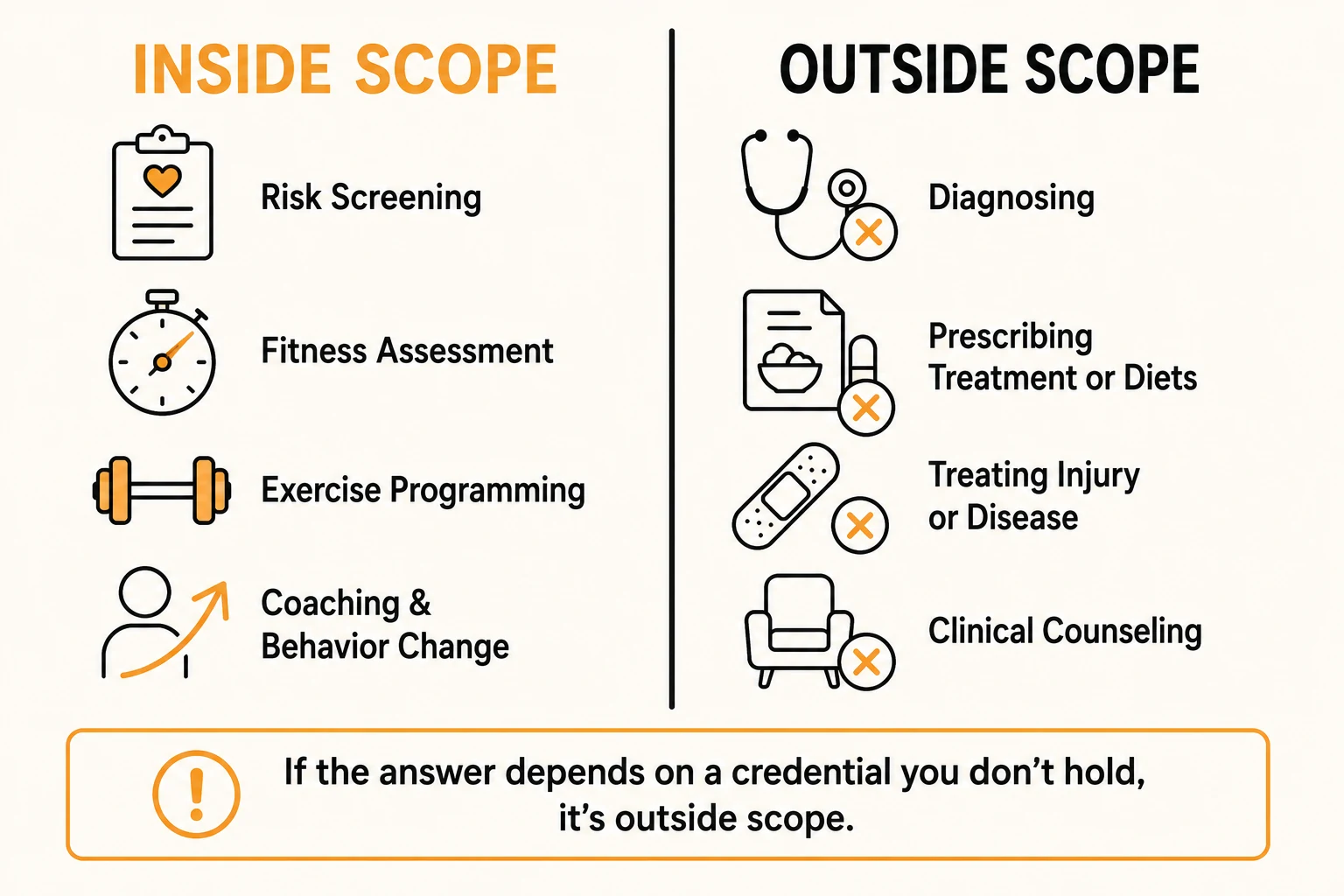
None of this means a trainer stays silent when something looks off. It means the correct response is a referral, not an improvised diagnosis or treatment plan. A useful mental test: if what you're about to say would change based on a medical credential you don't hold, it's outside scope — full stop, regardless of how confident the answer feels.
Building a Referral Network
Because so much of a trainer's value depends on recognizing the edge of their own scope, ACE frames building a referral network as a core professional responsibility — not an afterthought for when something goes wrong.
| Referral source | When to use it |
|---|---|
| Rehabilitation professionals (physical therapists, athletic trainers) | Existing injury, pain that doesn't resolve, post-surgical clients |
| Nutrition professionals (registered dietitians) | Requests for individualized meal plans or medically-driven diets |
| Physicians and nurse practitioners | Uncontrolled symptoms, unclear medical clearance, new red flags during screening |
| Mental-health professionals | Signs of a diagnosable condition beyond general motivational support |
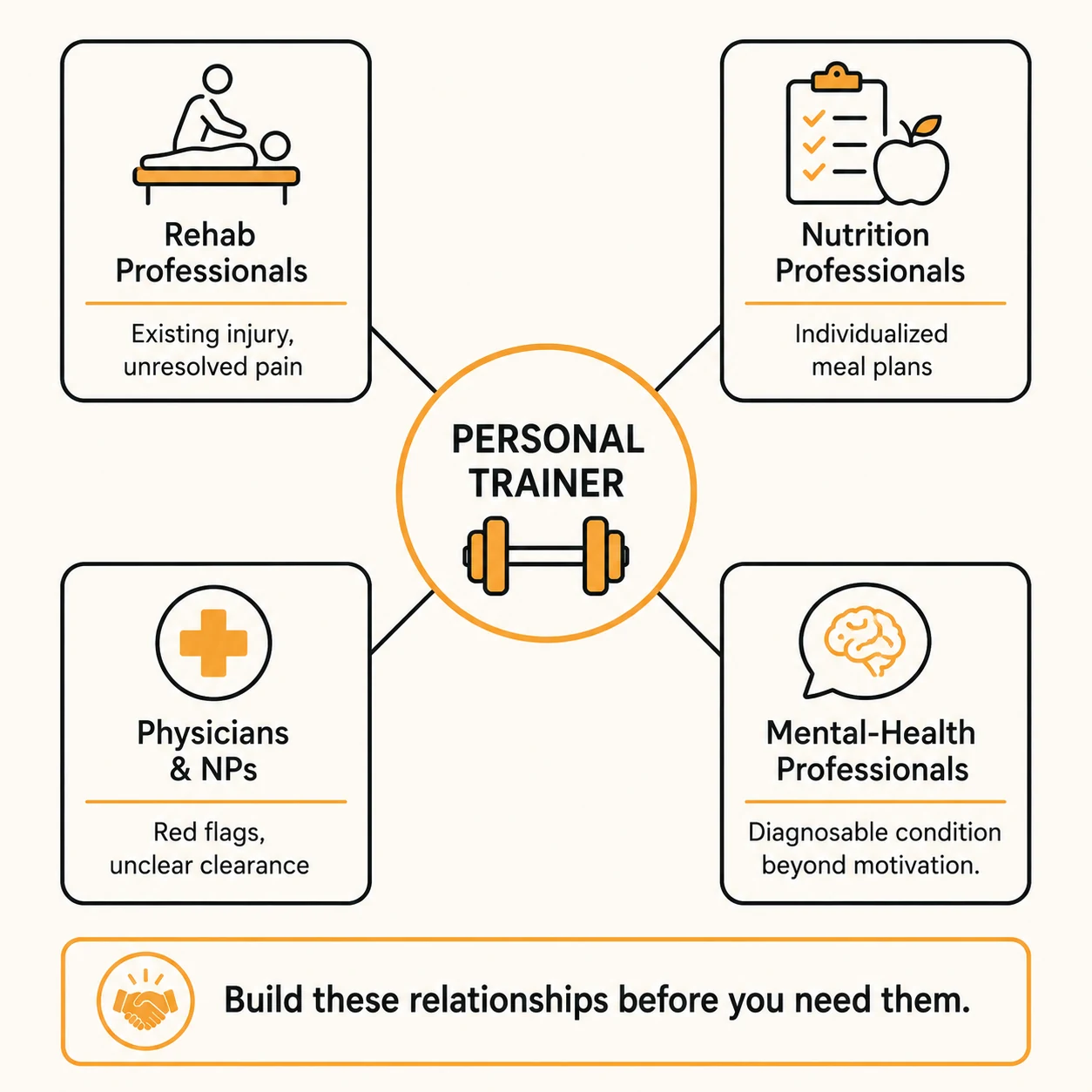
Building this network in practice means having actual names and contact information before the moment you need them — not scrambling to find a physical therapist while a client is mid-conversation about a nagging shoulder. A trainer who's proactively built relationships with two or three professionals in each category can make a warm handoff instead of a vague "you should probably see someone about that."
Professional Conduct and Why the Line Matters
Operating outside scope of practice isn't just a technicality — it's where most of a trainer's real liability risk lives. Staying inside scope, documenting health screenings, and referring out promptly when something surfaces are the basics of what's often called standard of care: the level of caution a reasonably competent trainer would exercise in the same situation.
This isn't legal advice, and the specifics of liability and licensing vary by location — but the underlying principle holds everywhere: the boundary of scope of practice is also the boundary of what a trainer can defend if something goes wrong. Lesson 17 covers this in more legal detail — negligence, informed consent, liability insurance — but the foundation is set right here: staying inside scope is the single biggest thing a trainer controls to reduce their own risk.
A Realistic Scenario
A client mentions, mid-session, that they've been having sharp pain in their lower back for two weeks and asks if you can "just show them some stretches for it." It's a completely normal request, and it's also a clean example of where the line sits: general education about movement is fine, but this specific request — addressing a symptom the client is describing as ongoing pain — is a treatment request, not a general-education one.
The scope-appropriate response isn't refusing to engage; it's redirecting. Something like: "I don't want to guess at what's causing that and risk making it worse — let's get you seen by someone who can actually diagnose it, and I'll work around whatever they recommend once you have guidance." That's the referral-network table above, the "when in doubt, refer out" principle, and the communication approach Lesson 3 covers, all showing up in one ordinary moment.
8 questions, modeled on ACE's real exam style. Score 72%+ to mark this lesson complete.
- A trainer's scope of practice covers exercise programming, risk screening, fitness assessment, and behavior coaching for apparently healthy or medically-cleared clients.
- Diagnosing, prescribing treatment or diets, treating injury or disease, and clinical counseling all fall outside scope of practice.
- A referral network — rehab, nutrition, medical, and mental-health professionals — is a core professional responsibility, not a last resort.
- Staying inside scope and referring out promptly are the basics of standard of care.
- A useful test for a borderline request: if the answer would change based on a medical credential you don't hold, it's outside scope.
Before moving to Lesson 2:
- Write down three requests a client might make that fall outside scope of practice, and name who you'd refer each one to.
- Draft one sentence you could actually say out loud when referring a client out, without it sounding like a rejection.
- Name one professional in each referral category (rehab, nutrition, medical, mental health) you could realistically build a relationship with, even hypothetically.
- Complete the knowledge check above and review any question you missed.