Before any assessment or program design happens, ACE's model calls for an investigation stage: building rapport, screening for health and exercise risk, and understanding a client's readiness to change — because the biggest predictor of whether a client sticks around isn't their fitness level, it's the quality of that first relationship.
Lesson 5 introduced the two IFT Model components you'll spend the rest of this course learning to program. Before you can place a client into a phase of either one, though, you need to actually know who they are. That's what the investigation stage is for.
The Investigation Stage: What It Actually Is
The investigation stage is the collection of everything relevant to understanding a client's needs and readiness — health and safety information, yes, but also their lifestyle preferences, interests, attitudes, and previous experience with exercise. It happens before any fitness assessment, and it's the foundation every later phase decision gets built on.
Skip or rush this stage, and you risk two failure modes at once: missing a real health-risk factor because you never asked, or designing a technically-correct program that a client abandons in three weeks because it never accounted for what they actually wanted or could realistically sustain. Picture a new client who mentions, almost in passing, that they "sometimes get a little dizzy on stairs" — buried in an otherwise upbeat first conversation about wanting to run a 5K. A trainer moving straight to assessment might never circle back to that detail. A trainer working through the full investigation stage has a structured moment built in to follow up, ask clarifying questions, and decide whether it warrants medical clearance before anything else proceeds.
This is also why the investigation stage sits before Lessons 7 and 8 rather than alongside them: physical assessment protocols assume you already know a client's risk profile, goals, and readiness. Skipping ahead to assessment without this groundwork means testing someone you don't yet have enough context to test safely or meaningfully.
Rapport Comes First
Rapport is a relationship marked by mutual understanding and trust — and in the IFT Model, it's treated as the literal foundation everything else sits on, not a soft skill bolted on afterward. A client's first few interactions with you shape whether they come back at all, long before any exercise program has a chance to produce results.
Building it in practice means genuinely active listening, reading both verbal and nonverbal cues, and adjusting your communication style to the person in front of you — a nervous first-time exerciser and a returning athlete need very different opening conversations, even if their eventual programs look similar. With the nervous first-timer, the priority is lowering the stakes: normalizing that questions like "what does a typical week look like for you?" are about building a realistic plan, not judging past inactivity. With the returning athlete, the priority is usually the opposite — getting past generic small talk quickly and into specifics, because they've likely done intake conversations before and disengage if it feels scripted or slow.
Health-History Intake and Risk Screening
Once rapport is underway, the investigation stage moves into structured screening. The most common entry-level tool is the PAR-Q+ (Physical Activity Readiness Questionnaire) — quick, non-invasive, and useful as a minimal safety check for low-to-moderate intensity exercise.
| Tool | Strength | Limitation |
|---|---|---|
| PAR-Q+ | Fast, simple, non-invasive — a reasonable minimum bar for most clients | Brief by design, so it can miss specific medications, past injuries, or nuanced conditions |
| Full health-history questionnaire | Captures medications, supplements, injuries, illnesses, surgeries, and family history | Takes longer and can feel clinical if not framed conversationally |
The broader health-risk appraisal process built on top of these tools includes reviewing the client's health information and lifestyle habits, stratifying their risk level, deciding whether medical clearance or supervision is needed, and only then moving toward exercise testing and programming recommendations.
Readiness for Behavior Change
Health screening tells you whether it's safe to exercise. It doesn't tell you whether a client is actually ready to change their behavior. For that, the investigation stage draws on the transtheoretical model (TTM) — also called the stages-of-change model.
- PrecontemplationNot currently considering exercise, and not planning to start in the near future.
- ContemplationAware change is needed and thinking about it, but hasn't committed to a timeline.
- PreparationIntends to act soon, and may already be taking small steps.
- ActionActively exercising, typically within the last six months.
- MaintenanceSustaining the behavior long-term and working to prevent relapse.
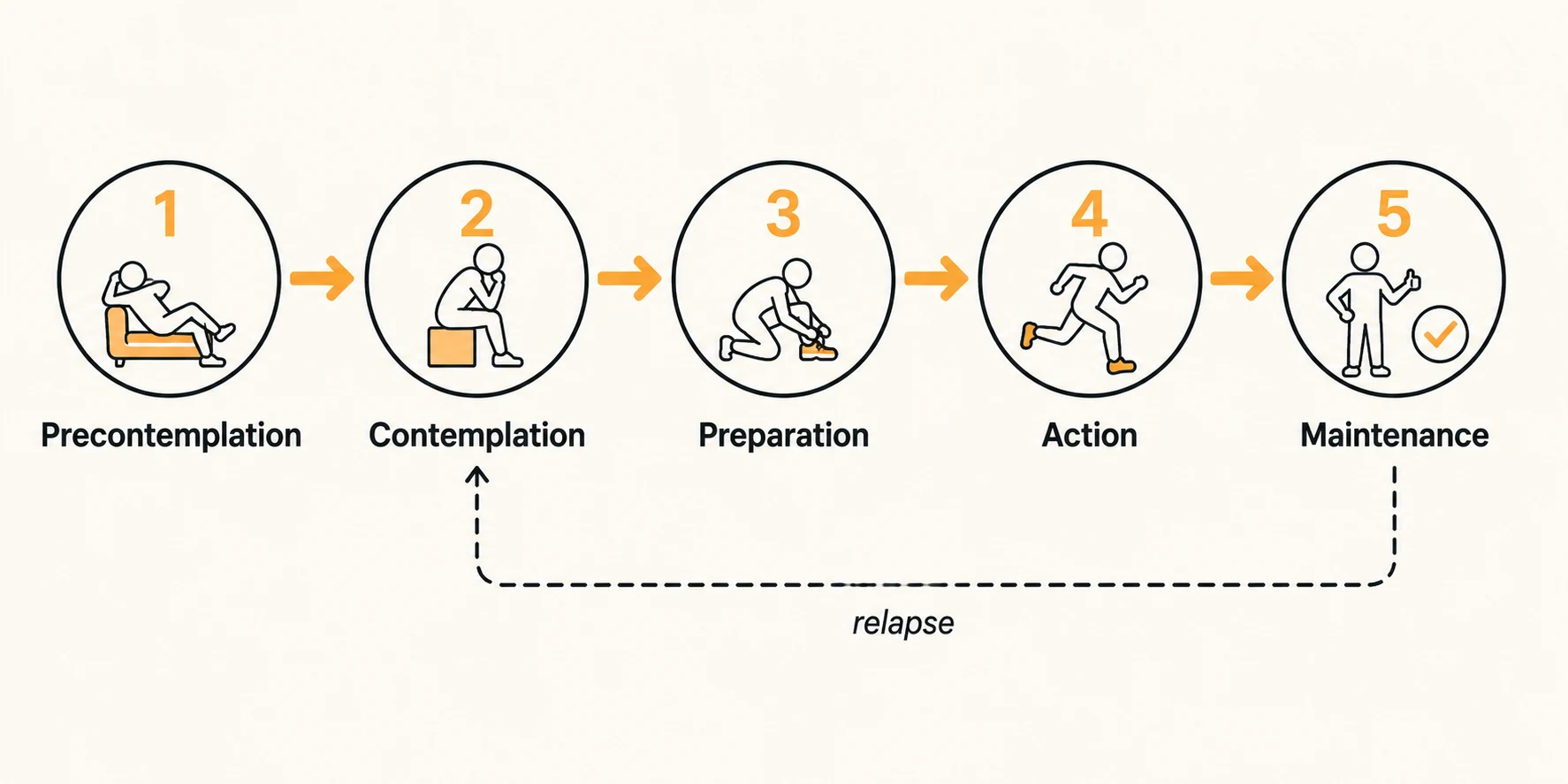
Knowing which stage a client is in changes how you talk to them. Someone in precontemplation needs a very different conversation than someone already in the action stage — pushing an aggressive program on a precontemplation-stage client is a fast way to lose them before you've started.
Setting Goals Together
The investigation stage closes with collaborative goal-setting — not the trainer prescribing a goal, but building one out with the client.
-
SMART goals A framework for what a well-formed goal looks like: Specific, Measurable, Attainable, Relevant, and Time-bound.
-
The GROW model A conversation structure for getting there collaboratively: Goal, Reality, Options, Will — walking a client from where they want to end up to what they're actually willing to commit to doing.
Putting It Together: A Sample Investigation Conversation
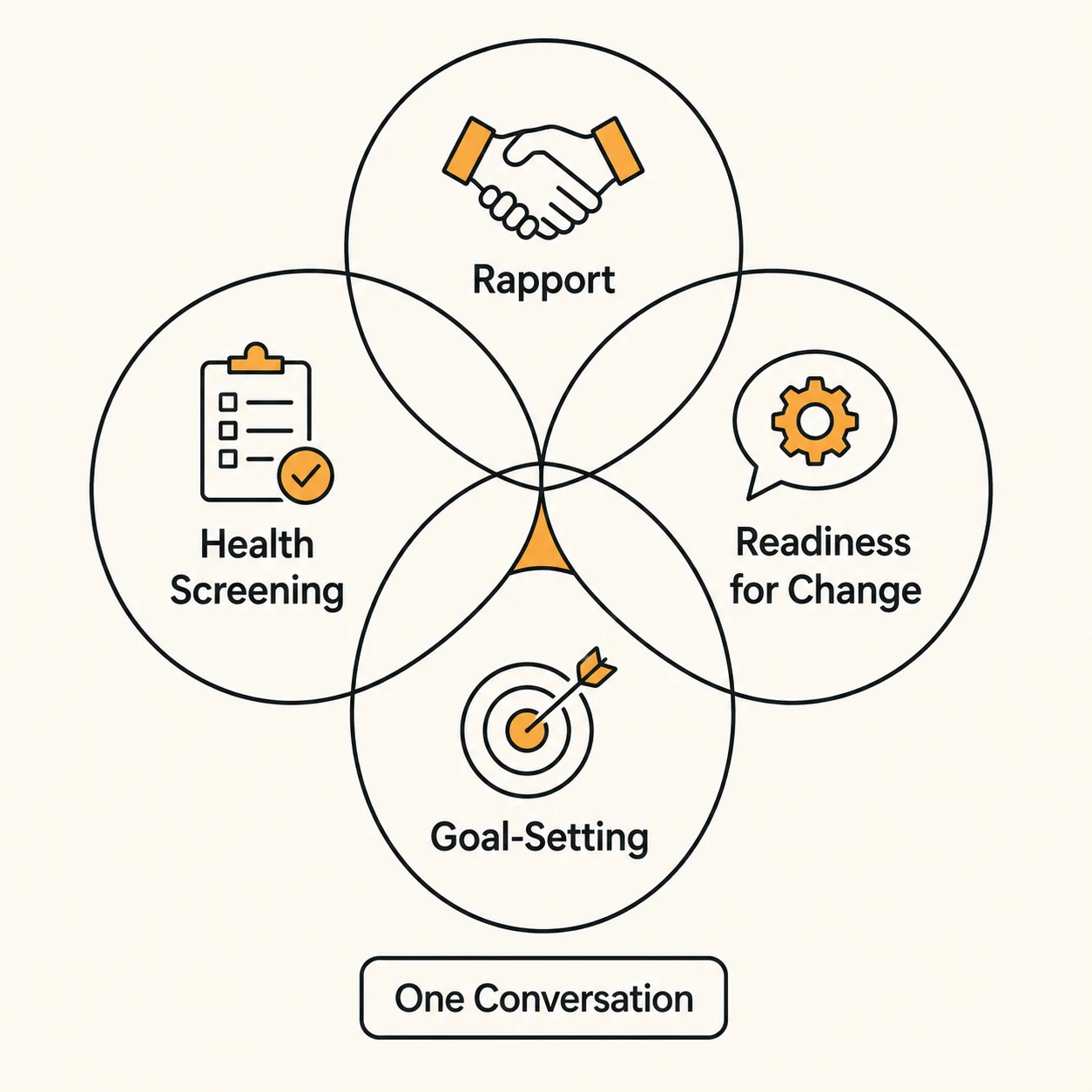
These four pieces — rapport, health screening, readiness for change, and goal-setting — don't happen as four separate, boxed-off steps in a real session. They interleave. Here's a compressed sketch of how a first meeting might actually flow:
The trainer opens with genuine, unhurried small talk — not "let's get started," but questions about the client's day, what brought them in. That's rapport-building, and it's already happening before any form comes out. Once the conversation settles, the trainer introduces the PAR-Q+ conversationally ("a few quick health questions so I know how to keep today safe"), rather than handing over a clipboard cold. A "yes" answer on the questionnaire — say, chest pain during exertion — becomes a follow-up conversation, not a checkbox: when does it happen, has a doctor seen it, is it a red flag requiring referral or something worth simply noting. From there the trainer listens for stage-of-change signals in how the client talks about exercise — "I've been meaning to start for months" reads very differently from "I've been doing this consistently since spring" — and finally steers toward a SMART goal, using GROW-style questions (What does success look like? What's realistic this month?) to get the client to state the goal in their own words rather than having one handed to them.
Notice what's absent from that sketch: a rigid script. ACE's model gives you the components and the order they need to happen in, not a word-for-word transcript — the skill is weaving them into a conversation that still feels like one.
8 questions, modeled on ACE's real exam style. Score 72%+ to mark this lesson complete.
- The investigation stage collects health, safety, lifestyle, and readiness information before any assessment or programming begins.
- Rapport is the foundation of the whole model — trust and communication quality predict adherence more than program design alone.
- The PAR-Q+ is a fast, minimal screening tool; a full health-history questionnaire catches detail it misses.
- The transtheoretical model's five stages — precontemplation, contemplation, preparation, action, maintenance — describe a client's readiness to change.
- SMART goals define what a good goal looks like; the GROW model is the conversation used to arrive at it collaboratively.
- Rapport, health screening, readiness-for-change, and goal-setting interleave into one conversation — none of the four is optional, and safety screening alone doesn't cover readiness or goals.
Before moving to Lesson 7:
- Write the five stages of change in order, then write one sentence describing how you'd talk differently to a client in precontemplation versus one in the action stage.
- Draft one SMART goal for a hypothetical client, then map how a GROW-model conversation might have gotten them there.
- Sketch a 60-second opening for two different client types — a nervous first-timer and a returning athlete — and note what you'd change between the two.
- Complete the knowledge check above and review any question you missed.