The ACE IFT Model organizes every exercise program around two independent components — Cardiorespiratory Training and Muscular Training — each divided into three phases named for their training focus. A client can sit in a different phase for each component at the same time, because the two tracks are assessed and progressed separately.
Chapters 1–4 covered scope of practice, adherence, communication, and behavior change — the "people" side of personal training. Chapter 5 is where the "program design" side begins: ACE's own blueprint for turning everything you know about a client into an actual, structured exercise program.
Why ACE Built This Model
ACE's own research found something uncomfortable for the industry: most clients who stop working with a trainer don't quit over cost. The overwhelming majority cited a negative experience with the trainer as the real reason. New exercisers, in particular, are prone to quitting within their first three to six months — regardless of whether they're paying for a trainer.
The ACE IFT Model was built to close that gap. Instead of treating "the science of exercise" and "the art of building a relationship with a client" as separate skills, it bakes rapport-building into the same framework used for program design — so the first few sessions are about creating a positive, sustainable experience, not just running a client through an assessment battery. This is also why Lesson 6's investigation stage comes before any of the physical assessments in Lessons 7 and 8 — the model is deliberately sequenced to build trust first.
Two Independent Training Components
The model has two components, and this is the detail most candidates get tripped up on: they are independent of each other. A client's phase in Cardiorespiratory Training has nothing to do with which phase they're in for Muscular Training. Each component is assessed on its own, so you could have a former competitive swimmer who enters Performance Training for cardio on day one, while still needing to start in Functional Training for muscular work because they've never lifted weights.
This two-track structure is also the single biggest structural difference from NASM's OPT Model, which runs cardiorespiratory and resistance training through one shared five-phase sequence. Neither approach is "more correct" — they're just different ways of organizing the same underlying training science, and it's worth being able to describe both if you're comparing certifying bodies.
-
Cardiorespiratory Training Three phases — Base, Fitness, and Performance Training — built around a three-zone intensity model using the talk test, RPE, and (where possible) heart rate at the first and second ventilatory thresholds (VT1 and VT2).
-
Muscular Training Three phases — Functional, Movement, and Load/Speed Training — progressing from postural stability, to clean movement patterns, to adding external load, speed, and power.
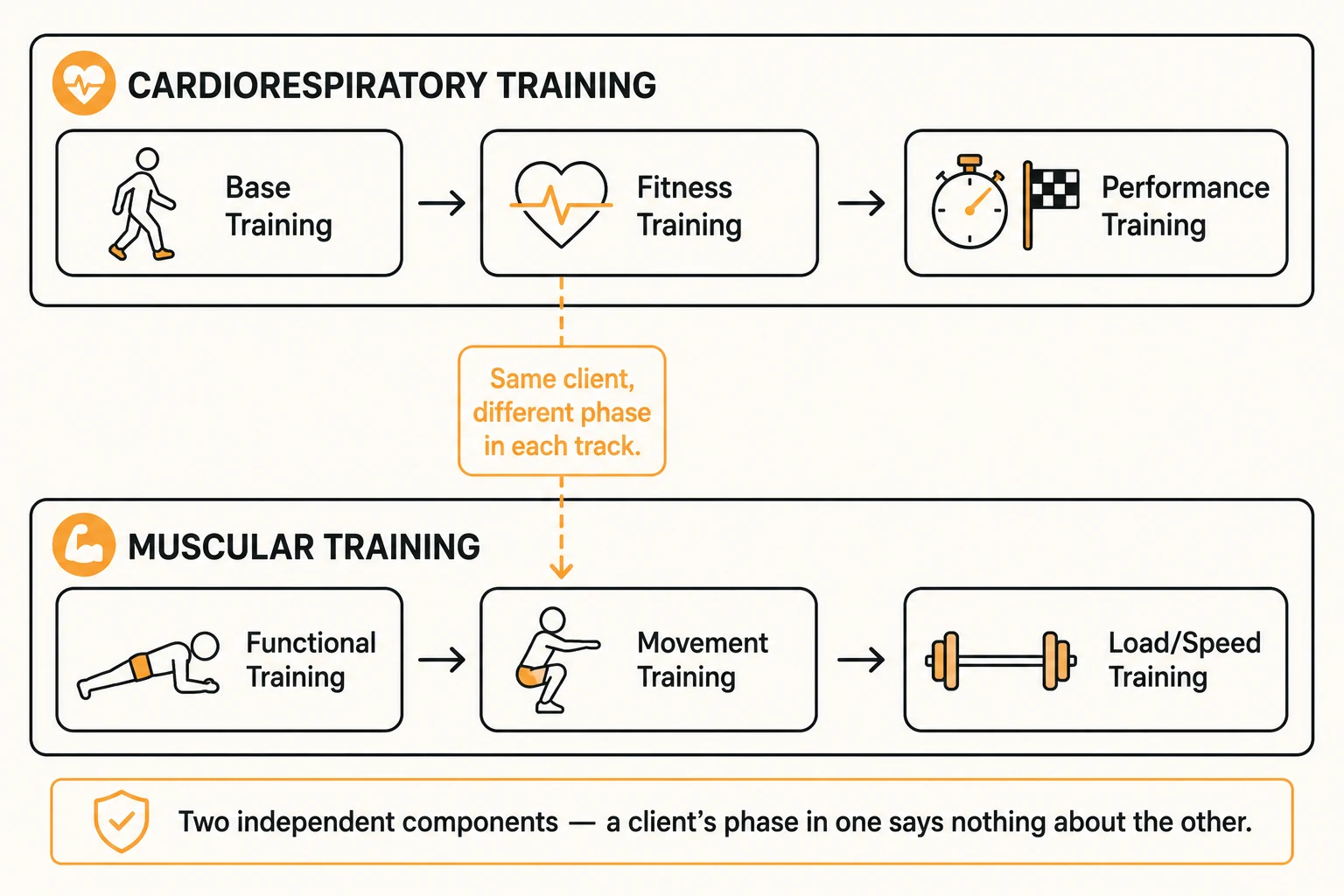
Cardiorespiratory Training's Three Phases
Programming across all three phases is guided by a three-zone intensity model, using client-specific markers — the talk test, ratings of perceived exertion (RPE), and heart rate at VT1/VT2 — rather than generic percentage-of-max-heart-rate formulas.
- Base TrainingFor any client not yet consistently exercising. The goal is simply frequency and duration — building toward 20+ minutes, 3–5 days a week, kept below the talk-test threshold (RPE 3–4). No cardio assessment needed here.
- Fitness TrainingFor clients already exercising consistently. Introduces the submaximal talk test for VT1 and Zone 2 intervals (RPE 5–6) to build aerobic efficiency — where most general-fitness clients train long-term.
- Performance TrainingFor clients with endurance-event or sport-specific goals. Adds the VT2 threshold test and Zone 3 intervals (RPE 7–10) to push speed, power, and race-day performance.
Muscular Training's Three Phases
The muscular side of the model treats "functional training" and "resistance training" as one continuum rather than two separate disciplines — deliberately built so that load never gets added to a movement pattern the client hasn't yet earned the right to load safely.
- Functional TrainingRebuilds postural stability and kinetic-chain mobility through core and balance work, mostly using body weight. This foundation keeps getting reinforced even after a client moves on — usually folded into the warm-up.
- Movement TrainingTeaches the five primary movement patterns cleanly, emphasizing control and sequencing before any meaningful external load is added.
- Load/Speed TrainingAdds external resistance, speed work, plyometrics, and power-lifting variations — where strength, hypertrophy, body-composition, and athletic-performance goals actually get trained.
The Five Primary Movement Patterns
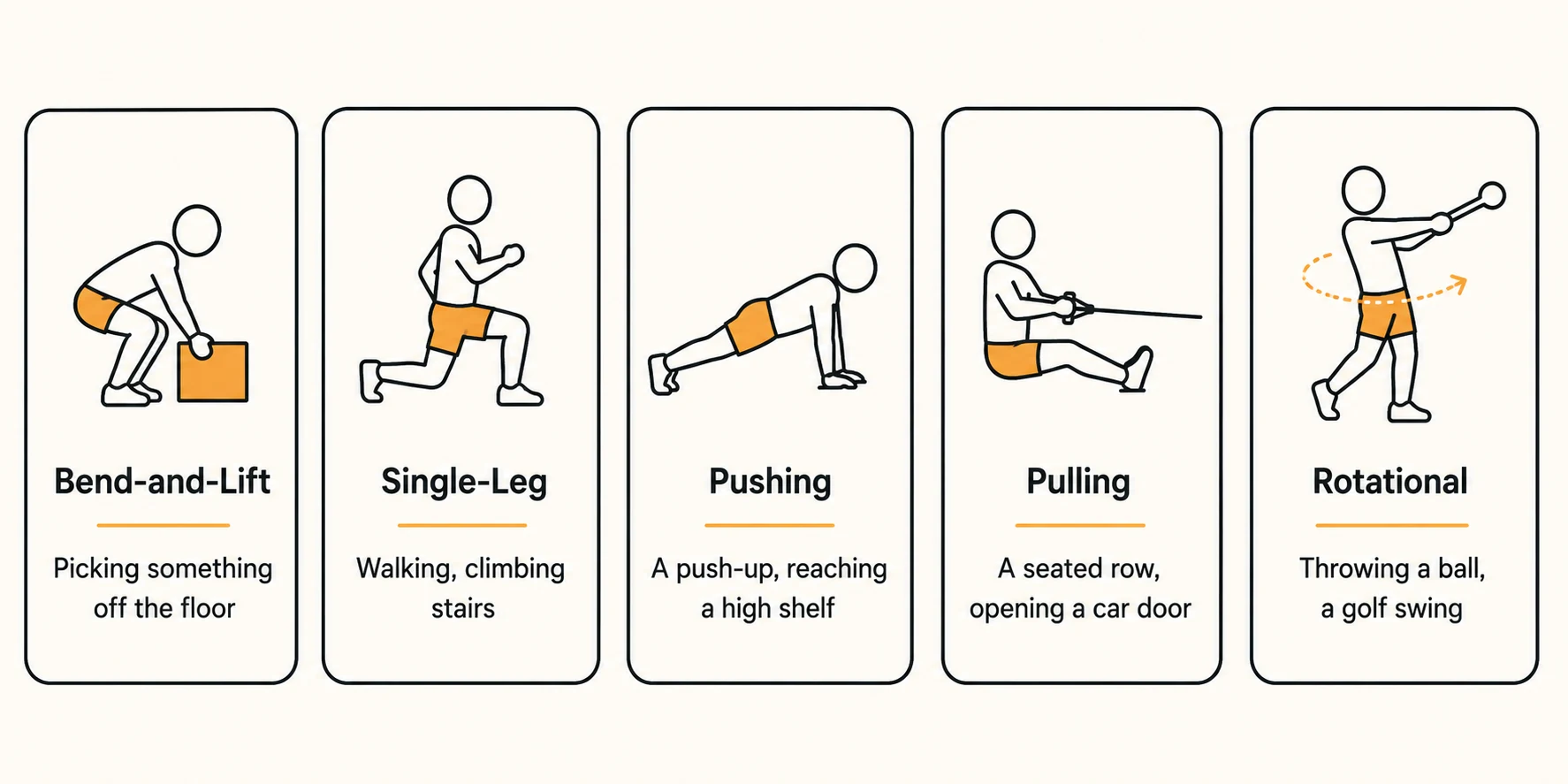
Movement Training is built around five patterns that show up constantly in daily life — the idea is to groove these patterns well before loading them in Load/Speed Training:
| Movement pattern | Everyday example |
|---|---|
| Bend-and-lift | Squatting down to pick something up off the floor |
| Single-leg | Walking, climbing stairs, lunging to reach for something low |
| Pushing | A push-up, lifting an item onto a high shelf, pushing yourself up out of a pool |
| Pulling | A seated row, opening a car door, picking up a child |
| Rotational | Throwing a ball, a twisting golf or tennis swing |
How This Model Sets Up the Rest of the Course
Everything from here through Lesson 12 is really this one model, unpacked chapter by chapter. Lesson 6 covers the investigation stage that has to happen before either component gets placed. Lessons 7 and 8 cover the functional and physiological assessments that actually determine a client's starting phase in each track. Lessons 9 through 11 cover programming within Muscular and Cardiorespiratory Training respectively — including how a client progresses from one phase to the next. Lesson 12 pulls all of it into one worked client scenario, start to finish.
Keeping this map in mind makes the next several chapters click into place faster: each one is answering a specific question about the same two-component structure you just learned here, not introducing something unrelated.
8 questions, modeled on ACE's real exam style. Score 72%+ to mark this lesson complete.
- The ACE IFT Model has two independent components: Cardiorespiratory Training and Muscular Training.
- Cardiorespiratory Training's three phases are Base, Fitness, and Performance Training, guided by a three-zone intensity model (talk test, RPE, VT1/VT2).
- Muscular Training's three phases are Functional, Movement, and Load/Speed Training, building from postural stability to loaded movement.
- Movement Training centers on five primary patterns: bend-and-lift, single-leg, pushing, pulling, and rotational.
- A client's phase in one component says nothing about their phase in the other — they're assessed and progressed independently.
- Lessons 6 through 12 unpack this model chapter by chapter: investigation, assessment, then programming for each track, ending in a full worked example.
Before moving to Lesson 6:
- Write the three phases of each component from memory, in order, without looking back at the lists above.
- Pick a hypothetical client and describe which Cardiorespiratory phase and which Muscular phase they'd likely start in — and why those two answers might be different.
- Write one sentence contrasting ACE's two-track IFT Model with NASM's single-track OPT Model.
- Complete the knowledge check above and review any question you missed.