Lesson 6 will show you how to apply the five stages of change at intake. This lesson covers the psychology underneath that application — the Health Belief Model, the transtheoretical model's deeper mechanics (decisional balance, processes of change, relapse), and basic operant conditioning — so the stages-of-change conversation in Lesson 6 isn't just a checklist, but something you actually understand.
This is the last of the four foundational chapters before Lesson 5 introduces the IFT Model itself. Chapters 1 through 3 covered scope, motivation, and communication. This one closes the loop with the psychological theory behind why people change behavior at all — and why they sometimes don't.
The Health Belief Model
The Health Belief Model predicts whether someone adopts a healthy behavior — like starting regular exercise — based on how they weigh a handful of specific beliefs, not just whether they know exercise is "good for them."
- Perceived susceptibilityHow much risk a person believes they personally face if they don't change.
- Perceived severityHow serious they believe the consequences of inaction would actually be.
- Perceived benefits and barriersWhether the upside of changing feels like it outweighs the effort, cost, or inconvenience.
- Cues to actionAn external trigger — a health scare, a friend's results, a doctor's warning — that prompts the decision to actually act.
Knowing which of these a client is weighing helps explain why two people with identical health information can respond completely differently — one moves to action, the other stays in precontemplation indefinitely. Take two coworkers who both get the same routine bloodwork flagging borderline cholesterol: one has a parent who had a heart attack young (high perceived susceptibility and severity) and starts exercising within the week; the other assumes it's minor and files it away. Same information, completely different weighting of the same four factors.
The Transtheoretical Model, Beyond the Five Stages
Lesson 6 will apply the transtheoretical model's five stages — precontemplation, contemplation, preparation, action, maintenance — directly to a client intake conversation. Underneath those five labels, though, are three mechanics that explain why someone moves between stages.
| Mechanic | What it describes |
|---|---|
| Processes of change | The actual strategies people use to move forward — from experiential (raising awareness, emotional insight) in earlier stages to behavioral (reminders, substitution, reward) in later ones |
| Decisional balance | Weighing the perceived pros and cons of changing — the pros generally need to outweigh the cons before sustained action becomes likely |
| Relapse | A normal, expected part of the cycle — not a failure or an endpoint, and often a return to an earlier stage rather than starting over from zero |
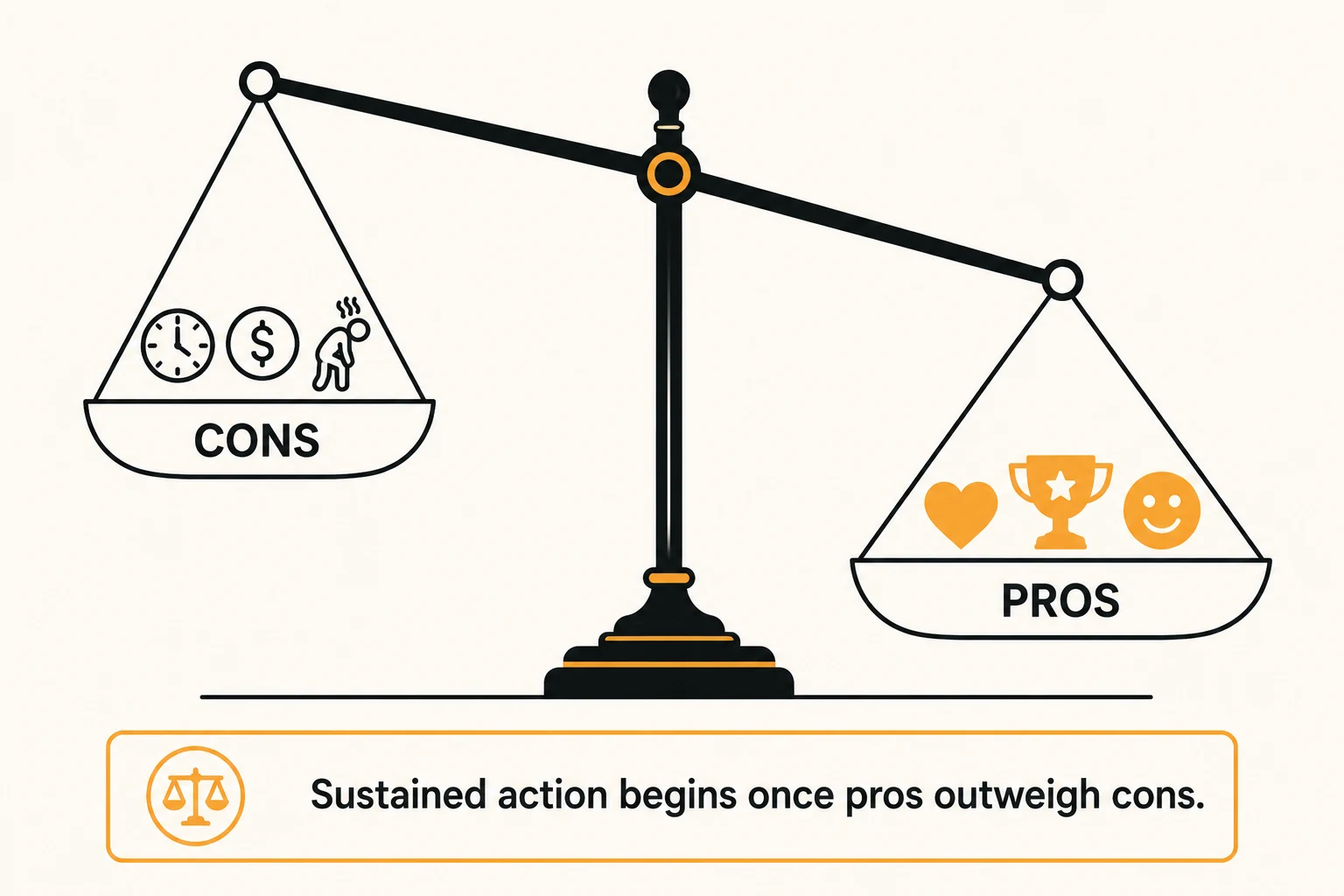
Reframing relapse this way changes how a trainer responds to it. A client who misses three weeks and returns hasn't "failed" the program — they've temporarily moved back a stage, often from action back to contemplation or preparation, and the conversation should meet them there rather than shame them for it. Asking "what changed?" and rebuilding decisional balance from that point is far more productive than restarting the entire relationship from scratch.
Operant Conditioning: Reinforcement, Shaping, and Stimulus Control
A separate but complementary set of tools comes from behavioral psychology — specifically, how consequences and environment shape behavior over time.
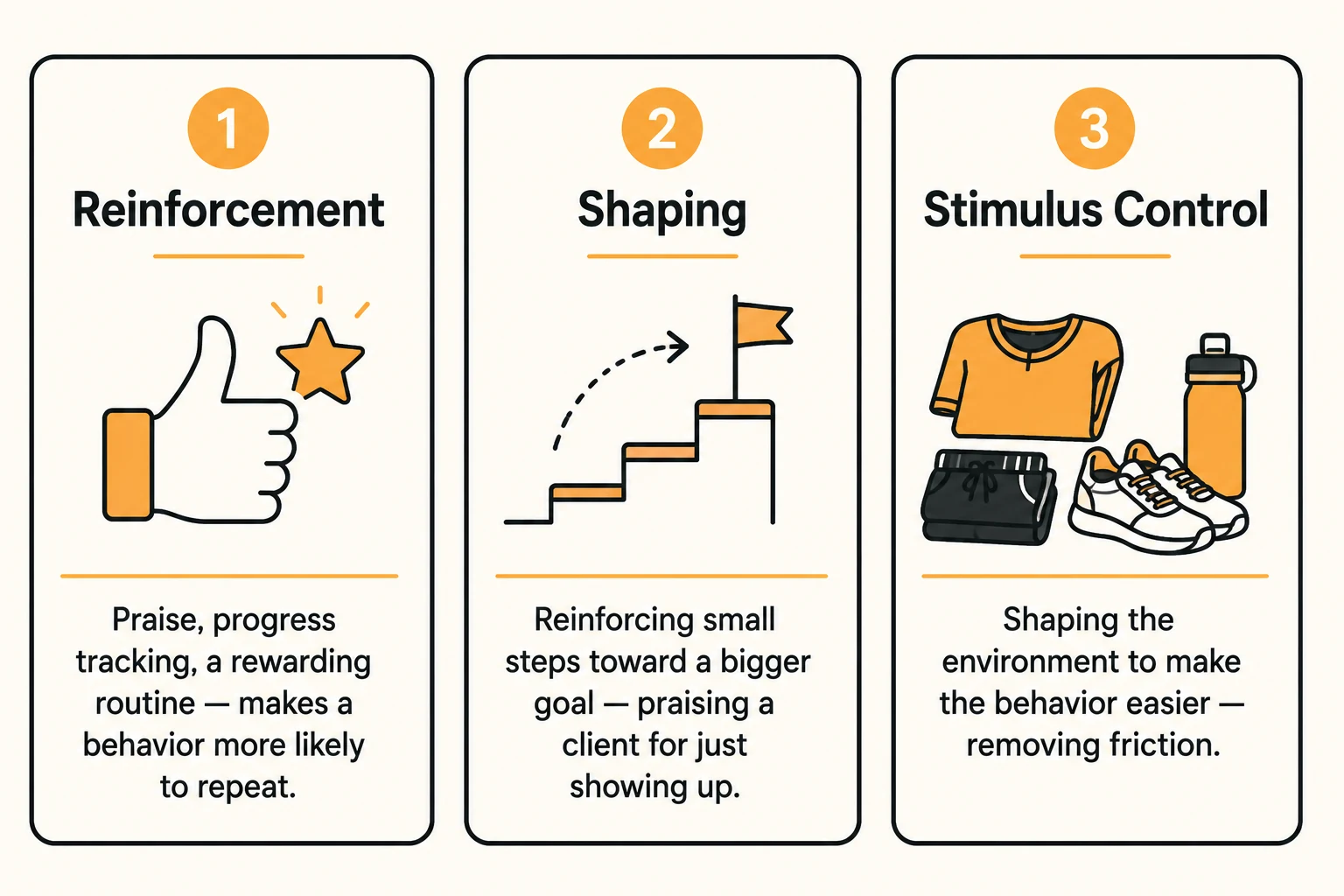
- ReinforcementFollowing a behavior with something that makes it more likely to happen again — praise, progress tracking, or a rewarding post-workout routine.
- ShapingReinforcing small, successive steps toward a bigger goal rather than waiting for the whole behavior to appear at once — e.g. praising a client for simply showing up before expecting a perfect session.
- Stimulus controlShaping the environment itself to make the desired behavior easier — laying out workout clothes the night before, scheduling sessions at a fixed time, removing friction between intention and action.
Putting the Theory Together: A Worked Example
These three frameworks aren't competing models a trainer picks between — they layer on top of each other for the same client. Consider someone in the contemplation stage after that same borderline cholesterol result: the Health Belief Model explains why they're considering change at all (susceptibility and severity now feel real), decisional balance explains what's keeping them stuck (the perceived barrier of time still outweighs the perceived benefit), and once they do start, shaping and stimulus control become the trainer's actual tools — praising the first week of just showing up, then helping them lay out gym clothes the night before to remove friction.
Seen this way, this chapter isn't four disconnected theories — it's the layered explanation for a single client's entire journey from "I should probably do something about this" to a habit that sticks.
8 questions, modeled on ACE's real exam style. Score 72%+ to mark this lesson complete.
- The Health Belief Model predicts behavior change based on perceived susceptibility, severity, benefits/barriers, and cues to action.
- Beyond its five stages, the transtheoretical model includes processes of change, decisional balance, and relapse as normal cycle mechanics.
- Decisional balance is the weighing of perceived pros and cons — pros generally need to outweigh cons before sustained action happens.
- Relapse is a normal, expected part of behavior change, not a failure or an endpoint.
- Reinforcement, shaping, and stimulus control are operant-conditioning tools a trainer can use deliberately to build lasting habits.
- These frameworks layer together for a single client, rather than functioning as separate, competing theories.
Before moving to Lesson 5:
- Write one example of a "cue to action" that might prompt a hypothetical client to finally start exercising.
- Describe one stimulus-control change a client could make to their environment to make working out easier.
- Walk a hypothetical client from precontemplation to a sustained habit in three sentences, naming which concept from this lesson applies at each step.
- Complete the knowledge check above and review any question you missed.