Rapport and motivation, covered in Lessons 2 and 6, still need a delivery mechanism — and that mechanism is communication. Verbal and nonverbal cues shape trust before a single rep happens, active listening is what actually gathers useful information, and matching teaching style to how a specific client learns is what turns a correct cue into a movement they can actually perform.
Lesson 2 covered what motivates a client. This lesson covers the actual mechanics of talking to, listening to, and teaching that client — skills that get used in every single session from here forward.
Verbal and Nonverbal Communication
Communication starts long before the first sentence. Nonverbal components — voice quality, eye contact, facial expression, hand gestures, and body position — shape a client's first impression and ongoing sense of trust, often more than the actual words being said.
A trainer who says the right thing in a flat tone, avoiding eye contact, sends a very different message than the same words delivered with genuine attention. Since rapport-building (Lesson 6) begins at first contact, nonverbal presentation matters from the very first handshake. Picture the difference between a trainer who greets a new client while checking their phone versus one who makes eye contact, faces the client fully, and puts the phone away — the words "great to meet you" land completely differently depending on which trainer says them.
Active Listening
Active listening means concentrating fully on what a client is saying — listening for both the content (the facts) and the emotion (how they feel about it) — rather than mentally drafting a response while they're still talking.
- Full attentionSetting aside distractions and genuinely focusing on the client while they speak.
- Listening for emotion, not just factsNoticing frustration, anxiety, or excitement underneath what's literally being said.
- Reflecting backBriefly summarizing what was heard, confirming understanding before responding.
This is exactly what powers a good investigation-stage conversation (Lesson 6) — a trainer who's actually listening catches details a checklist alone would miss. A client who says "I'm fine, just tired" while visibly tense is giving you two different pieces of information — the words say one thing, the delivery says another, and a trainer who only registers the words misses half the message.
The Three Learning Styles
People take in new information primarily through one of three channels. Most clients respond to some blend of all three, but recognizing which one a specific client leans on lets a trainer teach more efficiently.
| Learning style | What helps this client |
|---|---|
| Visual | Watching a demonstration, using a mirror, seeing a diagram of the movement |
| Auditory | Verbal cues and explanations, rhythmic counting, talking through the movement out loud |
| Kinesthetic | Physically guiding the movement (with consent), feeling the position, learning by doing repetitions |
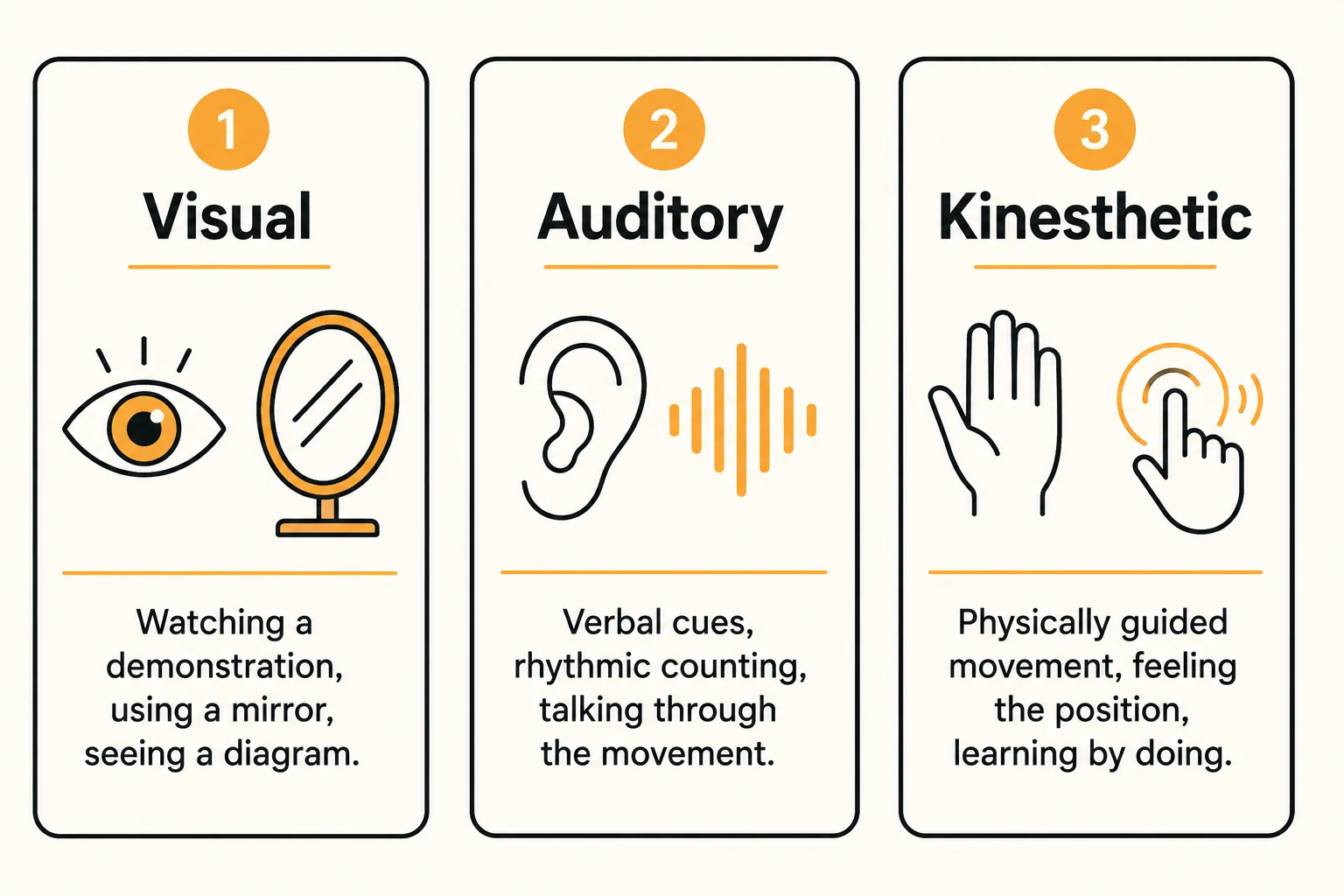
In practice, a trainer rarely gets a clean signal of which style dominates from a single conversation — it usually shows up in how a client responds to correction. A client who nods along to a verbal cue but still doesn't fix their form is often telling you, without saying so, that they need to see it or feel it instead.
Teaching a New Skill: Tell, Show, Do
Regardless of a client's dominant learning style, ACE recommends a consistent three-step structure for introducing any new exercise:
- TellBriefly explain what the exercise is and why it's included, in plain language.
- ShowDemonstrate the movement so the client has a visual reference before attempting it.
- DoLet the client attempt the movement, then give specific, corrective feedback — tying back to Lesson 2's point that specific feedback builds self-efficacy more than generic praise.
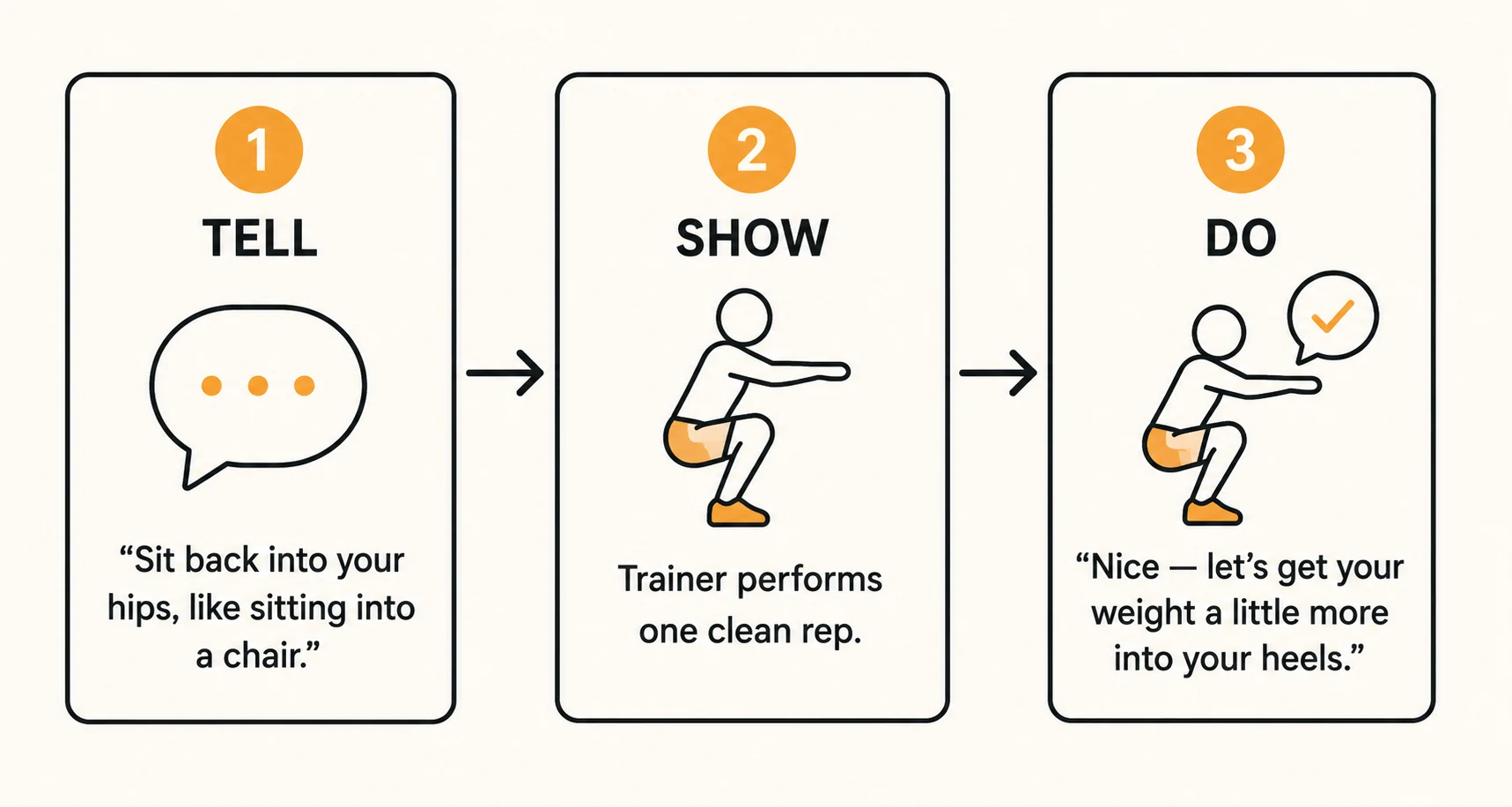
Applied to something as simple as a bodyweight squat: "Tell" is a one-sentence explanation ("we're going to sit back into your hips, like sitting into a chair"); "Show" is the trainer performing one clean rep; "Do" is the client attempting it, followed by one specific correction ("nice — let's get your weight a little more into your heels") rather than a vague "good job" that gives the client nothing to actually adjust.
Communicating Through Harder Conversations
Not every conversation is a straightforward teaching moment. Two situations come up often enough to be worth naming directly: referring a client out (Lesson 1) and adjusting a goal that's turned out to be unrealistic.
Both benefit from the same underlying approach — active listening first, so the client feels heard before hearing anything they might not want to. "I'm noticing some knee pain that's outside what I'm able to help with directly, and I want to get you the right support" lands very differently than an abrupt "you need to see a doctor," even though the content is nearly identical. The delivery, not just the message, determines whether a client feels dismissed or genuinely taken care of.
8 questions, modeled on ACE's real exam style. Score 72%+ to mark this lesson complete.
- Nonverbal communication — voice quality, eye contact, facial expression, gestures, body position — shapes trust as much as the words used.
- Active listening means attending to both content and emotion, then reflecting back to confirm understanding.
- The three primary learning styles are visual, auditory, and kinesthetic — most clients use a blend, but one often dominates.
- "Tell, show, do" is the standard three-step method for teaching any new exercise.
- Communication style should adapt to the individual client, not stay fixed regardless of who's in front of you.
- Harder conversations — referrals, adjusting goals — benefit from active listening first, so the client feels heard before hearing something difficult.
Before moving to Lesson 4:
- Pick one exercise and write out a "tell, show, do" script for teaching it to a first-time client.
- Write one sentence of active-listening reflection you could say back to a client who just described feeling anxious about starting a program.
- Write one sentence you could use to refer a client out (per Lesson 1) that leads with active listening rather than an abrupt instruction.
- Complete the knowledge check above and review any question you missed.