Adherence — not any single workout — is the real metric that determines whether a client gets results. Two concepts predict it more than anything else: self-efficacy (a client's belief they can actually do this) and the type of motivation driving them. A trainer can influence both, deliberately, from the very first session.
Lesson 1 drew the boundary around what a trainer does. This lesson is about the skill that makes everything inside that boundary actually work in practice: getting a client to keep showing up.
Why Adherence Is the Real Metric That Matters
Adherence is the extent to which a person actually sticks to an exercise program over time. It sounds obvious, but it's easy for a new trainer to over-focus on program design — perfect periodization, ideal exercise selection — while underweighting the much larger question of whether a client will still be showing up in month three.
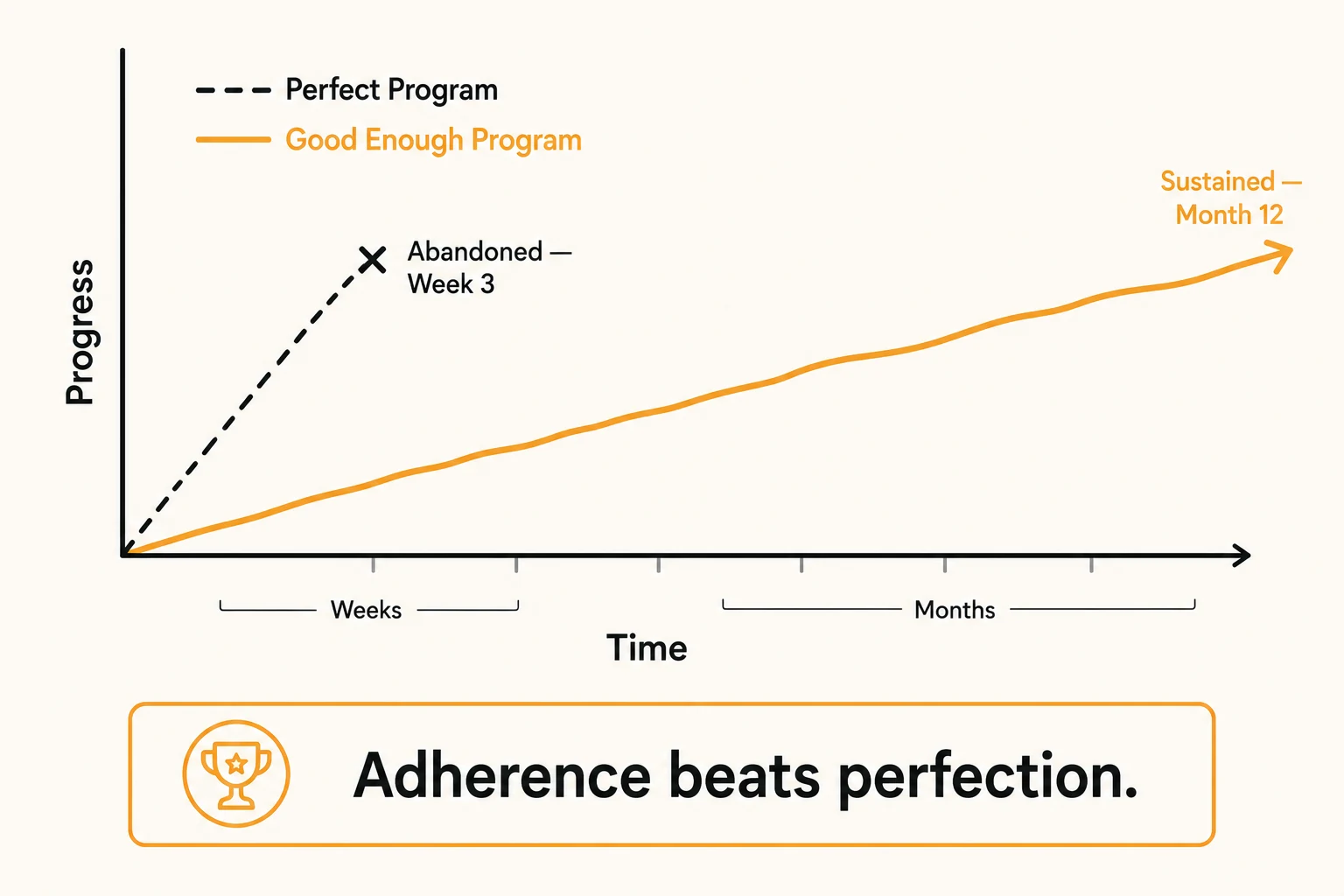
A technically excellent program a client quits in three weeks produces worse real-world outcomes than a "good enough" program a client sustains for a year. Adherence is the multiplier every other skill in this course gets applied through — a flawless assessment (Lesson 7), a perfectly periodized program (Lessons 9-11), none of it matters if the client stops showing up.
Self-Efficacy: The Belief That Predicts Behavior
Self-efficacy is a client's belief in their own capability to successfully carry out a physical activity program. It's distinct from actual skill or fitness level — two clients with identical fitness can have very different self-efficacy, and the one with higher self-efficacy tends to show up with more effort and persistence.
Because it's a belief rather than a fixed trait, self-efficacy is buildable — and ACE identifies specific, teachable sources a trainer can influence. Picture two clients starting from the exact same fitness level: one has completed a program before and succeeded, the other hasn't. Even before session one, the first client is more likely to persist through a rough week — not because they're fitter, but because their belief in their own capability is already higher.
- Past performance accomplishmentsThe single most influential source — a client's own track record of succeeding builds belief faster than anything else.
- Vicarious experienceWatching someone similar to yourself succeed — a client seeing a peer with a comparable starting point hit a goal.
- Verbal persuasionSpecific, credible encouragement from a trusted source — generic cheerleading is far weaker than concrete, believable feedback.
- Physiological and emotional stateHow a client interprets their own fatigue, soreness, or anxiety — framed as normal progress versus a sign they can't do this.
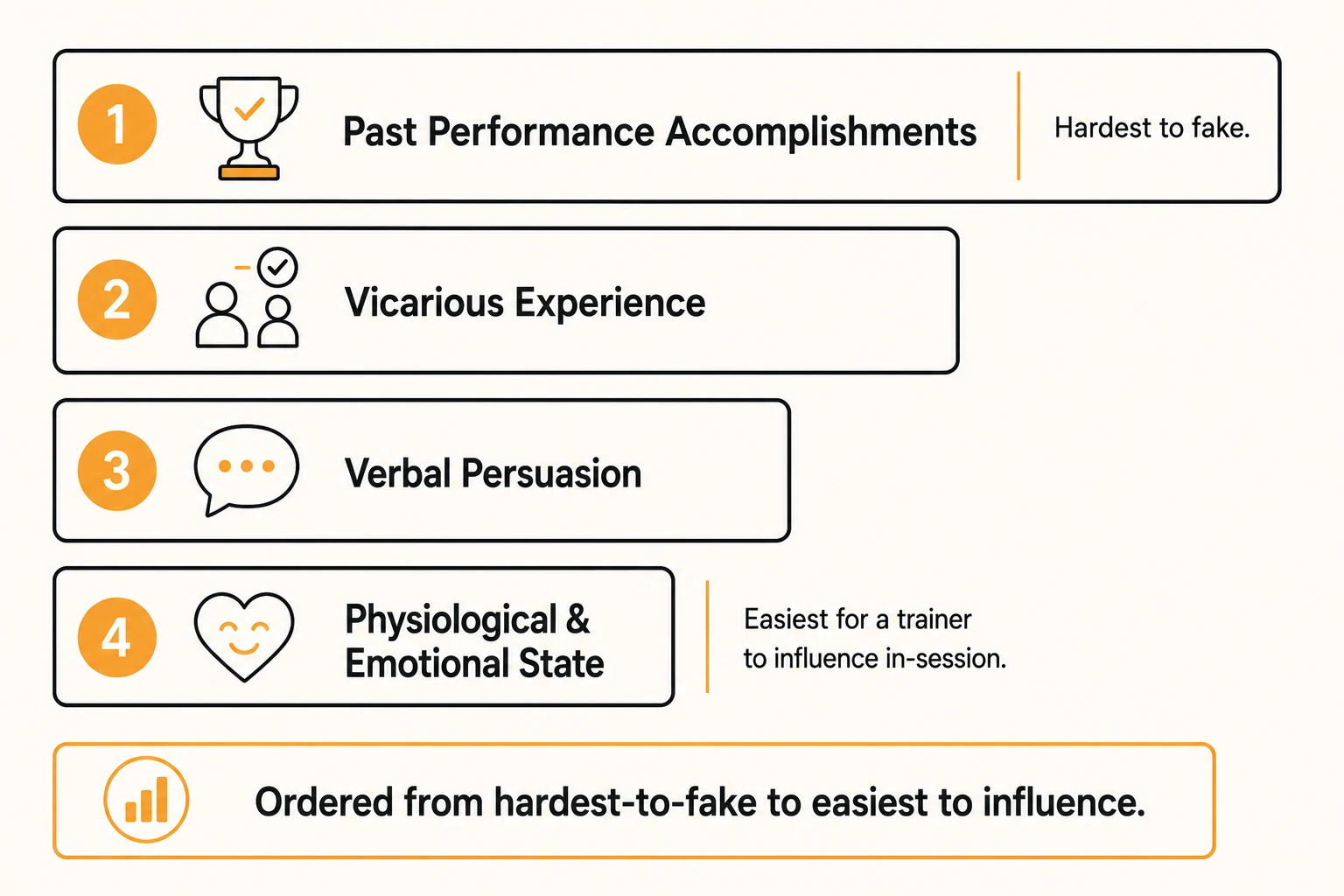
Notice the order isn't arbitrary — it runs from the hardest-to-fake to the easiest. A trainer can't manufacture a client's past accomplishments, but a trainer has direct, session-by-session control over the third and fourth sources: the feedback given and how a hard session gets framed afterward.
Intrinsic vs. Extrinsic Motivation
Not all motivation is the same, and the type matters for how durable it is.
| Type | Definition | Durability |
|---|---|---|
| Intrinsic motivation | Genuinely enjoying the activity and the experience of doing it | Tends to sustain longer, since it doesn't depend on reaching an outcome |
| Extrinsic motivation | Participating for an outside benefit — weight loss, appearance, meeting new people | Can be powerful short-term, but risks collapsing once the outcome is reached or stalls |
Most real clients run on a mix of both. A practical goal for a trainer isn't eliminating extrinsic motivation — it's helping a client discover enough intrinsic enjoyment that the program survives a plateau. A client who starts purely to lose weight for an event, for instance, often keeps training well past that event only if somewhere along the way they started genuinely enjoying the sessions themselves, not just the number on the scale.
Practical Levers a Trainer Can Pull
- Engineer early winsStructure the first few sessions so a client experiences genuine, visible success — feeding the most influential self-efficacy source first.
- Use relatable role modelsShare (with permission) stories or examples of clients with a similar starting point, not just elite outliers.
- Give specific, credible feedback"Your squat depth improved this week" lands harder than "great job" precisely because it's concrete and checkable.
- Reframe normal discomfortHelp a client interpret soreness or a hard session as evidence of progress, not evidence they aren't cut out for this.
Common Adherence Barriers and How to Address Them
The levers above work best when they're aimed at a specific, real obstacle rather than applied generically. Most adherence problems trace back to a handful of recurring barriers, and each one calls for a different response.
| Barrier | A trainer's practical response |
|---|---|
| Time constraints | Shorter, more efficient sessions and realistic frequency goals rather than an idealized schedule the client can't sustain |
| Boredom or plateau | Variety in exercise selection and periodic goal resets — often paired with reframing discomfort as progress |
| Low confidence / fear of judgment | Engineered early wins and relatable role models, aimed directly at building self-efficacy |
| Life disruption (travel, illness, injury) | A flexible re-entry plan that treats a break as a pause, not a restart from zero |
That last point matters more than it might seem: how a trainer responds to a lapse often determines whether it becomes a permanent dropout or a temporary interruption. Treating a missed month as evidence of failure tends to end the relationship; treating it as normal and picking back up without judgment tends to preserve it.
8 questions, modeled on ACE's real exam style. Score 72%+ to mark this lesson complete.
- Adherence, not program design alone, is the strongest predictor of long-term client results.
- Self-efficacy is a client's belief in their own ability to exercise successfully — distinct from actual fitness level.
- The four sources of self-efficacy, in order of influence: past performance, vicarious experience, verbal persuasion, and physiological/emotional state.
- Intrinsic motivation (enjoyment) tends to be more durable than extrinsic motivation (an outside outcome).
- Engineering early wins, using relatable role models, giving specific feedback, and reframing discomfort are practical, teachable levers.
- Time, boredom, low confidence, and life disruption are the most common adherence barriers — each calls for a different, specific response.
Before moving to Lesson 3:
- List the four sources of self-efficacy in order of influence, and write one concrete way a trainer could use each with a brand-new client.
- Think of a hypothetical client motivated mostly extrinsically (e.g. weight loss) — write one sentence describing how you'd help them find something intrinsically enjoyable in the process.
- Pick one adherence barrier from this lesson and write two sentences on how you'd handle a client who hits it in month two.
- Complete the knowledge check above and review any question you missed.