The OPT Model is NASM's system for sequencing the acute variables from Lesson 13 into five distinct training phases — stabilization endurance, strength endurance, hypertrophy, maximal strength, and power — each with its own rep, set, tempo, and rest prescriptions.
Lesson 13 gave you six acute variables: reps, sets, tempo, rest, intensity, and exercise selection/order. The OPT Model is what happens when you deliberately set those six dials to specific combinations, in a specific order, to build a client from wherever they're starting toward a specific outcome — whether that's general fitness, fat loss, or competitive performance. Every exercise category covered in Lessons 7 through 12 — flexibility, cardio, core, balance, plyometrics, SAQ — slots into this same five-phase skeleton, which is exactly why this lesson feels like a synthesis of everything that came before it.
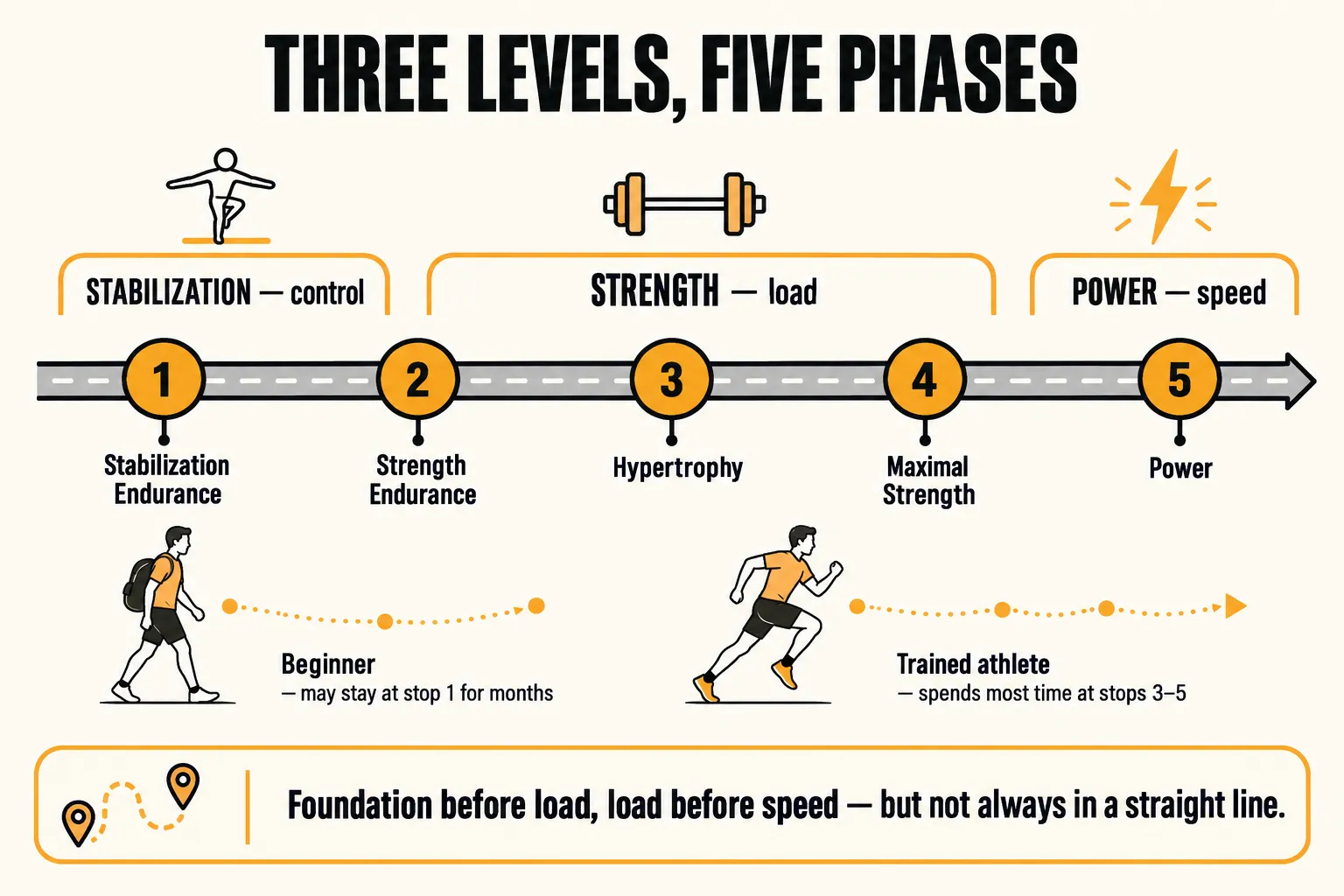
Three Levels, Five Phases
The OPT Model organizes training into three broad levels — stabilization, strength, and power — which are further broken into five phases. Progression through the levels generally builds a foundation before adding load, and adds load before adding speed:
- Stabilization level — Phase 1 onlyBuilds joint stability, balance, and muscular endurance before anything heavier is layered on.
- Strength level — Phases 2, 3, and 4Builds work capacity, muscle size, and maximal force production, in that order.
- Power level — Phase 5Applies the strength built in the previous phases at speeds closer to real-world and sporting demands.
Phase 1: Stabilization Endurance
The entry point for almost every client, regardless of goal. This phase prioritizes control over load — teaching the body to stabilize joints through a full range of motion before that range of motion gets loaded heavily.
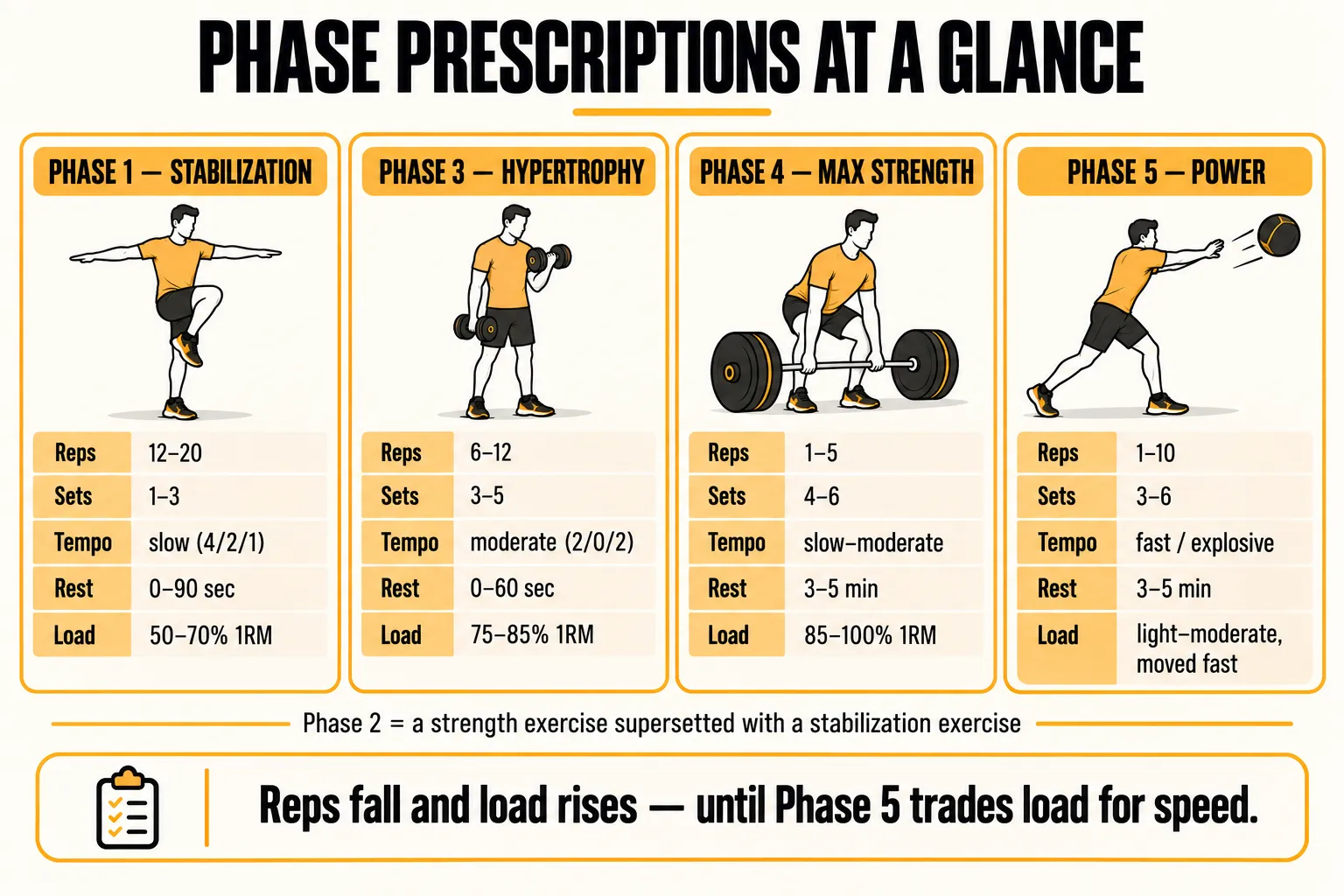
| Variable | Typical Phase 1 prescription |
|---|---|
| Reps | 12–20 |
| Sets | 1–3 |
| Tempo | Slow, controlled (e.g. 4/2/1 — slow eccentric, brief pause, controlled concentric) |
| Rest | 0–90 seconds |
| Intensity | Low to moderate (roughly 50–70% of 1-rep max) |
Exercises typically emphasize balance and core control — think single-leg work, stability-ball variations, and controlled tempos — over how much weight is on the bar.
Phase 2: Strength Endurance
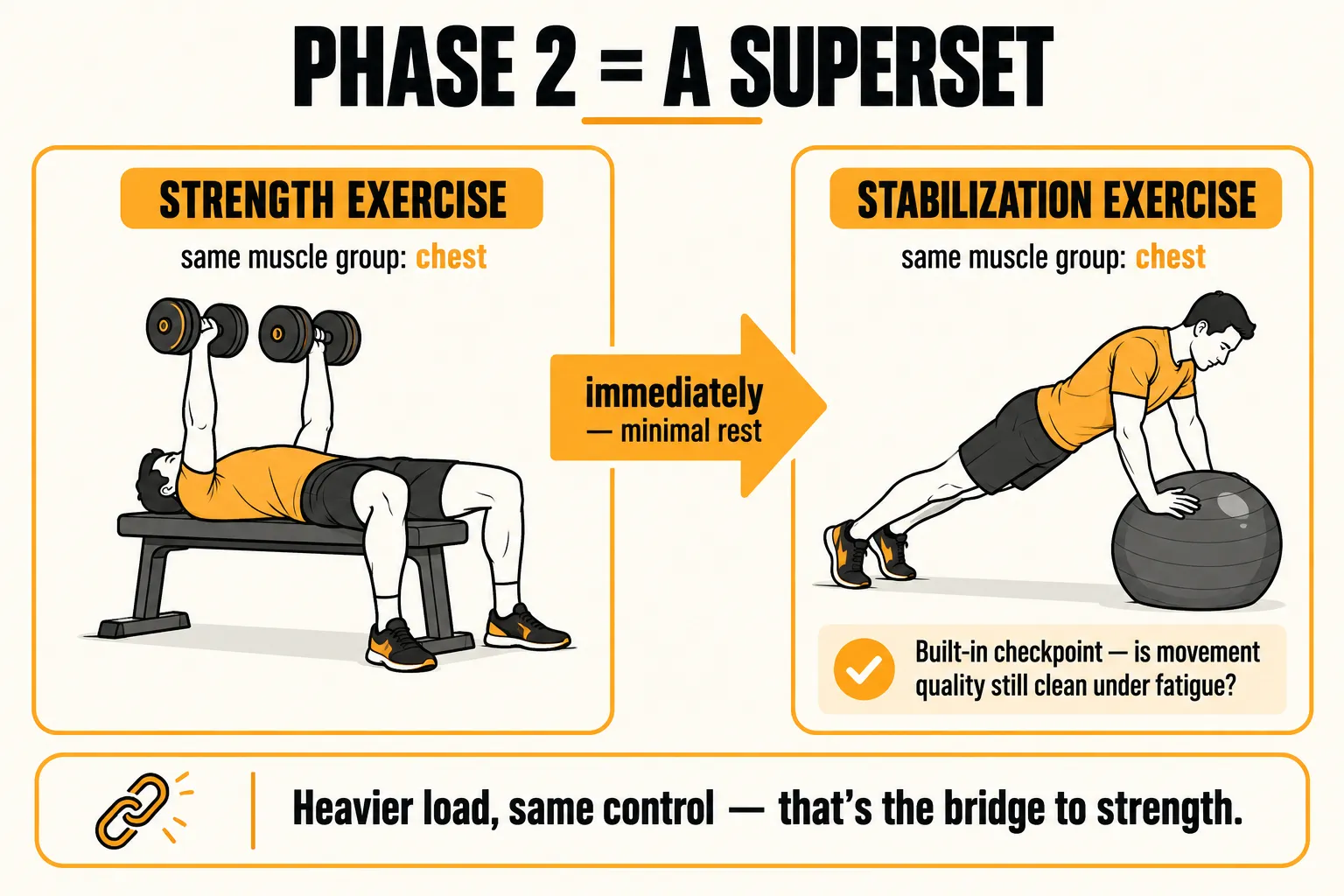
This is the one phase that isn't a single training style — it's a superset. A strength-level exercise is performed immediately followed by a stabilization-level exercise targeting the same muscle group, with minimal rest between the pair. A dumbbell bench press followed immediately by a stability-ball push-up is a classic example.
The goal is blending the best of both worlds: building the ability to stay stable and controlled even as load and fatigue increase — a bridge between pure stabilization work and heavier strength training.
Picture a client who has spent eight weeks in Phase 1 with clean movement quality on every checkpoint. Phase 2 doesn't throw that control away to chase heavier numbers — it deliberately keeps testing it, just under a slightly heavier strength stimulus. That's the whole point of pairing the two exercise types: the stabilization half of the superset is a built-in checkpoint, verifying that the strength work didn't quietly erode the movement quality Phase 1 spent two months building.
Phase 3: Hypertrophy (Muscular Development)
Once a client can control load through a full range of motion, Phase 3 shifts the goal toward increasing muscle size — the classic "bodybuilding" rep range.
| Variable | Typical Phase 3 prescription |
|---|---|
| Reps | 6–12 |
| Sets | 3–5 |
| Tempo | Moderate (e.g. 2/0/2) |
| Rest | 0–60 seconds |
| Intensity | Moderate to high (roughly 75–85% of 1-rep max) |
Phase 4: Maximal Strength
Phase 4 asks a different question than Phase 3: not "how much muscle," but "how much force." Reps drop, load climbs, and rest periods lengthen so the nervous system can fully recover between heavy efforts.
| Variable | Typical Phase 4 prescription |
|---|---|
| Reps | 1–5 |
| Sets | 4–6 |
| Tempo | Slow to moderate on the controlled lift |
| Rest | 3–5 minutes |
| Intensity | High (roughly 85–100% of 1-rep max) |
This phase demands a genuinely solid stabilization and hypertrophy foundation first — heavy loads exposed to poor movement control from skipping Phases 1–3 is exactly how a compensation pattern turns into an injury.
Phase 5: Power
The peak of the model. Power training takes the stability (Phase 1) and force (Phase 4) built in earlier phases and applies them at speed — training the rate at which force is produced, not just the total amount. This is where plyometrics, medicine ball throws, and Olympic-lift variations live.
| Variable | Typical Phase 5 prescription |
|---|---|
| Reps | 1–10 (varies heavily by exercise type) |
| Sets | 3–6 |
| Tempo | Fast, explosive on the concentric phase |
| Rest | 3–5 minutes |
| Intensity | Light-to-moderate loads moved explosively, or heavier loads for strength-speed work |
8 questions, modeled on NASM's real exam style. Score 70%+ to mark this lesson complete.
- The OPT Model has three levels (stabilization, strength, power) split into five phases.
- Phase 1 (Stabilization Endurance) prioritizes control and joint stability with high reps, light load.
- Phase 2 (Strength Endurance) is a superset of a strength exercise immediately followed by a stabilization exercise.
- Phase 3 (Hypertrophy) targets muscle size with moderate reps and moderate-to-high load.
- Phase 4 (Maximal Strength) uses low reps, heavy load, and long rest for maximum force production.
- Phase 5 (Power) applies earlier phases' adaptations at speed — the rate of force production, not just the amount.
- Starting phase depends on movement quality and training history — a well-trained client doesn't automatically restart at Phase 1.
Before moving to Lesson 15:
- Write out the rep, set, and rest ranges for all five phases from memory, then check them against the tables above.
- Pick one client scenario (e.g. "deconditioned beginner" or "trained athlete prepping for a sport") and decide which phase you'd start them in, and why.
- Explain, in your own words, why Phase 2's superset structure acts as a built-in check on movement quality, not just a way to add variety.
- Complete the knowledge check above and review any question you missed.