Most clients aren't textbook-healthy 25-year-olds. This lesson covers general training considerations for older adults, obesity, pregnancy, and common chronic conditions — and, just as importantly, the scope-of-practice framework for knowing when to refer a client to a doctor instead of training around a red flag.
This is deliberately the most cautious lesson in the course. Nothing here is medical advice, and it isn't a substitute for a client's own healthcare provider. The exam — and real practice — cares less about memorizing exact clinical thresholds and more about whether you know the general safe principles and, critically, where your scope of practice ends. In a typical general-population client base, the "textbook-healthy" client is closer to the exception than the rule — which is exactly why this lesson matters as much as the exercise-technique material earlier in the course.
Scope of Practice: The Framework Before the Specifics
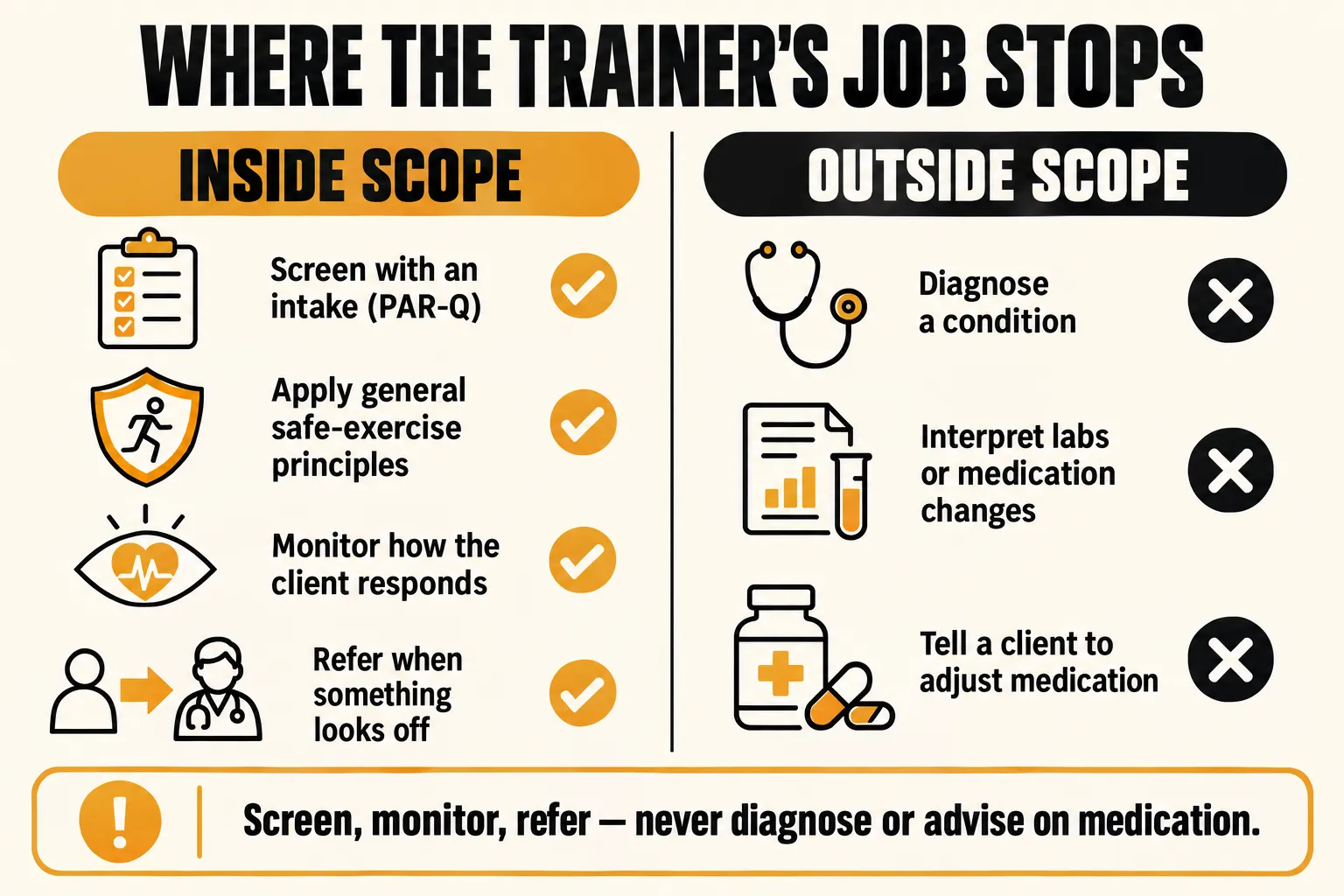
Before working with any client — but especially one with a known health condition — a trainer's job is screening and referral, not diagnosis or treatment. A Physical Activity Readiness Questionnaire (PAR-Q) or equivalent intake screen is the standard first step: a short set of questions designed to flag anyone who should get medical clearance before starting an exercise program.
- Inside scopeScreening intake, general safe-exercise principles for a known condition, monitoring how a client responds during sessions, and referring to a physician when something looks off.
- Outside scopeDiagnosing a condition, interpreting lab results or medication changes, or telling a client to adjust their prescribed medication based on how a workout felt.
Older Adults
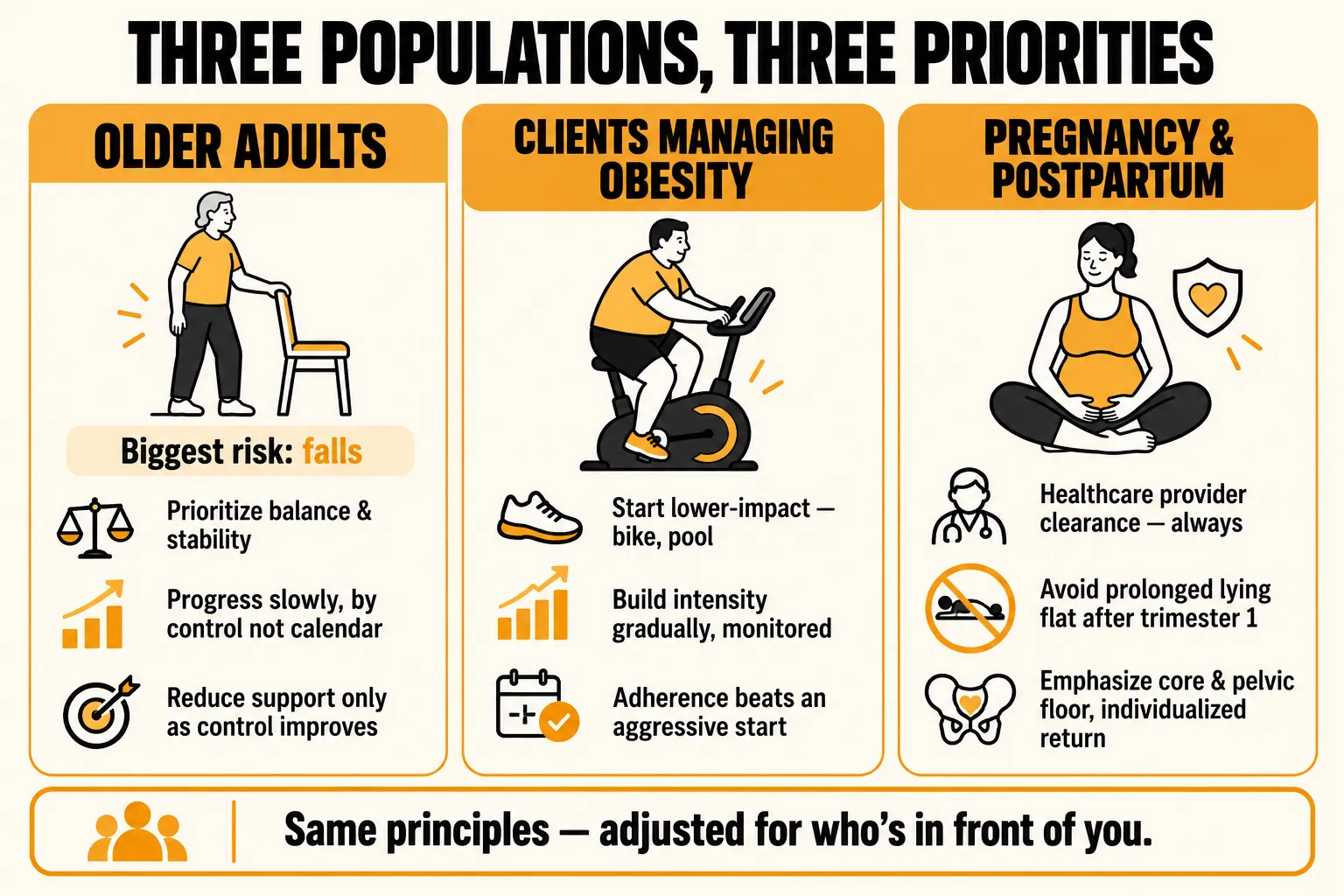
Regular, well-designed training is one of the most evidence-backed tools for helping older adults maintain independence — improving balance, coordination, reaction time, glucose tolerance, and bone health along the way. The biggest single risk to program around is falls.
- Progression should be slow and closely monitored, grounded in postural control rather than a fixed timeline.
- Balance and stability work (often close to Phase 1 of the OPT Model) deserves more programming weight than it would for a younger, healthy client.
- Exercises should progress toward less external support (e.g. from a supported seated position toward free-standing) only as control genuinely improves.
Clients Managing Obesity
- Extra body weight adds mechanical stress to joints — especially the knees and ankles — which often makes lower-impact modalities (cycling, swimming, water-based exercise) a sensible starting point.
- Cardiovascular health may already be compromised, so intensity should be introduced gradually with appropriate monitoring (see Lesson 15's intensity-monitoring methods).
- Sustainable adherence matters more than an aggressive early program — understanding a client's motivation and building a plan they'll actually keep doing tends to outperform a harder plan they quit in three weeks.
Pregnancy & Postpartum
- Exercise during pregnancy offers real benefits, but always requires clearance and ongoing communication with the client's own healthcare provider — this is a hard line for scope of practice.
- Common general modifications include avoiding prolonged supine (flat-on-back) positions after the first trimester, and adjusting intensity as the pregnancy progresses.
- Core and pelvic floor-focused work is commonly emphasized, both during pregnancy and in a gradual, individualized postpartum return to training.
Common Chronic Conditions: General Framework
Hypertension, cardiovascular disease, diabetes, and arthritis all show up regularly in general population client bases. Rather than memorizing exact clinical numbers (which change, and which are a physician's call, not a trainer's), the exam-relevant skill is applying the same general pattern to each:
| Condition | General training pattern |
|---|---|
| Hypertension / cardiovascular disease | Favor moderate, well-monitored intensity; avoid breath-holding (Valsalva) during heavy lifts; watch for dizziness or chest discomfort as an immediate stop signal |
| Diabetes / blood sugar management | Be aware of hypoglycemia symptoms during and after sessions; consistent timing of exercise can support blood sugar management, but medication/insulin timing is coordinated with their physician, not the trainer |
| Arthritis | Favor low-impact modalities and full range-of-motion work on good days; train around pain, never through sharp joint pain |
A Worked Example: Applying the Framework, Not the Numbers
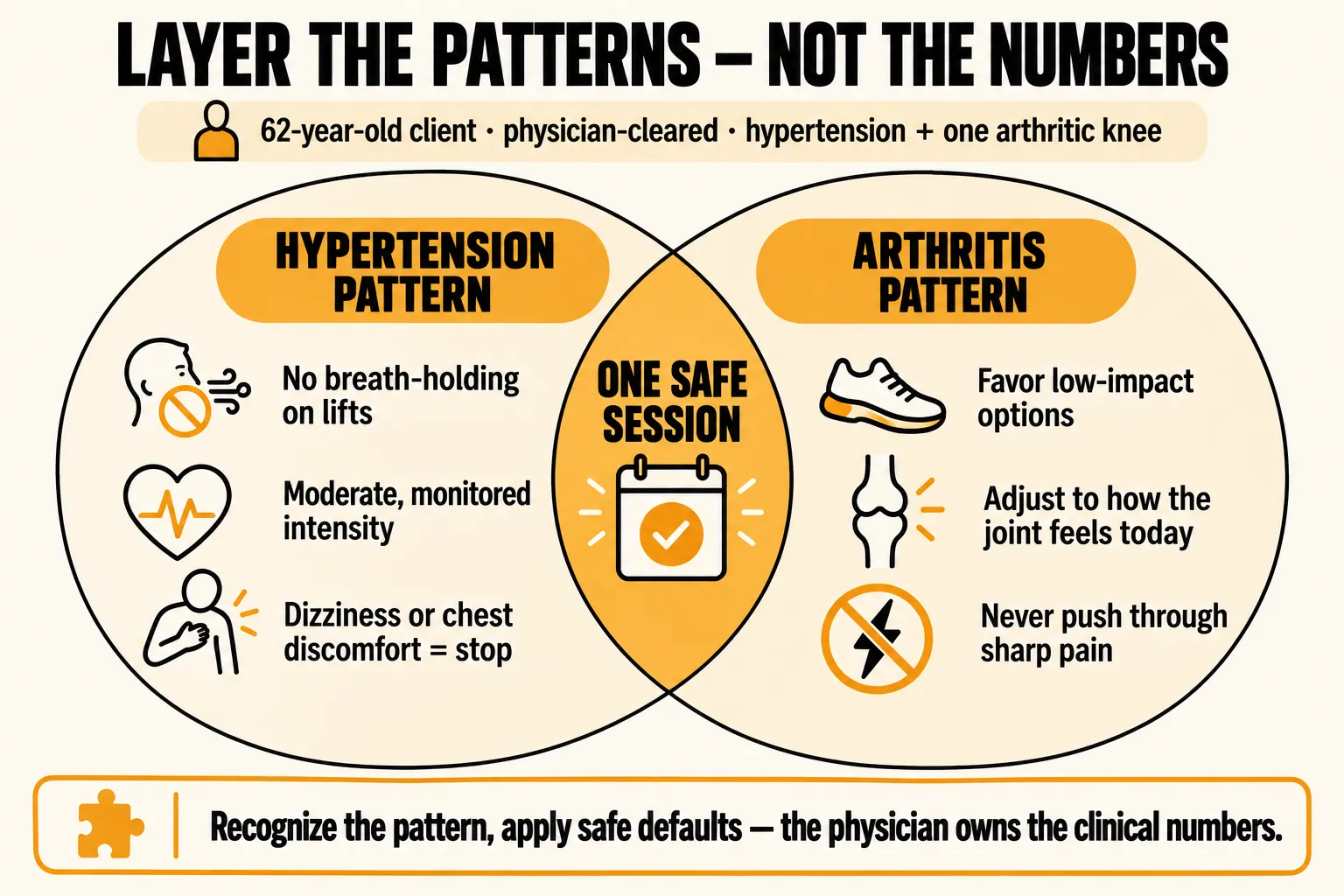
Consider a 62-year-old client managing both hypertension and mild arthritis in one knee, referred by her physician with general clearance to exercise. The exam-relevant skill here isn't recalling her exact blood pressure reading or a specific joint-inflammation marker — it's applying the same pattern covered above to a client who happens to fit two categories at once. Cardiovascular considerations mean avoiding breath-holding during any resistance work and keeping intensity moderate and well-monitored, per Lesson 15's methods. Arthritis considerations mean favoring low-impact modalities and never pushing through sharp knee pain, adjusting exercise selection day to day based on how the joint feels that session.
Neither consideration cancels the other out, and neither requires the trainer to look up a clinical threshold — they require recognizing which general pattern applies and layering them together sensibly. That's the actual skill NASM is testing in this domain: pattern recognition and safe defaults, not memorized clinical data.
8 questions, modeled on NASM's real exam style. Score 70%+ to mark this lesson complete.
- Scope of practice covers screening, general programming, and referral — never diagnosis, medication guidance, or overriding a physician.
- A PAR-Q or equivalent screen is the standard first step before training any new client.
- Falls are the biggest risk to program around for older adults; balance and postural control deserve extra programming weight.
- Obesity programming favors low-impact modalities early and prioritizes sustainable adherence over aggressive intensity.
- Pregnancy always requires physician clearance and ongoing communication — this is a hard scope-of-practice line.
- Hypertension, diabetes, and arthritis each have a general safe-training pattern, but exact clinical thresholds are a physician's call, not a trainer's.
- A client with more than one condition just needs both general patterns layered together sensibly — neither cancels out the other.
You've now completed the Program Design domain (Lessons 13-16) — the highest-weighted section of the real NASM-CPT exam:
- Write, from memory, three things that are inside a personal trainer's scope of practice and three things that are outside it.
- Review your knowledge check scores across Lessons 13-16 and revisit any lesson where you scored below 70%.
- Practice layering two general patterns together for a hypothetical client managing more than one condition at once.
- Complete the knowledge check above before considering this domain finished.