The right exercise modality isn't the fanciest piece of equipment — it's whatever matches the client's goal, current ability, and injury history. This lesson covers cardio and resistance training equipment options and the five practical ways to monitor how hard someone is actually working.
By Lesson 14 you know how to sequence acute variables into an OPT phase. This lesson fills in the other half of program design: what equipment and modalities actually deliver those variables, and how to check, in real time, whether a client is training at the intensity the program calls for. A perfectly designed Phase 3 hypertrophy program on paper still fails in the room if the exercise selection ignores what the client can actually stabilize, or if "moderate intensity" turns out to mean something completely different to the client than it does to the trainer.
Cardiorespiratory Training Modalities
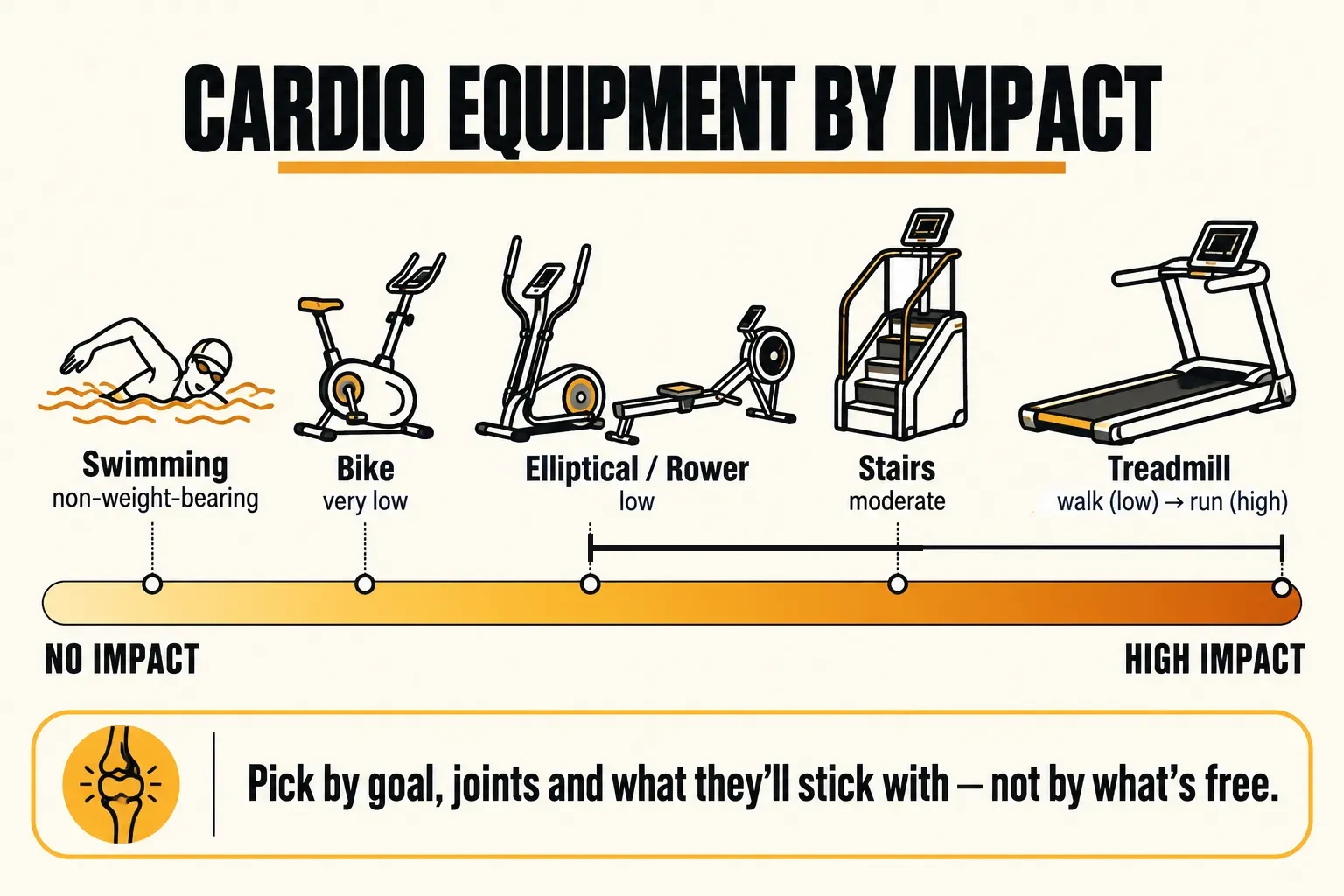
Cardio equipment is often chosen by default (whatever machine is free) rather than by design. A more deliberate approach weighs three things: the client's goal, joint/impact considerations, and what they'll actually stick with.
| Modality | Impact level | Best suited for |
|---|---|---|
| Treadmill (walk/run) | Low (walk) to high (run) | General cardio base-building; running adds impact stress worth screening for |
| Cycle ergometer | Very low | Clients with joint pain, knee/ankle limitations, or early-stage deconditioning |
| Elliptical | Low | A running-like stimulus without the impact — good bridge modality |
| Rowing machine | Low | Full-body cardio with a pulling/posterior-chain bias |
| Stair climber | Moderate | Lower-body strength-endurance overlap with cardio demand |
| Swimming | None (non-weight-bearing) | Joint-friendly option for clients who can't tolerate any impact |
Resistance Training Modalities
- MachinesControl the movement path for the client, reducing stabilization demand. Often the safer starting point for beginners with poor movement control, or for isolating a specific muscle.
- Free weights (barbells, dumbbells)Demand active stabilization through the whole kinetic chain — more transferable to real-world movement, but require more skill and coaching attention.
- CablesAllow multi-directional, functional movement patterns that neither machines nor free weights can replicate as easily.
- BodyweightZero equipment barrier, infinitely scalable through leverage and tempo changes — a strong default when equipment access is limited.
- Resistance bandsPortable, provide variable resistance (more tension at end-range), useful for activation work and travel-friendly programming.
- Suspension trainers (e.g. TRX-style)Bodyweight-based with an added stabilization demand from the unstable strap system.
- Medicine ballsSupport explosive, rotational, and throwing patterns — a Phase 5 (Power) staple.
The selection question is rarely "which is best" in the abstract — it's "which matches this client's current stabilization capacity, this phase's goal, and what's actually available in the room." A Phase 1 client with poor single-leg stability probably shouldn't be handed a heavy barbell squat on day one, regardless of how effective barbell squats are in general.
A Worked Example: Matching Modality to Two Clients
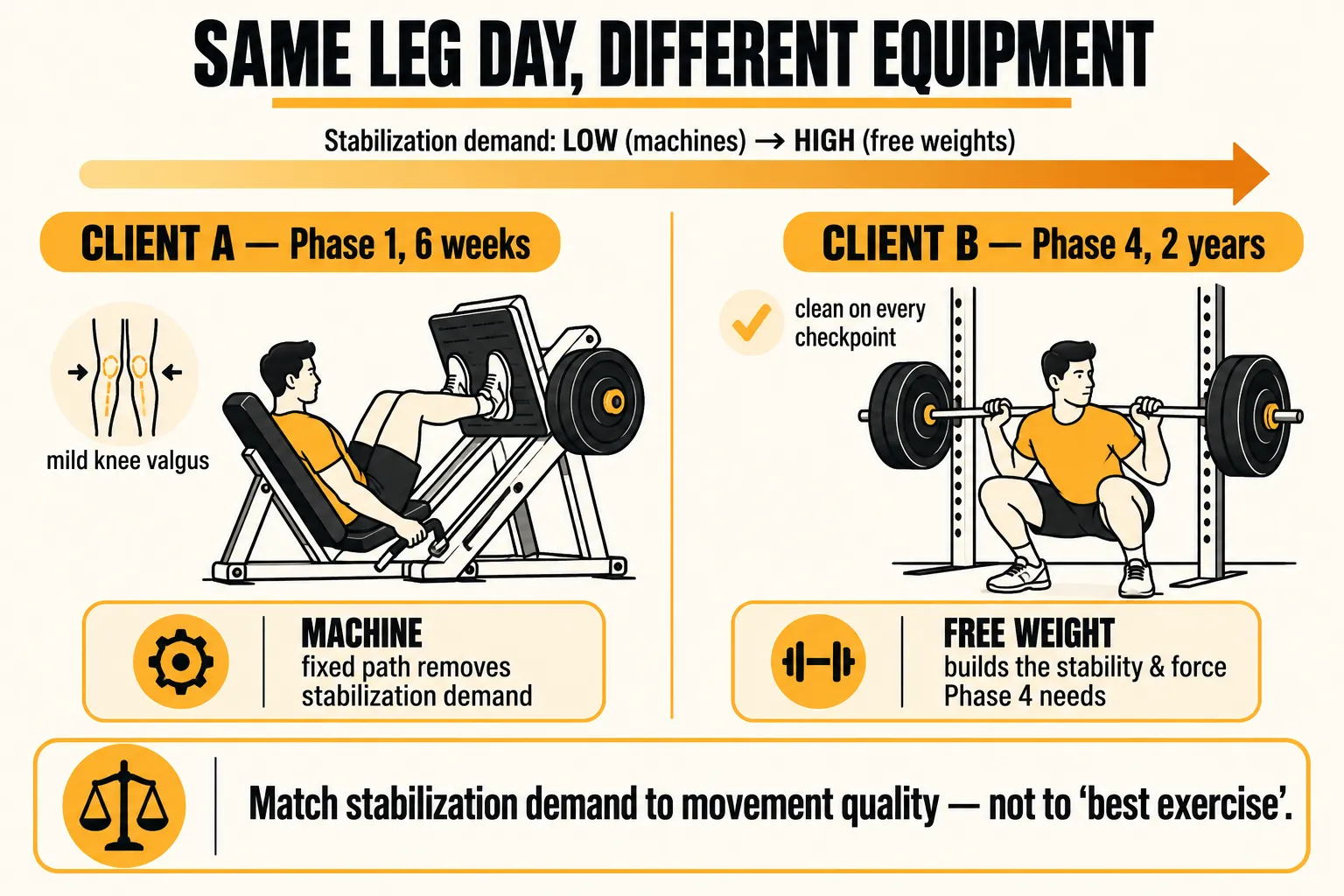
Consider two clients both training legs on the same day, in the same gym. Client A is in Phase 1, six weeks into training, with an OHSA (Lesson 13) showing mild knee valgus that hasn't fully resolved. The appropriate modality here is a machine — a leg press or a supported split-squat pattern — because the machine's fixed path removes the stabilization demand that would otherwise let that valgus pattern show up under load. Client B is in Phase 4, has trained for two years, and shows clean movement quality across every checkpoint. For Client B, a barbell back squat is not just acceptable but arguably the better choice, because free weights demand the exact stabilization and force production Phase 4 is designed to build, and Client B has already earned the ability to control that demand safely.
Same exercise category, same training day, two completely different equipment choices — because the deciding factor was never "which is objectively the better exercise." It was which one matched each client's current movement quality and phase.
Five Ways to Monitor Exercise Intensity
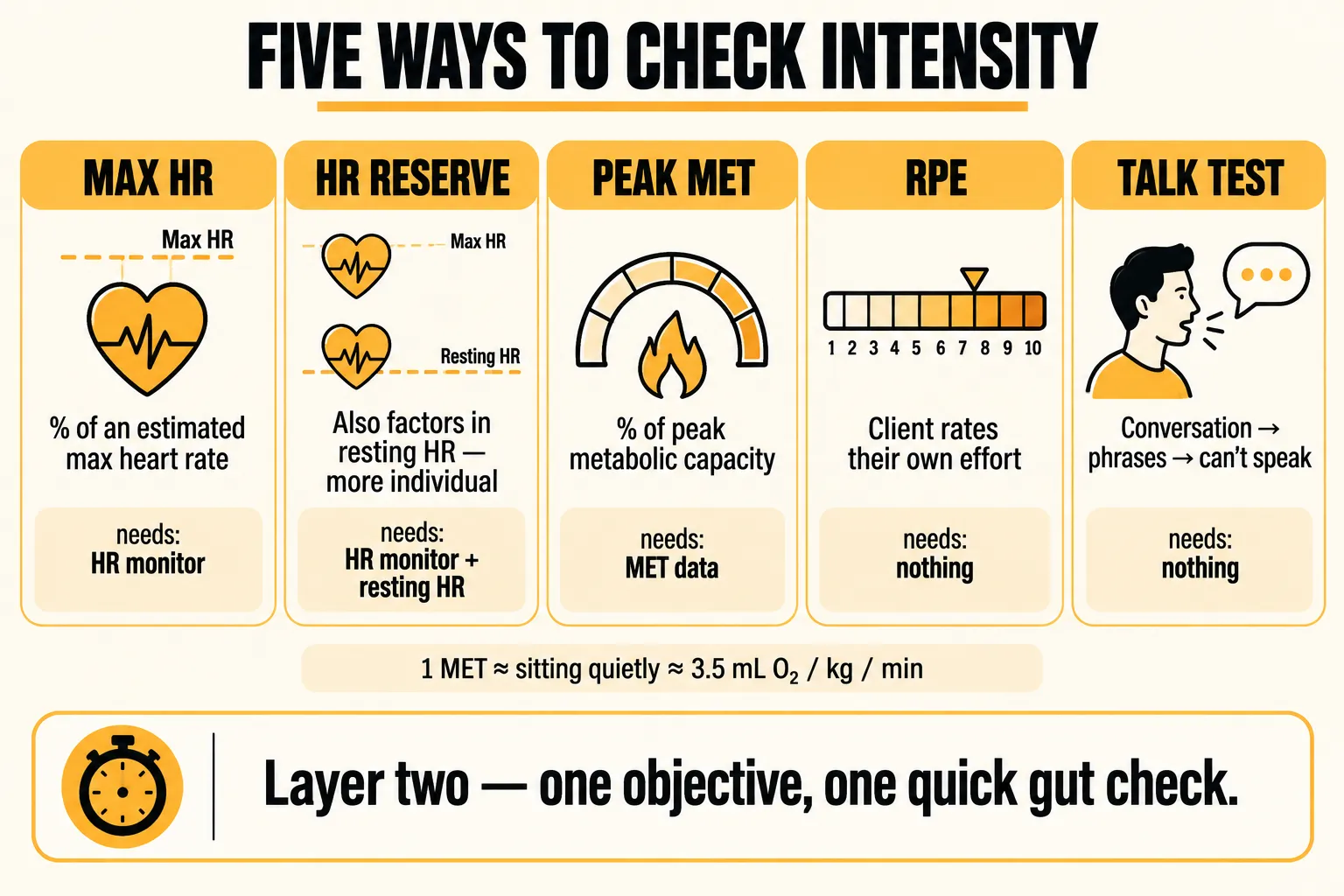
Prescribing "moderate intensity" on paper means nothing if you can't verify it in the room. NASM's framework includes several practical methods, each with different equipment needs and precision:
| Method | How it works |
|---|---|
| Max heart rate (MHR) method | Estimates a ceiling heart rate, then prescribes training zones as a percentage of it |
| Heart rate reserve (HRR) method | Accounts for resting heart rate too, giving a more individualized zone than MHR alone |
| Peak MET method | Prescribes intensity as a percentage of a client's peak metabolic equivalent capacity |
| Rating of Perceived Exertion (RPE) | The client self-rates effort on a numeric scale — fast, equipment-free, but relies on self-awareness |
| Talk test | Full conversation = low intensity; short phrases only = moderate-to-vigorous; can't speak = very high |
In practice, most trainers layer two methods — a wearable or manual heart-rate check for objectivity, plus RPE or the talk test as a quick, ongoing gut check between formal measurements.
8 questions, modeled on NASM's real exam style. Score 70%+ to mark this lesson complete.
- Cardio modality choice should weigh goal, impact/joint considerations, and client adherence — not just what's free in the room.
- Resistance modalities exist on a spectrum of stabilization demand: machines control the path, free weights demand active stabilization, and cables/bodyweight/bands sit in between.
- Modality selection should match the client's current stabilization capacity and OPT phase, not just training effectiveness in the abstract.
- Five common intensity-monitoring methods: MHR, HRR, peak MET, RPE, and the talk test — each trading off precision for convenience.
- One MET ≈ resting energy expenditure (about 3.5 mL O2/kg/min); other activities are described as multiples of it.
- The "right" piece of equipment is whichever matches the client's current movement quality and OPT phase — not whichever is objectively the most effective exercise in general.
Before moving to Lesson 16:
- Pick three cardio modalities and rank them by impact level, low to high.
- Practice explaining the talk test to a friend or family member in one sentence, as if they were a new client.
- Take one exercise (like a squat) and describe how you'd modify the equipment choice for a Phase 1 client versus a Phase 4 client.
- Complete the knowledge check above and review any question you missed.