Every program you'll ever write starts with an assessment, not an exercise list. This lesson covers how NASM's assessment framework reads a client's movement — starting with the overhead squat assessment — and the six acute training variables that turn those findings into an actual program.
It's tempting to think program design starts with picking exercises. It doesn't. It starts with finding out how someone actually moves — where they're stable, where they compensate, and where a "normal-looking" exercise might reinforce a dysfunction instead of fixing it. That's what this lesson covers: how to read a client's movement, and the basic vocabulary — acute variables — you'll use to turn those findings into a program in Lesson 14.
Why Assessment Comes Before Programming
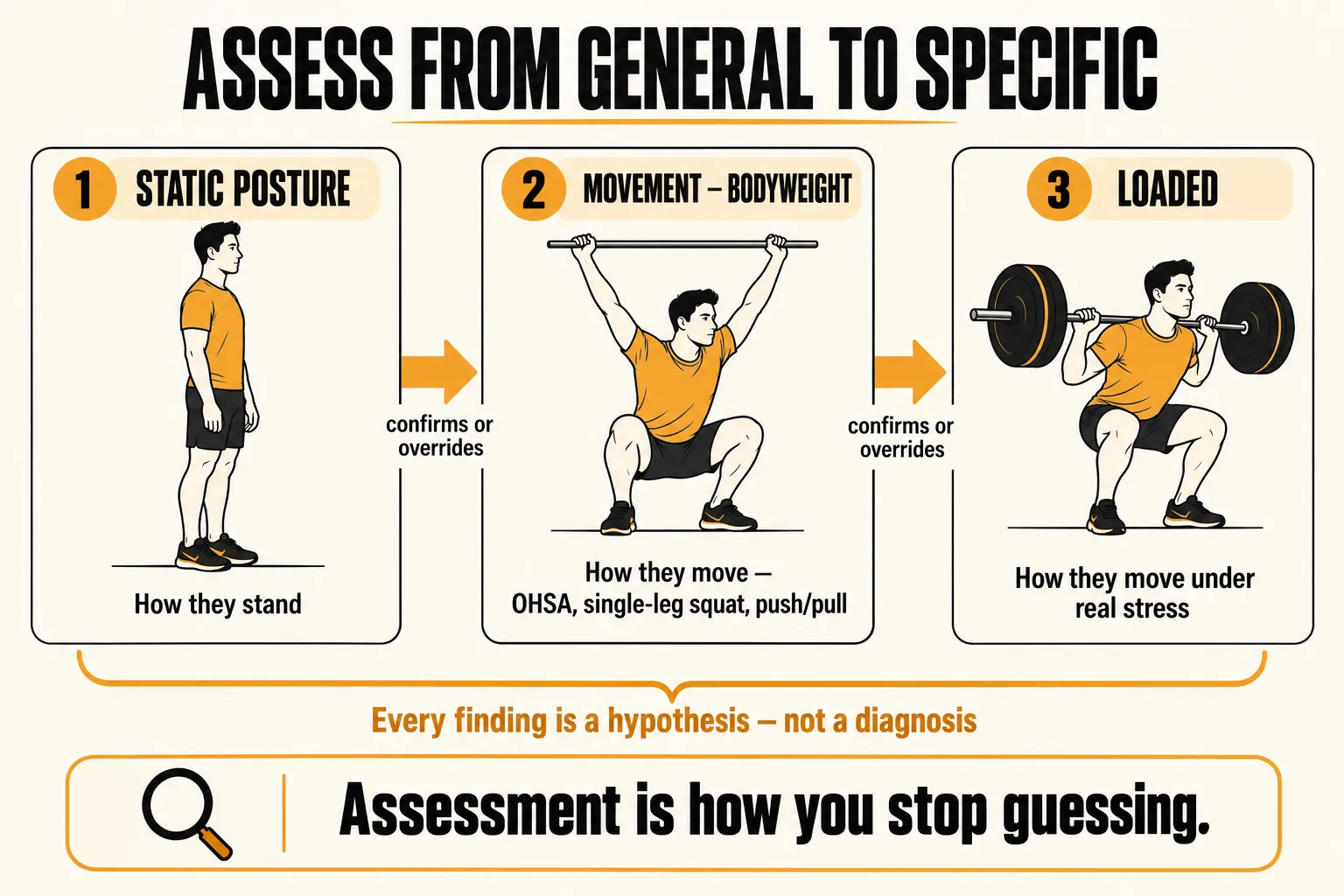
Two clients can want the same outcome — "get stronger," "lose fat," "run a 5K" — and need completely different starting programs, because their bodies are moving completely differently under the hood. A generic program applied to both is a coin flip: it might work, or it might load a compensation pattern that eventually causes pain or a plateau. Assessment is how you stop guessing.
NASM's assessment framework works from general to specific: start with how someone stands still (static posture), then how they move under a bodyweight-only pattern (transitional/dynamic assessment), then, if needed, how they move under load. Each layer either confirms or overrides what the previous layer suggested.
The Five Kinetic Chain Checkpoints, Recap
Lesson 6 introduced the five kinetic chain checkpoints during static posture assessment — the same five regions, from the ground up, that every NASM assessment scans, whether the client is standing still or moving through a squat:
| Checkpoint | What you're looking for |
|---|---|
| Foot & ankle | Feet flattening (pronation), turning out, or heels lifting off the ground |
| Knee | Knees caving inward (valgus) or tracking outside the toes |
| LPHC (lumbo-pelvic-hip complex) | Excessive forward lean, low back arching, or the pelvis tilting forward/backward |
| Shoulders & thoracic spine | Shoulders rounding forward or elevating toward the ears |
| Head & neck | Head tilting or jutting forward relative to the rest of the spine |
If you skipped ahead, these five checkpoints are worth committing to memory now — they're the shared vocabulary behind every NASM assessment, and the rest of this section builds directly on them.
The Overhead Squat Assessment (OHSA)
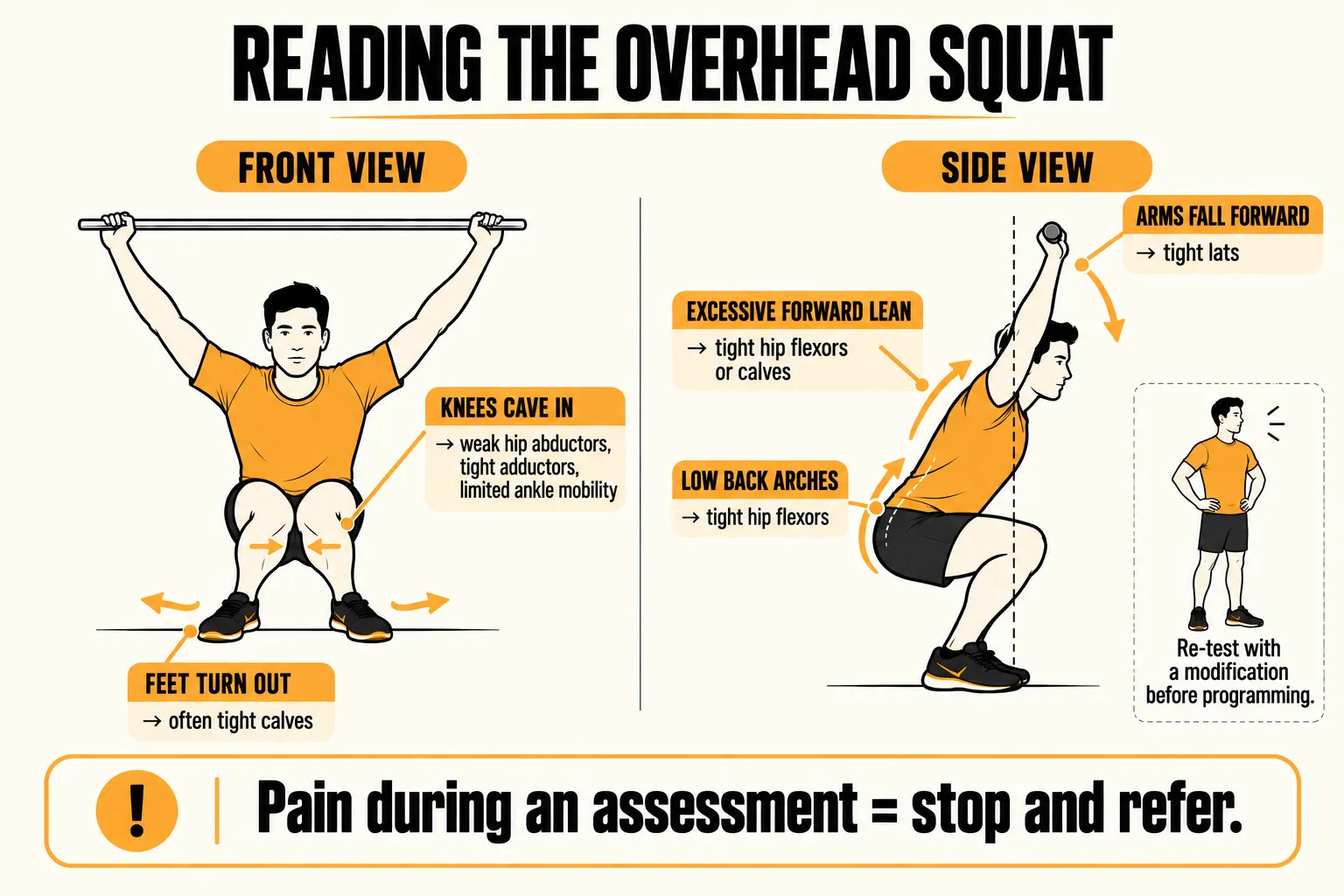
The overhead squat assessment is the workhorse dynamic movement screen: arms overhead, feet shoulder-width apart, squatting to a comfortable depth for 5-plus reps while you watch the five checkpoints from the front, side, and back. Because it loads the ankles, knees, hips, spine, and shoulders simultaneously, it tends to surface compensations that a static, standing-still check misses entirely.
- Feet turn out or flattenOften tied to tight calves (gastrocnemius/soleus) limiting ankle dorsiflexion, forcing the foot to compensate to reach depth.
- Knees cave inward (valgus)Commonly linked to weak hip abductors/external rotators, overactive hip adductors, and that same limited ankle dorsiflexion.
- Excessive forward leanFrequently a sign of tight hip flexors or limited ankle dorsiflexion, forcing the torso to compensate for a range-of-motion shortfall lower in the chain.
- Low back archesOften connects to tight hip flexors and an anterior pelvic tilt pulling the lumbar spine into extension.
- Arms fall forwardCan point to a tight latissimus dorsi limiting overhead shoulder flexion — testable by re-running the squat with hands on hips instead of overhead.
None of these are diagnoses — they're hypotheses. A single OHSA compensation can have more than one underlying cause, which is exactly why NASM pairs the assessment with follow-up tests (like the heel-lift or hands-on-hips modification) rather than jumping straight to a corrective program off one observation.
Beyond the OHSA: Other Assessments Worth Knowing
- Single-leg squat assessmentIsolates each side individually — useful when the OHSA shows asymmetries a bilateral squat can mask.
- Pushing and pulling assessmentsScreen upper-body pressing and rowing patterns for the same shoulder/thoracic-spine compensations seen in the OHSA.
- Loaded assessmentsOnce bodyweight patterns look clean, adding load (e.g. a loaded squat or deadlift pattern) can reveal compensations that only appear under real training stress.
The Acute Training Variables
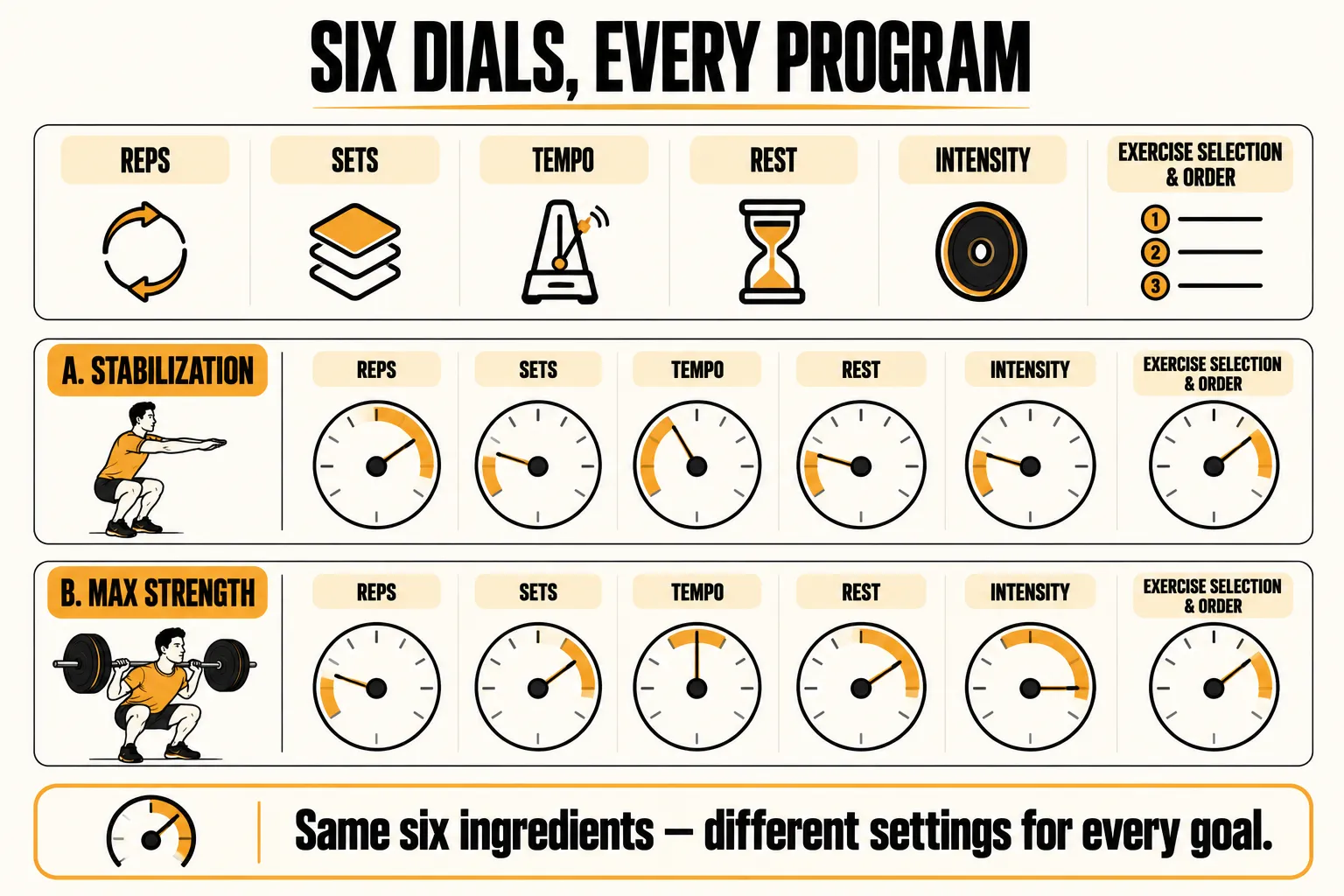
Once you know how someone moves, the next question is how you'll actually program around it. Every program — regardless of goal or OPT phase, which Lesson 14 covers in depth — is built from the same six adjustable dials, known as the acute variables:
| Variable | What it controls |
|---|---|
| Reps | How many times an exercise is performed per set — drives whether the emphasis leans toward endurance, hypertrophy, strength, or power |
| Sets | How many rounds of that rep count are performed — controls total training volume |
| Tempo | The speed of each phase of the rep (eccentric–isometric–concentric) — slower tempos build control and stability, faster tempos build rate of force production |
| Rest periods | Recovery time between sets — shorter rest favors endurance/metabolic demand, longer rest favors max strength and power output |
| Intensity / load | How heavy the resistance is, usually expressed as a percentage of what someone can lift for one rep |
| Exercise selection & order | Which movements are chosen and the sequence they're performed in — typically most complex/demanding movements first, while a client is freshest |
Everything in Lesson 14's OPT model is really just a different recipe using these six ingredients. Stabilization-focused training uses high reps, light loads, and slow-to-moderate tempos; maximal strength training uses low reps, heavy loads, and long rest periods. Same six variables, different settings.
8 questions, modeled on NASM's real exam style. Score 70%+ to mark this lesson complete.
- Assessment comes before exercise selection — the same goal can need completely different starting programs depending on how someone actually moves.
- The five kinetic chain checkpoints (foot/ankle, knee, LPHC, shoulders/thoracic spine, head/neck) are the shared vocabulary behind every NASM movement assessment.
- The overhead squat assessment loads the whole chain at once, surfacing compensations a static check alone would miss — but each compensation is a hypothesis, not a diagnosis.
- Every program is built from six acute variables: reps, sets, tempo, rest, intensity, and exercise selection/order.
- When an exam question asks for the "most likely" cause of a compensation, go with NASM's most common taught pairing rather than an obscure alternative.
Before moving to Lesson 14:
- Practice naming the five kinetic chain checkpoints from memory, in order, from the ground up.
- Watch (or perform) an overhead squat and try to spot at least one compensation using the checkpoints above.
- Complete the knowledge check above and review any question you missed before moving on.