Speed, agility, and quickness (SAQ) sound like one skill but are actually three distinct qualities, each trainable with its own drills. This lesson defines all three, covers the drill types used to train them, and closes out the Exercise Technique & Training Instruction domain by tying SAQ back to the plyometric foundation from Lesson 11.
SAQ training is often thought of as "athlete stuff" — cone drills, ladders, sprint work. It is that, but the underlying qualities also show up in everyday movement: reacting to a curb you didn't see, changing direction to catch a falling object, or simply moving quickly and safely through a crowded space. This lesson also closes out an entire domain of the course — everything from Lesson 7's flexibility through Lesson 11's plyometrics has been building toward exactly this: a client who can move well, then move well quickly, then react well under unpredictable conditions.
Defining Speed, Agility, and Quickness
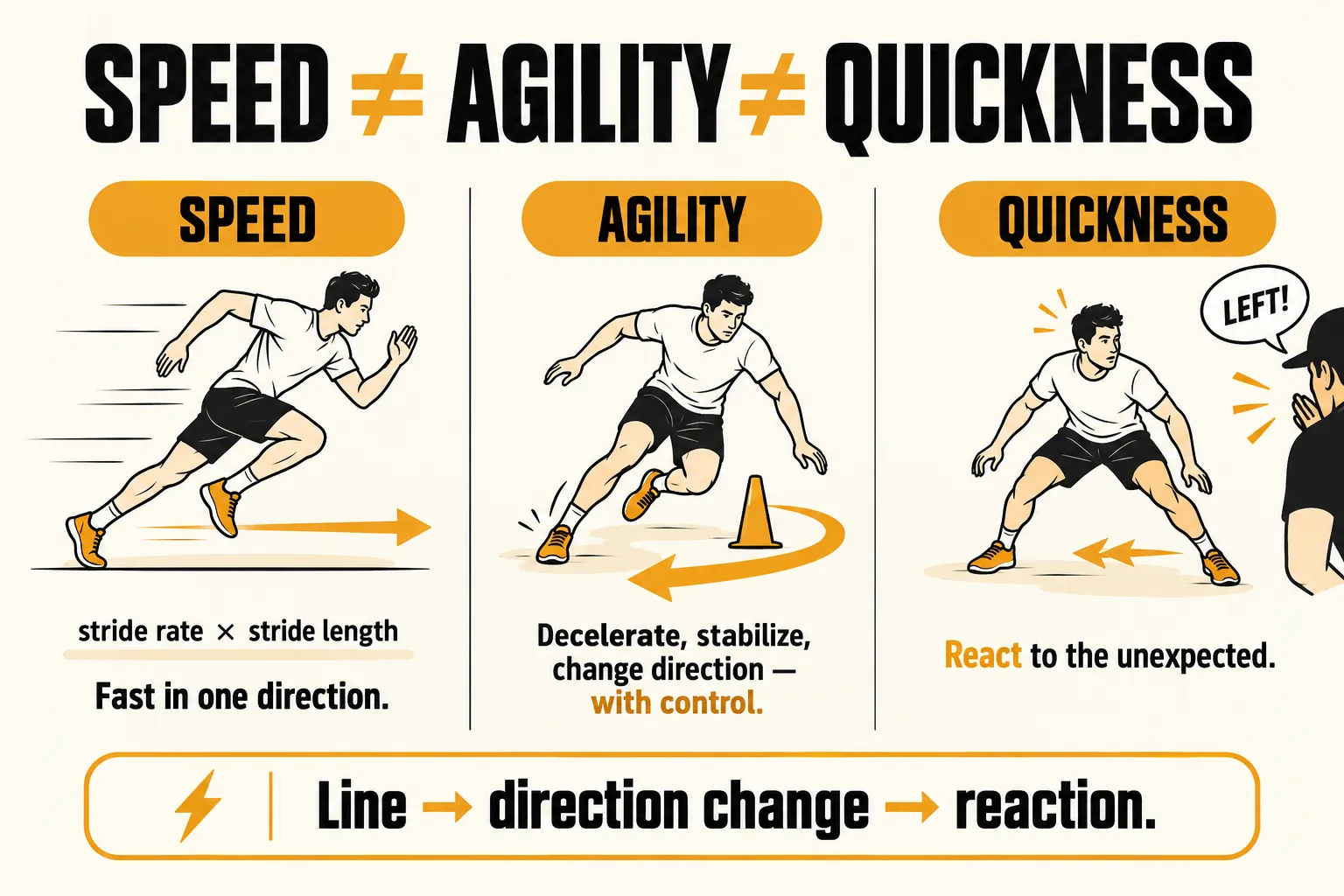
These three terms get used interchangeably in everyday language, but NASM defines each one precisely — and the exam expects you to be able to tell them apart:
- SpeedThe rate of motion in a specific direction, determined by stride rate (how fast the legs cycle) multiplied by stride length (how much ground each stride covers).
- AgilityThe ability to accelerate, decelerate, stabilize, and change direction quickly while maintaining proper posture and control throughout.
- QuicknessThe ability to react to a stimulus and change body position with a maximal rate of force production — the reactive, "no time to think" component of movement.
Notice the progression: speed is about moving fast in a line, agility is about controlling direction changes, and quickness is about reacting to something unpredictable. A well-rounded SAQ program trains all three.
Common SAQ Training Drills
| Drill type | What it trains | Example |
|---|---|---|
| Ladder drills | Footwork, coordination, and stride-rate precision | In-and-out steps, lateral shuffles through an agility ladder |
| Cone drills | Change-of-direction mechanics under a planned, known pattern | T-drills, 5-10-5 shuttle runs, zig-zag cone runs |
| Reactive drills | Reaction time and unplanned, stimulus-driven change of direction | Partner-called direction changes, mirror drills, reaction-ball catches |
Notice the progression from planned to reactive: cone drills teach the mechanics of changing direction under known conditions, while reactive drills layer an unpredictable stimulus on top of mechanics that are already sound.
SAQ Training and the OPT Model
SAQ training shares the same readiness logic as Lesson 11's plyometric training: it demands a strength and stability foundation before it's introduced, and it's most heavily emphasized in Phase 5 (Power), where speed and reactivity are the explicit training goal. In practice, plyometric and SAQ exercises are often programmed together in the same power-phase session, since both rely on the same underlying qualities — rate of force production and efficient use of the stretch-shortening cycle from Lesson 11. A client who hasn't built that foundation isn't ready for either category yet, regardless of how much they want to work on "quickness" specifically.
A Worked Example: Scaling SAQ for a Non-Athlete Client
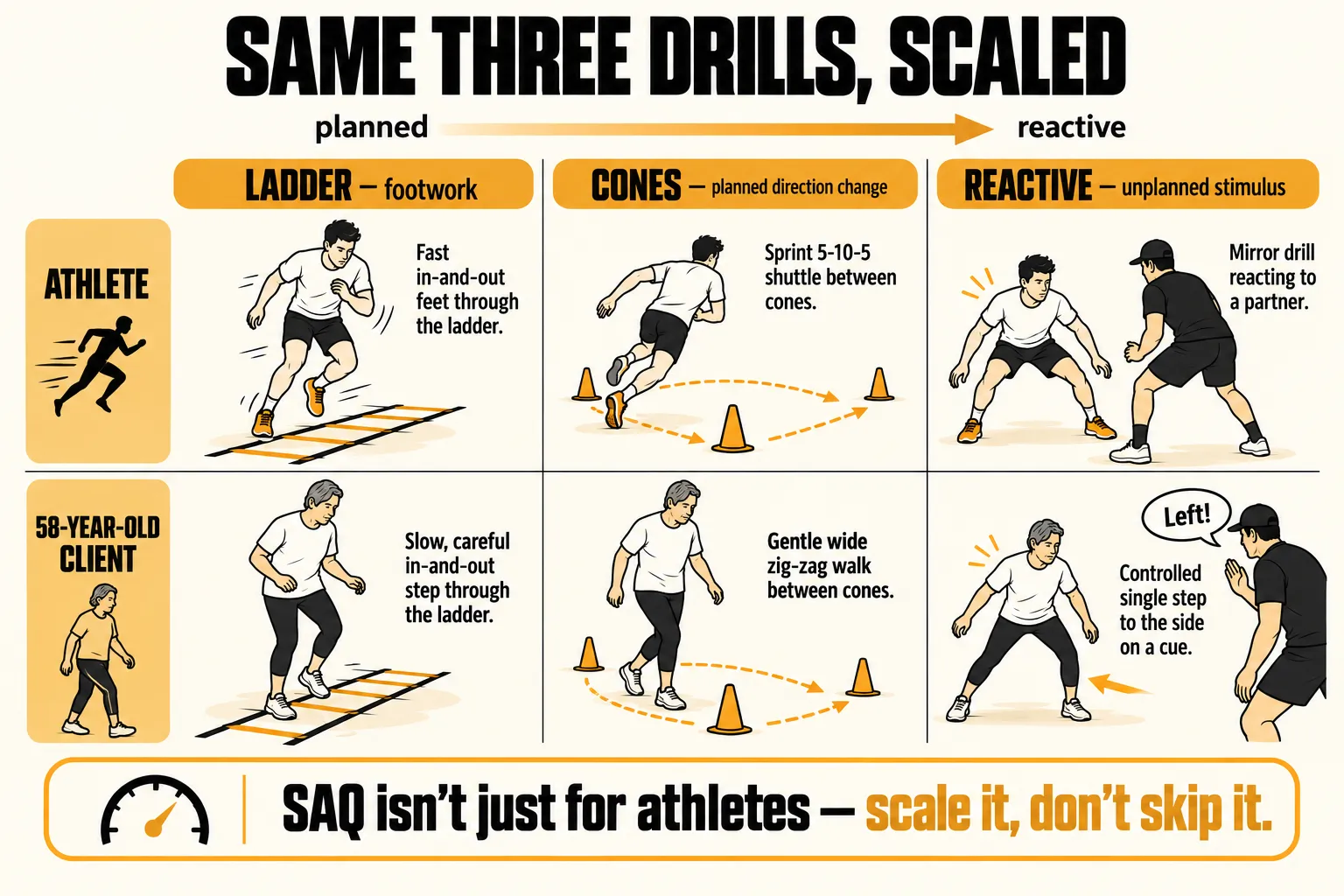
Consider a 58-year-old general-population client whose goal is simply staying independent and steady on her feet, not sport performance. Ladder drills still apply — slowed down and simplified to a basic in-and-out step pattern, they build the same footwork precision an athlete would train, just at a pace and complexity appropriate to her current ability. Cone drills scale down to a wide, gentle zig-zag walk rather than a sprinted 5-10-5 shuttle. And reactive drills might be as simple as a trainer calling out "left" or "right" while she takes a controlled step in that direction — the same unplanned-stimulus principle behind a professional athlete's reactive cone drill, just at a fraction of the speed and range.
None of these looks anything like a sprint coach's session, but structurally, they're the exact same three drill categories, applied at a different point on the same continuum. That's the real skill this lesson is testing: not memorizing what SAQ training looks like for elite athletes, but recognizing how to scale the same underlying qualities to whoever is actually in front of you.
8 questions, modeled on NASM's real exam style. Score 70%+ to mark this lesson complete.
- Speed = stride rate × stride length in a specific direction. Agility = controlled acceleration, deceleration, and direction changes. Quickness = reacting to a stimulus with maximal rate of force production.
- Ladder drills train footwork/coordination, cone drills train planned change-of-direction mechanics, and reactive drills train unplanned, stimulus-driven reaction.
- SAQ training shares plyometrics' readiness requirements — a strength/stability foundation should exist first.
- SAQ training is most emphasized in Phase 5 (Power), often programmed alongside plyometrics.
- SAQ training benefits general-population clients too, not just athletes — including fall-risk reduction for older adults.
- The same three drill categories (ladder, cone, reactive) scale to any client — the drill type doesn't change, just the speed and complexity.
You've now completed the entire Exercise Technique & Training Instruction domain (Lessons 7-12):
- Write one-sentence definitions for speed, agility, and quickness from memory, and one drill example for each.
- Review Lessons 7 through 12 as a set — notice how flexibility, cardio, core, balance, plyometrics, and SAQ all follow the same underlying OPT-phase logic.
- Sketch a scaled-down version of one ladder, cone, and reactive drill for a hypothetical older-adult client.
- Complete the knowledge check above and review any question you missed before returning to the course overview.