Plyometric (reactive) training is how the body converts a rapid stretch into explosive power — think jumping and landing. This lesson covers the three-phase stretch-shortening cycle behind that power, what needs to be in place before programming plyometrics safely, and how plyometric exercises progress across the OPT Model.
Plyometrics are often the exercise type clients (and new trainers) get most excited about — jumps, bounds, explosive throws — and also the type most likely to cause injury when programmed too early. This lesson gives you the framework to know when a client is actually ready. It's the reactive-training equivalent of what Lesson 4's ATP-PC system fuels and what Lesson 9's core-power and Lesson 10's balance-power exercises apply in their own domains — high force, produced fast, over a very short window.
The Stretch-Shortening Cycle
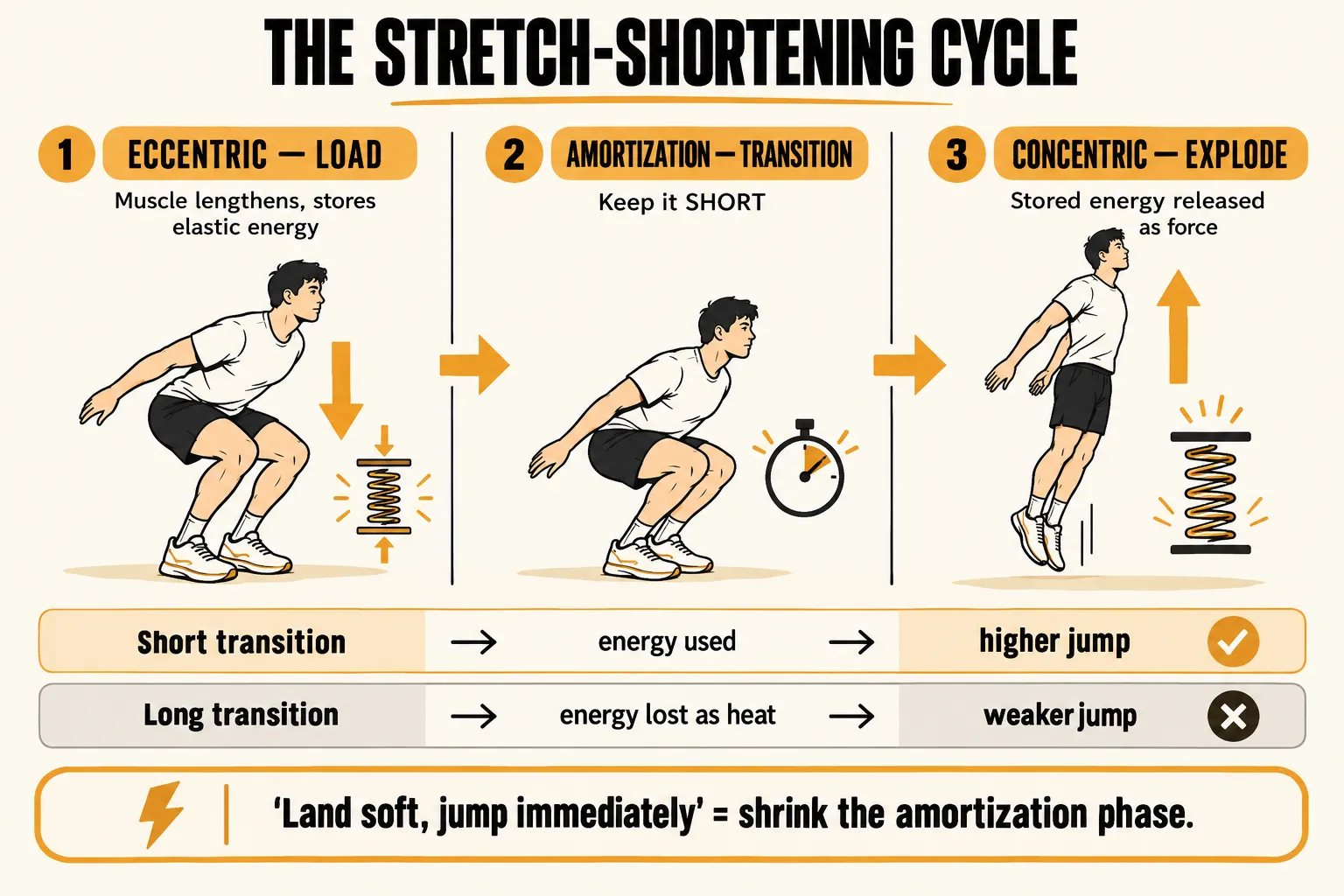
Plyometric power comes from a specific three-phase neuromuscular mechanism called the stretch-shortening cycle (SSC). Understanding the three phases explains both why plyometrics work and why the transition between them matters so much:
- Eccentric (loading) phaseThe muscle rapidly lengthens under load — think the downward part of a countermovement jump — storing elastic energy in the tendon and muscle.
- Amortization (transition) phaseThe brief pause between the eccentric and concentric phases. The shorter this transition, the more stored elastic energy is used productively rather than lost as heat — a longer amortization phase means a weaker, slower jump.
- Concentric (explosive) phaseThe muscle rapidly shortens, releasing the stored elastic energy as explosive force — the upward, powerful part of the jump.
A coaching cue like "land soft, jump immediately" is really just a plain-language instruction to minimize the amortization phase — the technical goal behind almost every plyometric coaching cue.
Prerequisites Before Programming Plyometrics
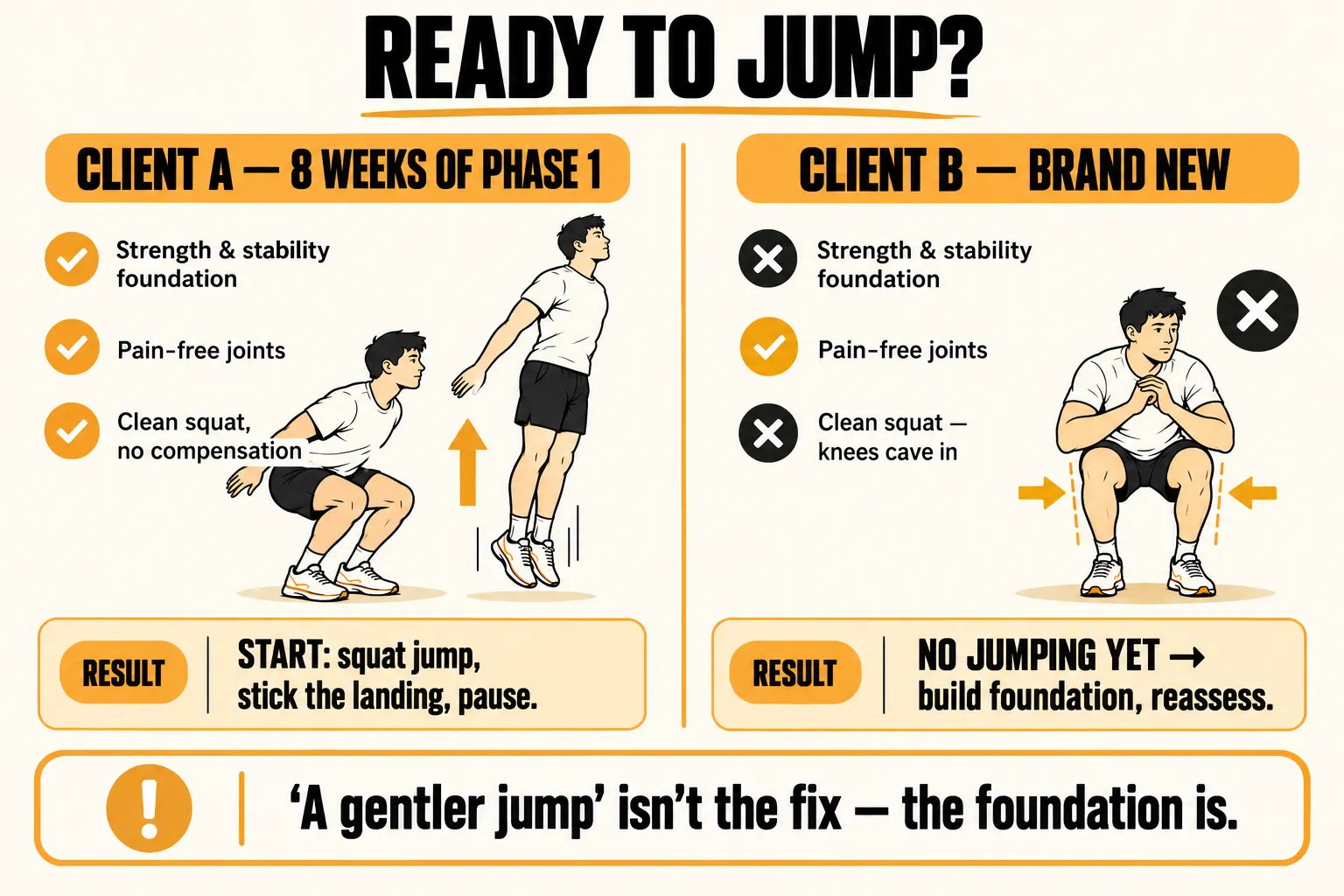
Because plyometrics involve rapid, high-force loading, they carry more injury risk than most other exercise types if introduced too early. Before programming plyometrics, a trainer should confirm:
| Prerequisite | Why it matters |
|---|---|
| Adequate strength and stability foundation | A client needs enough strength to safely absorb and redirect landing forces before adding speed to the equation |
| Pain-free joints | Plyometrics load joints rapidly and repeatedly — any existing pain is a stop-and-refer signal, not something to train through |
| Movement quality under control | Compensations identified in Lesson 13's assessment (like knee valgus) get amplified, not fixed, under the speed and load of plyometric training |
A Worked Example: Two Clients, Two Very Different First Sessions
Consider two prospective clients both asking to "start jump training." Client A has completed eight weeks of Phase 1 stabilization work, moves through a bodyweight squat with no visible compensation, and reports no joint pain. Client A is a reasonable candidate to begin with a basic squat jump, landing softly and pausing before the next rep — a Phase 1 stabilization-level plyometric that still emphasizes control over speed. Client B is brand new, has never trained before, and their overhead squat assessment (Lesson 13) shows both knees caving inward under load. Programming any plyometric work for Client B right now — even a "beginner" jump — would load exactly the compensation pattern the assessment just flagged, at speed, repeatedly.
The right move for Client B isn't "a gentler jump." It's no jumping yet at all — building the strength and movement-quality foundation first, then reassessing before plyometrics enter the picture. This is the same logic that governs every other exercise category in this course: a stabilization foundation always comes before speed and power, no exceptions made for enthusiasm.
Plyometric Training by OPT Phase
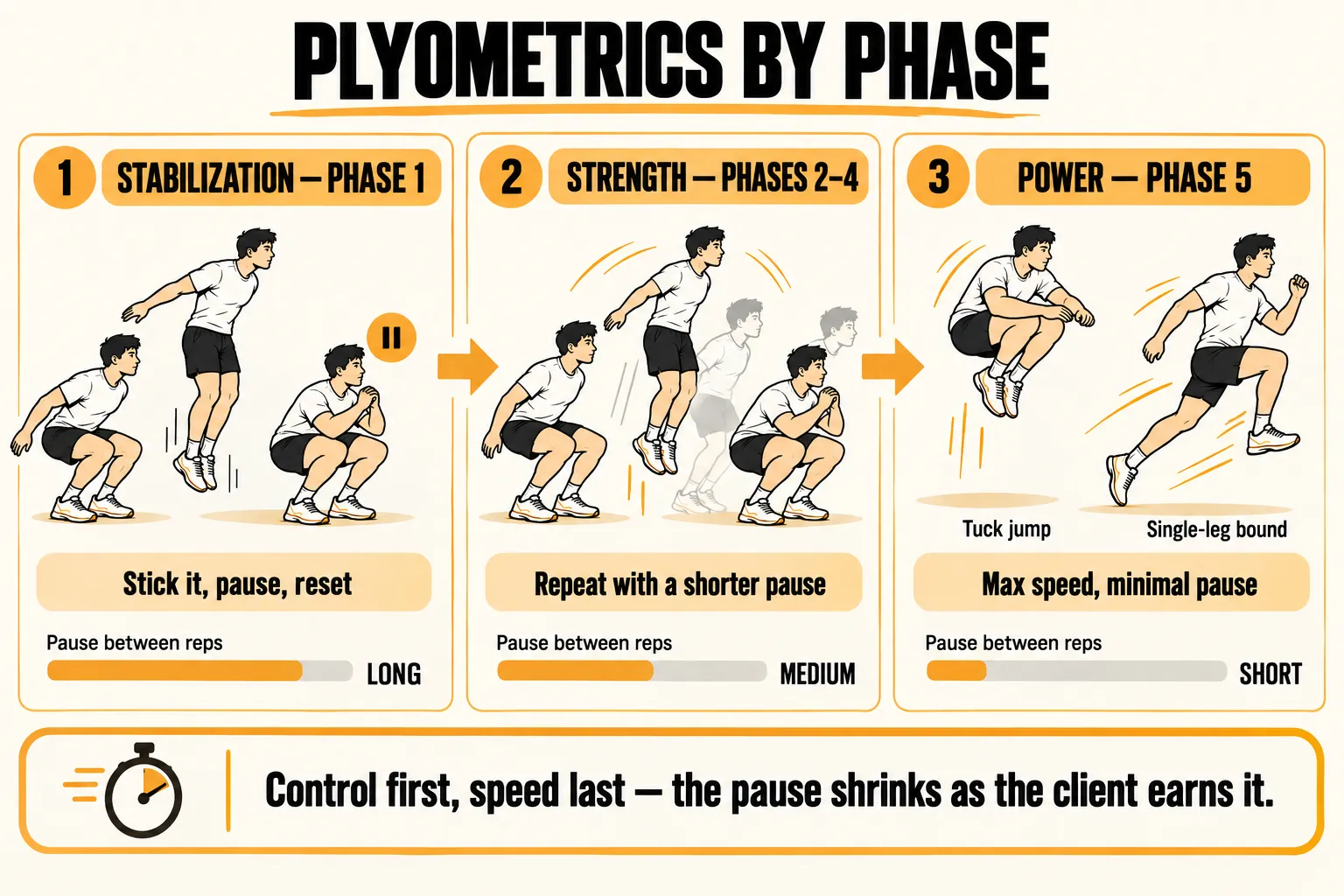
| OPT phase | Plyometric type | Example |
|---|---|---|
| Phase 1 — Stabilization | Stabilization-level plyometrics | Squat jump with a controlled, "stick" landing and a pause before the next rep |
| Phases 2–4 — Strength | Strength-level plyometrics | Repeated squat jumps with a shorter pause between reps |
| Phase 5 — Power | Power-level plyometrics | Tuck jumps, single-leg bounds — maximal speed, minimal amortization |
Plyometrics follow the same three-tier logic as core (Lesson 9) and balance (Lesson 10) training — stabilization and control come first, speed comes last, and Lesson 12's speed/agility/quickness training builds directly on this same foundation. By the time a client reaches Phase 5 power-level plyometrics, they've already spent months building the exact strength, stability, and movement control that makes reactive training safe rather than reckless.
8 questions, modeled on NASM's real exam style. Score 70%+ to mark this lesson complete.
- The stretch-shortening cycle has three phases: eccentric (loading), amortization (transition), and concentric (explosive) — a shorter amortization phase means more powerful, efficient output.
- Before programming plyometrics, confirm adequate strength/stability, pain-free joints, and controlled movement quality.
- Heavy or explosive load applied before a client has that foundation is how a compensation pattern turns into an injury — a common exam trap.
- Plyometrics progress through the same three tiers as core and balance training: stabilization (Phase 1), strength (Phases 2-4), and power (Phase 5).
- "Land soft, go again fast" is a plain-language cue for minimizing the amortization phase.
- An unresolved assessment finding (like knee valgus) is a reason to delay plyometrics entirely, not a reason to pick a "gentler" jump.
Before moving to Lesson 12:
- Name the three phases of the stretch-shortening cycle from memory, in order.
- List the three prerequisites a trainer should confirm before programming plyometrics for a new client.
- Practice explaining, out loud, why a client with an unresolved assessment finding should wait on plyometrics rather than start with a modified version.
- Complete the knowledge check above and review any question you missed before moving on.