Balance isn't a fixed trait someone either has or doesn't — it's a trainable skill built on proprioception, the body's sense of where its joints are in space. This lesson covers the balance training continuum and how balance exercises progress across the OPT Model, from a stable, both-feet stance all the way to reactive, single-leg power work.
Balance training shows up constantly in real programming — from a simple single-leg reach for a general-population client to a reactive hop-and-stick drill for an athlete. Understanding the continuum lets a trainer make any balance exercise harder or easier on the fly, without needing a completely different exercise for every skill level. It's also directly relevant to Lesson 5's stabilizer muscle role and Lesson 6's assessment — a client who can't hold a single-leg stance without excessive knee valgus is showing you a stability gap the same LPHC checkpoints already trained you to look for.
What Balance Training Actually Trains
Balance is the ability to maintain the body's center of gravity over its base of support — and doing that well depends on proprioception, the nervous system's ongoing sense of where each joint is positioned in space, without needing to look at it. Balance training deliberately challenges that system so it adapts, the same way resistance training challenges muscle to adapt.
The Balance Training Continuum
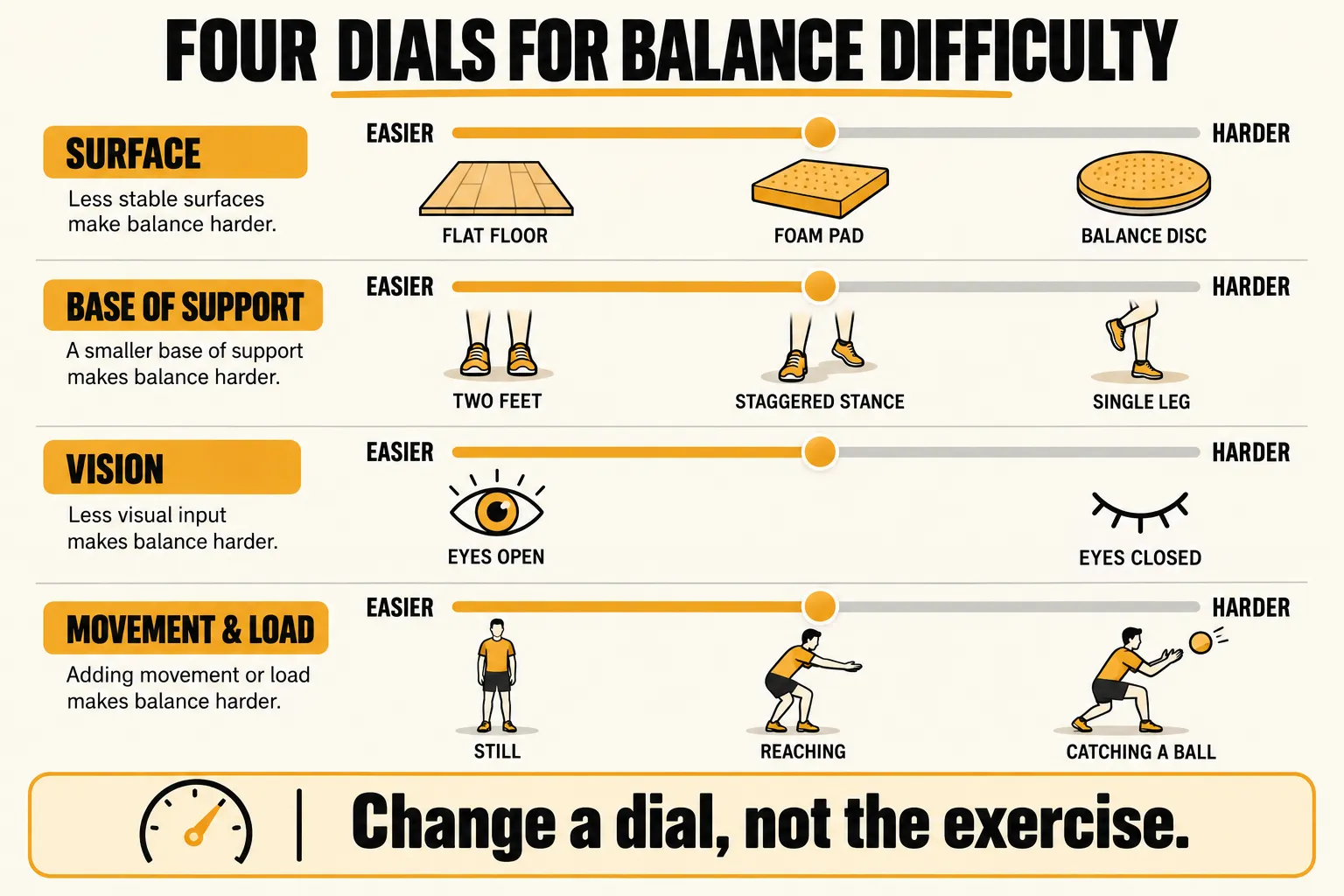
A handful of variables control how demanding a balance exercise is. Changing any one of them — without changing the exercise itself — makes it progressively harder:
- Surface stabilityStable ground (floor) progresses to unstable surfaces (foam pad, balance disc), which demand far more proprioceptive input to control.
- Base of supportBoth feet progresses to a staggered stance, which progresses to single-leg — each step shrinks the base the body has to balance over.
- Visual inputEyes open progresses to eyes closed, removing one of the body's primary balance-feedback channels and forcing greater reliance on proprioception.
- Movement and loadA static hold progresses to controlled movement (reaching, catching), which progresses to added external resistance or unpredictable, reactive movement.
A trainer rarely needs a brand-new exercise to make balance training harder or easier — adjusting one of these four variables is usually enough.
A Worked Example: Progressing One Exercise Four Ways
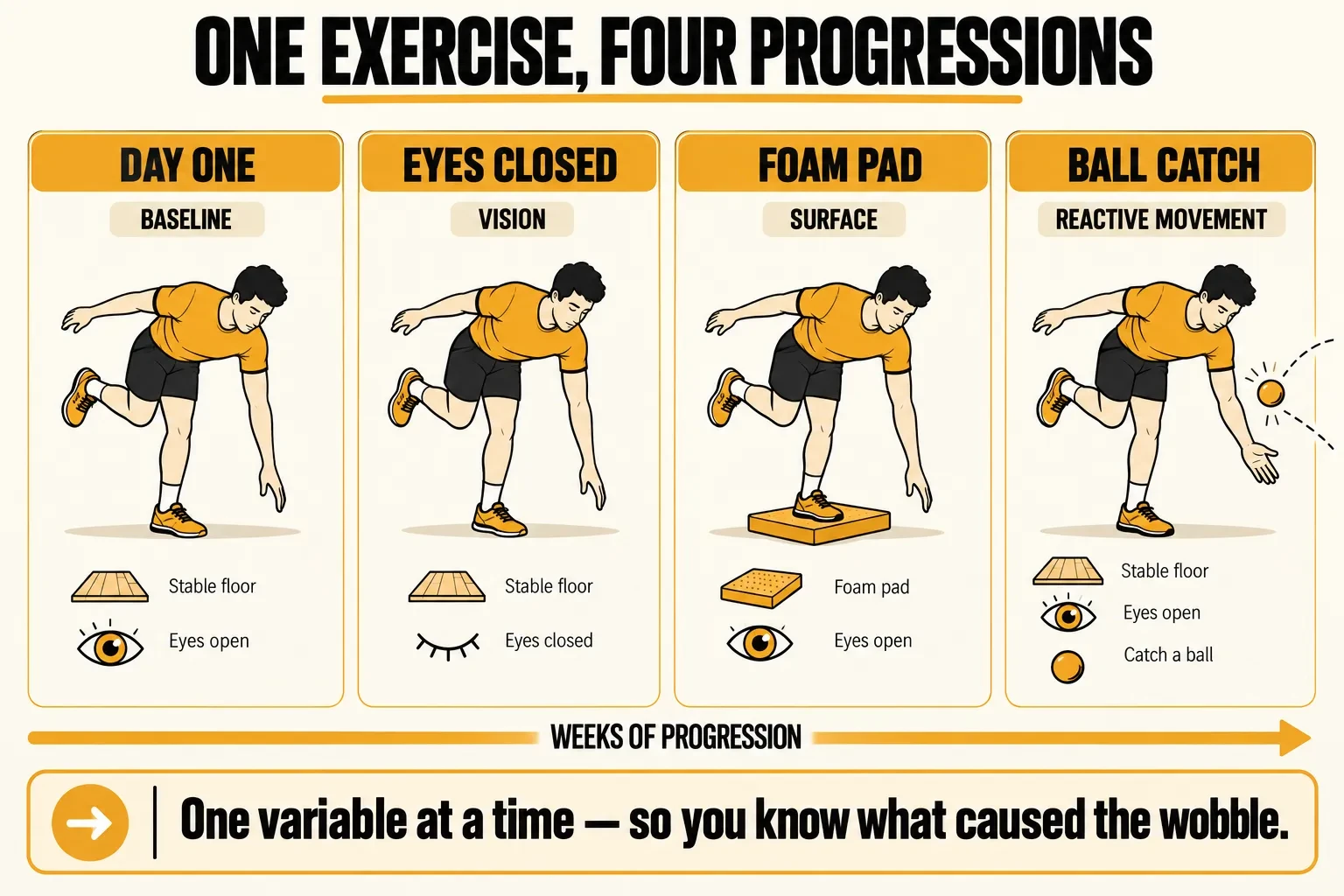
Take a single-leg reach — standing on one leg, tapping the opposite hand toward the floor and back up. On day one with a new client, that's already challenging enough on its own: stable floor, eyes open, no added load. As the client's proprioceptive control improves, a trainer doesn't need to invent a new drill — closing the eyes on that same single-leg reach removes visual feedback and immediately raises the difficulty, without changing a single thing about the movement pattern itself.
Weeks later, the same exercise moves onto a foam pad (surface stability) while the client is still standing on one leg with eyes open — one variable changed at a time, exactly as the warning below recommends. Eventually, a reactive element gets added: a partner tosses a ball for the client to catch mid-reach, layering unpredictable movement onto a base that's already been tested under the first three variables. Four completely different training stimuli, and it's still fundamentally the same single-leg reach a trainer taught on day one.
Balance Training by OPT Phase
| OPT phase | Balance training type | Example |
|---|---|---|
| Phase 1 — Stabilization | Balance-stabilization exercises | Single-leg balance with a reach, holding a stable position with control |
| Phases 2–4 — Strength | Balance-strength exercises | Single-leg squat touchdowns, lunges performed with a balance challenge |
| Phase 5 — Power | Balance-power (reactive) exercises | Single-leg hop-and-stick, reactive catch-and-stabilize drills |
This is the same three-tier logic used in Lesson 9's core training continuum and Lesson 11's plyometric progression — stabilization builds the foundation, strength adds load, power adds speed and reactivity.
Why Balance Training Matters Beyond Athletes
Balance training is often associated with athletes, but its highest-stakes application is with general-population clients — particularly older adults, where falls are the single biggest training-related risk (a topic Lesson 16 covers in depth). A trainer who understands the balance continuum can safely and progressively build balance capacity for a client at any starting point, from someone relearning to stand on one leg to an athlete training reactive agility. The two populations look nothing alike on paper, yet the same four continuum variables apply to both — only the starting point and the pace of progression differ.
8 questions, modeled on NASM's real exam style. Score 70%+ to mark this lesson complete.
- Balance training trains proprioception — the body's sense of joint position and control over its center of gravity relative to its base of support.
- Four variables control balance-exercise difficulty: surface stability, base of support, visual input, and movement/load.
- Balance training progresses through the same three OPT tiers: stabilization exercises (Phase 1), strength exercises (Phases 2-4), and power/reactive exercises (Phase 5).
- Balance training matters well beyond athletes — it's central to fall-risk reduction in older adults.
- Progress one balance variable at a time so adaptation and troubleshooting both stay clear.
- The same exercise (like a single-leg reach) can be progressed four separate ways just by changing one continuum variable at a time — no new exercise required.
Before moving to Lesson 11:
- List the four balance-continuum variables from memory, with one example of how to progress each.
- Try a single-leg balance hold yourself, then close your eyes and notice how much harder it gets.
- Pick one exercise and describe four ways to progress it, one continuum variable at a time.
- Complete the knowledge check above and review any question you missed before moving on.