"Core training" means a lot more than crunches. The core is the lumbo-pelvic-hip complex — a whole system of deep stabilizing muscles and larger movement-producing muscles working together to keep the spine controlled during everything else a client does. This lesson covers that system and how core training progresses across the OPT Model.
Every compensation involving the LPHC checkpoint you met in Lesson 6's assessment framework — excessive forward lean, low back arching, pelvic tilt — ties back to how well this system is working. Core training isn't a separate "ab day" add-on; it's foundational to almost everything else in this course. A weak or poorly coordinated core doesn't just show up as a compensation on an assessment — it shows up as a client who can't safely load a squat, deadlift, or overhead press, because the spine has nothing controlling it while the limbs try to move heavy weight.
What "The Core" Actually Means
NASM defines the core as the lumbo-pelvic-hip complex (LPHC) — the same region Lesson 6's kinetic chain checkpoints flagged for excessive forward lean, low back arching, and pelvic tilt. It's not just the abdominal muscles you can see; it's every muscle that attaches to, surrounds, or stabilizes the spine and pelvis, working together to control movement and transfer force between the upper and lower body.
Local vs. Global Stabilization Systems
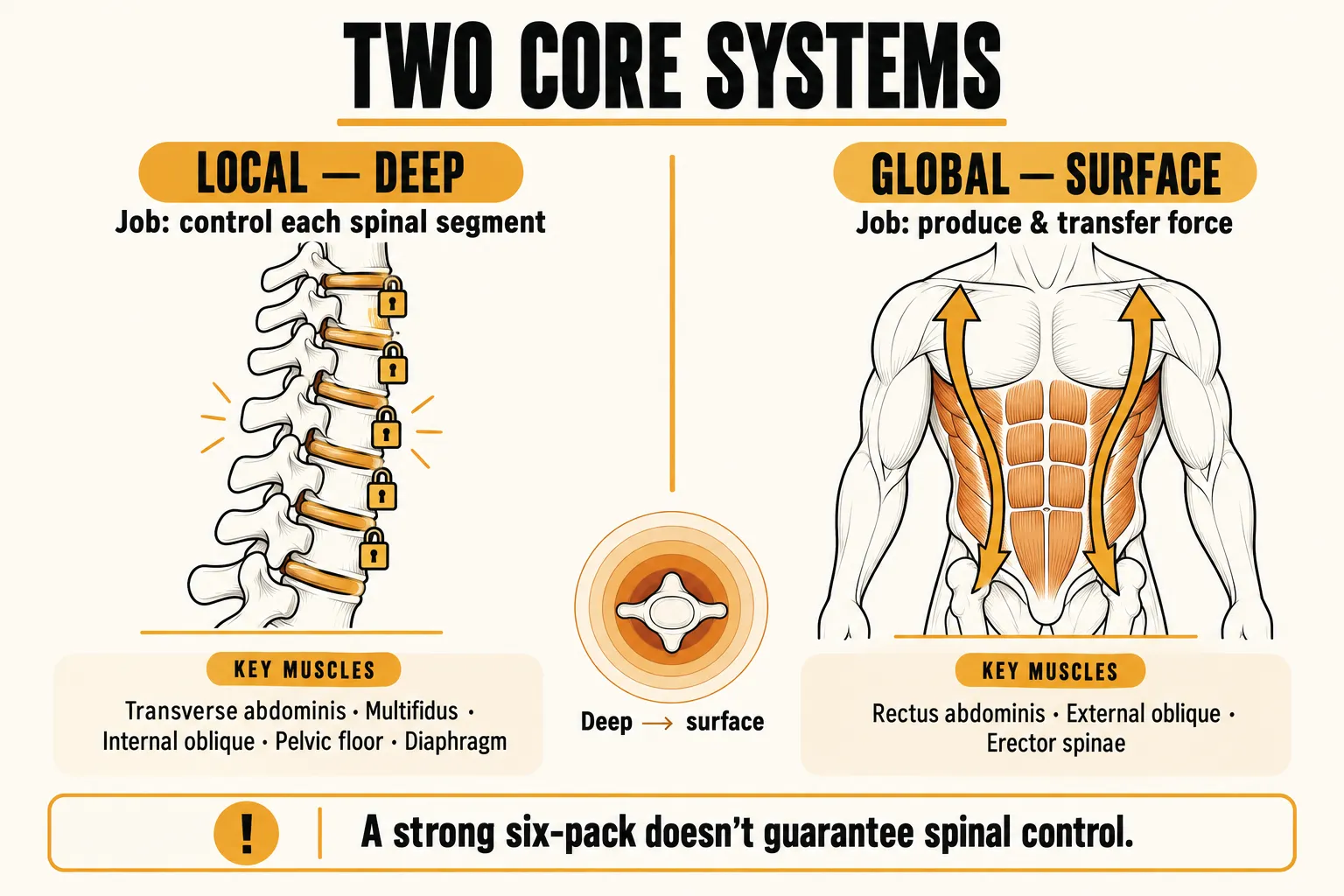
The muscles of the core split into two functional groups, working at different depths and for different jobs:
- Local stabilization systemDeep muscles including the transverse abdominis, multifidus, internal oblique, pelvic floor, and diaphragm. Their job is fine spinal control — stabilizing individual vertebral segments during movement.
- Global stabilization systemLarger, more superficial muscles including the rectus abdominis, external oblique, and erector spinae. Their job is producing movement and transferring force between the upper and lower body.
Both systems need to work together — a client with strong global "six-pack" muscles but a weak local system can still have poor spinal control, which is exactly the kind of gap program design needs to address.
Seeing Both Systems Work Together: A Deadlift
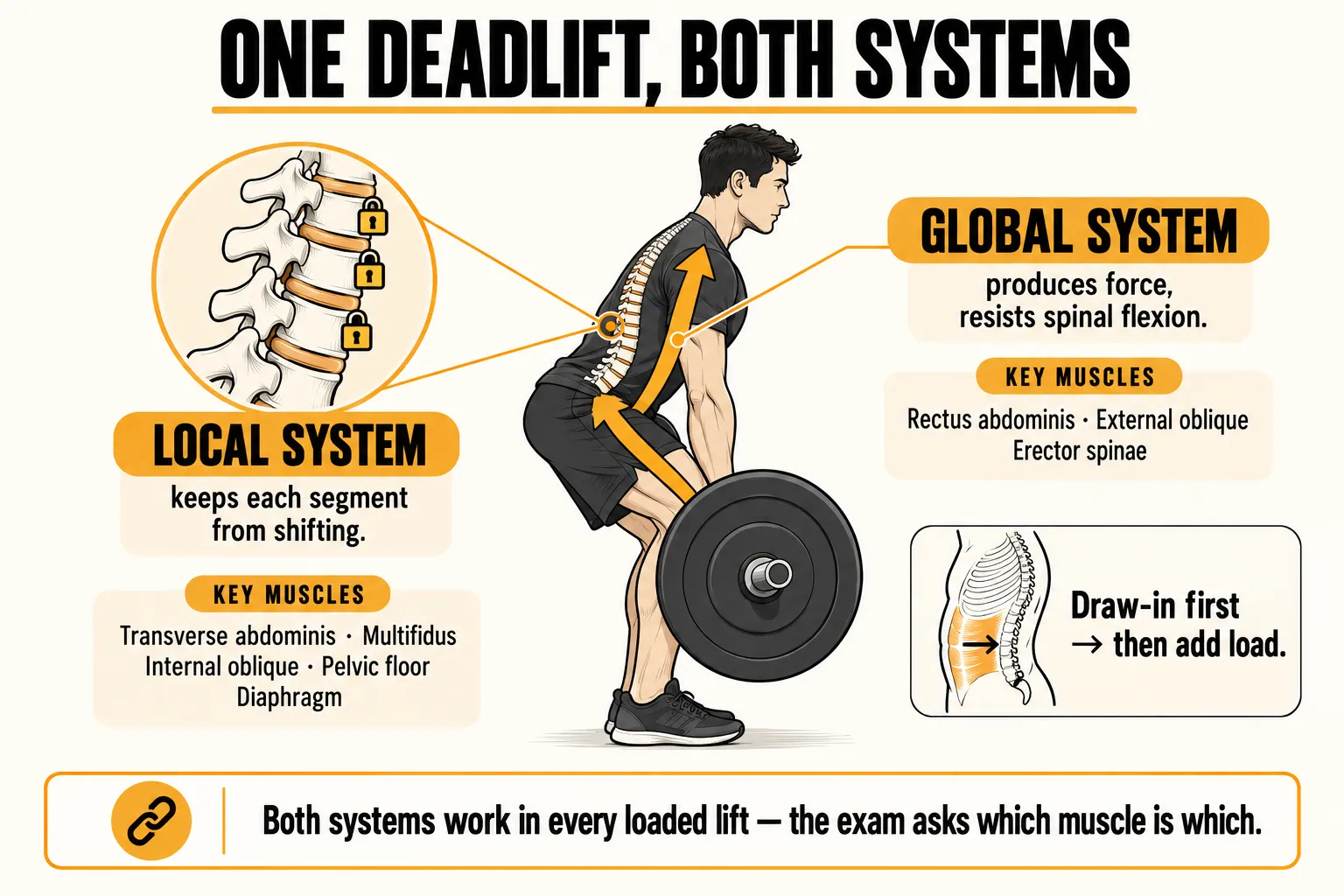
A heavy deadlift is a clean way to see why both systems matter at once. As the bar leaves the floor, the local stabilization system — the transverse abdominis, multifidus, and the rest — is working to keep each individual vertebral segment from shifting out of a safe, neutral position under load. Meanwhile the global system, particularly the erector spinae and rectus abdominis, is producing and transferring force, resisting the pull toward spinal flexion as the weight comes up and helping move load from the hips through the trunk to the bar.
Take either system out of the equation and the lift changes character. Strong global muscles with an underdeveloped local system might still move the weight, but with individual segments of the spine subtly shifting under load — exactly the kind of fine instability a client won't feel in the moment but that accumulates into injury risk over time. This is why NASM has trainees learn the draw-in maneuver before ever loading a heavy compound lift: it's rehearsing the local system's job in isolation, before asking it to do that job under real load.
The Draw-In Maneuver
The draw-in maneuver is a simple cue used to activate the local stabilization system, particularly the transverse abdominis, before or during a core exercise: gently drawing the navel in toward the spine without holding the breath or excessively tensing the larger, more visible abdominal muscles. It's a foundational cue trainers use constantly, well beyond just dedicated "core" exercises — a version of it underlies bracing during a squat or deadlift too.
The Core Training Continuum
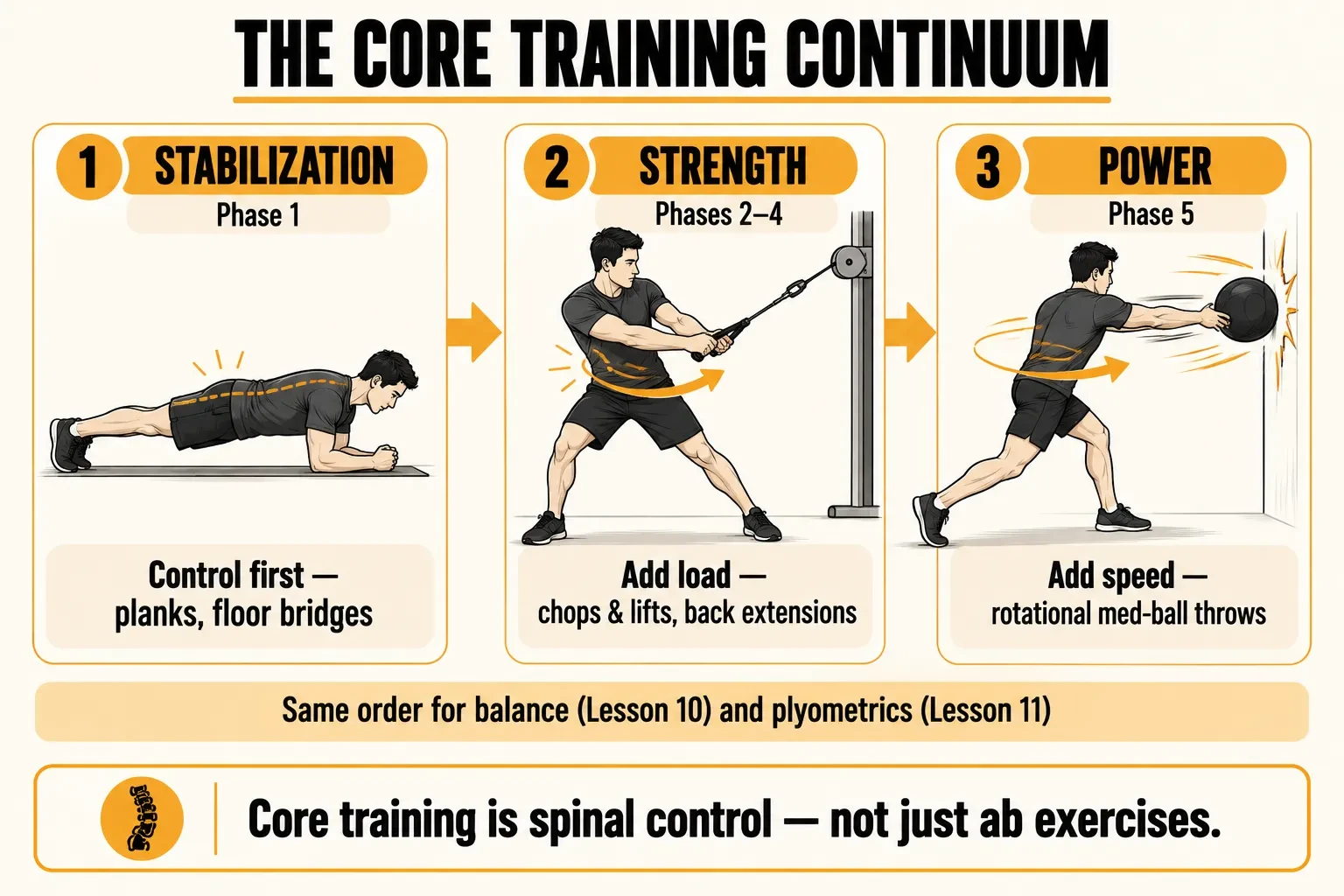
Like flexibility, core training progresses systematically across the OPT Model — starting with control, then adding load, then adding speed:
| OPT phase | Core training type | Example |
|---|---|---|
| Phase 1 — Stabilization | Core-stabilization exercises | Plank variations, slow cable/tubing rotations, floor bridges |
| Phases 2–4 — Strength | Core-strength exercises | Cable chop and lift patterns, ball crunches, back extensions |
| Phase 5 — Power | Core-power (reactive) exercises | Rotational medicine ball throws, front oblique throws |
This is the same three-tier logic Lessons 10 (Balance) and 11 (Plyometrics) apply to their own exercise types — stabilization first, strength next, power last. Once you can name why a plank comes before a rotational medicine ball throw for the core, you've effectively already learned why the same ordering applies to balance and reactive training too — it's one underlying progression principle, just applied to three different exercise categories.
8 questions, modeled on NASM's real exam style. Score 70%+ to mark this lesson complete.
- The core is the lumbo-pelvic-hip complex (LPHC) — the same region flagged by Lesson 6's kinetic chain checkpoints.
- The local stabilization system (transverse abdominis, multifidus, internal oblique, pelvic floor, diaphragm) controls fine spinal stability; the global system (rectus abdominis, external oblique, erector spinae) produces movement and transfers force.
- The draw-in maneuver activates the transverse abdominis and is used well beyond dedicated core exercises.
- Core training progresses through the same three tiers as the OPT Model: stabilization exercises (Phase 1), strength exercises (Phases 2-4), and power/reactive exercises (Phase 5).
- Core training means spinal stabilization during movement — not just visible ab exercises.
- Both stabilization systems are active in nearly every loaded movement, like a deadlift — one isn't "more important," they do different jobs simultaneously.
Before moving to Lesson 10:
- List two muscles from the local system and two from the global system, from memory.
- Practice cueing the draw-in maneuver on yourself before your next core or lifting exercise.
- Walk through a heavy compound lift (like a deadlift or squat) and identify what each stabilization system is doing throughout the movement.
- Complete the knowledge check above and review any question you missed before moving on.