"Cardio" isn't one thing — it's four distinct training methods, each with a different physiological demand, and each suited to a different point in a client's progression. This lesson covers all four methods, how to gauge intensity in the room, and how cardio programming shifts across the OPT Model.
A brand-new client and a client who's been training for a year both need cardiorespiratory work — but prescribing the same method and intensity to both is a common beginner mistake. This lesson gives you the vocabulary to match the method to where the client actually is. It also connects directly to Lesson 4's bioenergetics: each of these four methods leans on a different mix of the ATP-PC, glycolytic, and oxidative systems, which is exactly why they feel so different in the room and why they get introduced in a deliberate order rather than all at once.
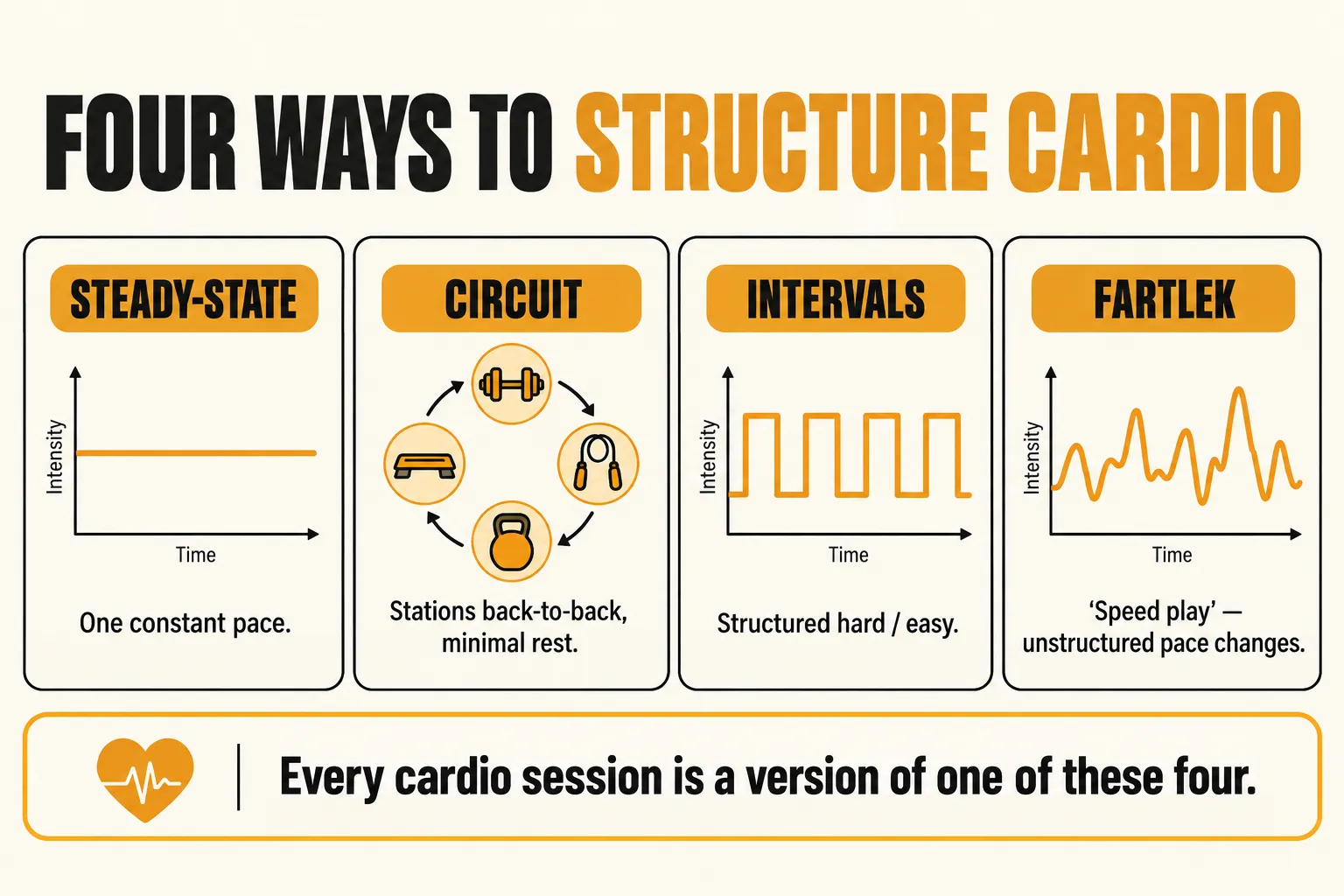
The Four Cardiorespiratory Training Methods
Every cardio session a trainer programs is really a version of one of these four structures:
| Method | Structure | Best suited for |
|---|---|---|
| Steady-state training | Continuous activity at a constant, unchanging intensity for the full duration | Beginners, building an aerobic base, active recovery sessions |
| Circuit training | Resistance and cardio exercises performed back-to-back in stations, with minimal rest between them | Clients who need cardio and strength benefits in the same session, time-limited sessions |
| Interval training | Structured alternation between higher-intensity work periods and lower-intensity (or rest) recovery periods | Clients with an established aerobic base who are ready for higher-intensity work capacity gains |
| Fartlek training | Swedish for "speed play" — an unstructured mix of paces and intensities within one continuous session, often terrain- or feel-based | More advanced clients, and as a lower-pressure alternative to strict interval structure |
Training Zones and Reading Intensity in the Room
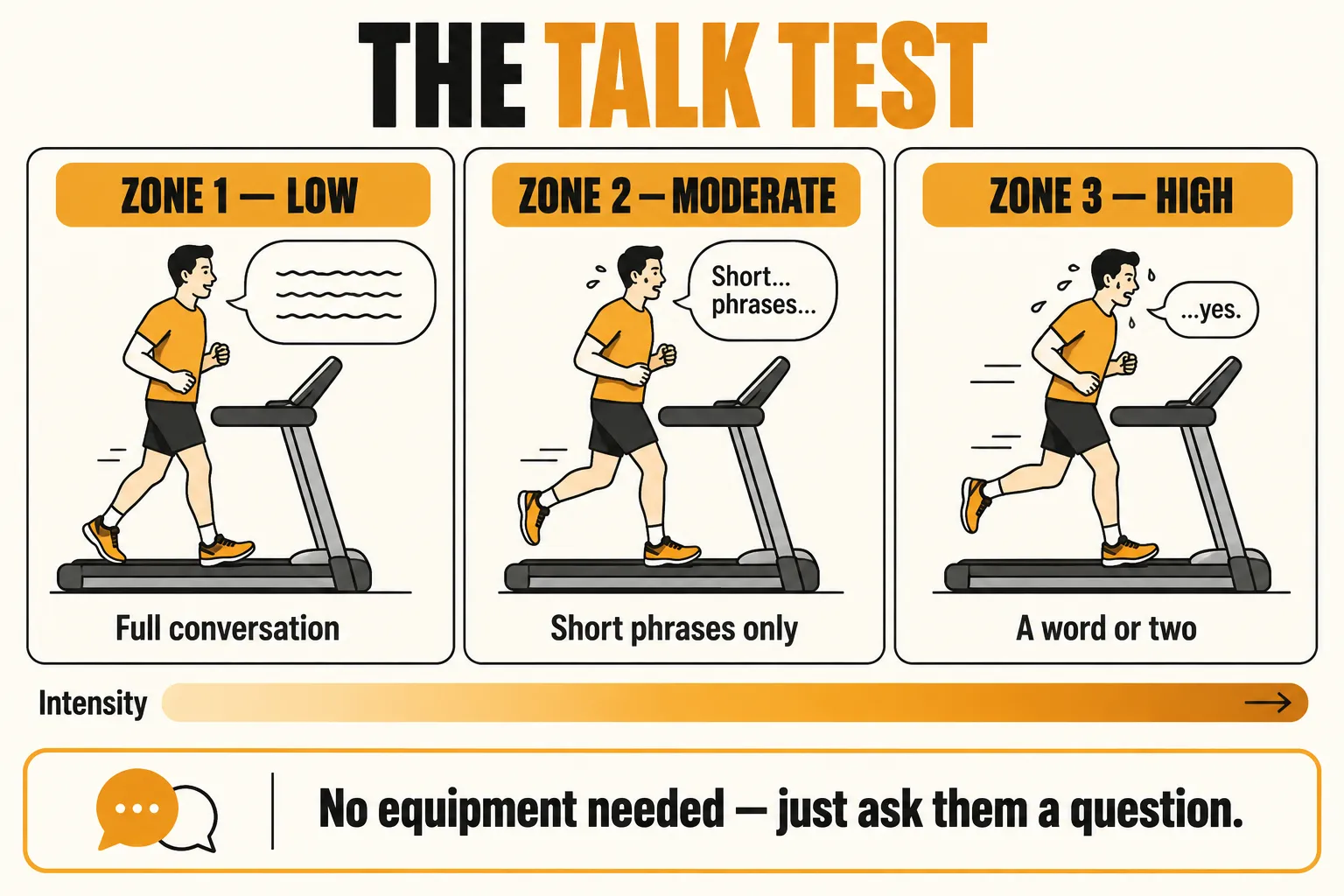
Prescribing "moderate intensity" on paper means nothing if a trainer can't verify it during a session. NASM groups intensity into rough zones, and pairs them with practical, no-equipment-needed ways to check where a client actually is:
| Zone | Feel | Talk test |
|---|---|---|
| Zone 1 — low intensity | Easy, sustainable for a long duration; builds the aerobic base | Can hold a full, comfortable conversation |
| Zone 2 — moderate intensity | Noticeably harder, sustainable for a moderate duration | Can speak in short phrases, not a full conversation |
| Zone 3 — high intensity | Hard, sustainable only briefly; anaerobic threshold territory | Can't speak more than a word or two at a time |
Lesson 15 covers four more formal intensity-monitoring methods (max heart rate, heart rate reserve, peak MET, and RPE) — the talk test above is the fastest field check a trainer can use without any equipment.
A Worked Example: Programming Cardio for Two Different Clients
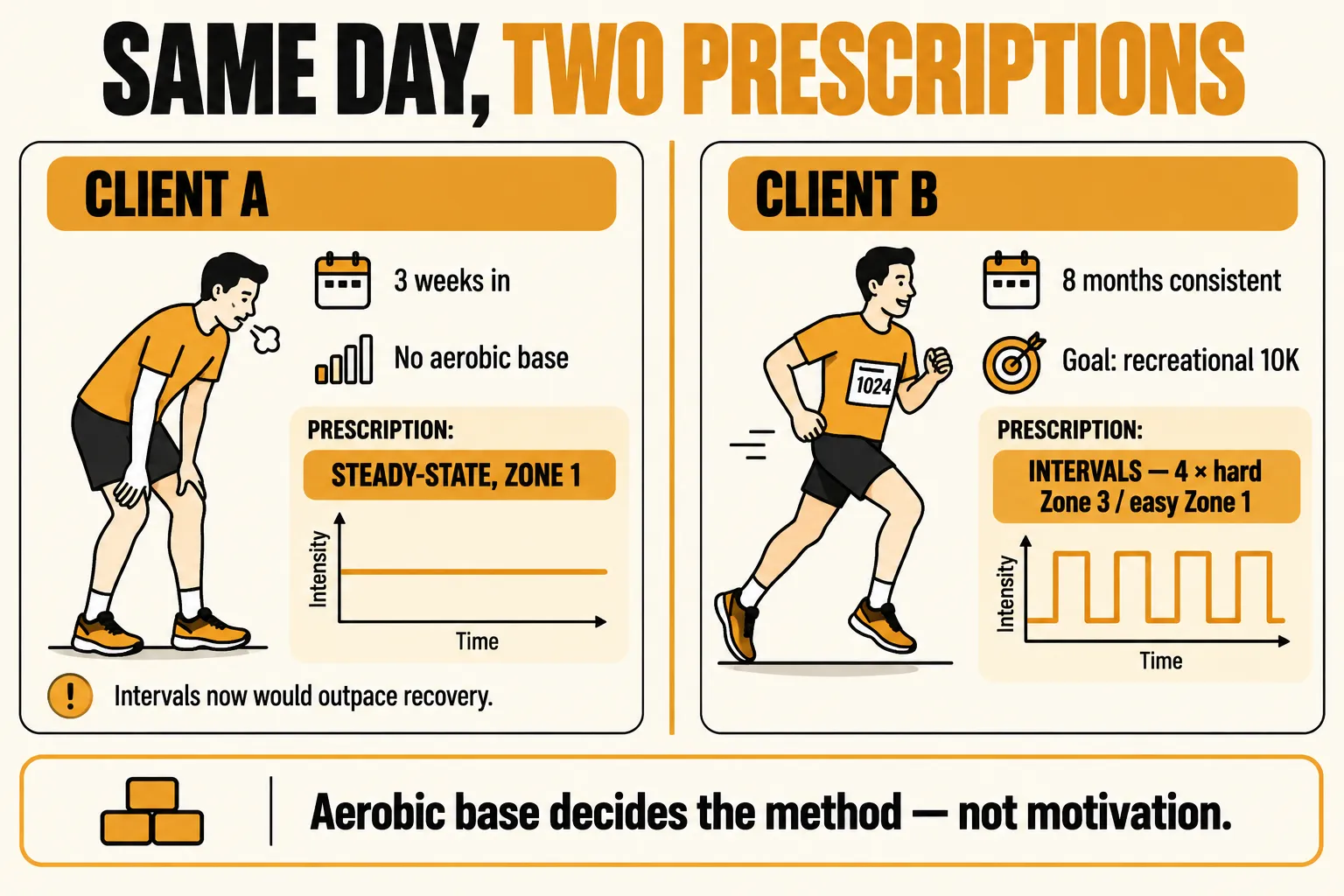
Consider two clients booked back-to-back. Client A is deconditioned, three weeks into training, with no prior cardio base. Client B has been training consistently for eight months and wants to improve conditioning for a recreational 10K. For Client A, the right call is steady-state training in Zone 1 — nothing structurally complex, just continuous, sustainable work that builds the aerobic base everything else depends on. Prescribing intervals here wouldn't build fitness faster; it would just outpace Client A's recovery capacity and risk the overtraining signs covered below.
Client B is a different case entirely. An established aerobic base is already there, so the program can introduce structured interval work — say, four rounds of a harder Zone 3 effort followed by an easier Zone 1 recovery period — to build the higher-end conditioning a 10K goal actually requires. Same trainer, same day, two completely different prescriptions, because the method has to match where each client's aerobic base and work capacity currently sit, not a generic "cardio day" template.
Matching Cardio Method to OPT Phase
Cardio programming follows roughly the same logic as the rest of the OPT Model — build a base before adding intensity, and add intensity before adding complexity:
- Early phases (Stabilization)Steady-state training in Zone 1, building a general aerobic base before anything more demanding is layered on top.
- Middle phasesSteady-state extends into Zone 2, and circuit training is often introduced to blend cardio demand with resistance work.
- Later phasesInterval and fartlek training are introduced at higher intensities, once a client has the aerobic base and work capacity to recover between hard efforts.
This progression isn't unique to cardio — it's the same "build a base, then add intensity, then add complexity" logic that governs resistance training and core, balance, and plyometric progressions throughout the OPT Model. Once that pattern clicks for cardio, it becomes much easier to recognize the same underlying structure everywhere else this course applies it.
8 questions, modeled on NASM's real exam style. Score 70%+ to mark this lesson complete.
- Four cardio methods: steady-state (continuous, constant), circuit (stations, minimal rest), interval (structured high/low alternation), and fartlek (unstructured pace mixing).
- The talk test is a fast, no-equipment way to gauge Zone 1/2/3 intensity in real time.
- Cardio programming builds an aerobic base first (steady-state, Zone 1), then adds intensity and complexity (circuit, interval, fartlek) as a client's work capacity grows.
- Jumping to high-intensity intervals without an aerobic base risks overtraining — watch for fatigue, declining performance, and mood changes.
- The right cardio method depends on the client's current aerobic base and work capacity, not on which method sounds more advanced.
Before moving to Lesson 9:
- Write one-sentence definitions for all four cardio methods from memory.
- Practice using the talk test on yourself during your next cardio session — notice which zone you're actually training in.
- Sketch a cardio prescription for a hypothetical deconditioned client and a hypothetical well-conditioned client, and explain why they differ.
- Complete the knowledge check above and review any question you missed before moving on.