Flexibility isn't just "can this person touch their toes" — it's normal, pain-free extensibility of soft tissue that lets a joint move through its full range. This lesson covers the neuromuscular mechanisms behind stretching, the three types of stretching NASM teaches, and how they map onto the five OPT phases you'll meet properly in Lesson 14.
Later, Lesson 13 catalogs common movement compensations — knees caving in, low backs arching, arms falling forward during the overhead squat. A lot of those compensations trace back to tissue that's simply too short or too dense to let a joint move where it needs to. Flexibility training is how a trainer addresses that root cause, rather than just cueing a client to "brace harder" around a restriction that never gets resolved. Skip the mechanisms in this lesson, and the flexibility continuum in a few pages just looks like an arbitrary rulebook — three stretch types assigned to five OPT phases with no explanation for why one type belongs at one phase and not another.
The Neuromuscular Mechanisms Behind Stretching
Stretching isn't just pulling on a muscle until it lengthens — it works because of specific reflexes built into the nervous system. Two mechanisms explain almost everything about why different stretch types feel and work differently:
- Autogenic inhibitionA muscle relaxes in response to tension detected within that same muscle, via receptors in the muscle-tendon junction. This is the mechanism behind static stretching and self-myofascial release — hold tension long enough, and the muscle itself signals "ease off."
- Reciprocal inhibitionA muscle relaxes because its functional opposite (antagonist) is actively contracting. This is the mechanism behind active stretching — contracting the hamstrings to lift a leg reflexively relaxes the hip flexors on the same side.
Both mechanisms lead to the same practical outcome — a muscle that's easier to lengthen — but they get there through different neurological pathways, which is why NASM pairs them with different stretch types and different OPT phases.
Self-Myofascial Release (SMR)
Before stretching a muscle, it often helps to address the fascia — the connective tissue wrapping around and through it — directly. Self-myofascial release, most commonly foam rolling, applies sustained pressure to a tissue to reduce density and adhesions (sometimes called "knots") that restrict normal movement. It works largely through the same autogenic inhibition mechanism as static stretching: sustained pressure signals the tissue to relax.
SMR is typically programmed as a first step, before any active stretching or exercise — think of it as preparing the tissue so the stretch that follows is more effective, not as a replacement for stretching itself.
The Three Types of Stretching
| Type | How it works | Best used for |
|---|---|---|
| Static stretching | A passive, held stretch — moving a muscle to the point of mild tension and holding it there, relying on autogenic inhibition to let it lengthen further over time | Correcting a specific length-tension imbalance identified in assessment (corrective flexibility) |
| Active stretching | Using the opposing muscle's own contraction (reciprocal inhibition) to actively move a limb through range of motion, without external assistance | Building active, usable range of motion a client can access under their own control |
| Dynamic stretching | Controlled, movement-based stretching that mimics the speed and pattern of the activity to come — think leg swings or walking lunges with a reach | Preparing tissue for real training or sport demands at higher OPT phases |
The Flexibility Continuum, Mapped to the OPT Model
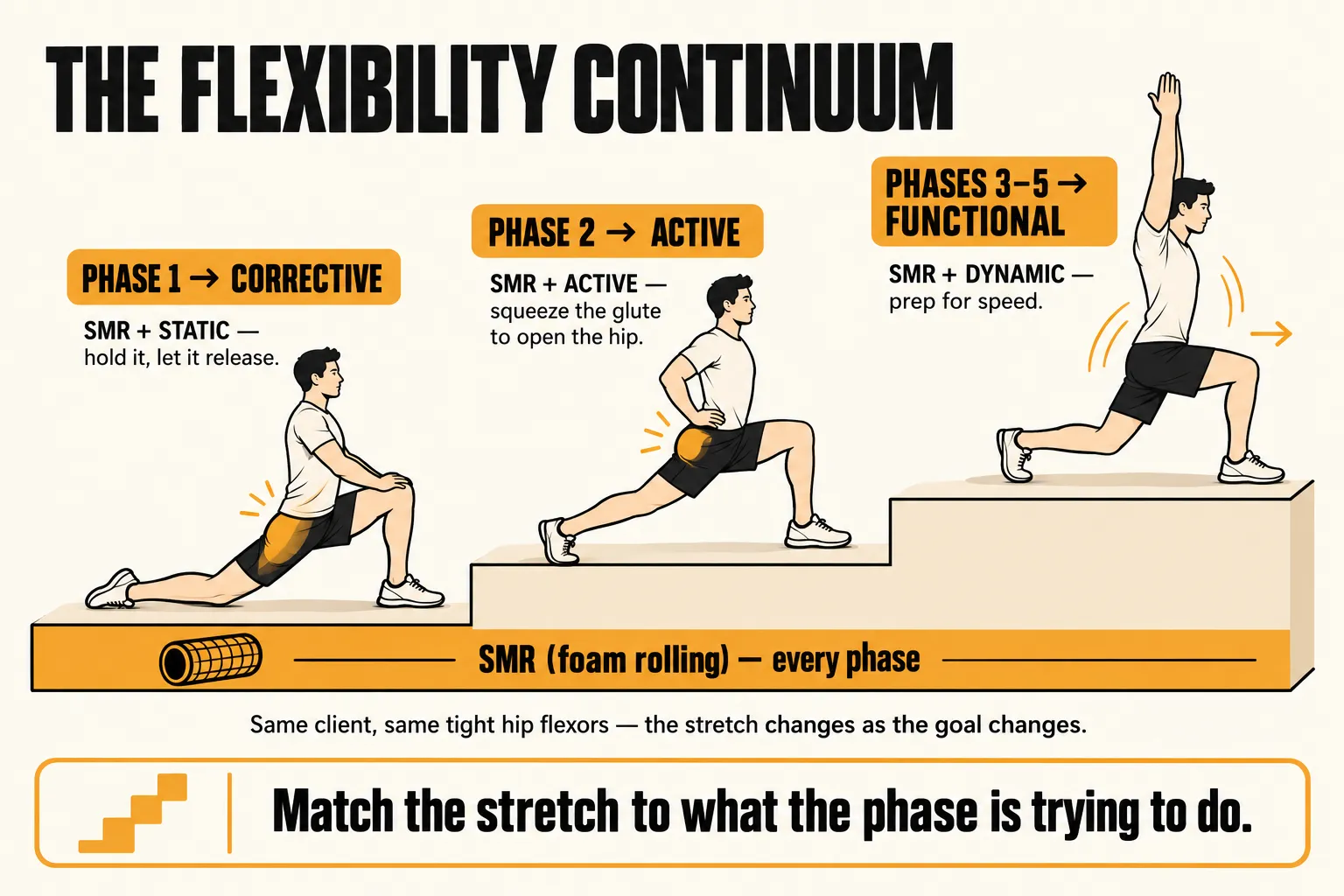
NASM doesn't treat flexibility as a single, one-size-fits-all warm-up. It's programmed deliberately, phase by phase, alongside whatever else that phase of the OPT Model is training:
| OPT phase | Flexibility approach | Goal |
|---|---|---|
| Phase 1 — Stabilization | SMR + static stretching | Corrective flexibility — resolve specific restrictions found in assessment |
| Phase 2 — Strength Endurance | SMR + active stretching | Active flexibility — build usable range of motion the client controls |
| Phases 3–5 — Hypertrophy, Max Strength, Power | SMR + dynamic stretching | Functional flexibility — prepare tissue for the speed and demand of real training |
Notice this lines up with Lesson 14's OPT phases before you've formally met them — flexibility, core, balance, and plyometric training all get layered onto the same five-phase skeleton, just with different exercise selections.
A Worked Example: Progressing One Client Through the Continuum
Consider a client whose static posture assessment (Lesson 6) and overhead squat assessment (Lesson 13) both flag tight hip flexors and excessive forward lean. In Phase 1, the program pairs foam rolling the hip flexors (SMR) with a held static stretch — passive, no muscular effort, just giving autogenic inhibition time to work. By Phase 2, once that restriction has genuinely improved, the same muscle group gets an active stretch instead: a standing hip flexor stretch driven by actively contracting the glutes, which reciprocally inhibits the hip flexor being lengthened while also starting to train the exact muscle (the glutes) that was underactive in the first place.
By Phase 3 and beyond, static and active stretching give way to dynamic stretching — walking lunges with a reach, for instance — because the goal has shifted from correcting a specific restriction to preparing tissue for the speed of real training. The stretch type isn't chosen at random at any of these three stages; it's chosen because it matches what that phase is actually trying to accomplish for that specific client.
Flexibility and the Compensations From Lesson 13
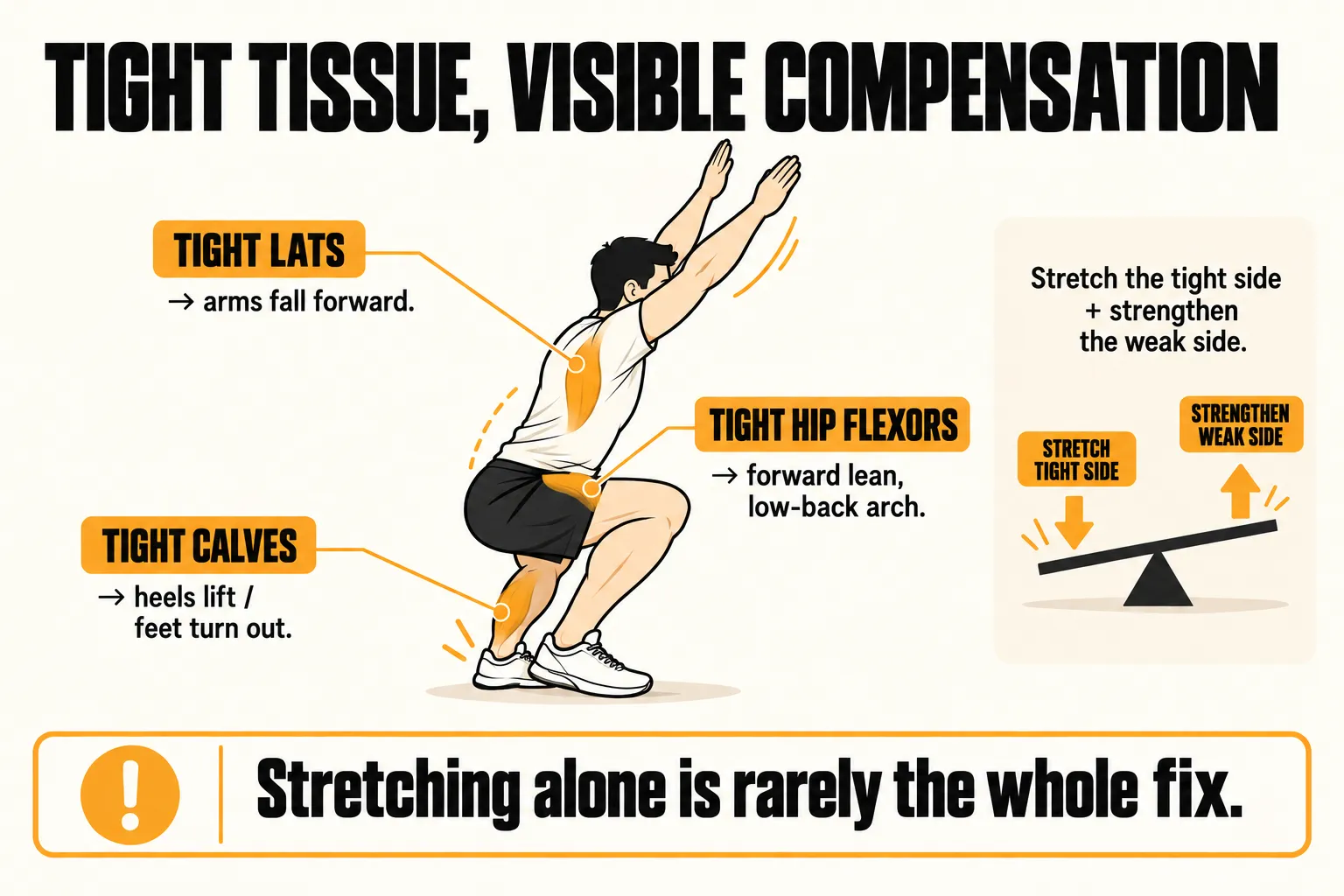
Several OHSA compensations trace directly back to tissue that's simply too tight to allow proper range of motion — which is exactly why flexibility training is often the first corrective tool a trainer reaches for:
- Tight calves (gastrocnemius/soleus)Limits ankle dorsiflexion — a frequent contributor to feet turning out or heels lifting during a squat.
- Tight hip flexorsPulls the pelvis into an anterior tilt, contributing to excessive forward lean and low back arching.
- Tight latissimus dorsiLimits overhead shoulder flexion, a common cause of arms falling forward during the overhead squat.
8 questions, modeled on NASM's real exam style. Score 70%+ to mark this lesson complete.
- Autogenic inhibition (tension within the same muscle) drives static stretching and SMR; reciprocal inhibition (contraction of the opposing muscle) drives active stretching.
- SMR reduces tissue density and adhesions, typically programmed before stretching to make it more effective.
- Three stretch types: static (corrective), active (usable range under the client's own control), and dynamic (functional, movement-based).
- NASM maps flexibility to the OPT Model: Phase 1 = SMR + static, Phase 2 = SMR + active, Phases 3-5 = SMR + dynamic.
- Several Lesson 13 OHSA compensations trace back to specific tight muscles — flexibility training is often the first corrective tool, paired with strengthening the opposing muscle.
- The stretch type at each OPT phase isn't arbitrary — it matches that phase's goal, from corrective (Phase 1) to functional, sport-speed (Phases 3-5).
Before moving to Lesson 8:
- Practice explaining autogenic inhibition and reciprocal inhibition in your own words, without looking at your notes.
- Pick one OHSA compensation from Lesson 13 and identify which stretch type (and which tight muscle) would be the first corrective step.
- Walk through how a single tight muscle's corrective plan would change as a client progresses from Phase 1 to Phase 3.
- Complete the knowledge check above and review any question you missed before moving on.