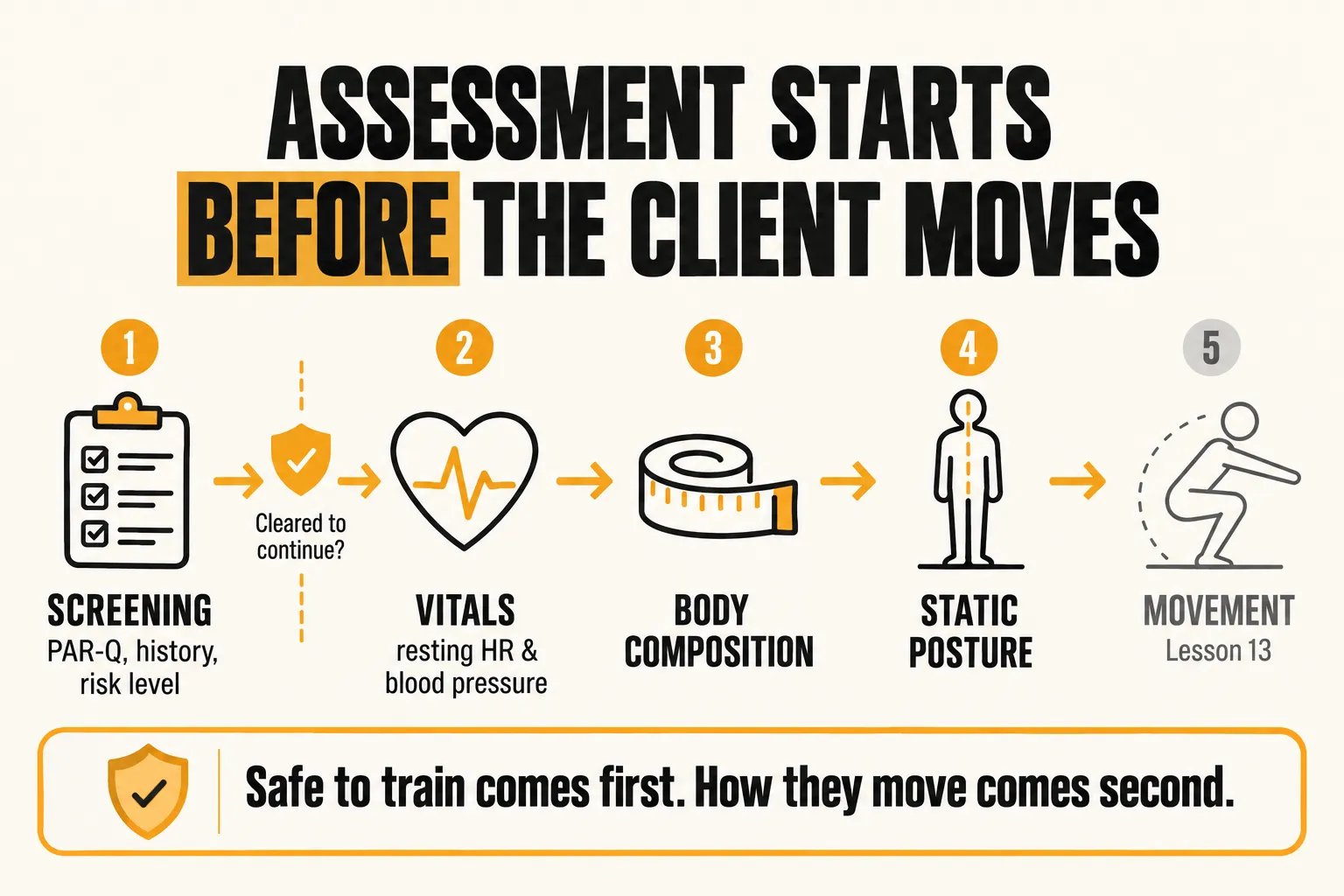
Before a trainer ever watches a client move, there's a whole layer of assessment that happens first: screening for health risks, checking vitals, estimating body composition, and observing static posture. This lesson covers that intake layer — the step that comes before Lesson 13's dynamic overhead squat assessment.
Later, Lesson 13 covers the overhead squat assessment — a dynamic, movement-based screen that tests the same five kinetic chain checkpoints this lesson introduces. But that dynamic screen isn't actually where assessment starts. It starts here, with questions asked and measurements taken before a client does a single rep. Skip this layer, and a trainer risks programming exercise for someone who genuinely shouldn't start yet — the entire point of screening first is catching that before it becomes a liability.
Why Assessment Starts Before the Client Ever Moves
Movement assessments like the OHSA are excellent at revealing compensation patterns, but they can't tell a trainer whether a client is medically ready to exercise in the first place, or how a client's health markers compare to safe reference ranges. That earlier layer of screening is just as much a part of "assessment" as anything a client physically does.
Health Risk Assessment & Pre-Participation Screening
Before any exercise is prescribed, a trainer needs to know whether a client can safely begin, or whether they should be referred for medical clearance first:
- PAR-Q (Physical Activity Readiness Questionnaire)A short, standardized screening questionnaire that flags anyone who should get medical clearance before starting an exercise program — Lesson 16 covers this in more depth.
- Medical history & informed consentA record of past injuries, conditions, medications, and family history, paired with a client's documented understanding of the risks of exercise participation.
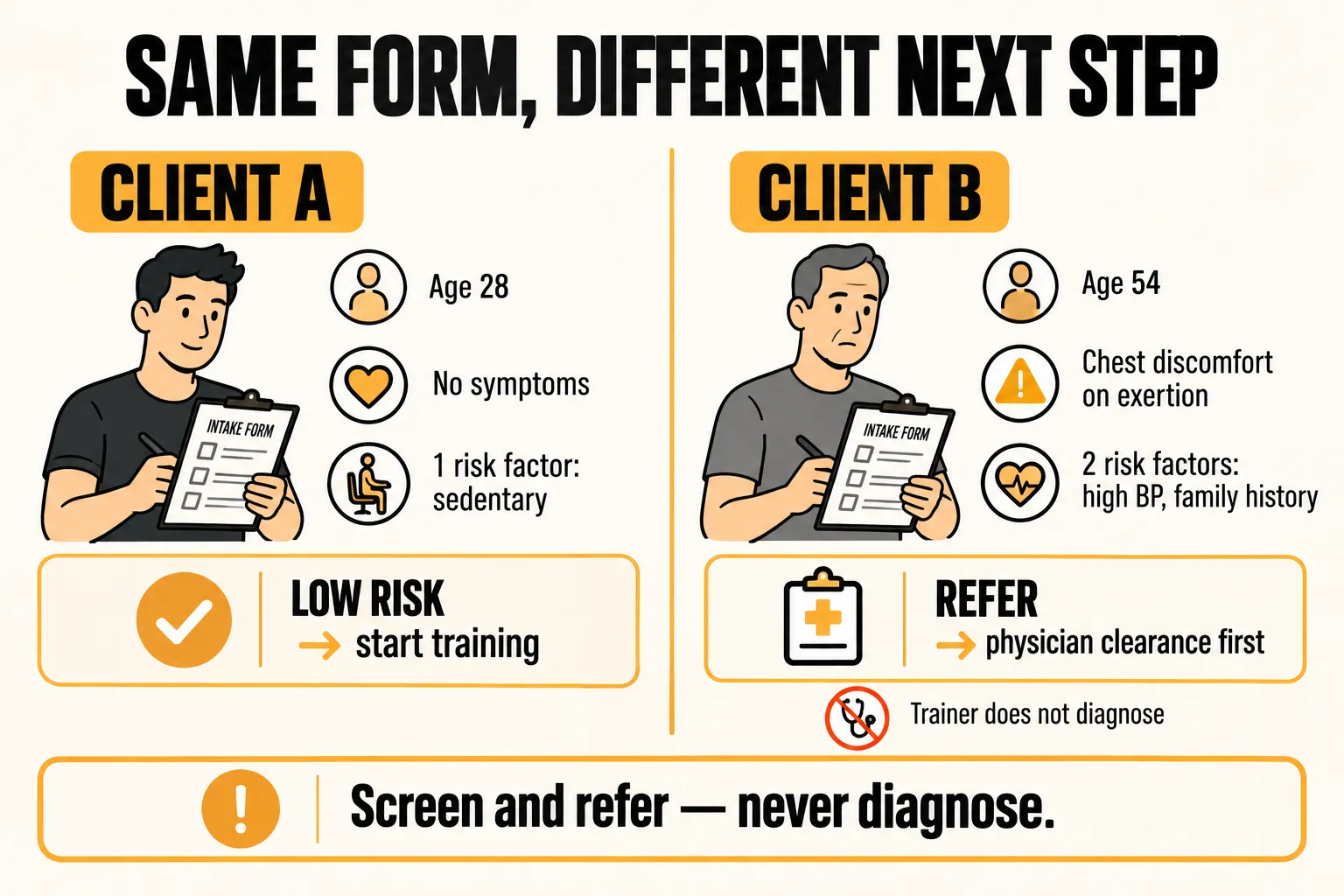
- Risk stratificationSorting a client into a general risk category (e.g. low, moderate, or high) based on their screening answers — which determines whether they can start training right away or need physician clearance first.
Putting Risk Stratification Into Practice
Risk stratification only makes sense with a concrete example attached. Take two prospective clients filling out the same intake form. Client A is 28, has no reported symptoms, no diagnosed conditions, and one risk factor (a sedentary lifestyle). Client B is 54, reports occasional chest discomfort during exertion, and has two additional risk factors: high blood pressure and a family history of early heart disease. Client A sorts into a low-risk category and can typically begin a general exercise program right away. Client B's combination of a symptom plus multiple risk factors is exactly the profile that gets referred for physician clearance before any programming begins — not because Client B definitely has a problem, but because the screening's entire job is to catch that possibility before a workout does.
Notice what the trainer is not doing in Client B's case: diagnosing anything. The trainer's role stops at recognizing the pattern and making the referral. That boundary — screen and refer, never diagnose — is one NASM tests directly and one of the most common places new trainers overstep in the real world.
Resting Heart Rate & Blood Pressure
Two simple vital-sign measurements give a trainer a general baseline for a client's cardiovascular status before programming begins:
| Measurement | What it tells a trainer |
|---|---|
| Resting heart rate (RHR) | A general marker of cardiovascular fitness and baseline conditioning, typically measured after a few minutes at rest |
| Blood pressure (BP) | Measured as systolic over diastolic pressure; elevated readings are a signal to refer a client for medical evaluation before starting a program |
Exact reference ranges are best confirmed against current medical guidelines rather than memorized as fixed numbers — the practical exam skill is knowing these measurements exist, why they're taken, and what an abnormal reading means for next steps (refer, don't diagnose).
Body Composition Assessment
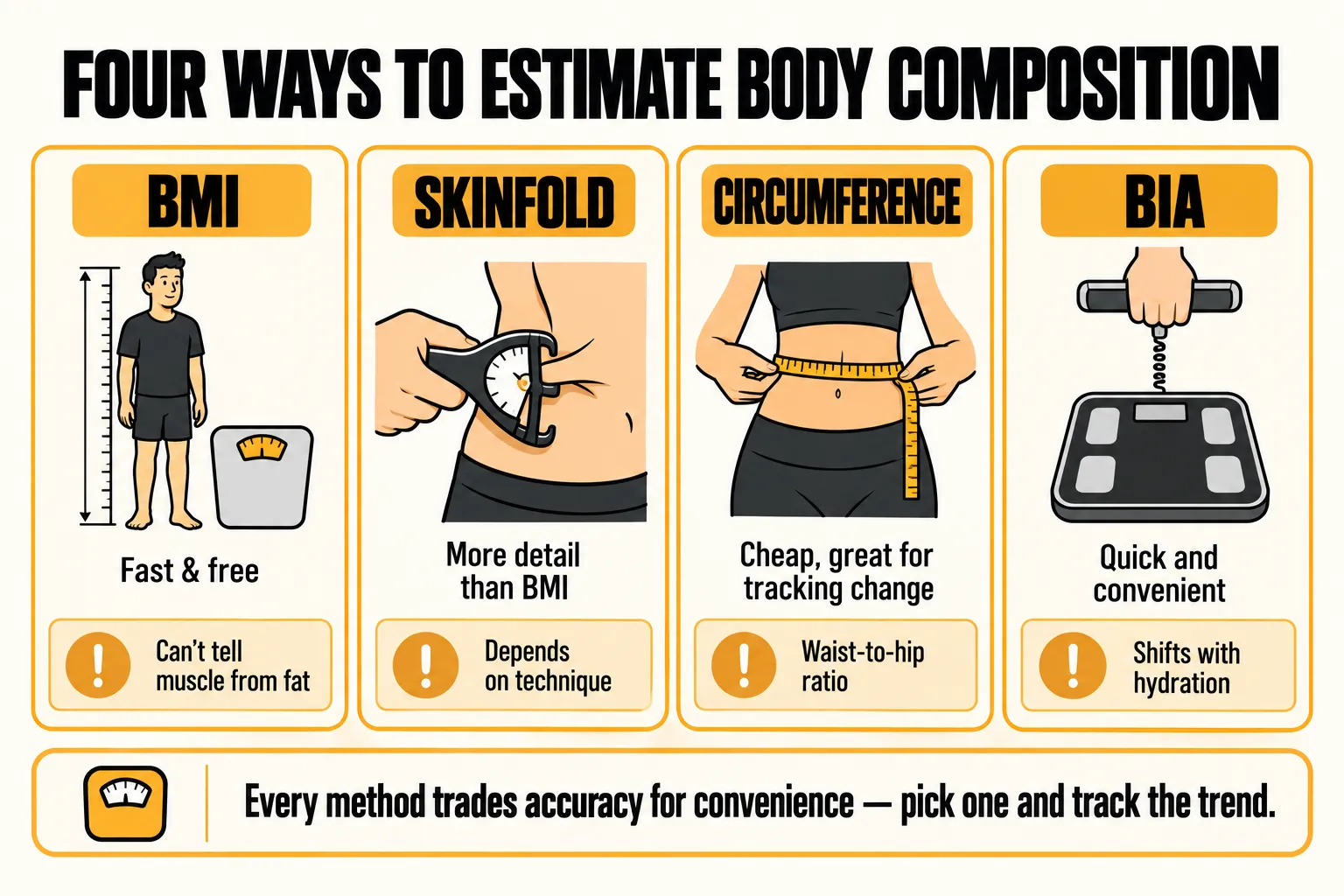
Body composition methods estimate the ratio of fat mass to lean mass, each with a different tradeoff between accuracy, cost, and convenience:
- BMI (Body Mass Index)A simple height-to-weight ratio. Fast and free, but doesn't distinguish muscle mass from fat mass — a muscular client can register as "overweight" by BMI alone.
- Skinfold measurementCalipers pinch and measure skin-fold thickness at standardized sites to estimate subcutaneous fat — more informative than BMI, but technique-dependent.
- Circumference measurementsTape-measure readings at standardized sites (like waist-to-hip ratio) — simple, cheap, and useful for tracking change over time.
- Bioelectrical impedance analysis (BIA)Estimates body composition from how tissue resists a small electrical current — convenient, but accuracy can shift with hydration status.
Static Posture Assessment
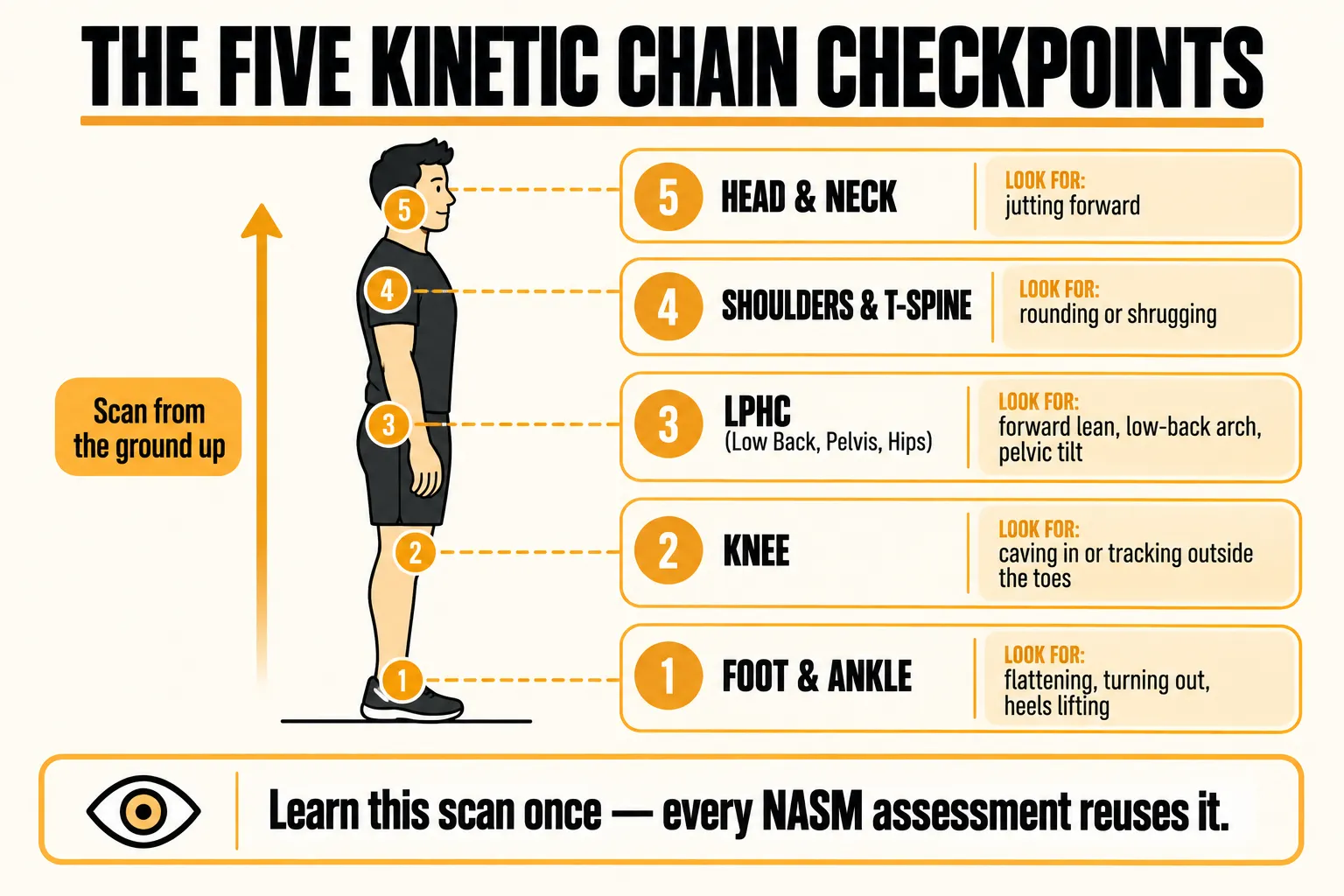
Once screening and vitals are complete, the next step is observing how a client stands — before they move at all. Whether you're looking at someone standing still or, later, moving through a squat, you're scanning the same five regions, from the ground up. NASM calls these the kinetic chain checkpoints:
| Checkpoint | What you're looking for |
|---|---|
| Foot & ankle | Feet flattening (pronation), turning out, or heels lifting off the ground |
| Knee | Knees caving inward (valgus) or tracking outside the toes |
| LPHC (lumbo-pelvic-hip complex) | Excessive forward lean, low back arching, or the pelvis tilting forward/backward |
| Shoulders & thoracic spine | Shoulders rounding forward or elevating toward the ears |
| Head & neck | Head tilting or jutting forward relative to the rest of the spine |
These five checkpoints are the shared vocabulary behind every NASM assessment. Learn them once here, and every assessment later in this course — including Lesson 13's overhead squat assessment — becomes a variation on the same scan.
Static posture assessment views a client standing still, from the front, side, and back, scanning each of those five checkpoints for baseline alignment. A static posture assessment builds an early hypothesis about a client's alignment — tight or overactive muscles pulling a joint out of neutral, for instance. That hypothesis later gets tested and often confirmed under real movement during Lesson 13's overhead squat assessment, which loads all five checkpoints at once.
8 questions, modeled on NASM's real exam style. Score 70%+ to mark this lesson complete.
- Assessment starts before a client ever moves — with health risk screening, vitals, and body composition.
- The PAR-Q, medical history, and risk stratification determine whether a client can start training right away or needs physician clearance first.
- Resting heart rate and blood pressure give a baseline cardiovascular read; abnormal readings mean refer, not diagnose.
- Body composition methods (BMI, skinfold, circumference, bioelectrical impedance) each trade off accuracy, cost, and convenience.
- Static posture assessment scans five kinetic chain checkpoints — foot & ankle, knee, LPHC, shoulders & thoracic spine, head & neck — standing still, forming a hypothesis that Lesson 13's dynamic overhead squat assessment later tests.
- A trainer's role in risk stratification is to screen and refer — never to diagnose a condition or push forward with programming despite a red flag.
Before moving on:
- List the three components of pre-participation screening from memory: PAR-Q, medical history/informed consent, and risk stratification.
- Name all four body composition assessment methods and one tradeoff for each.
- Practice sorting a hypothetical client into a risk category, and state clearly what you would (and would not) tell them.
- Complete the knowledge check above and review any question you missed before revisiting Lesson 13's dynamic assessment.