This lesson gives you the vocabulary to describe any movement precisely — the plane it happens in, and which muscles are doing what. It's the missing piece behind Lesson 6's kinetic chain checkpoints and every exercise description in this course.
Terms like "flexion," "abduction," and "rotation" will show up constantly from here on — starting with the assessment and exercise-technique lessons ahead. This lesson gives you the formal system behind that vocabulary before you need it. Without it, a phrase like "assess frontal-plane control at the hip" (Lesson 6) or "program a transverse-plane power exercise" (Lesson 15) is just noise — with it, those instructions tell you exactly what to look for and exactly what to program.
Planes of Motion
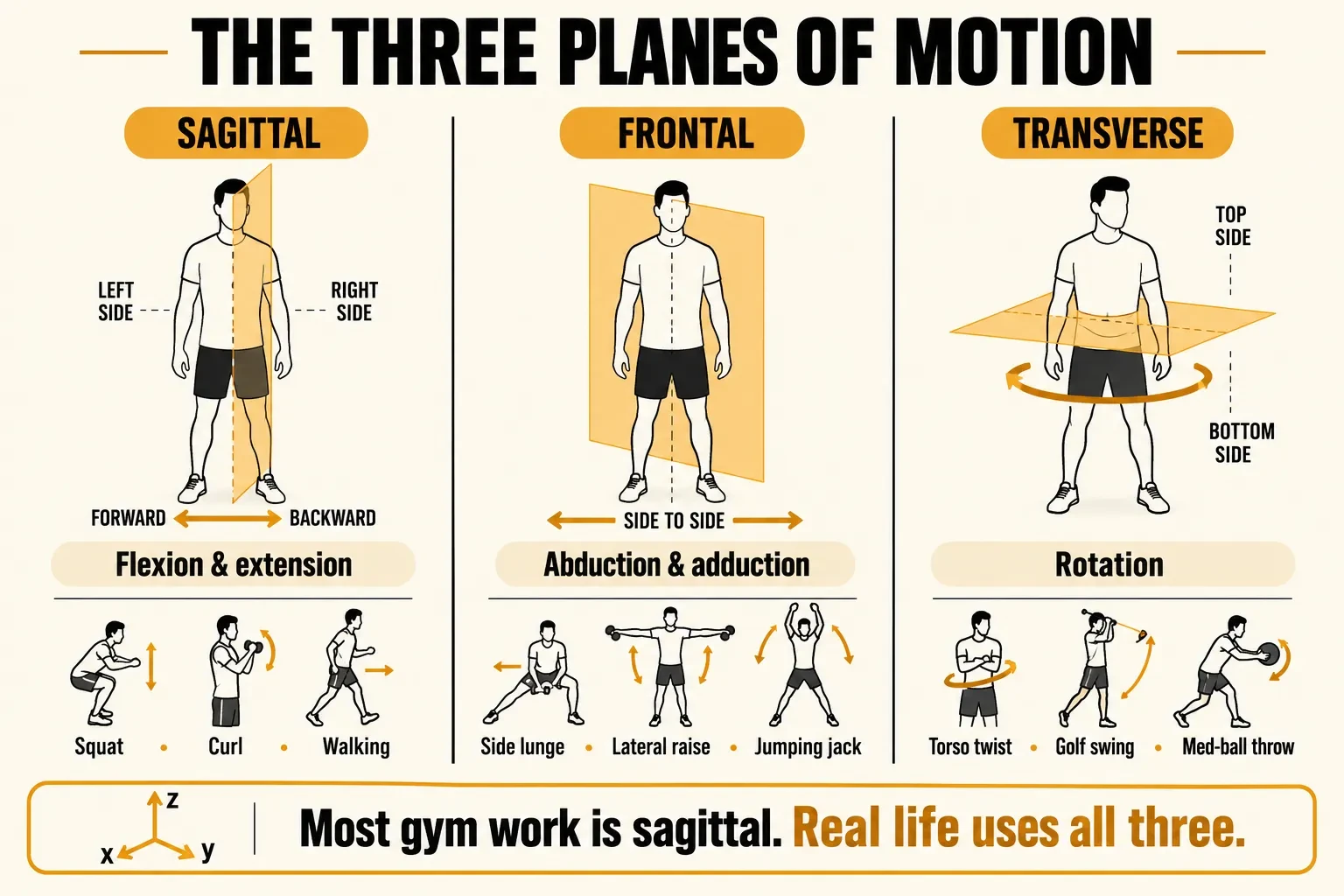
Every human movement can be described as happening in one (or a blend) of three imaginary planes that slice through the body:
| Plane | Movement type | Example |
|---|---|---|
| Sagittal | Flexion and extension — forward/backward movement | A squat, a bicep curl, walking forward |
| Frontal | Abduction and adduction — side-to-side movement | A side lunge, a lateral raise, a jumping jack |
| Transverse | Rotation — twisting movement | A torso twist, a golf swing, a rotational medicine ball throw (Lesson 9) |
Most real-world and sport movement blends multiple planes at once — a well-rounded program (per Lesson 1's integrated training philosophy) trains in all three, not just the sagittal plane most gym exercises default to.
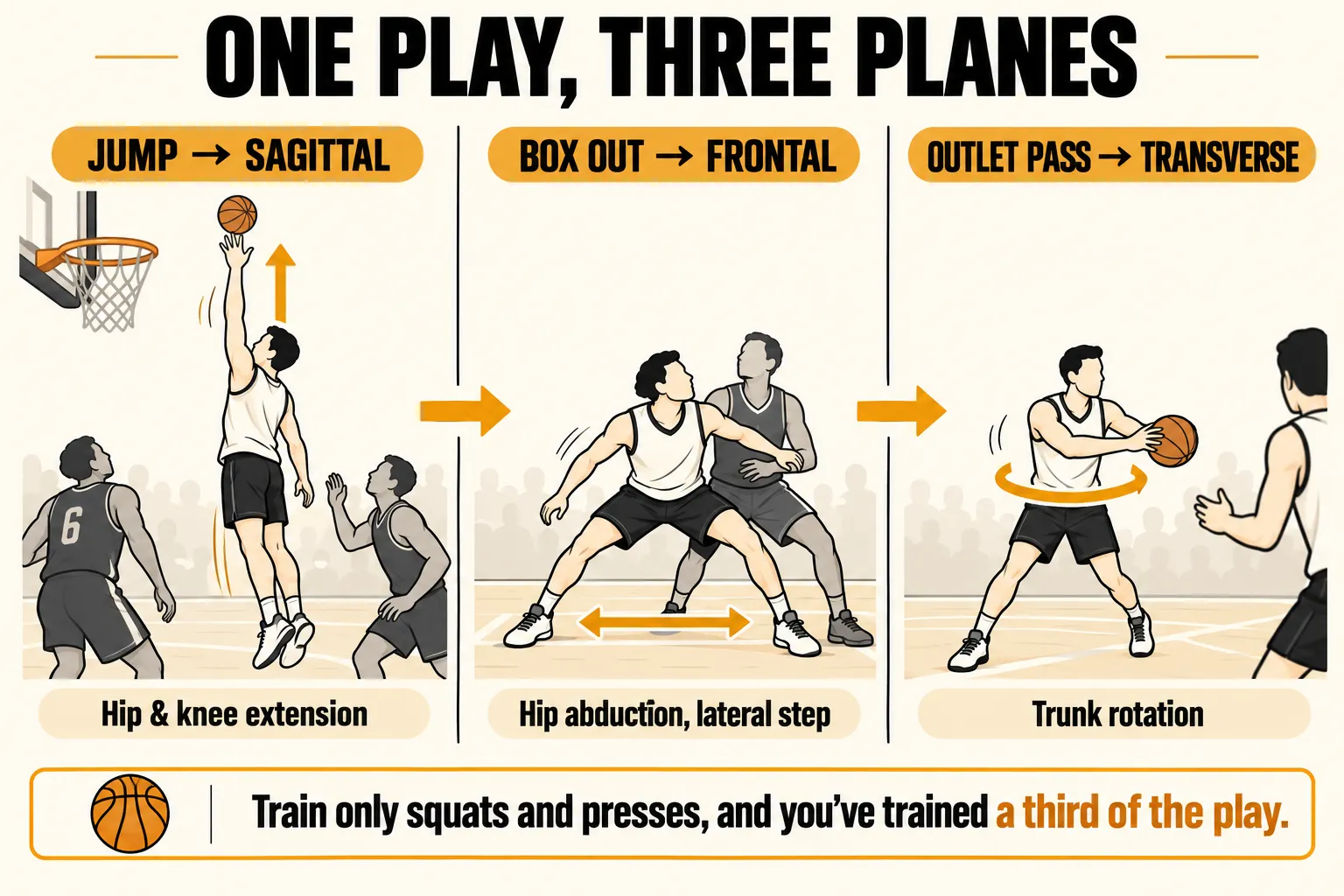
A basketball rebound is a useful case study because it never stays in one plane. The jump itself is sagittal (hip and knee flexion loading into extension). Boxing out an opponent to the side is frontal (lateral hip abduction and a shuffle step). Turning to outlet-pass the ball upcourt is transverse (trunk rotation). Miss any one of the three in training — say, a program built entirely from squats, presses, and curls — and the athlete is conditioned for only a third of the movement they actually need on the court.
This is also why NASM's assessment lessons (starting in Lesson 6) don't just watch a client squat once and call it done. A single sagittal-plane movement can look flawless while a frontal-plane fault — like the knees caving inward — stays completely hidden until you add a lateral or single-leg movement to the assessment.
Muscle Roles
In any given movement, different muscles play different functional roles — often switching roles entirely in a different exercise:
- Agonist (prime mover)The muscle most responsible for producing the movement — the biceps during a bicep curl.
- AntagonistThe muscle that opposes the agonist — the triceps during a bicep curl. This is the same muscle pair reciprocal inhibition (Lesson 7) works through.
- SynergistA muscle that assists the agonist, sharing the workload or helping guide the movement.
- StabilizerA muscle that holds a body segment steady so the agonist and synergists can produce force efficiently — the local stabilization system from Lesson 9 is a core example.
Muscle Roles in Action: A Push-Up
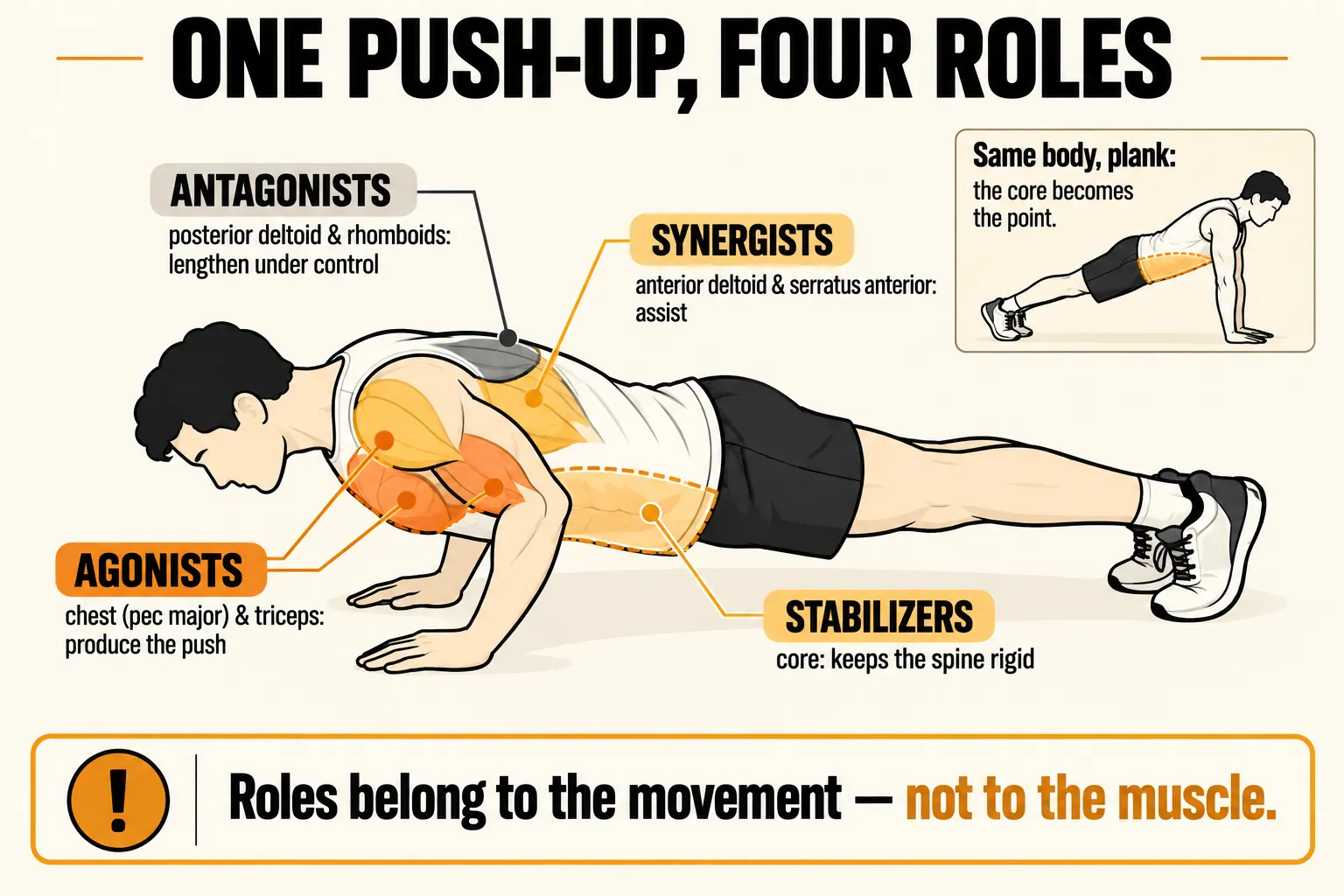
The four roles above are easiest to see by walking through one exercise from top to bottom rather than defining them in isolation. Take a standard push-up. On the way down and back up, the pectoralis major and triceps are the agonists — the prime movers actually producing elbow extension and shoulder horizontal adduction. The posterior deltoid and rhomboids act as antagonists, lengthening under control rather than fighting the movement, which is what keeps the descent smooth instead of a controlled drop. The anterior deltoid and serratus anterior are synergists, assisting the pecs and sharing enough of the load that the prime movers aren't working entirely alone. And the entire core — rectus abdominis, obliques, transverse abdominis — is stabilizing, holding the spine rigid so none of that force leaks into an arched lower back or a sagging hip.
Change the exercise and every one of those labels can move. Turn the same body into a plank instead of a push-up, and the pecs and triceps drop out almost entirely — now the core has shifted from stabilizer to the primary muscle group being trained. That's the practical payoff of learning muscle roles as movement-specific labels rather than fixed muscle properties: it's the same skill you'll use to explain to a client exactly why "core exercise" doesn't just mean crunches, and why a stabilizer in one drill can be the whole point of the next.
Force-Couple Relationships
A force-couple relationship describes multiple muscles working together around a joint to produce coordinated movement — no single muscle acts entirely alone. The rotator cuff muscles stabilizing the shoulder while the deltoid produces an overhead press is a classic example: several muscles, each contributing a different piece, working as one coordinated system.
This is the same underlying idea as Lesson 1's kinetic chain — muscles don't work in isolation, they work in coordinated groups. When one part of a force-couple is weak or inhibited, another part often overcompensates, which is exactly how several of Lesson 13's OHSA compensations develop in the first place.
8 questions, modeled on NASM's real exam style. Score 70%+ to mark this lesson complete.
- Three planes of motion: sagittal (flexion/extension), frontal (abduction/adduction), transverse (rotation).
- Four muscle roles: agonist (prime mover), antagonist (opposes), synergist (assists), stabilizer (holds position).
- A force-couple relationship is multiple muscles working together around a joint — no muscle acts entirely alone.
- Muscle roles are movement-specific, not fixed — a muscle can be the agonist in one exercise and a stabilizer in another.
- Well-rounded programming trains all three planes, not just the sagittal plane most gym exercises default to.
- A stabilizer isn't a "resting" muscle — it can work extremely hard while holding a segment steady rather than producing the movement itself.
You've now completed the first half of the Basic & Applied Sciences domain:
- Name the three planes of motion and one exercise example in each.
- Pick one exercise and identify its agonist, antagonist, synergist, and a stabilizer.
- Walk through a second exercise (like a plank) and note how the same muscle groups can swap roles entirely.
- Complete the knowledge check above and review any question you missed before moving on to Nutrition.