Nutrition is one of the areas where personal trainers get into the most trouble — not because the basics are complicated, but because it's tempting to overstep into territory that belongs to a registered dietitian. This lesson covers the foundational nutrition vocabulary every trainer should know, and exactly where that knowledge should stop being applied.
Lesson 4 introduced energy balance — calories in versus calories out. This lesson picks up from there with the building blocks of "calories in": what macronutrients and micronutrients actually are, and how a trainer talks about them responsibly. Nutrition questions come up in nearly every client conversation, which makes this lesson deceptively high-stakes: the content itself is simple, but the boundary around how far to take it is one of the most heavily tested scope-of-practice topics on the real exam.
Macronutrients
| Macronutrient | Primary role |
|---|---|
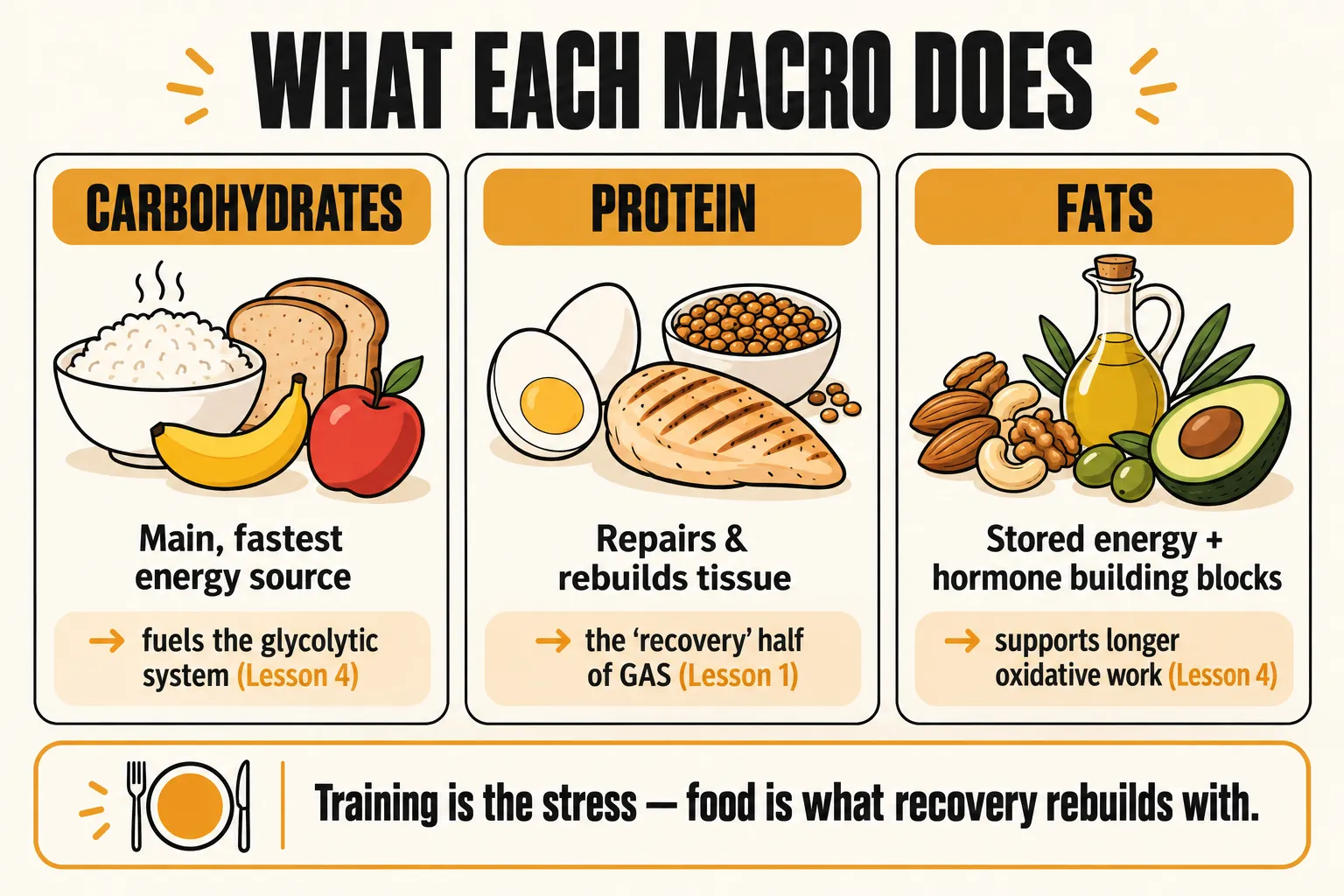
| Carbohydrates | The body's primary and most readily available energy source, especially for the glycolytic system (Lesson 4) |
| Protein | Used for tissue repair and growth — the raw material for recovering from the training stress described in Lesson 1's General Adaptation Syndrome |
| Fats | Used for energy storage, hormone production, and supporting the oxidative energy system over longer durations |
Each macronutrient connects directly back to earlier lessons in a way that's worth noticing. Carbohydrate availability is a big part of why the glycolytic system (Lesson 4) can only sustain effort for so long before it needs to hand off to the oxidative system. Protein intake is the raw material half of the recovery equation Lesson 1's General Adaptation Syndrome describes — training provides the stress, but without adequate protein, the "recovery" side of that equation has nothing to rebuild with. And fat isn't just stored energy; it's also a building block for the hormones that regulate training adaptation in the first place.
Micronutrients and Hydration
Vitamins and minerals (micronutrients) don't provide energy directly, but they're essential for the chemical processes — including the ones behind the energy systems in Lesson 4 — that let the body actually use the macronutrients it takes in. Hydration matters just as much: even mild dehydration can impair performance and recovery, and it's also one of the variables that can skew Lesson 6's bioelectrical impedance body composition readings.
A Worked Example: Where "General Education" Ends
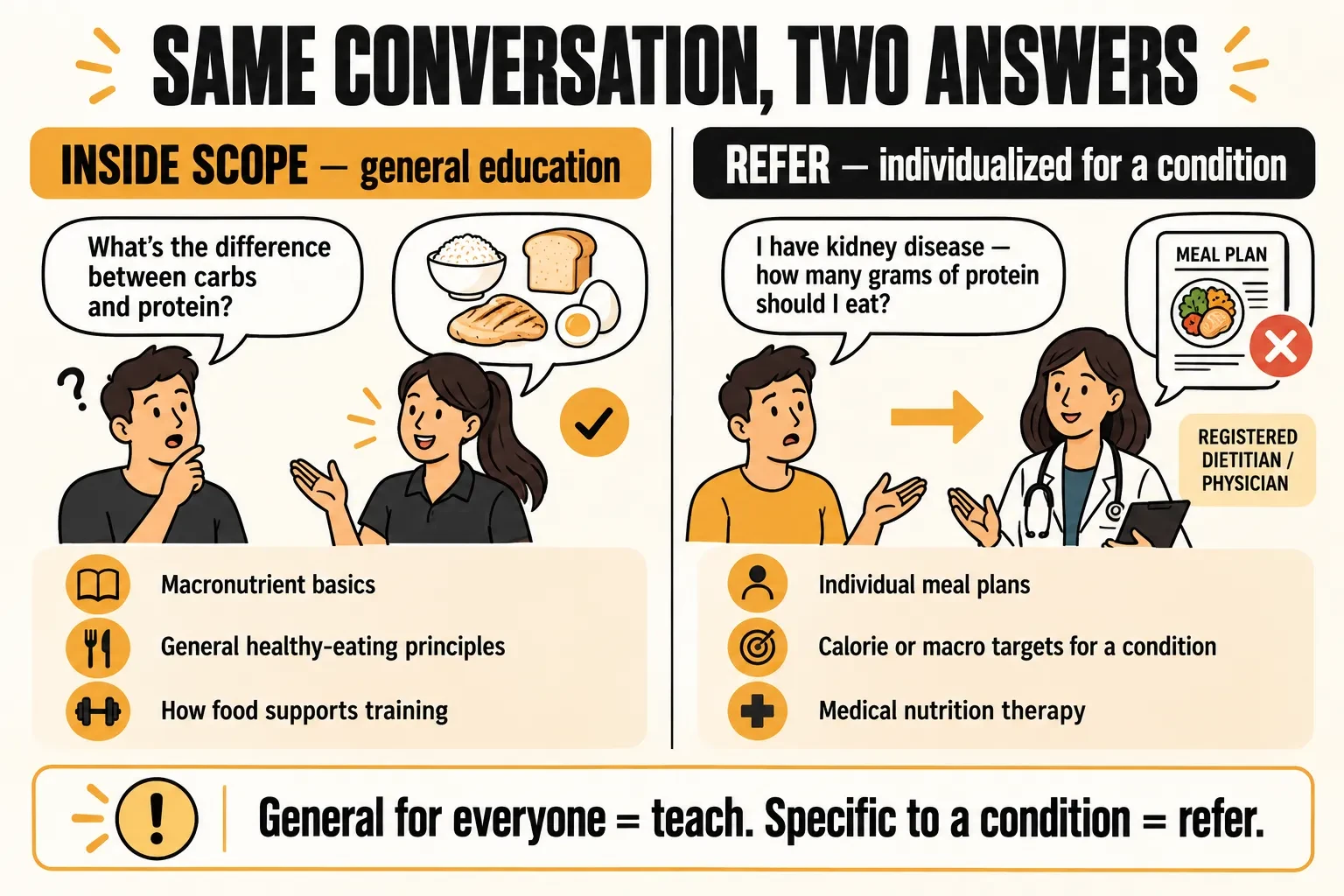
A client asks two questions after a session. Question one: "What's the difference between carbs and protein, and why do I need both?" That's squarely inside scope — a factual, general explanation of macronutrient roles applies to anyone, regardless of their individual health situation, and doesn't require knowing anything specific about this client's medical history. Question two: "I have kidney disease — exactly how many grams of protein should I eat per day?" That question sounds almost identical in format, but it's asking for an individualized medical nutrition recommendation for someone with a diagnosed condition where protein intake genuinely needs clinical management. The second question is a referral to a registered dietitian or physician, full stop.
The pattern that separates the two isn't complicated once you see it: general, universally applicable education stays inside scope; anything tied to a specific individual's diagnosed medical condition crosses into a dietitian's or physician's territory. The same client, the same conversation, two very different appropriate responses. This exact distinction — general vs. individualized-for-a-condition — is the same one Lesson 16 applies to exercise programming for chronic conditions, just pointed at food instead of exercise selection.
Where a Trainer's Nutrition Scope of Practice Ends
This is the most important section of this lesson, and one of the most frequently tested scope-of-practice topics on the real exam:
- Inside scopeGeneral, publicly available nutrition education — explaining what macronutrients are, general healthy-eating principles, and how nutrition supports training goals broadly.
- Outside scopeDesigning individualized meal plans, prescribing specific caloric or macro targets for medical conditions, or providing medical nutrition therapy — this is a registered dietitian's territory, the same "refer, don't diagnose" boundary from Lesson 6 and Lesson 16.
It's worth being honest about why this boundary is so easy to cross by accident: trainers spend enough time around nutrition information that it can start to feel like part of the job description, and a well-meaning client will often ask directly. Recognizing the boundary in the moment — before answering — is a skill worth rehearsing just as deliberately as any physical cue or assessment technique covered earlier in this course.
Want to go further than the CPT nutrition chapter? Our free NASM Certified Nutrition Coach (CNC) exam prep covers nutrition science, behavior change and practical nutrition coaching across 24 lessons — including a full lesson on scope of practice.
8 questions, modeled on NASM's real exam style. Score 70%+ to mark this lesson complete.
- Three macronutrients: carbohydrates (primary energy), protein (repair/growth), fats (storage, hormones).
- Micronutrients support the chemical processes behind energy production; hydration affects both performance and body composition readings.
- Inside scope: general nutrition education. Outside scope: individualized meal plans or medical nutrition therapy.
- "What should I eat?" is a common real-world scope-of-practice trap — general education is fine, personalized prescription is a referral.
- The dividing line: general, universally applicable education stays inside scope; anything tied to a client's specific diagnosed condition belongs to a dietitian or physician.
Before moving to Lesson 18:
- Name the three macronutrients and their primary roles from memory.
- Write a one-sentence answer you'd give a client who asks "what should I eat" that stays inside scope of practice.
- Practice telling apart two similar-sounding client questions — one general, one tied to a diagnosed condition — and decide which is inside scope.
- Complete the knowledge check above and review any question you missed before moving on.