Every rep, sprint, and set is fueled by one shared currency — ATP — produced through three different systems depending on how hard and how long the activity lasts. This lesson covers all three and explains why a heavy deadlift and a marathon literally run on different fuel systems.
Understanding these systems explains why Lesson 8's cardio methods target different training zones, and why Lesson 14's OPT phases pair specific rep ranges with specific rest periods — both are really decisions about which energy system to emphasize. Skip this chapter, and phase-specific rest-period prescriptions later in the course start to look like arbitrary rules instead of the deliberate physiological choices they actually are.
The Three Energy Systems
The body always has three ways to produce ATP (the molecule that actually powers muscle contraction), and it draws on all three to different degrees depending on the demand:
| System | Duration | Best suited for |
|---|---|---|
| ATP-PC system | Immediate — roughly 0 to 10 seconds | Maximal, short-duration efforts: a heavy single lift, a short sprint, a max vertical jump |
| Glycolytic system | Short-term — roughly 10 seconds to 2 minutes | High-intensity efforts sustained a bit longer: a hard interval, a 400m run |
| Oxidative system | Long-term — beyond roughly 2 minutes | Sustained, lower-intensity activity: steady-state cardio, a long run |
Which System Dominates When
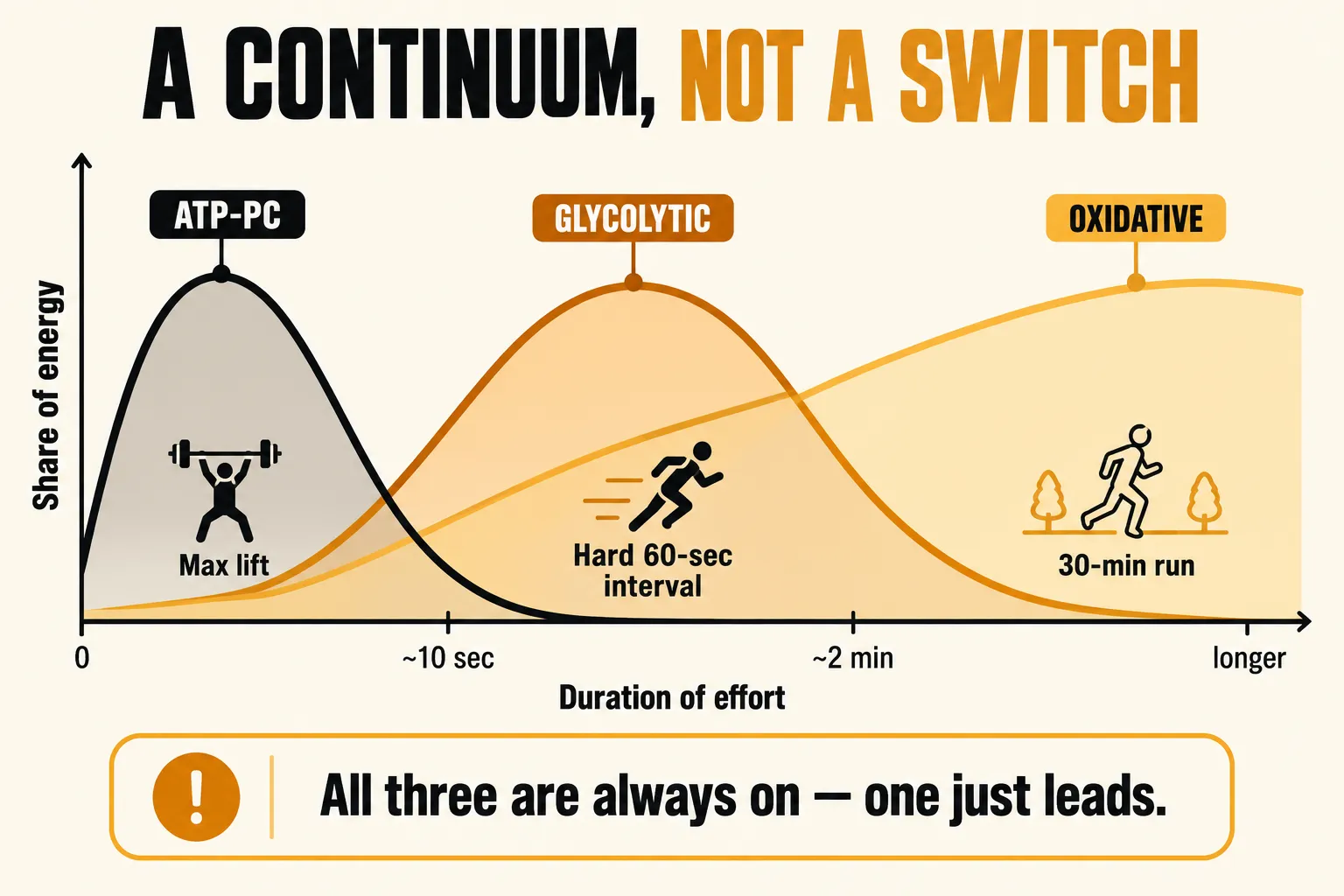
These systems don't switch on and off like a light switch — all three are always contributing to some degree. What changes is which one dominates, based on the duration and intensity of the activity:
- A max-effort deadlift attemptLasts only a few seconds at maximal intensity — the ATP-PC system dominates, matching Lesson 14's Phase 4 prescription of low reps and long rest.
- A hard 60-second interval (Lesson 8)Too long for ATP-PC alone, too intense to be purely oxidative — the glycolytic system dominates.
- A 30-minute steady-state runLong duration, moderate intensity — the oxidative system dominates, using oxygen to sustain effort over time.
A Worked Example: One Workout, All Three Systems
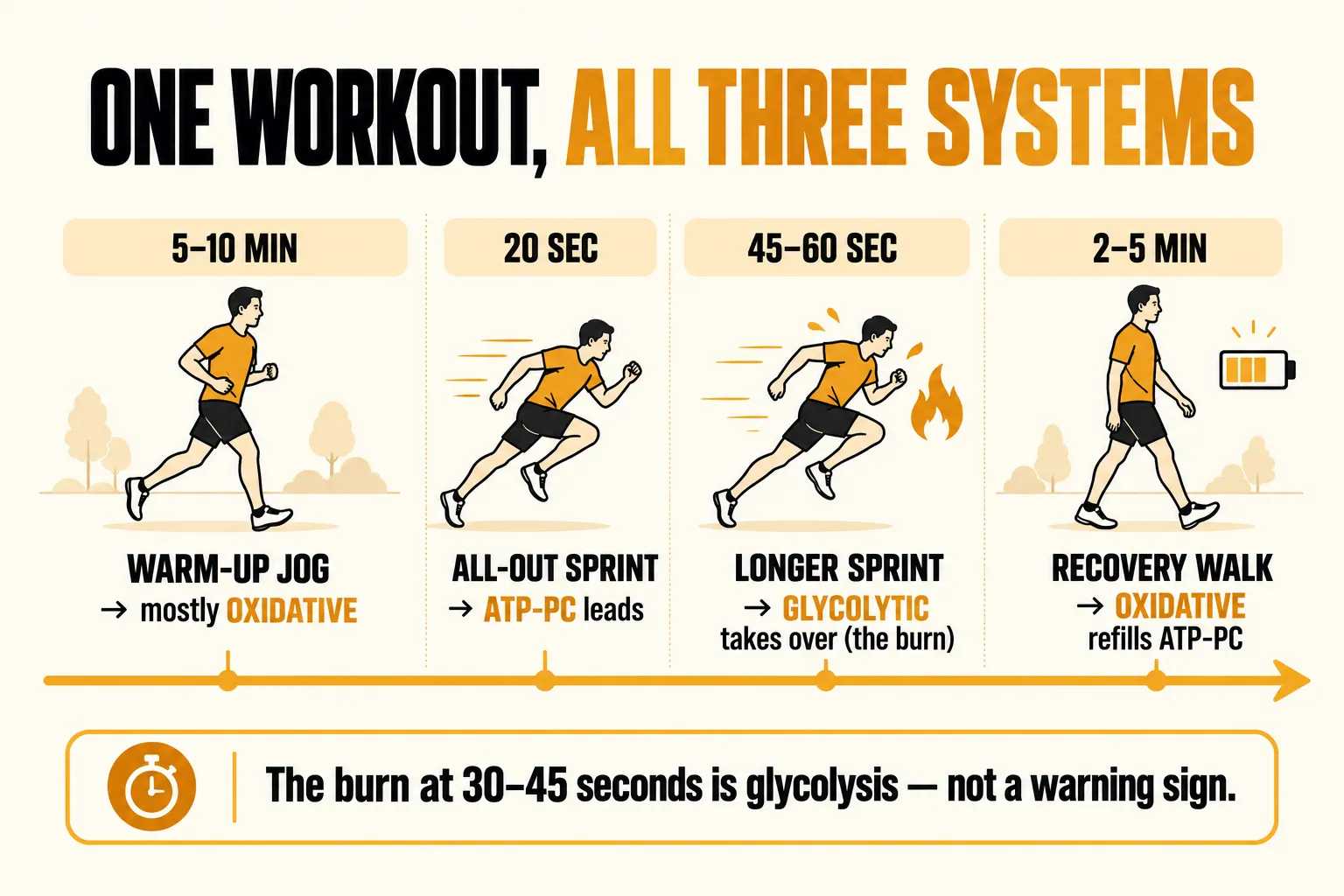
A single HIIT-style workout is a good place to see all three systems in one session rather than three separate ones. The warm-up jog is mostly oxidative — low intensity, sustained. A 20-second all-out sprint interval leans heavily on ATP-PC, since it's maximal effort over a very short window. If that sprint stretched to 45-60 seconds instead, the glycolytic system would take over as the dominant contributor, which is part of why that burning, breathless feeling shows up around the 30-45 second mark of a hard effort — it's the signature of glycolytic metabolism, not a sign something's wrong.
Between sprint intervals, the recovery walk is where the oxidative system works hardest of all — restoring the ATP-PC system's stores and clearing the metabolic byproducts the glycolytic system left behind, so the next sprint can draw on ATP-PC again instead of starting already glycolytic-dominant.
Recovery Between Efforts: EPOC
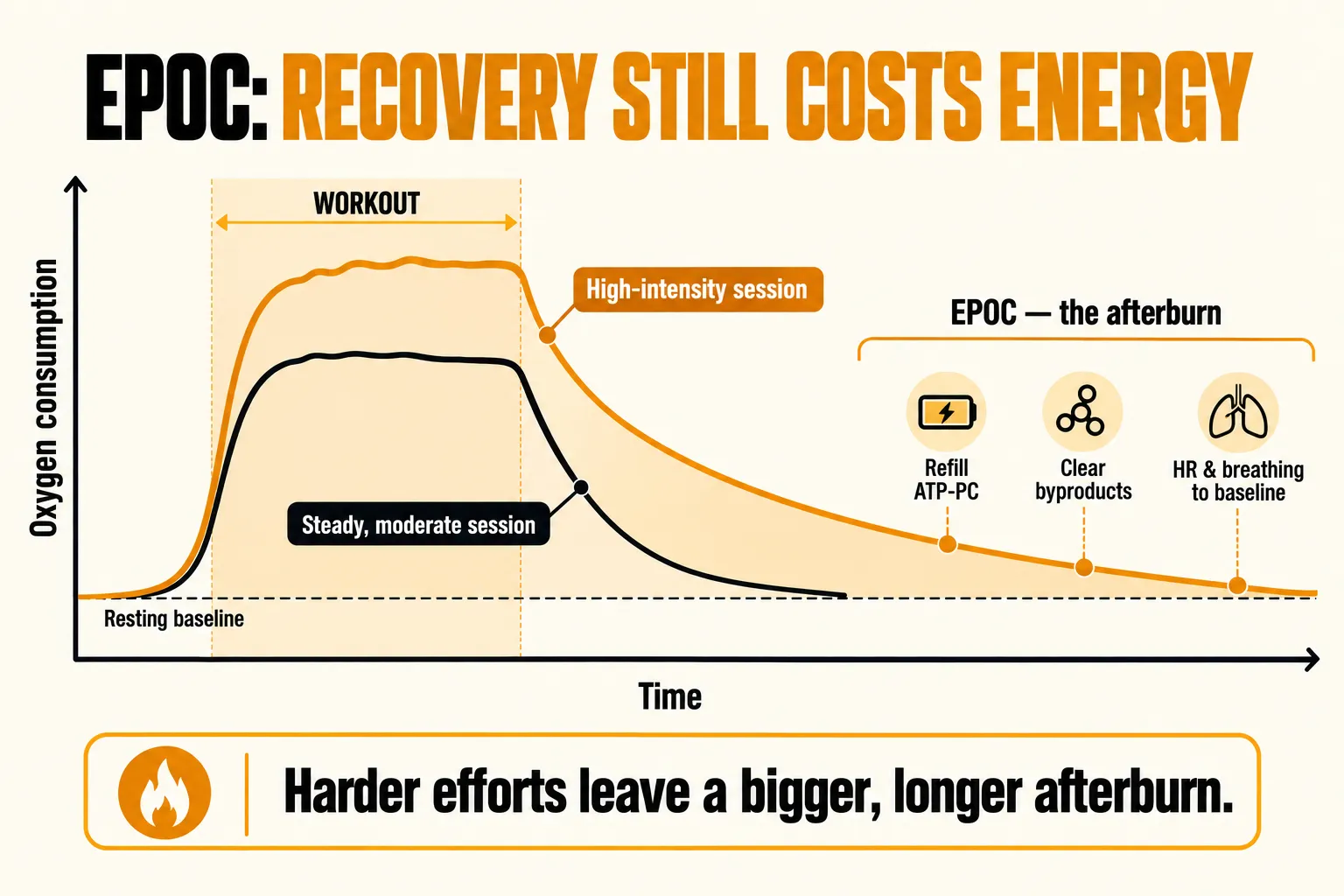
Excess post-exercise oxygen consumption (EPOC) — sometimes called the "afterburn effect" — describes the elevated oxygen consumption and calorie burn that continues after a workout ends, as the body works to restore itself to its pre-exercise state: replenishing ATP-PC stores, clearing metabolic byproducts, and returning heart rate and breathing to baseline. Higher-intensity efforts, particularly ones that lean heavily on the glycolytic system, tend to produce a larger and longer-lasting EPOC than steady, purely oxidative work at the same total duration.
Metabolism and Energy Balance
Zooming out from any single set, the body's overall energy balance — calories consumed versus calories expended — determines whether someone gains, maintains, or loses weight over time. All three energy systems ultimately draw from the same underlying fuel sources (carbohydrate, fat, and to a lesser degree protein), which is exactly why Lesson 17's nutrition chapter picks up directly from here.
It's worth being explicit about what this chapter isn't saying: no single energy system is inherently "better" for fat loss than another. A client fixated on training exclusively in some mythical "fat-burning zone" is missing the bigger picture — total energy expenditure across a session (and across a week) matters far more than which specific system happened to be dominant during any given minute of it.
8 questions, modeled on NASM's real exam style. Score 70%+ to mark this lesson complete.
- Three energy systems: ATP-PC (immediate, 0-10 sec), glycolytic (short-term, 10 sec-2 min), oxidative (long-term, beyond 2 min).
- All three systems are always contributing — which one dominates depends on duration and intensity, not a hard on/off switch.
- A max lift leans ATP-PC; a hard interval leans glycolytic; a long steady-state session leans oxidative.
- Overall energy balance (calories in vs. out) determines weight change over time — the bridge into Lesson 17's nutrition content.
- EPOC ("afterburn") is the elevated post-exercise oxygen consumption and calorie burn as the body restores itself — larger after glycolytic-dominant efforts than after steady oxidative work.
Before moving to Lesson 5:
- Name the three energy systems and their approximate duration ranges from memory.
- Pick three activities from your own training and identify which energy system likely dominates each.
- Explain in one sentence why a hard interval session tends to produce more EPOC than the same total time spent on steady-state cardio.
- Complete the knowledge check above and review any question you missed before moving on.