Supplements are one of the most-asked-about topics clients bring to a trainer — and one of the easiest places to accidentally step outside scope of practice. This lesson covers common supplement categories at a general level, and draws the same scope-of-practice line Lesson 17 drew for nutrition.
This lesson closes out the Basic & Applied Sciences and Nutritional Concepts domain — the same domain that opened with Lesson 1's integrated training philosophy and has moved through the nervous system, cardiorespiratory system, energy systems, movement science, and nutrition to get here. It's a fitting place to end that domain: supplement questions sit right at the intersection of the science you've learned (bioenergetics, recovery, nutrition) and the scope-of-practice discipline that's been a recurring thread since Lesson 6's screening framework.
Common Supplement Categories
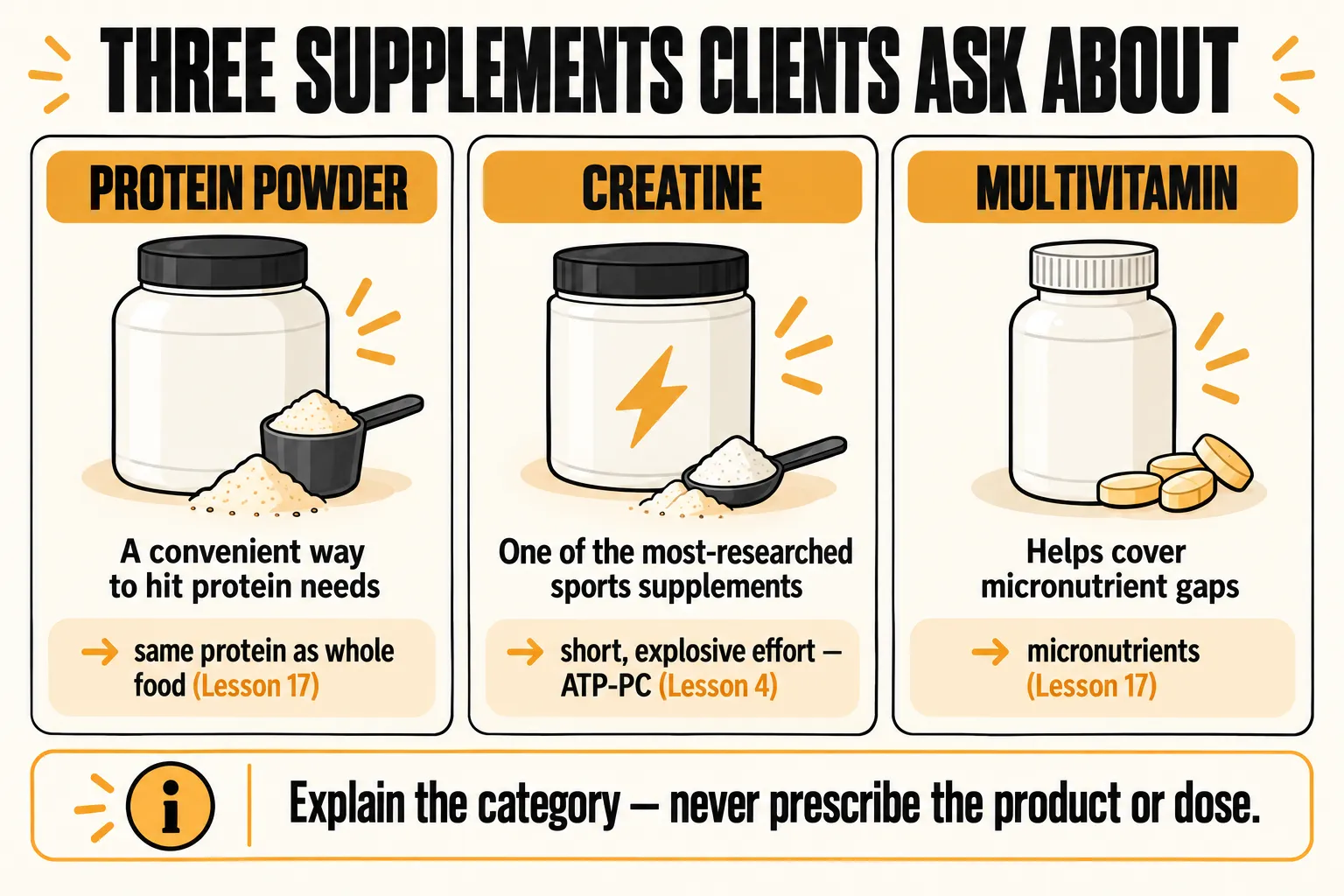
Clients ask about a handful of supplement categories more than any others. A trainer should be able to explain, at a general level, what each one is and what it's commonly used for — without prescribing a specific product, brand, or dose:
- Protein powderA concentrated, convenient source of dietary protein (Lesson 17), commonly used to help meet daily protein targets alongside whole-food sources.
- CreatineOne of the most-researched sports supplements, generally associated with supporting high-intensity, short-duration effort — the same ATP-PC system territory covered in Lesson 4.
- MultivitaminsA general category intended to help cover micronutrient gaps (Lesson 17) in someone's overall diet.
Each of these categories connects to something you already know from earlier in this course. Protein powder is really just a convenient delivery format for a macronutrient you studied in depth in Lesson 17 — nothing about the powder form changes the underlying biology of what protein does. Creatine's relevance to short, explosive effort ties directly back to Lesson 4's ATP-PC energy system, which is exactly why creatine research focuses so heavily on strength and power performance rather than endurance. And multivitamins address the same category of nutrient — micronutrients — that Lesson 17 already established don't provide energy directly but are essential for the chemical processes that let macronutrients actually get used.
A Worked Example: Answering "Should I Take Creatine?"
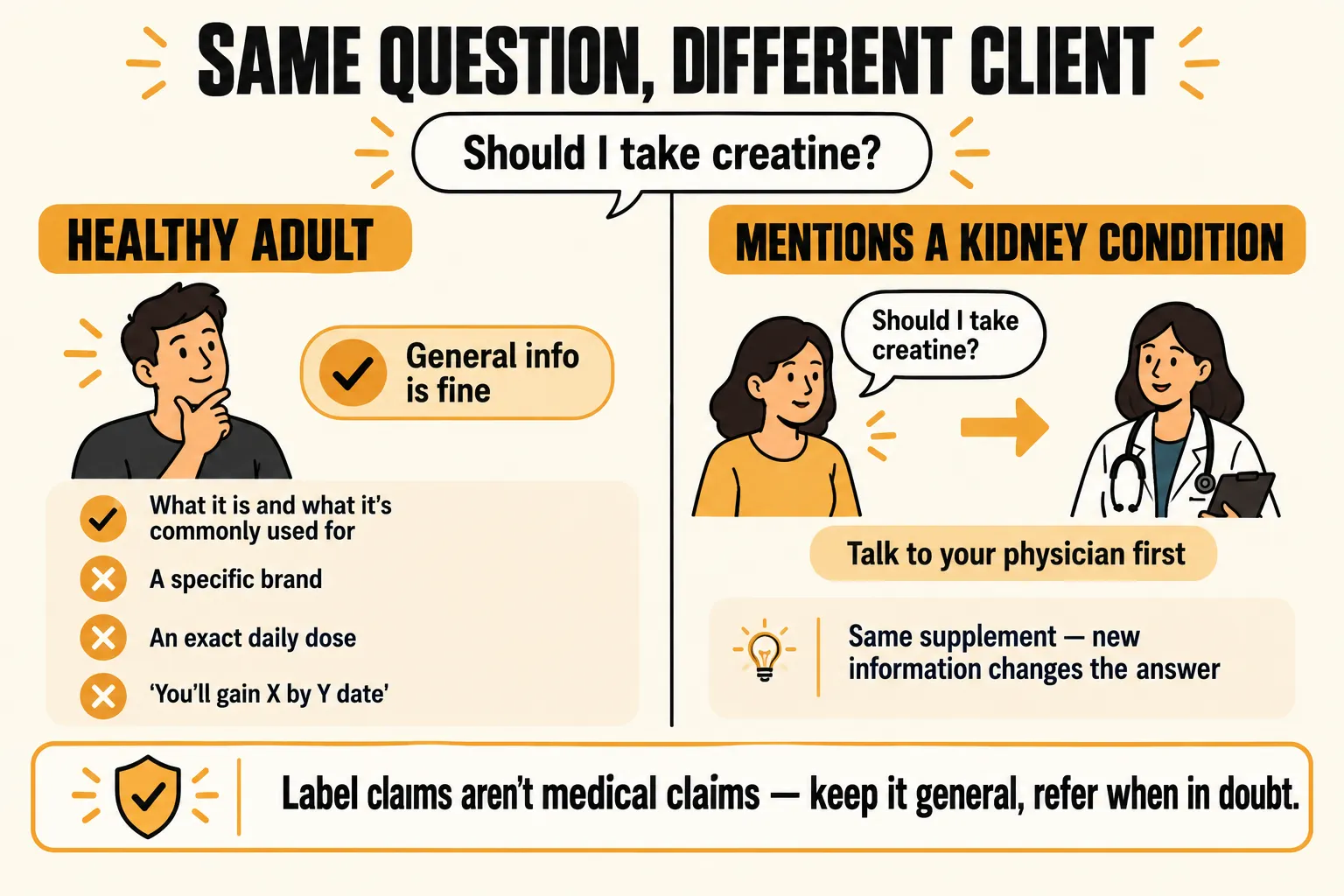
A healthy adult client with no reported medical conditions asks whether they should take creatine to support their strength training. This is a genuinely common, reasonable question, and it's answerable inside scope: a trainer can explain that creatine is one of the most-researched sports supplements, generally associated with supporting high-intensity, short-duration effort, and that it's widely available and commonly used by strength and power athletes. What a trainer should not do is recommend a specific brand, tell the client exactly how many grams to take per day, or claim it will produce a specific strength gain by a specific date — those are all forms of individualized prescription that cross the same line Lesson 17 drew around nutrition.
Now change one detail: the client mentions they have a kidney condition. The general information about creatine doesn't change, but the appropriate response does — this is now a case where the client should be directed to discuss creatine specifically with their physician before starting it, since kidney function is a genuine consideration for that supplement category. Same question, same supplement, a different appropriate trainer response based entirely on what's now known about the client.
What Trainers Can and Can't Say About Supplements
This is the exact same scope-of-practice boundary Lesson 17 drew for nutrition, applied specifically to supplements:
| Inside scope | Outside scope |
|---|---|
| Explaining general categories and what they're commonly used for | Recommending a specific product, brand, or dosage |
| Pointing to publicly available, general research summaries | Making medical claims about what a supplement will "fix" or "cure" |
| Encouraging a client to discuss supplements with their physician or a registered dietitian | Advising a client to combine a supplement with a prescribed medication |
This regulatory gap is worth internalizing, not just memorizing for the exam. A confident label claim on a supplement bottle carries none of the scrutiny a prescription medication's approved use does — which means a trainer repeating that claim as fact, even with good intentions, is passing along a claim that hasn't necessarily been verified the way a client might assume it has. Sticking to general, well-established information (what a supplement category is, what it's commonly used for) rather than repeating specific marketing claims is the safer default in every direction.
8 questions, modeled on NASM's real exam style. Score 70%+ to mark this lesson complete.
- Common supplement categories: protein powder, creatine, and multivitamins — know what each is generally used for.
- Inside scope: general category education. Outside scope: specific products, doses, or medical claims.
- Supplement regulation varies and isn't held to medication standards — one more reason to keep guidance general.
- Any client on prescribed medication should be referred to their physician before adding a new supplement.
- This closes the Basic & Applied Sciences and Nutritional Concepts domain — Lessons 1-5, 17, and 18 together.
- The same supplement question can have two different appropriate answers depending on whether the client has a relevant health condition.
You've now completed the entire Basic & Applied Sciences and Nutritional Concepts domain:
- Name the three supplement categories covered here and one general fact about each.
- Write a one-sentence answer you'd give a client asking "should I take creatine?" that stays inside scope of practice.
- Practice how your answer would change if that same client mentioned a relevant health condition.
- Complete the knowledge check above, then return to the course overview to see what's live next.