Knowing the correct exercise prescription doesn't matter if a client never actually does it. This lesson covers how people actually change behavior — the stages they move through, and the coaching techniques that support them through it — separate from anything to do with sets, reps, or exercise selection.
Every lesson before this one covered what to prescribe. This lesson covers something just as important: why clients do or don't follow through, and how a trainer can genuinely help without crossing into a therapist's or counselor's territory. A technically perfect Phase 1 program (Lesson 14) delivers zero results if the client stops showing up after week three — which makes this lesson, in a very real sense, the one that determines whether everything else in this course actually gets applied.
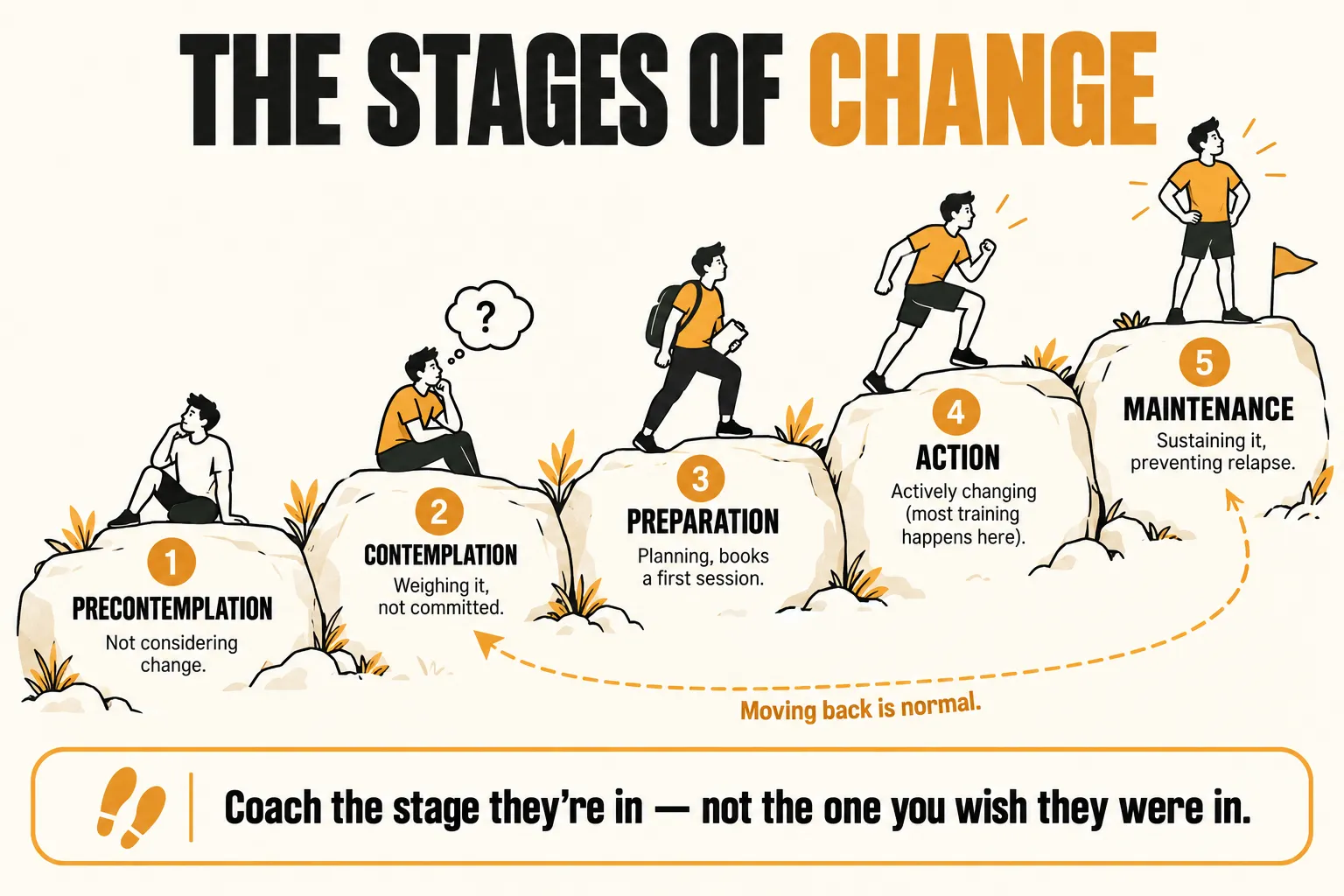
The Stages of Change Model
Behavior change rarely happens in one decisive moment. The stages of change model describes it as a process clients move through, sometimes forward, sometimes back:
| Stage | What it looks like |
|---|---|
| Precontemplation | Not yet considering change — may not see a need for it |
| Contemplation | Aware a change might be needed, weighing it, but not committed yet |
| Preparation | Committed and planning specific steps — often when a client books their first session |
| Action | Actively changing behavior — this is where most of a trainer's day-to-day work happens |
| Maintenance | Sustaining the change over time, working to prevent relapse back to old habits |
A trainer who treats every client as if they're in the "action" stage will frustrate a client who's really still in "contemplation." Matching coaching style to the client's actual stage is more effective than a one-size-fits-all pep talk.
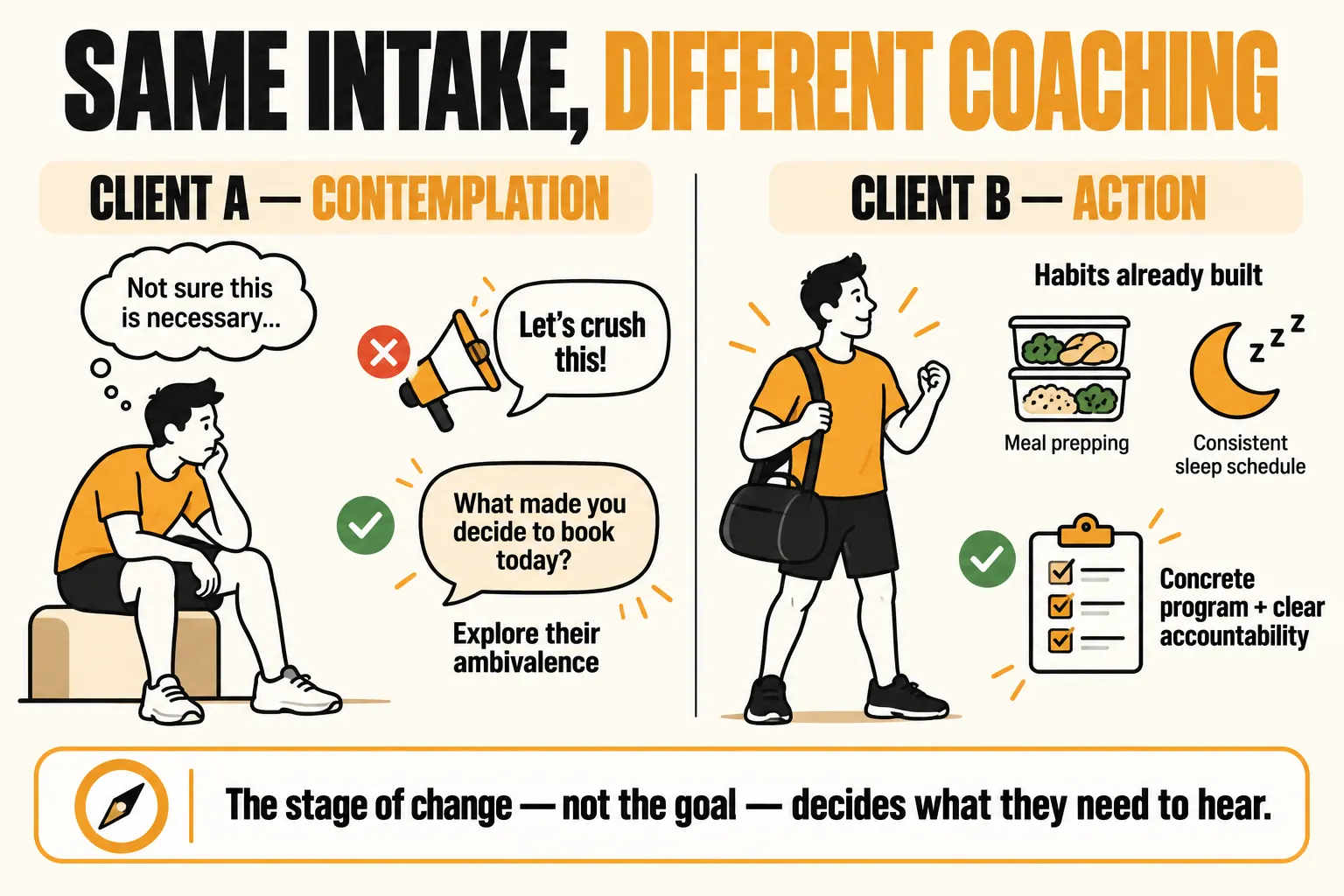
A Worked Example: Two Clients, Two Different Stages
Consider two new clients who both signed up for training this week. Client A booked a session because their spouse suggested it, and admits during intake they're "not really sure this is necessary right now" — a clear precontemplation-to-contemplation signal. Pushing Client A straight into an aggressive action-stage pep talk ("let's crush this program!") is likely to backfire, because Client A hasn't actually decided change is needed yet. The more effective move is exploring their ambivalence with an open-ended question — "what made you decide to book today, even if you're not fully sure?" — and letting them talk through their own reasoning.
Client B, by contrast, already meal-preps, has a consistent sleep schedule, and booked training specifically to add structured resistance work to habits they've already built — clearly in the action stage already. For Client B, the same tentative, exploratory questioning would feel patronizing and slow. Client B is ready for a concrete program and clear accountability structures right away. Same intake conversation format, two completely different appropriate coaching approaches, because the stage of change — not the training goal — determined what each client actually needed to hear.
Motivational Interviewing: OARS
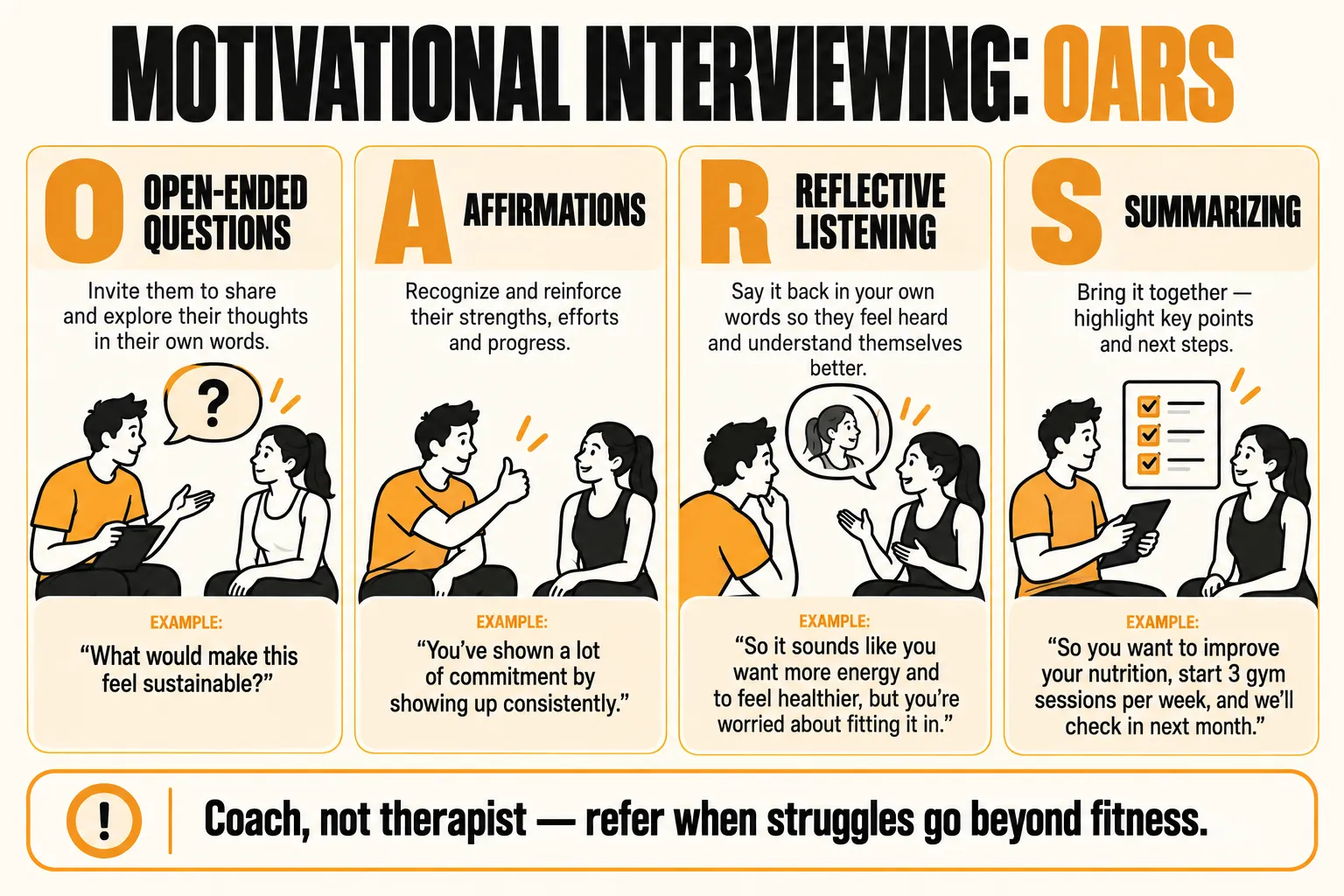
Motivational interviewing is a coaching style built around drawing a client's own motivation out, rather than lecturing them into compliance. Four core techniques, remembered as OARS:
- Open-ended questionsQuestions that can't be answered with a simple yes/no — "What would make this program feel sustainable for you?" instead of "Can you do this?"
- AffirmationsGenuine recognition of a client's effort or strength — reinforcing progress builds the self-efficacy behind long-term adherence.
- Reflective listeningRestating what a client said in your own words to show they've been heard, and to let them hear their own reasoning back.
- SummarizingPulling a conversation's key points together at the end, so the client leaves with clarity on what was discussed and decided.
SMART Goal Setting
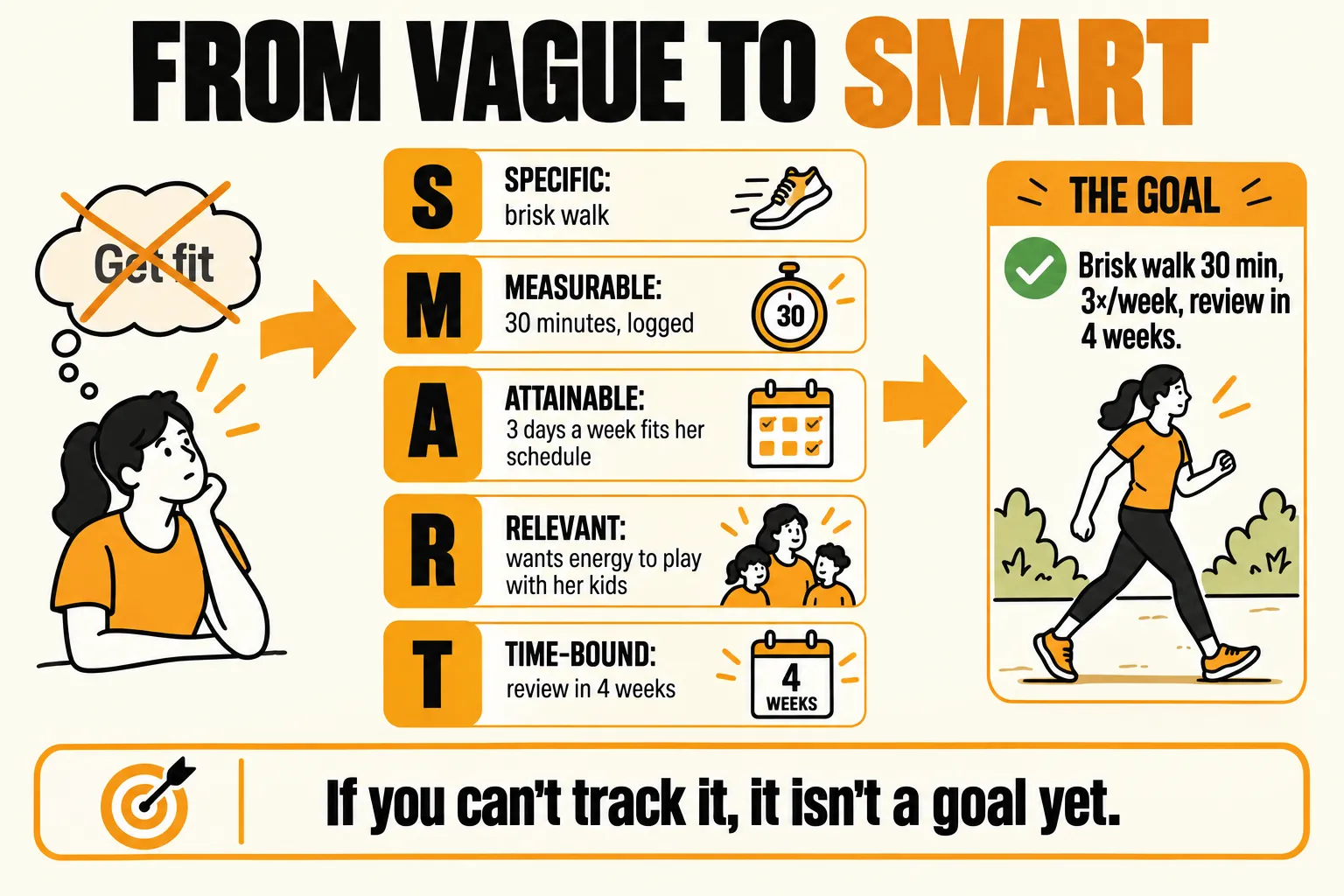
Vague intentions ("get fit," "eat better") rarely survive contact with a real week. SMART turns an intention into something trackable:
- SpecificExactly what will be done, not a general direction.
- MeasurableA way to track whether it happened or not.
- AttainableRealistic given the client's current life, not an aspirational stretch.
- RelevantConnected to what the client actually cares about.
- Time-boundHas a clear deadline or checkpoint, not an open-ended "eventually."
The line here is worth being deliberate about, because motivational interviewing techniques and therapeutic listening can look similar on the surface. The distinction is scope and purpose: a trainer uses OARS to support motivation around exercise and fitness-related habits specifically. If a client's struggles clearly extend well beyond fitness adherence — persistent low mood, anxiety that interferes with daily functioning, or anything resembling a mental health crisis — that's the trainer's cue to express concern and refer, not to keep applying coaching techniques as if they'll resolve something outside their intended scope.
8 questions, modeled on NASM's real exam style. Score 70%+ to mark this lesson complete.
- Five stages of change: precontemplation, contemplation, preparation, action, maintenance.
- Match coaching style to a client's actual stage rather than assuming everyone is ready for "action."
- OARS: open-ended questions, affirmations, reflective listening, summarizing — the core motivational interviewing toolkit.
- SMART goals turn vague intentions into specific, measurable, attainable, relevant, time-bound targets.
- Behavioral coaching supports fitness-related motivation — it is not mental health treatment, and signs of a mental health condition should be referred out.
- The right coaching approach depends on the client's actual stage of change, not the training goal itself — the same conversation format can need two very different tones.
Before moving to Lesson 20:
- Write one open-ended question and one reflective-listening response you could use with a hesitant client.
- Turn "I want to get healthier" into a full SMART goal.
- Practice identifying which stage of change a hypothetical new client is in, based on how they describe why they booked training.
- Complete the knowledge check above and review any question you missed before moving on.